Recognition: no theorem link
How do the LIGO-Virgo-KAGRA's Heavy Black Holes Form? No evidence for core-collapse Intermediate-mass black holes in GWTC-4
Pith reviewed 2026-05-12 05:12 UTC · model grok-4.3
The pith
Analysis of the latest LIGO-Virgo-KAGRA catalog finds no evidence for intermediate-mass black holes formed by core collapse, instead attributing heavy black holes to hierarchical mergers.
A machine-rendered reading of the paper's core claim, the machinery that carries it, and where it could break.
Core claim
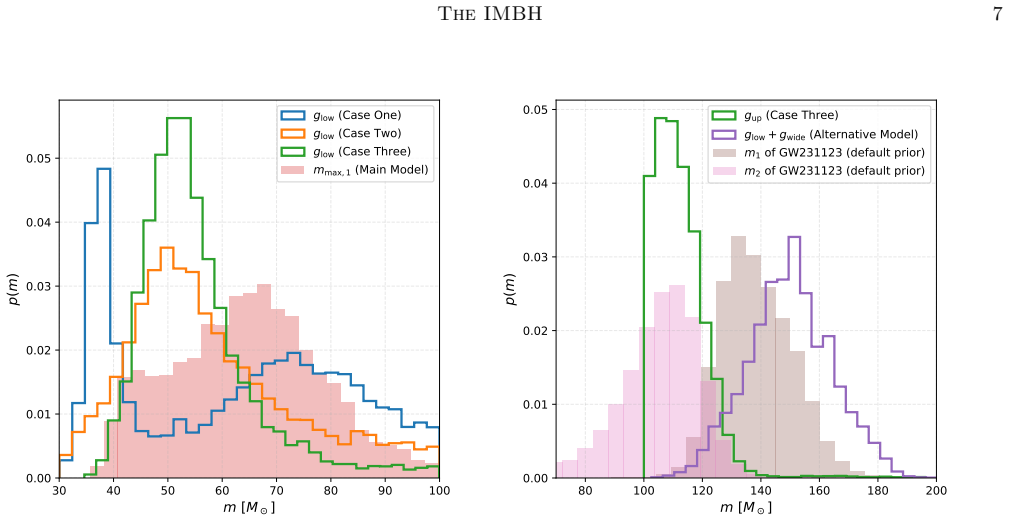
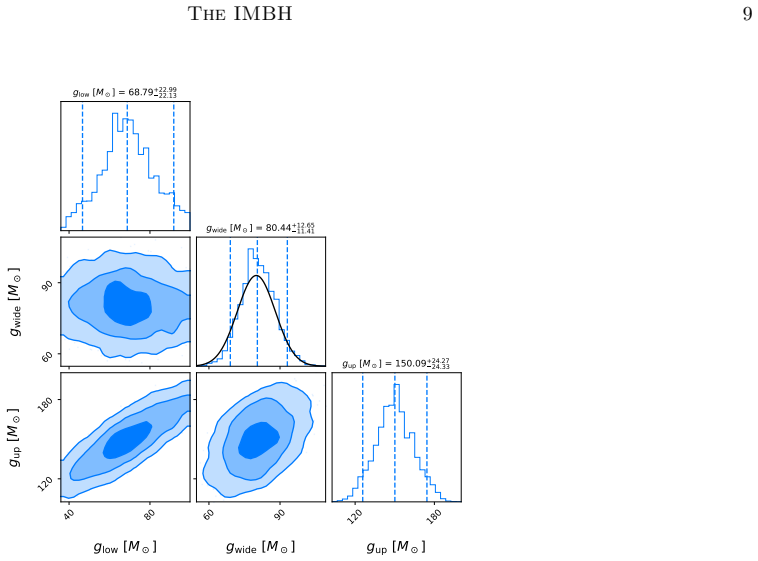
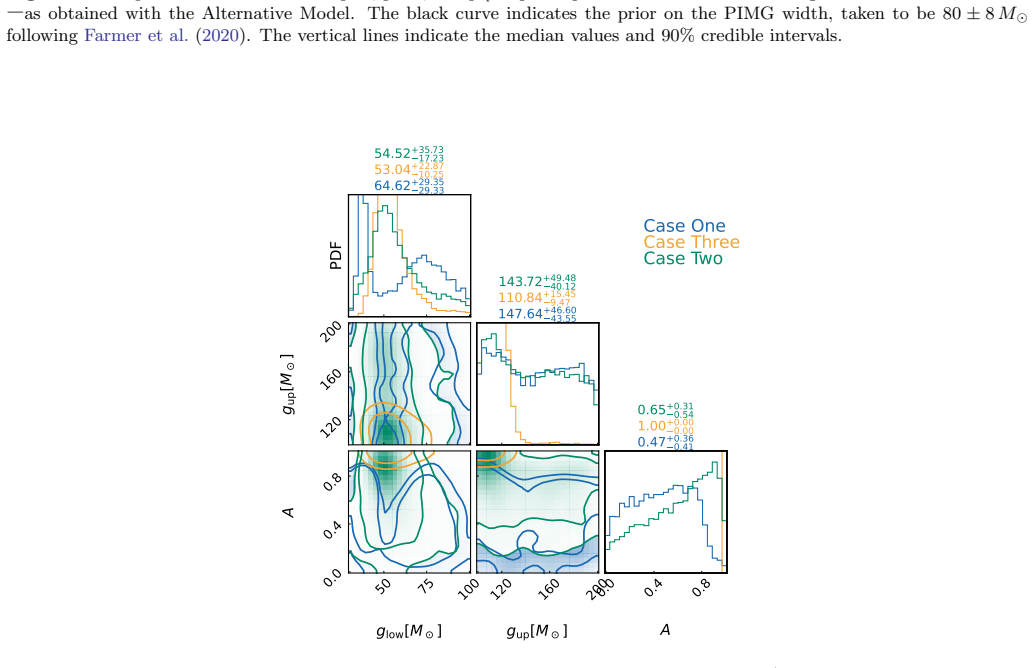
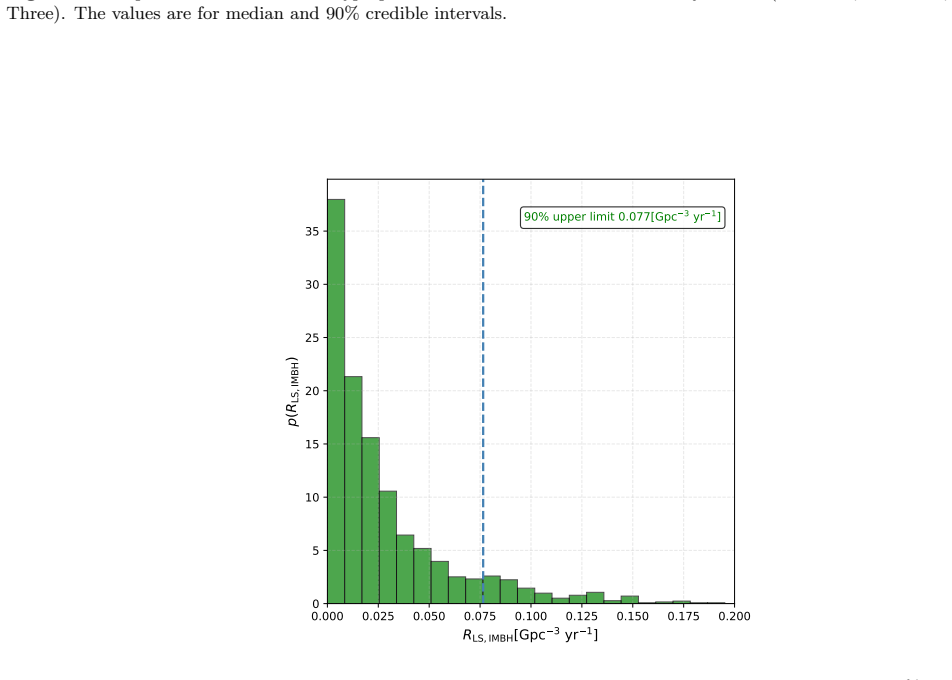
We investigate the population properties of binary black holes from the LIGO-Virgo-KAGRA collaboration, focusing especially on those in the high-mass range, using the newly released GWTC-4 catalog. For the first time, we search for a subpopulation of low-spin intermediate-mass black holes that would indicate formation via stellar core collapse. With the currently available catalog, we find no evidence for such a subpopulation, and set a 90% upper limit on the merger rate of collapse-formed IMBHs at 0.077 Gpc^{-3} yr^{-1}. The mass distribution of low-spin stellar-origin black holes truncates at 65 solar masses, consistent with the lower edge of the pair-instability mass gap, although we do 1
What carries the argument
Separation of black-hole populations by spin to isolate a possible low-spin core-collapse channel from a high-spin hierarchical-merger channel in the GWTC-4 mass-spin distribution.
If this is right
- The lower edge of the pair-instability mass gap sits near 65 solar masses, as shown by the truncation of the low-spin black-hole mass distribution.
- Stellar-evolution models combined with the data place the upper edge of the pair-instability mass gap near 150 solar masses.
- All currently observed intermediate-mass black holes belong to a high-spin subpopulation produced by successive mergers.
- The merger rate of core-collapse intermediate-mass black holes is limited to less than 0.077 events per cubic gigaparsec per year.
Where Pith is reading between the lines
- Hierarchical mergers must operate efficiently enough to populate the observed high-mass end without a large direct-collapse contribution.
- Future catalogs with improved spin precision or additional high-mass events could directly test whether the high-spin channel continues to dominate.
- If the low-spin cutoff remains fixed, it would tighten constraints on the supernova physics that sets the lower boundary of the pair-instability gap.
Load-bearing premise
Any core-collapse intermediate-mass black holes would appear as a distinct low-spin subpopulation that can be cleanly separated from high-spin merger products without major detection biases or model degeneracies.
What would settle it
Detection of one or more low-spin black holes with masses well above 65 solar masses, or an inferred merger rate for such objects exceeding 0.077 Gpc^{-3} yr^{-1}, in future expanded catalogs.
Figures




read the original abstract
We investigate the population properties of binary black holes (BBHs) from the LIGO-Virgo-KAGRA collaboration, focusing especially on those in the high-mass range, using the newly released GWTC-4 catalog. For the first time, we search for a subpopulation of low-spin intermediate-mass black holes (IMBHs) that would indicate formation via stellar core collapse. With the currently available catalog, we find no evidence for such a subpopulation, and set a 90\% upper limit on the merger rate of collapse-formed IMBHs at $0.077~\mathrm{Gpc}^{-3}\,\mathrm{yr}^{-1}$. The mass distribution of low-spin (stellar-origin) black holes truncates at $65^{+23}_{-22}\,M_\odot$, consistent with the lower edge of the pair-instability mass gap (PIMG), although we cannot directly determine its upper boundary from current data. Informed by stellar evolution theory, we estimate the upper edge of the PIMG to be $150\pm24\,M_\odot$. We find that the observed IMBHs belong to a high-spin subpopulation, consistent with formation through successive hierarchical mergers.
Editorial analysis
A structured set of objections, weighed in public.
Referee Report
Summary. The manuscript analyzes the GWTC-4 catalog to search for a low-spin subpopulation of intermediate-mass black holes (IMBHs) formed via stellar core collapse. It reports no evidence for such a subpopulation and sets a 90% upper limit on the merger rate at 0.077 Gpc^{-3} yr^{-1}. The low-spin black hole mass distribution truncates at 65^{+23}_{-22} M_odot (consistent with the lower edge of the pair-instability mass gap), while the upper edge is estimated at 150±24 M_odot from stellar evolution theory. Observed IMBHs are attributed to a high-spin subpopulation formed via hierarchical mergers.
Significance. If robust, the result supplies useful constraints on high-mass black hole formation channels by showing consistency with stellar-origin black holes below the pair-instability gap and hierarchical assembly for the observed high-mass systems. Strengths include the data-driven (rather than prior-dominated) rate upper limit, explicit spin and mass parametrizations in a standard mixture-model hierarchical inference, selection-function corrections, and posterior sampling; these elements make the no-evidence conclusion and truncation measurement falsifiable with future catalogs.
major comments (1)
- [Population model and inference section] The separability assumption—that any core-collapse IMBHs would appear as a distinct low-spin component cleanly separable from high-spin hierarchical products—is load-bearing for the no-evidence claim and rate limit. The manuscript uses a standard mixture model, but explicit checks for model degeneracies, selection biases, or spin-mass correlations that could mask a low-spin subpopulation (e.g., via injection-recovery tests or alternative parametrizations) would strengthen the result.
minor comments (2)
- [Abstract] The abstract reports the mass truncation with uncertainties but does not state the confidence level for those uncertainties (in contrast to the explicit 90% for the rate limit); this should be clarified for consistency.
- [Introduction and results sections] Notation for the pair-instability mass gap (PIMG) edges and the distinction between data-driven truncation and theory-informed upper edge should be defined once in the main text before repeated use.
Simulated Author's Rebuttal
We thank the referee for their positive assessment of our manuscript and for the constructive recommendation of minor revision. We address the single major comment below and will incorporate the suggested strengthening of the analysis in the revised version.
read point-by-point responses
-
Referee: [Population model and inference section] The separability assumption—that any core-collapse IMBHs would appear as a distinct low-spin component cleanly separable from high-spin hierarchical products—is load-bearing for the no-evidence claim and rate limit. The manuscript uses a standard mixture model, but explicit checks for model degeneracies, selection biases, or spin-mass correlations that could mask a low-spin subpopulation (e.g., via injection-recovery tests or alternative parametrizations) would strengthen the result.
Authors: We agree that the separability assumption is central to the no-evidence conclusion and the derived rate upper limit. Our hierarchical mixture model explicitly parametrizes two subpopulations with independent mass and spin distributions (low-spin component for potential core-collapse IMBHs and high-spin component for hierarchical products), which by construction allows the data to assign negligible weight to the low-spin IMBH subpopulation. We have examined the joint posteriors for parameter correlations and performed basic model-consistency checks. However, we did not include targeted injection-recovery tests that inject low-spin IMBH populations under the GWTC-4 selection function or explore alternative parametrizations to quantify possible masking from spin-mass correlations. We will add these explicit validation tests to the revised manuscript, reporting recovery fractions and any biases in the inferred rate and truncation mass. revision: yes
Circularity Check
No significant circularity detected
full rationale
The paper performs standard hierarchical Bayesian population inference on GWTC-4 to derive a data-driven 90% upper limit on the merger rate of a hypothesized low-spin IMBH subpopulation and a mass truncation for the low-spin component. The upper edge of the pair-instability mass gap is taken from external stellar-evolution theory rather than any internal fit or self-definition. No derivation step reduces by construction to its own inputs, renames a fitted parameter as a prediction, or relies on a load-bearing self-citation chain; the modeling uses explicit parametrizations, selection corrections, and posterior sampling that remain independent of the reported conclusions.
Axiom & Free-Parameter Ledger
free parameters (2)
- PIMG upper edge estimate =
150±24 M_sun
- Merger rate upper limit =
0.077 Gpc^{-3} yr^{-1}
axioms (2)
- domain assumption Low-spin IMBHs indicate core-collapse formation while high-spin IMBHs indicate hierarchical mergers
- domain assumption The pair-instability mass gap lower edge is identifiable from the truncation in low-spin black hole masses
Forward citations
Cited by 2 Pith papers
-
Secondary-Mass Features improve Spectral-Siren $H_0$ Constraints
A new model emphasizing secondary mass features and pairing transitions improves spectral siren H0 constraints by ~30% using 142 GW events from GWTC-4.0.
-
High-Spin BBH Subpopulation from AGN Accretion
Mixture model analysis of LIGO data identifies a ~10% high-spin subpopulation with a1 ≈ 0.9 matching AGN accretion predictions, disfavoring hierarchical mergers at a1 ≈ 0.7 for that group.
Reference graph
Works this paper leans on
-
[1]
The Science of the Einstein Telescope
Abac, A., Abramo, R., Albanesi, S., et al. 2025a, arXiv e-prints, arXiv:2503.12263, doi: 10.48550/arXiv.2503.12263
work page internal anchor Pith review Pith/arXiv arXiv doi:10.48550/arxiv.2503.12263
-
[2]
Abac, A. G., Abbott, R., Abouelfettouh, I., et al. 2024, ApJL, 970, L34, doi: 10.3847/2041-8213/ad5beb
-
[3]
G., Abouelfettouh, I., Acernese, F., et al
Abac, A. G., Abouelfettouh, I., Acernese, F., et al. 2025b, PhRvL, 135, 111403, doi: 10.1103/kw5g-d732 —. 2025c, ApJL, 993, L21, doi: 10.3847/2041-8213/ae0d54
-
[4]
Abbott, B. P., Abbott, R., Abbott, T. D., et al. 2017, Nature, 551, 85, doi: 10.1038/nature24471 —. 2018, Living Reviews in Relativity, 21, 3, doi: 10.1007/s41114-018-0012-9 —. 2019, ApJL, 882, L24, doi: 10.3847/2041-8213/ab3800
-
[5]
Abbottet al.[LIGO Scientific and Virgo], Phys
Abbott, R., Abbott, T. D., Abraham, S., et al. 2020a, PhRvL, 125, 101102, doi: 10.1103/PhysRevLett.125.101102 —. 2020b, PhRvD, 102, 043015, doi: 10.1103/PhysRevD.102.043015 —. 2020c, ApJL, 896, L44, doi: 10.3847/2041-8213/ab960f —. 2021, ApJL, 913, L7, doi: 10.3847/2041-8213/abe949
-
[6]
Abbott, R., Abbott, T. D., Acernese, F., et al. 2023a, Physical Review X, 13, 011048, doi: 10.1103/PhysRevX.13.011048 —. 2023b, Physical Review X, 13, 041039, doi: 10.1103/PhysRevX.13.041039
-
[7]
2015, Classical and Quantum Gravity, 32, 024001, doi: 10.1088/0264-9381/32/2/024001
Acernese, F., Agathos, M., Agatsuma, K., et al. 2015, Classical and Quantum Gravity, 32, 024001, doi: 10.1088/0264-9381/32/2/024001 Ali-Ha¨ ımoud, Y., Kovetz, E. D., & Kamionkowski, M. 2017, PhRvD, 96, 123523, doi: 10.1103/PhysRevD.96.123523
-
[8]
Laser Interferometer Space Antenna
Amaro-Seoane, P., Audley, H., Babak, S., et al. 2017, arXiv e-prints, arXiv:1702.00786, doi: 10.48550/arXiv.1702.00786
work page internal anchor Pith review Pith/arXiv arXiv doi:10.48550/arxiv.1702.00786 2017
-
[9]
2023, Living Reviews in Relativity, 26, 2, doi: 10.1007/s41114-022-00041-y
Amaro-Seoane, P., Andrews, J., Arca Sedda, M., et al. 2023, Living Reviews in Relativity, 26, 2, doi: 10.1007/s41114-022-00041-y
-
[10]
Gravitational-wave constraints on the pair-instability mass gap and nuclear burning in massive stars
Antonini, F., Romero-Shaw, I., Callister, T., et al. 2025a, arXiv e-prints, arXiv:2509.04637, doi: 10.48550/arXiv.2509.04637
work page internal anchor Pith review Pith/arXiv arXiv doi:10.48550/arxiv.2509.04637
-
[11]
Antonini, F., Romero-Shaw, I. M., & Callister, T. 2025b, PhRvL, 134, 011401, doi: 10.1103/PhysRevLett.134.011401
- [12]
-
[13]
2013, PhRvD, 88, 043007, doi: 10.1103/PhysRevD.88.043007 Astropy Collaboration, Robitaille, T
Aso, Y., Michimura, Y., Somiya, K., et al. 2013, PhRvD, 88, 043007, doi: 10.1103/PhysRevD.88.043007
-
[14]
Banagiri, S., Thrane, E., & Lasky, P. D. 2025, arXiv e-prints, arXiv:2509.15646, doi: 10.48550/arXiv.2509.15646
-
[15]
1967, PhRvL, 18, 379, doi: 10.1103/PhysRevLett.18.379
Barkat, Z., Rakavy, G., & Sack, N. 1967, PhRvL, 18, 379, doi: 10.1103/PhysRevLett.18.379
-
[16]
Accretion is All You Need: Black Hole Spin Alignment in Merger GW231123 Indicates Accretion Pathway,
Bartos, I., & Haiman, Z. 2025, arXiv e-prints, arXiv:2508.08558, doi: 10.48550/arXiv.2508.08558
-
[17]
Baumgarte, T. W., & Shapiro, S. L. 2025, PhRvL, 135, 191401, doi: 10.1103/26yd-1mhd
-
[18]
S., Fragos, T., Qin, Y., et al
Bavera, S. S., Fragos, T., Qin, Y., et al. 2020, A&A, 635, A97, doi: 10.1051/0004-6361/201936204
-
[19]
S., Stevenson, S., & Thrane, E
Broekgaarden, F. S., Stevenson, S., & Thrane, E. 2022, ApJ, 938, 45, doi: 10.3847/1538-4357/ac8879
-
[20]
2016, PyMultiNest: Python interface for
Buchner, J. 2016, PyMultiNest: Python interface for
work page 2016
-
[21]
2017, Progress of Theoretical and Experimental Physics, 2017, 083E01, doi: 10.1093/ptep/ptx087
Chiba, T., & Yokoyama, S. 2017, Progress of Theoretical and Experimental Physics, 2017, 083E01, doi: 10.1093/ptep/ptx087
-
[22]
Collaboration, L. S., Collaboration, T. V., & Collaboration, T. K. 2025, GWTC-4.0: Population Properties of Merging Compact Binaries, Zenodo, doi: 10.5281/zenodo.16911563
-
[23]
Croon, D., Sakstein, J., & Gerosa, D. 2025, arXiv e-prints, arXiv:2508.10088, doi: 10.48550/arXiv.2508.10088 De Luca, V., Desjacques, V., Franciolini, G., & Riotto, A. 2020, JCAP, 2020, 028, doi: 10.1088/1475-7516/2020/11/028 De Luca, V., Franciolini, G., & Riotto, A. 2025, arXiv e-prints, arXiv:2508.09965, doi: 10.48550/arXiv.2508.09965
-
[24]
2022, ApJ, 924, 101, doi: 10.3847/1538-4357/ac3667
Edelman, B., Doctor, Z., Godfrey, J., & Farr, B. 2022, ApJ, 924, 101, doi: 10.3847/1538-4357/ac3667
-
[25]
Jumping the Gap: Searching for LIGO s Biggest Black Holes
Ezquiaga, J. M., & Holz, D. E. 2021, ApJL, 909, L23, doi: 10.3847/2041-8213/abe638 —. 2022, PhRvL, 129, 061102, doi: 10.1103/PhysRevLett.129.061102
-
[26]
2020, ApJL, 902, L36, doi: 10.3847/2041-8213/abbadd
Justham, S. 2020, ApJL, 902, L36, doi: 10.3847/2041-8213/abbadd
-
[27]
E., Marchant, P., & Justham, S
Justham, S. 2019, ApJ, 887, 53, doi: 10.3847/1538-4357/ab518b
-
[28]
M., Fishbach, M., Ye, J., & Holz, D
Farr, W. M., Fishbach, M., Ye, J., & Holz, D. E. 2019, ApJL, 883, L42, doi: 10.3847/2041-8213/ab4284
-
[29]
Fishbach, M., Essick, R., & Holz, D. E. 2020, ApJL, 899, L8, doi: 10.3847/2041-8213/aba7b6
-
[30]
Fishbach, M., Holz, D. E., & Farr, B. 2017, ApJL, 840, L24, doi: 10.3847/2041-8213/aa7045 14Xia et al
-
[31]
Fowler, W. A., & Hoyle, F. 1964, ApJS, 9, 201, doi: 10.1086/190103
-
[32]
2019, ApJL, 881, L1, doi: 10.3847/2041-8213/ab339b
Fuller, J., & Ma, L. 2019, ApJL, 881, L1, doi: 10.3847/2041-8213/ab339b
-
[33]
Are merging black holes born from stellar collapse or previous mergers?
Gerosa, D., & Berti, E. 2017, PhRvD, 95, 124046, doi: 10.1103/PhysRevD.95.124046
-
[34]
2021, Nature Astronomy, 5, 749, doi: 10.1038/s41550-021-01398-w
Gerosa, D., & Fishbach, M. 2021, Nature Astronomy, 5, 749, doi: 10.1038/s41550-021-01398-w
-
[35]
Gottlieb, O., Metzger, B. D., Issa, D., et al. 2025, ApJL, 993, L54, doi: 10.3847/2041-8213/ae0d81
-
[36]
Goyal, S., Villarrubia-Rojo, H., & Zumalacarregui, M. 2025, arXiv e-prints, arXiv:2512.17631, doi: 10.48550/arXiv.2512.17631
-
[37]
2024, ApJ, 975, 54, doi: 10.3847/1538-4357/ad758a
Guo, W.-H., Li, Y.-J., Wang, Y.-Z., et al. 2024, ApJ, 975, 54, doi: 10.3847/1538-4357/ad758a
-
[38]
Guttman, N., Payne, E., Lasky, P. D., & Thrane, E. 2026, ApJ, 996, 144, doi: 10.3847/1538-4357/ae17af
-
[39]
Could the high-mass black holes from gravitational-wave observations be explained by lensing?
Harshe, R., Prasad, R., & Ajith, P. 2026, arXiv e-prints, arXiv:2604.14247, doi: 10.48550/arXiv.2604.14247
work page internal anchor Pith review Pith/arXiv arXiv doi:10.48550/arxiv.2604.14247 2026
-
[40]
GW231123: Overlapping Gravitational Wave Signals?
Hu, Q., Narola, H., Heynen, J., et al. 2025, arXiv e-prints, arXiv:2512.17550, doi: 10.48550/arXiv.2512.17550
-
[41]
National Science Review4(5), 685–686 (2017) https: //doi.org/10.1093/nsr/nwx116
Hu, W.-R., & Wu, Y.-L. 2017, National Science Review, 4, 685, doi: 10.1093/nsr/nwx116
-
[42]
King, A. R., & Dehnen, W. 2005, MNRAS, 357, 275, doi: 10.1111/j.1365-2966.2005.08634.x Kıro˘ glu, F., Kremer, K., & Rasio, F. A. 2025, ApJL, 994, L37, doi: 10.3847/2041-8213/ae1eeb
-
[43]
2025a, Reports on Progress in Physics, 88, 056901, doi: 10.1088/1361-6633/adc9be
Li, E.-K., Liu, S., Torres-Orjuela, A., et al. 2025a, Reports on Progress in Physics, 88, 056901, doi: 10.1088/1361-6633/adc9be
-
[44]
2025, arXiv e-prints, arXiv:2509.08298, doi:10.48550/arXiv.2509.08298
Li, G.-P., & Fan, X.-L. 2025, arXiv e-prints, arXiv:2509.08298, doi: 10.48550/arXiv.2509.08298
-
[45]
2024a, ApJ, 977, 67, doi: 10.3847/1538-4357/ad83b5
Li, Y.-J., Tang, S.-P., Gao, S.-J., Wu, D.-C., & Wang, Y.-Z. 2024a, ApJ, 977, 67, doi: 10.3847/1538-4357/ad83b5
-
[46]
2024b, ApJ, 976, 153, doi: 10.3847/1538-4357/ad888b
Li, Y.-J., Tang, S.-P., Wang, Y.-Z., & Fan, Y.-Z. 2024b, ApJ, 976, 153, doi: 10.3847/1538-4357/ad888b
-
[47]
2025, arXiv e-prints, arXiv:2507.17551, doi:10.48550/arXiv.2507.17551
Li, Y.-J., Tang, S.-P., Xue, L.-Q., & Fan, Y.-Z. 2025b, arXiv e-prints, arXiv:2507.17551, doi: 10.48550/arXiv.2507.17551
-
[48]
2025a, ApJ, 987, 65, doi: 10.3847/1538-4357/add535
Li, Y.-J., Wang, Y.-Z., Tang, S.-P., Chen, T., & Fan, Y.-Z. 2025c, ApJ, 987, 65, doi: 10.3847/1538-4357/add535
-
[49]
2024c, PhRvL, 133, 051401, doi: 10.1103/PhysRevLett.133.051401
Li, Y.-J., Wang, Y.-Z., Tang, S.-P., & Fan, Y.-Z. 2024c, PhRvL, 133, 051401, doi: 10.1103/PhysRevLett.133.051401 —. 2025d, arXiv e-prints, arXiv:2509.23897, doi: 10.48550/arXiv.2509.23897 LIGO Scientific Collaboration, Aasi, J., Abbott, B. P., et al. 2015, Classical and Quantum Gravity, 32, 074001, doi: 10.1088/0264-9381/32/7/074001
-
[50]
Classical and Quantum Gravity33(3), 035010 (2016) https://doi.org/ 10.1088/0264-9381/33/3/035010
Luo, J., Chen, L.-S., Duan, H.-Z., et al. 2016, Classical and Quantum Gravity, 33, 035010, doi: 10.1088/0264-9381/33/3/035010
-
[51]
2022, PhR, 955, 1, doi: 10.1016/j.physrep.2022.01.003
Mandel, I., & Farmer, A. 2022, PhR, 955, 1, doi: 10.1016/j.physrep.2022.01.003
-
[52]
Mandel, I., Farr, W. M., & Gair, J. R. 2019, MNRAS, 486, 1086, doi: 10.1093/mnras/stz896
-
[53]
2020, ApJ, 888, 76, doi: 10.3847/1538-4357/ab584d
Mapelli, M., Spera, M., Montanari, E., et al. 2020, ApJ, 888, 76, doi: 10.3847/1538-4357/ab584d
-
[54]
Marchant, P., Langer, N., Podsiadlowski, P., Tauris, T. M., & Moriya, T. J. 2016, A&A, 588, A50, doi: 10.1051/0004-6361/201628133
-
[55]
Miller, M. C., & Colbert, E. J. M. 2004, International Journal of Modern Physics D, 13, 1, doi: 10.1142/S0218271804004426
-
[56]
Moore, C. J., Gerosa, D., & Klein, A. 2019, MNRAS, 488, L94, doi: 10.1093/mnrasl/slz104
-
[57]
2025, ApJL, 994, L54, doi: 10.3847/2041-8213/ae1447
Sedda, M. 2025, ApJL, 994, L54, doi: 10.3847/2041-8213/ae1447
-
[58]
2025, arXiv e-prints, arXiv:2510.14363, doi:10.48550/arXiv.2510.14363
Passenger, L., Banagiri, S., Thrane, E., et al. 2025, arXiv e-prints, arXiv:2510.14363, doi: 10.48550/arXiv.2510.14363
-
[59]
Signatures of a subpopulation of hierarchical mergers in the GWTC-4 gravitational-wave dataset
Plunkett, C., Callister, T., Zevin, M., & Vitale, S. 2026, arXiv e-prints, arXiv:2601.07908, doi: 10.48550/arXiv.2601.07908
work page internal anchor Pith review Pith/arXiv arXiv doi:10.48550/arxiv.2601.07908 2026
-
[60]
Popa, S. A., & de Mink, S. E. 2025a, ApJL, 995, L76, doi: 10.3847/2041-8213/ae20f1 —. 2025b, arXiv e-prints, arXiv:2509.00154, doi: 10.48550/arXiv.2509.00154
-
[61]
2018, A&A, 616, A28, doi: 10.1051/0004-6361/201832839
Qin, Y., Fragos, T., Meynet, G., et al. 2018, A&A, 616, A28, doi: 10.1051/0004-6361/201832839
-
[62]
Ray, A., & Kalogera, V. 2025, arXiv e-prints, arXiv:2510.18867, doi: 10.48550/arXiv.2510.18867
-
[63]
Renzo, M., Cantiello, M., Metzger, B. D., & Jiang, Y.-F. 2020, ApJL, 904, L13, doi: 10.3847/2041-8213/abc6a6
-
[64]
Sesana, A. 2016, PhRvL, 116, 231102, doi: 10.1103/PhysRevLett.116.231102
-
[65]
2022, ApJ, 930, 26, doi: 10.3847/1538-4357/ac61da
Shao, Y., & Li, X.-D. 2022, ApJ, 930, 26, doi: 10.3847/1538-4357/ac61da
-
[66]
Stegmann, J., Olejak, A., & de Mink, S. E. 2025a, ApJL, 992, L26, doi: 10.3847/2041-8213/ae0e5f —. 2025b, arXiv e-prints, arXiv:2507.15967, doi: 10.48550/arXiv.2507.15967
-
[67]
Talbot, C., & Golomb, J. 2023, MNRAS, 526, 3495, doi: 10.1093/mnras/stad2968
-
[68]
Tang, S.-P., Wang, H.-T., Li, Y.-J., & Fan, Y.-Z. 2026, Science Bulletin, 71, 83, doi: 10.1016/j.scib.2025.11.002 The IMBH15 The LIGO Scientific Collaboration, the Virgo Collaboration, & the KAGRA Collaboration. 2025a, arXiv e-prints, arXiv:2507.08219, doi: 10.48550/arXiv.2507.08219 The LIGO Scientific Collaboration, the Virgo Collaboration, the KAGRA Col...
-
[69]
Tong, H., Callister, T. A., Fishbach, M., et al. 2025a, arXiv e-prints, arXiv:2511.05316, doi: 10.48550/arXiv.2511.05316
-
[70]
Evidence of the pair instability gap from black hole masses
Tong, H., Fishbach, M., Thrane, E., et al. 2025b, arXiv e-prints, arXiv:2509.04151, doi: 10.48550/arXiv.2509.04151
work page internal anchor Pith review Pith/arXiv arXiv doi:10.48550/arxiv.2509.04151
-
[71]
P., Mapelli, M., P´ erigois, C., et al
Vaccaro, M. P., Mapelli, M., P´ erigois, C., et al. 2024, A&A, 685, A51, doi: 10.1051/0004-6361/202348509
-
[72]
Detection of a Higher Harmonic Quasi- normal Mode in the Ringdown Signal of GW231123,
Wang, H.-T., Tang, S.-P., Li, P.-C., & Fan, Y.-Z. 2025a, arXiv e-prints, arXiv:2509.02047, doi: 10.48550/arXiv.2509.02047
-
[73]
Wang, Y.-Z., Li, Y.-J., Gao, S.-J., Tang, S.-P., & Fan, Y.-Z. 2025b, arXiv e-prints, arXiv:2510.22698, doi: 10.48550/arXiv.2510.22698
-
[74]
Wang, Y.-Z., Li, Y.-J., Vink, J. S., et al. 2022, ApJL, 941, L39, doi: 10.3847/2041-8213/aca89f
-
[75]
2021, ApJ, 913, 42, doi: 10.3847/1538-4357/abf5df
Wang, Y.-Z., Tang, S.-P., Liang, Y.-F., et al. 2021, ApJ, 913, 42, doi: 10.3847/1538-4357/abf5df
-
[76]
2026, A&A, 708, A62, doi: 10.1051/0004-6361/202557224
Wang, Z.-Y., Qin, Y., Hu, R.-C., et al. 2026, A&A, 708, A62, doi: 10.1051/0004-6361/202557224
-
[77]
Woosley, S. E. 2017, ApJ, 836, 244, doi: 10.3847/1538-4357/836/2/244
-
[78]
Woosley, S. E., & Heger, A. 2021, ApJL, 912, L31, doi: 10.3847/2041-8213/abf2c4
-
[79]
2025, arXiv e-prints, arXiv:2512.20890, doi: 10.48550/arXiv.2512.20890
Yang, Q., You, Z.-Q., & Fan, X. 2025, arXiv e-prints, arXiv:2512.20890, doi: 10.48550/arXiv.2512.20890
-
[80]
Standard-siren cosmology using gravitational waves from binary black holes
You, Z.-Q., Zhu, X.-J., Ashton, G., Thrane, E., & Zhu, Z.-H. 2021, ApJ, 908, 215, doi: 10.3847/1538-4357/abd4d4
discussion (0)
Sign in with ORCID, Apple, or X to comment. Anyone can read and Pith papers without signing in.