Recognition: 2 theorem links
· Lean TheoremGeometry of R\'enyi Entropy on the Majorization Lattice
Pith reviewed 2026-05-12 04:01 UTC · model grok-4.3
The pith
Rényi entropy is subadditive on the majorization lattice for every order α and supermodular for α equal to 0 or at least 1.
A machine-rendered reading of the paper's core claim, the machinery that carries it, and where it could break.
Core claim
For every order α ∈ [0, ∞], the Rényi entropy is subadditive on the majorization lattice. The entropy is further supermodular on the same lattice when α belongs to {0} ∪ [1, ∞]. Both properties follow from a fundamental relation between the comonotone coupling and the independent coupling associated with any collection of marginal distributions.
What carries the argument
The fundamental relation between the comonotone coupling and the independent coupling of a collection of marginal distributions.
If this is right
- Subadditivity supplies an upper bound on the Rényi entropy of the join of any two distributions in terms of their individual entropies.
- Supermodularity for α ≥ 1 gives a convexity-type inequality that relates the entropy of the meet to the entropies of the inputs.
- The same properties hold for the limiting cases α = 0 and α = ∞, recovering known behaviors of min-entropy and max-entropy on the lattice.
- The results extend the classical subadditivity of Shannon entropy (the α = 1 case) to the entire one-parameter family of Rényi entropies.
Where Pith is reading between the lines
- The same coupling relation might be usable to prove lattice properties for other f-divergences or entropies beyond the Rényi family.
- Because majorization appears in quantum information and resource theories, the subadditivity result could translate into bounds on entropy-like quantities for quantum states ordered by majorization.
- Numerical checks on small supports would quickly confirm or refute the claimed inequalities for intermediate α values.
Load-bearing premise
The majorization partial order forms a complete lattice on ordered probability distributions and the comonotone coupling relates to the independent coupling in the specific way needed for the entropy inequalities.
What would settle it
Select two concrete ordered distributions, compute their meet and join under majorization, then verify numerically whether the Rényi entropy of the join is at most the sum of the entropies of the two distributions for a chosen α outside the claimed supermodular range.
Figures
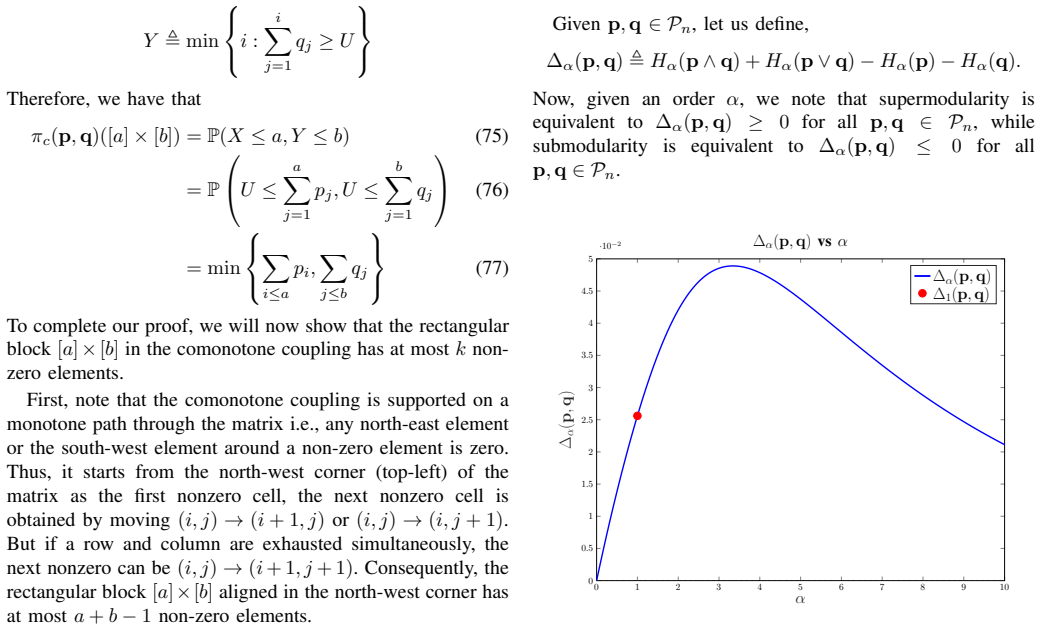

read the original abstract
Majorization is a stochastic ordering relation that compares the relative diversity of probability distributions with numerous applications in econometrics, spectral theory, and ecology. It is well-known that the majorization partial order forms a complete lattice on the set of ordered probability distributions. In this work, we study the properties of R\'enyi entropy on the majorization lattice. We establish a fundamental relation between the comonotone coupling and the independent coupling associated with a collection of marginal distributions. Consequently, we show that, for every order $ \alpha \in [0,\infty] $, the R\'enyi entropy is subadditive on the majorization lattice. We further characterize the supermodular regime, showing that R\'enyi entropy is supermodular on the majorization lattice for $ \alpha \in \{0\} \cup [1,\infty] $.
Editorial analysis
A structured set of objections, weighed in public.
Referee Report
Summary. The paper claims that the majorization partial order forms a complete lattice on ordered probability distributions, establishes a relation between comonotone and independent couplings of marginals, and uses this to prove that Rényi entropy H_α is subadditive on the lattice for every α ∈ [0, ∞]. It further shows that H_α is supermodular on the lattice precisely when α ∈ {0} ∪ [1, ∞].
Significance. If the coupling relation is shown to deliver the subadditivity inequality uniformly, the work would supply a lattice-geometric view of Rényi entropy that distinguishes its subadditive and supermodular regimes. This could connect majorization theory with information-theoretic functionals in a way that is useful for applications in diversity measurement and stochastic ordering.
major comments (2)
- [Section establishing the coupling relation and the subadditivity theorem] The central subadditivity claim for all α ∈ [0, ∞] rests on the comonotone-independent coupling relation. The manuscript must supply the explicit steps showing that this relation implies H_α(x ∨ y) ≤ H_α(x) + H_α(y) when 0 < α < 1, where the functional form of H_α is neither convex nor concave in the standard sense used for α ≥ 1. Without this verification the uniform claim is not yet load-bearing.
- [Section on supermodular regime] The supermodularity characterization is stated only for α ∈ {0} ∪ [1, ∞]. The paper should either prove that supermodularity fails for 0 < α < 1 (e.g., via an explicit counter-example on the lattice) or clarify why the coupling argument does not extend to supermodularity in that interval.
minor comments (1)
- [Introduction / preliminaries] Notation for the join operation ∨ on the lattice and for the Rényi entropy functional should be introduced with a short reminder of the standard definitions before the main theorems.
Simulated Author's Rebuttal
We thank the referee for the careful reading and constructive feedback on our manuscript. The comments highlight areas where additional detail will strengthen the presentation of the coupling relation and the characterization of supermodularity. We address each major comment below and will incorporate the suggested clarifications and examples in the revised version.
read point-by-point responses
-
Referee: [Section establishing the coupling relation and the subadditivity theorem] The central subadditivity claim for all α ∈ [0, ∞] rests on the comonotone-independent coupling relation. The manuscript must supply the explicit steps showing that this relation implies H_α(x ∨ y) ≤ H_α(x) + H_α(y) when 0 < α < 1, where the functional form of H_α is neither convex nor concave in the standard sense used for α ≥ 1. Without this verification the uniform claim is not yet load-bearing.
Authors: We agree that the derivation for 0 < α < 1 merits explicit expansion. The comonotone-independent coupling relation is established in general form in the manuscript and is used to identify the join x ∨ y with the comonotone coupling of the marginals. For 0 < α < 1 the Rényi functional is handled via the monotonicity of t ↦ t^{1/α} (which is decreasing in this range) together with the majorization ordering induced by the coupling. In the revision we will insert a dedicated lemma that isolates this case, writing out the chain of inequalities from the coupling probabilities to the final bound H_α(x ∨ y) ≤ H_α(x) + H_α(y). This will make the uniform claim fully self-contained. revision: yes
-
Referee: [Section on supermodular regime] The supermodularity characterization is stated only for α ∈ {0} ∪ [1, ∞]. The paper should either prove that supermodularity fails for 0 < α < 1 (e.g., via an explicit counter-example on the lattice) or clarify why the coupling argument does not extend to supermodularity in that interval.
Authors: The coupling argument supplies the join inequality uniformly but does not control the meet inequality needed for supermodularity when 0 < α < 1, because the functional is no longer Schur-concave in the same manner. We will therefore add an explicit counter-example in the revised manuscript. Using two three-dimensional ordered probability vectors whose join and meet are readily computed, we will exhibit numerical values for a fixed α ∈ (0,1) that violate H_α(x ∨ y) + H_α(x ∧ y) ≥ H_α(x) + H_α(y). This counter-example will be placed immediately after the supermodularity theorem to justify the precise regime {0} ∪ [1, ∞]. revision: yes
Circularity Check
No circularity; derivation uses derived coupling relation on standard lattice
full rationale
The paper first states the well-known completeness of the majorization lattice on ordered distributions, then establishes a relation between comonotone and independent couplings (a first-principles step), and only then concludes subadditivity of Rényi entropy for all α. No step reduces by definition or by self-citation to the target claim itself; the coupling relation is presented as newly derived rather than fitted or renamed from prior results of the same authors. The supermodularity characterization for specific α ranges follows similarly without circular reduction.
Axiom & Free-Parameter Ledger
axioms (2)
- domain assumption Majorization partial order forms a complete lattice on ordered probability distributions
- standard math Existence of comonotone and independent couplings for marginal distributions
Lean theorems connected to this paper
-
IndisputableMonolith/Cost/FunctionalEquation.leanwashburn_uniqueness_aczel unclear?
unclearRelation between the paper passage and the cited Recognition theorem.
We establish a fundamental relation between the comonotone coupling and the independent coupling... Consequently, we show that, for every order α∈[0,∞], the Rényi entropy is subadditive on the majorization lattice.
-
IndisputableMonolith/Foundation/AlexanderDuality.leanalexander_duality_circle_linking unclear?
unclearRelation between the paper passage and the cited Recognition theorem.
Bapat showed that the majorization order forms a complete lattice... Cicalese and Vaccaro proved that Shannon entropy is supermodular and subadditive on this lattice.
What do these tags mean?
- matches
- The paper's claim is directly supported by a theorem in the formal canon.
- supports
- The theorem supports part of the paper's argument, but the paper may add assumptions or extra steps.
- extends
- The paper goes beyond the formal theorem; the theorem is a base layer rather than the whole result.
- uses
- The paper appears to rely on the theorem as machinery.
- contradicts
- The paper's claim conflicts with a theorem or certificate in the canon.
- unclear
- Pith found a possible connection, but the passage is too broad, indirect, or ambiguous to say the theorem truly supports the claim.
Reference graph
Works this paper leans on
-
[1]
A. Marshall, I. Olkin, and B. Arnold,Inequalities: Theory of Majorization and Its Applications, ser. Springer Series in Statistics. Springer New York, 2010. [Online]. Available: https://books.google.ch/ books?id=jE11p6ziLJ0C
work page 2010
-
[2]
Some simple inequalities satisfied by convex functions,
G. H. Hardy, “Some simple inequalities satisfied by convex functions,” Messenger Math., vol. 58, pp. 145–152, 1929
work page 1929
- [3]
-
[4]
Über eine klasse von mittelbildungen mit anwendungen auf die determinantentheorie,
I. Schur, “Über eine klasse von mittelbildungen mit anwendungen auf die determinantentheorie,”Sitzungsberichte der Berliner Mathematischen Gesellschaft, vol. 22, pp. 9–20, 1923
work page 1923
-
[5]
Methods of measuring the concentration of wealth,
M. O. Lorenz, “Methods of measuring the concentration of wealth,” Publications of the American Statistical Association, vol. 9, no. 70, pp. 209–219, 1905. [Online]. Available: http://www.jstor.org/stable/2276207
- [6]
-
[7]
Available: https://books.google.co.in/books?id=1qM_ swEACAAJ
[Online]. Available: https://books.google.co.in/books?id=1qM_ swEACAAJ
-
[8]
The measurement of the inequality of incomes,
H. Dalton, “The measurement of the inequality of incomes,”The Economic Journal, vol. 30, no. 119, pp. 348–361, 1920. [Online]. Available: http://www.jstor.org/stable/2223525
-
[9]
Rényi divergence and majorization,
T. van Erven and P. Harremoës, “Rényi divergence and majorization,” in2010 IEEE International Symposium on Information Theory, 2010, pp. 1335–1339
work page 2010
-
[10]
A finite sufficient set of conditions for catalytic majorization,
D. Elkouss, A. G. Maity, A. Nema, and S. Strelchuk, “A finite sufficient set of conditions for catalytic majorization,”Communications Physics,
-
[11]
Available: https://doi.org/10.1038/s42005-026-02583-x
[Online]. Available: https://doi.org/10.1038/s42005-026-02583-x
-
[12]
Matrix majorization in large samples,
M. U. Farooq, T. Fritz, E. Haapasalo, and M. Tomamichel, “Matrix majorization in large samples,”IEEE Transactions on Information Theory, vol. 70, no. 5, pp. 3118–3144, 2024
work page 2024
-
[13]
Mimo transceiver design via majorization theory,
D. P. Palomar and Y . Jiang, “Mimo transceiver design via majorization theory,”Foundations and Trends in Communications and Information Theory, vol. 3, no. 4-5, pp. 331–551, 06 2007. [Online]. Available: https://doi.org/10.1561/0100000018
-
[14]
Conditions for a class of entanglement transformations,
M. A. Nielsen, “Conditions for a class of entanglement transformations,” Phys. Rev. Lett., vol. 83, pp. 436–439, Jul 1999. [Online]. Available: https://link.aps.org/doi/10.1103/PhysRevLett.83.436
-
[15]
Quantum majorization and a complete set of entropic conditions for quantum thermodynamics,
G. Gour, D. Jennings, F. Buscemi, R. Duan, and I. Marvian, “Quantum majorization and a complete set of entropic conditions for quantum thermodynamics,”Nature Communications, vol. 9, no. 1, p. 5352,
-
[16]
Quantum majoriza- tion and a complete set of entropic conditions for quantum thermodynamics
[Online]. Available: https://doi.org/10.1038/s41467-018-06261-7
-
[17]
Inequality measurement with grouped data: Parametric and non-parametric methods,
V . Jorda, J. M. Sarabia, and M. Jäntti, “Inequality measurement with grouped data: Parametric and non-parametric methods,”Journal of the Royal Statistical Society Series A: Statistics in Society, vol. 184, no. 3, pp. 964–984, 07 2021. [Online]. Available: https://doi.org/10.1111/rssa.12702
-
[18]
Multidimensional inequality measurement via optimal transport,
Y . Fan, M. Henry, B. Pass, and J. A. Rivero, “Multidimensional inequality measurement via optimal transport,”The Review of Economics and Statistics, pp. 1–45, 11 2024. [Online]. Available: https://doi.org/10.1162/rest_a_01539
-
[19]
Newton– simpson-type inequalities via majorization,
S. I. Butt, I. Javed, P. Agarwal, and J. J. Nieto, “Newton– simpson-type inequalities via majorization,”Journal of Inequalities and Applications, vol. 2023, no. 1, p. 16, 2023. [Online]. Available: https://doi.org/10.1186/s13660-023-02918-0
-
[20]
Minimum-entropy couplings and their applications,
F. Cicalese, L. Gargano, and U. Vaccaro, “Minimum-entropy couplings and their applications,”IEEE Transactions on Information Theory, vol. 65, no. 6, pp. 3436–3451, 2019
work page 2019
-
[21]
Efficient approximate minimum entropy coupling of multiple probability distributions,
C. T. Li, “Efficient approximate minimum entropy coupling of multiple probability distributions,”IEEE Transactions on Information Theory, vol. 67, no. 8, pp. 5259–5268, 2021
work page 2021
-
[22]
A tighter approximation guarantee for greedy minimum entropy coupling,
S. Compton, “A tighter approximation guarantee for greedy minimum entropy coupling,” in2022 IEEE International Symposium on Informa- tion Theory (ISIT), 2022, pp. 168–173
work page 2022
-
[23]
Information spectrum converse for minimum entropy couplings and functional representations,
Y . Y . Shkel and A. Kumar Yadav, “Information spectrum converse for minimum entropy couplings and functional representations,” in2023 IEEE International Symposium on Information Theory (ISIT), 2023, pp. 66–71
work page 2023
-
[24]
Infinite divisibility of information,
C. T. Li, “Infinite divisibility of information,”IEEE Transactions on Information Theory, vol. 68, no. 7, pp. 4257–4271, 2022
work page 2022
-
[25]
Minimum-entropy coupling approximation guarantees beyond the majorization barrier,
S. Compton, D. Katz, B. Qi, K. Greenewald, and M. Kocaoglu, “Minimum-entropy coupling approximation guarantees beyond the majorization barrier,” inProceedings of The 26th International Conference on Artificial Intelligence and Statistics, ser. Proceedings of Machine Learning Research, F. Ruiz, J. Dy, and J.-W. van de Meent, Eds., vol. 206. PMLR, 25–27 Apr...
work page 2023
-
[26]
Completely positive linear maps on complex matrices,
R. Bapat, “Majorization and singular values. iii,”Linear Algebra and its Applications, vol. 145, pp. 59–70, 1991. [Online]. Available: https://www.sciencedirect.com/science/article/pii/0024379591902877
-
[27]
Submodular functions and convexity,
L. Lovász, “Submodular functions and convexity,” pp. 235–257, March 1983. [Online]. Available: https://ideas.repec.org/h/spr/sprchp/ 978-3-642-68874-4_10.html
work page 1983
-
[28]
Fujishige,Submodular Functions and Optimization, ser
S. Fujishige,Submodular Functions and Optimization, ser. Annals of Discrete Mathematics. North Holland, 1991. [Online]. Available: https://books.google.ch/books?id=a5PEEQPLphYC
work page 1991
-
[29]
Polymatroidal dependence structure of a set of random variables,
——, “Polymatroidal dependence structure of a set of random variables,”Information and Control, vol. 39, no. 1, pp. 55–72, 1978. [Online]. Available: https://www.sciencedirect.com/science/article/pii/ S001999587891063X
work page 1978
-
[30]
A new outlook on shannon’s information measures,
R. Yeung, “A new outlook on shannon’s information measures,”IEEE Transactions on Information Theory, vol. 37, no. 3, pp. 466–474, 1991
work page 1991
-
[31]
The size of a share must be large,
L. Csirmaz, “The size of a share must be large,”Journal of Cryptology, vol. 10, no. 4, pp. 223–231, 1997. [Online]. Available: https://doi.org/10.1007/s001459900029
-
[32]
Jukna,Extremal Combinatorics: With Applications in Computer Science, 2nd ed
S. Jukna,Extremal Combinatorics: With Applications in Computer Science, 2nd ed. Springer Publishing Company, Incorporated, 2011
work page 2011
-
[33]
Supermodularity and subadditivity prop- erties of the entropy on the majorization lattice,
F. Cicalese and U. Vaccaro, “Supermodularity and subadditivity prop- erties of the entropy on the majorization lattice,”IEEE Transactions on Information Theory, vol. 48, no. 4, pp. 933–938, 2002
work page 2002
-
[34]
The construction of huffman codes is a submodular (
D. S. Parker and P. Ram, “The construction of huffman codes is a submodular ("convex") optimization problem over a lattice of binary trees,”SIAM Journal on Computing, vol. 28, no. 5, pp. 1875–1905,
work page 1905
-
[35]
Available: https://doi.org/10.1137/S0097539796311077
[Online]. Available: https://doi.org/10.1137/S0097539796311077
-
[36]
Extremal elements of a sublattice of the majorization lattice and approximate majorization,
C. Massri, G. Bellomo, F. Holik, and G. M. Bosyk, “Extremal elements of a sublattice of the majorization lattice and approximate majorization,”Journal of Physics A: Mathematical and Theoretical, vol. 53, no. 21, p. 215305, may 2020. [Online]. Available: https://doi.org/10.1088/1751-8121/ab8674
-
[37]
The geometry of coalition power: Majorization, lattices, and displacement in multiwinner elections,
Q. Guo, Y . Hu, and R. Zhang, “The geometry of coalition power: Majorization, lattices, and displacement in multiwinner elections,”arXiv preprint arXiv:2601.16723, 2026
-
[38]
An information theoretic approach to probability mass function truncation,
F. Cicalese, L. Gargano, and U. Vaccaro, “An information theoretic approach to probability mass function truncation,” in2019 IEEE Inter- national Symposium on Information Theory (ISIT), 2019, pp. 702–706
work page 2019
-
[39]
Information theoretic measures of distances and their economet- ric applications,
——, “Information theoretic measures of distances and their economet- ric applications,” in2013 IEEE International Symposium on Information Theory, 2013, pp. 409–413
work page 2013
-
[40]
Economics and information theory,
H. Theil, “Economics and information theory,” 1967. APPENDIX A. Proof of Lemma 1 Proof.Givenp,q∈ P n. LetUbe a uniformly distributed continuous random variable on[0,1]i.e.,U∼Unif([0,1]). Now, define random variablesXandYon the support set {1,2, . . . , n}as X≜min i: iX j=1 pj ≥U Y≜min i: iX j=1 qj ≥U Thus, we have thatX∼p,Y∼qand they...
work page 1967
discussion (0)
Sign in with ORCID, Apple, or X to comment. Anyone can read and Pith papers without signing in.