Recognition: 2 theorem links
· Lean TheoremHigher-order Persistence Diagrams
Pith reviewed 2026-05-12 04:53 UTC · model grok-4.3
The pith
Higher-order persistence diagrams arise recursively from containment relations among intervals, enabling direct aggregation via zeta transforms.
A machine-rendered reading of the paper's core claim, the machinery that carries it, and where it could break.
Core claim
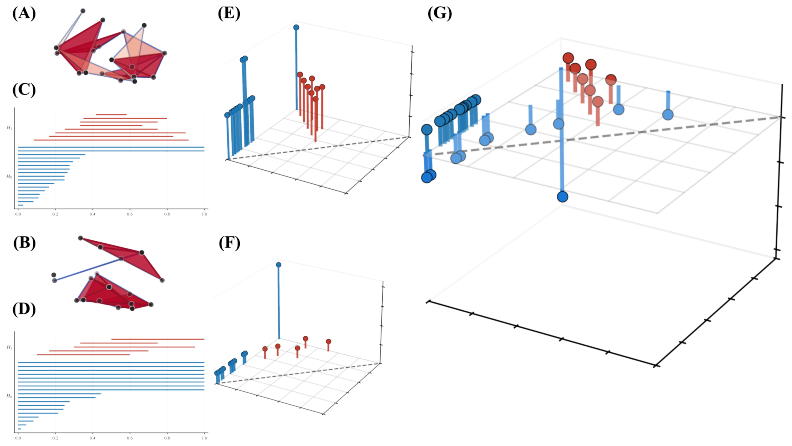
Higher-order persistence diagrams are obtained from a recursive construction in which containment relations among ordinary persistence intervals define higher-order persistence intervals. This construction supports direct comparison and aggregation on the diagrams themselves while preserving interval-level structure. Harmonic analysis reduces frequency-space evaluations of the aggregated diagrams to zeta transforms, avoiding explicit construction of the higher-order objects and replacing quadratic pair enumeration with nearly linear-time computation.
What carries the argument
Recursive containment relation among persistence intervals that defines higher-order intervals, reduced to zeta transforms for aggregation.
If this is right
- Aggregations of persistence diagrams retain which intervals contain others rather than flattening them away.
- Comparison and kernel methods can operate directly on the preserved interval relations.
- Frequency-space zeta transforms replace explicit quadratic enumeration with faster evaluation for large collections.
- Existing TDA pipelines can incorporate the construction without changing the input diagrams.
Where Pith is reading between the lines
- The recursive structure could extend naturally to other hierarchical topological summaries that possess containment or nesting relations.
- Linear-time aggregation might enable new statistical or machine-learning procedures on diagram collections that treat containment as a first-class feature.
- If the transform equivalence holds, closed-form expressions for certain summary statistics of higher-order diagrams may become available.
Load-bearing premise
The zeta-transform reduction in frequency space exactly reproduces the higher-order diagrams obtained from the recursive containment construction.
What would settle it
Compute the explicit higher-order diagram for a small set of intervals by enumerating all containments, then compare every entry against the result of the zeta-transform evaluation on the same set.
Figures


read the original abstract
Many topological data analysis (TDA) pipelines compute large collections of persistence diagrams, yet vectorizations and kernel methods discard the rank-induced implication relations among persistence intervals that are essential for faithful structural comparison and interpretability. We introduce higher-order persistence diagrams, a recursive construction in which containment relations among persistence intervals define higher-order persistence intervals. This construction performs comparison and aggregation directly on persistence diagrams and preserves interval-level structure. We use harmonic analysis to reduce frequency-space evaluations of aggregated diagrams to zeta transforms. This reduction avoids explicit construction of higher-order diagrams and replaces quadratic pair enumeration with nearly linear-time evaluation. Experiments on random network models show substantial speedups over explicit aggregation. Anonymized code is available at https://anonymous.4open.science/r/higher-order-persistence-8201.
Editorial analysis
A structured set of objections, weighed in public.
Referee Report
Summary. The paper introduces higher-order persistence diagrams via a recursive construction that defines new intervals from containment relations among intervals in standard persistence diagrams. It claims that harmonic analysis reduces frequency-space evaluations of aggregated higher-order diagrams to zeta transforms, avoiding explicit quadratic pair enumeration and enabling nearly linear-time computation while preserving interval-level structure. Experiments on random network models demonstrate substantial speedups over explicit aggregation, with anonymized code provided.
Significance. If the zeta-transform reduction is shown to be faithful to the recursive containment definition, the approach could enable scalable structural comparison and aggregation of persistence diagrams in TDA without discarding rank-induced relations, addressing a practical bottleneck in pipelines that handle large diagram collections. The emphasis on preserving interval structure and the provision of code for reproducibility are strengths.
major comments (3)
- [Abstract and method description] The central claim that harmonic analysis reduces aggregated higher-order diagram evaluations exactly to zeta transforms (avoiding information loss relative to the recursive containment construction) lacks an explicit derivation, equivalence proof, or invertibility argument. This equivalence is load-bearing for the nearly-linear-time claim and the assertion that the method computes the stated higher-order diagrams.
- [Harmonic analysis reduction] No verification is provided that the zeta convolution on the poset of intervals recovers the exact containment-induced higher-order intervals (e.g., via Möbius inversion or direct comparison to the recursive definition). Without this, it is unclear whether the computed object matches the introduced higher-order diagrams.
- [Experiments] The experiments report speedups on random networks but provide no quantitative validation that the zeta-transform outputs match explicit higher-order diagram aggregation on even small instances, nor error analysis for the approximation.
minor comments (2)
- [Introduction] The abstract and introduction would benefit from a brief statement of the poset structure on intervals and a small illustrative example of the recursive containment construction.
- [Method] Notation for the frequency-space representation and the precise definition of the zeta transform in this context should be introduced with equations for clarity.
Simulated Author's Rebuttal
We thank the referee for the thorough review and constructive suggestions. The comments correctly identify areas where additional rigor and validation would strengthen the manuscript. We will revise the paper to include an explicit derivation of the harmonic analysis reduction, a verification of the zeta transform equivalence, and quantitative experimental validation on small instances.
read point-by-point responses
-
Referee: [Abstract and method description] The central claim that harmonic analysis reduces aggregated higher-order diagram evaluations exactly to zeta transforms (avoiding information loss relative to the recursive containment construction) lacks an explicit derivation, equivalence proof, or invertibility argument. This equivalence is load-bearing for the nearly-linear-time claim and the assertion that the method computes the stated higher-order diagrams.
Authors: We agree that the manuscript would benefit from an explicit derivation. In the revised version we will add a dedicated subsection deriving the reduction from the incidence algebra of the interval poset. The argument will show that the frequency-space aggregation via harmonic analysis is precisely the zeta transform over containment relations, with the inverse given by Möbius inversion on the same poset. This establishes exact equivalence to the recursive definition and confirms that no structural information is lost. revision: yes
-
Referee: [Harmonic analysis reduction] No verification is provided that the zeta convolution on the poset of intervals recovers the exact containment-induced higher-order intervals (e.g., via Möbius inversion or direct comparison to the recursive definition). Without this, it is unclear whether the computed object matches the introduced higher-order diagrams.
Authors: We will address this by adding both a theoretical verification and a small-scale direct comparison. The new material will explicitly apply Möbius inversion to recover the higher-order intervals from the zeta convolution and will include a side-by-side computation on a synthetic collection of intervals, confirming that the outputs coincide with those obtained from the recursive containment construction. revision: yes
-
Referee: [Experiments] The experiments report speedups on random networks but provide no quantitative validation that the zeta-transform outputs match explicit higher-order diagram aggregation on even small instances, nor error analysis for the approximation.
Authors: We acknowledge the absence of direct numerical validation. The revised experimental section will include a controlled study on small persistence diagrams (fewer than 20 intervals) for which explicit enumeration remains tractable. We will report the exact numerical agreement between the zeta-transform outputs and the direct aggregation, together with an error analysis demonstrating that discrepancies are limited to floating-point precision and that the method is exact in exact arithmetic. revision: yes
Circularity Check
No circularity detected; recursive construction and zeta-transform reduction presented as independent computational shortcut
full rationale
The abstract defines higher-order persistence diagrams via a new recursive containment-based construction on intervals, then separately invokes harmonic analysis to reduce aggregated evaluations to zeta transforms for efficiency. No quoted equations or self-citations in the provided text show the zeta transform being defined in terms of the higher-order diagrams themselves, nor any fitted parameter renamed as a prediction, nor load-bearing self-citation chains. The derivation chain remains self-contained against external benchmarks, with the reduction framed as an algorithmic optimization rather than a definitional equivalence. This matches the default expectation of no significant circularity.
Axiom & Free-Parameter Ledger
axioms (2)
- domain assumption Persistence intervals are well-defined and their containment relations can be used to recursively define higher-order intervals without additional structure.
- domain assumption Harmonic analysis applies to aggregated persistence diagrams such that frequency-space evaluation reduces exactly to zeta transforms.
invented entities (1)
-
higher-order persistence diagrams
no independent evidence
Reference graph
Works this paper leans on
-
[1]
Journal of Applied and Computational Topology , year =
Bubenik, Peter and Elchesen, Alex , title =. Journal of Applied and Computational Topology , year =
-
[2]
Computational Geometry , year =
Bubenik, Peter and Elchesen, Alex , title =. Computational Geometry , year =
-
[3]
Foundations of Computational Mathematics , year =
Bubenik, Peter and de Silva, Vin and Scott, Jonathan , title =. Foundations of Computational Mathematics , year =
-
[4]
Journal of Machine Learning Research , year =
Bubenik, Peter , title =. Journal of Machine Learning Research , year =
-
[5]
Journal of Applied and Computational Topology , year =
Bubenik, Peter and Scott, Jonathan and Stanley, Donald , title =. Journal of Applied and Computational Topology , year =
-
[6]
Bubenik, Peter and V. Exact weights and path metrics for triangulated categories and the derived category of persistence modules , journal =. 2025 , volume =
work page 2025
-
[7]
Proceedings 41st Annual Symposium on Foundations of Computer Science , year =
Edelsbrunner, Herbert and Letscher, David and Zomorodian, Afra , title =. Proceedings 41st Annual Symposium on Foundations of Computer Science , year =
-
[8]
Discrete & Computational Geometry , year =
Zomorodian, Afra and Carlsson, Gunnar , title =. Discrete & Computational Geometry , year =
- [9]
-
[10]
Discrete & Computational Geometry , year =
Cohen-Steiner, David and Edelsbrunner, Herbert and Harer, John , title =. Discrete & Computational Geometry , year =
-
[11]
Foundations of Computational Mathematics , year =
Cohen-Steiner, David and Edelsbrunner, Herbert and Harer, John , title =. Foundations of Computational Mathematics , year =
-
[12]
Proceedings of the 22nd Annual Symposium on Computational Geometry , year =
Cohen-Steiner, David and Edelsbrunner, Herbert and Morozov, Dmitriy , title =. Proceedings of the 22nd Annual Symposium on Computational Geometry , year =
-
[13]
The Structure and Stability of Persistence Modules , year =
Chazal, Fr. The Structure and Stability of Persistence Modules , year =. 1207.3674 , archivePrefix =
- [14]
-
[15]
Algorithms and Computation , editor =
Carlsson, Gunnar and Singh, Gurjeet and Zomorodian, Afra , title =. Algorithms and Computation , editor =. 2009 , volume =
work page 2009
-
[16]
Foundations of Computational Mathematics , year =
Lesnick, Michael , title =. Foundations of Computational Mathematics , year =
-
[17]
Journal of Applied and Computational Topology , year =
Patel, Amit , title =. Journal of Applied and Computational Topology , year =
-
[18]
Generalized Persistence Diagrams for Persistence Modules over Posets , journal =
Kim, Woojin and M. Generalized Persistence Diagrams for Persistence Modules over Posets , journal =. 2021 , volume =
work page 2021
- [19]
-
[20]
Journal of Applied and Computational Topology , year =
Divol, Vincent and Lacombe, Thibaut , title =. Journal of Applied and Computational Topology , year =
-
[21]
Persistence Stability for Geometric Complexes , journal =
Chazal, Fr. Persistence Stability for Geometric Complexes , journal =. 2014 , volume =
work page 2014
-
[22]
Journal of Computational Geometry , year =
Bauer, Ulrich and Lesnick, Michael , title =. Journal of Computational Geometry , year =
-
[23]
and Tillmann, Ulrike and Grindrod, Peter and Harrington, Heather A
Otter, Nina and Porter, Mason A. and Tillmann, Ulrike and Grindrod, Peter and Harrington, Heather A. , title =. EPJ Data Science , year =
-
[24]
Advances in Neural Information Processing Systems 20 , year =
Rahimi, Ali and Recht, Benjamin , title =. Advances in Neural Information Processing Systems 20 , year =
- [25]
-
[26]
Transactions of the American Mathematical Society , year =
Aronszajn, Nachman , title =. Transactions of the American Mathematical Society , year =
- [27]
- [28]
- [29]
-
[30]
Berg, Christian and Christensen, Jens Peter Reus and Ressel, Paul , title =. 1984 , volume =
work page 1984
-
[31]
Lecture Notes in Mathematics , year =
Jorgensen, Palle and Pedersen, Steen and Tian, Feng , title =. Lecture Notes in Mathematics , year =
- [32]
-
[33]
Fukushima, Masatoshi and Oshima, Yoichi and Takeda, Masayoshi , title =. 1994 , volume =
work page 1994
- [34]
- [35]
-
[36]
Morris, S. A. , title =. Proceedings of the American Mathematical Society , year =
- [37]
-
[38]
Hofmann, Karl H. and Morris, Sidney A. , title =. 2023 , volume =
work page 2023
-
[39]
arXiv preprint arXiv:0911.3788 , year =
van Neerven, Jan , title =. arXiv preprint arXiv:0911.3788 , year =
-
[40]
Weaver, Nik , title =
-
[41]
Vakhania, N. N. and Tarieladze, V. I. and Chobanyan, S. A. , title =. 1987 , volume =
work page 1987
- [42]
-
[43]
Journal of Machine Learning Research , year =
Adams, Henry and Emerson, Tegan and Kirby, Michael and Neville, Rachel and Peterson, Chris and Shipman, Patrick and Chepushtanova, Sofya and Hanson, Eric and Motta, Francis and Ziegelmeier, Lori , title =. Journal of Machine Learning Research , year =
-
[44]
Proceedings of the IEEE Conference on Computer Vision and Pattern Recognition , year =
Reininghaus, Jan and Huber, Stefan and Bauer, Ulrich and Kwitt, Roland , title =. Proceedings of the IEEE Conference on Computer Vision and Pattern Recognition , year =
-
[45]
Proceedings of the 33rd International Conference on Machine Learning , year =
Kusano, Genki and Hiraoka, Yasuaki and Fukumizu, Kenji , title =. Proceedings of the 33rd International Conference on Machine Learning , year =
-
[46]
Sliced Wasserstein Kernel for Persistence Diagrams , journal =
Carri. Sliced Wasserstein Kernel for Persistence Diagrams , journal =. 2017 , volume =
work page 2017
-
[47]
Advances in Neural Information Processing Systems , year =
Le, Tam and Yamada, Makoto , title =. Advances in Neural Information Processing Systems , year =
-
[48]
Advances in Neural Information Processing Systems , year =
Hofer, Christoph and Kwitt, Roland and Niethammer, Marc and Uhl, Andreas , title =. Advances in Neural Information Processing Systems , year =
-
[49]
Artificial Intelligence Review , year =
Pun, Chi Seng and Lee, Si Xian and Xia, Kelin , title =. Artificial Intelligence Review , year =
-
[50]
and Byrne, Nicholas and Oksuz, Ilkay and Zimmer, Veronika A
Clough, James R. and Byrne, Nicholas and Oksuz, Ilkay and Zimmer, Veronika A. and Schnabel, Julia A. and King, Andrew P. , title =. IEEE Transactions on Pattern Analysis and Machine Intelligence , year =
-
[51]
Medical Image Analysis , year =
Qaiser, Talha and Tsang, Yee-Wah and Taniyama, Daiki and Sakamoto, Naoya and Nakane, Kazuaki and Epstein, David and Rajpoot, Nasir , title =. Medical Image Analysis , year =
-
[52]
Proceedings of the IEEE/CVF International Conference on Computer Vision , year =
Qi, Yaolei and He, Yuting and Qi, Xiaoming and Zhang, Yuan and Yang, Guanyu , title =. Proceedings of the IEEE/CVF International Conference on Computer Vision , year =
-
[53]
and Tillmann, Ulrike and Pugh, Christopher W
Vipond, Oliver and Bull, Joshua Adam and Macklin, Philip S. and Tillmann, Ulrike and Pugh, Christopher W. and Byrne, Helen M. and Harrington, Heather A. , title =. Proceedings of the National Academy of Sciences , year =
-
[54]
European Congress of Mathematics , year =
Edelsbrunner, Herbert and Morozov, Dmitriy , title =. European Congress of Mathematics , year =
- [55]
-
[56]
Riehl, Emily , title =
- [57]
- [58]
-
[59]
Hatcher, Allen , title =
- [60]
-
[61]
Christensen, J. Daniel and Dwyer, William G. and Isaksen, Daniel C. , title =. Advances in Mathematics , year =
- [62]
- [63]
-
[64]
Contemporary Mathematics , year =
Hurder, Steven , title =. Contemporary Mathematics , year =
-
[65]
Journal of Noncommutative Geometry , year =
Accornero, Luca and Crainic, Marius , title =. Journal of Noncommutative Geometry , year =
- [66]
-
[67]
Watts, Duncan J. and Strogatz, Steven H. , title =. Nature , year =
-
[68]
Inventiones mathematicae , volume=
Pointwise theorems for amenable groups , author=. Inventiones mathematicae , volume=. 2001 , publisher=
work page 2001
-
[69]
Journal of Machine Learning Research , volume=
Topology of deep neural networks , author=. Journal of Machine Learning Research , volume=
-
[70]
arXiv preprint arXiv:2211.13706 , year=
Fast M " obius and Zeta Transforms , author=. arXiv preprint arXiv:2211.13706 , year=
-
[71]
Correlation with Molecular Orbital Energies and Hydrophobicity , author=
Structure-Activity Relationship of Mutagenic Aromatic and Heteroaromatic Nitro Compounds. Correlation with Molecular Orbital Energies and Hydrophobicity , author=. Journal of Medicinal Chemistry , volume=
-
[72]
TUDataset: A collection of benchmark datasets for learning with graphs , author=. arXiv preprint arXiv:2007.08663 , year=
discussion (0)
Sign in with ORCID, Apple, or X to comment. Anyone can read and Pith papers without signing in.