Recognition: 2 theorem links
· Lean TheoremParameter Estimation for Partially Observed Time-Changed SDEs
Pith reviewed 2026-05-12 04:36 UTC · model grok-4.3
The pith
Multilevel MCMC achieves O(ε²) mean square error for Bayesian parameter estimation in partially observed time-changed SDEs at cost O(ε^{-2} log(ε)²).
A machine-rendered reading of the paper's core claim, the machinery that carries it, and where it could break.
Core claim
A variant of the proposed MCMC algorithm enables multilevel-based Bayesian parameter estimation that achieves mean square error of order ε² with total cost of order ε^{-2} log(ε)² for any ε > 0.
What carries the argument
Unbiased score-based stochastic approximation via MCMC combined with multilevel variance reduction for the Bayesian posterior.
Load-bearing premise
The time-changed SDEs possess well-defined transition densities and the MCMC chains mix fast enough for unbiasedness and variance reduction to hold.
What would settle it
A numerical example in which the mean square error fails to decay as O(ε²) or the observed cost exceeds O(ε^{-2} log(ε)²) while the transition densities exist and the chains are run to the required mixing tolerance would refute the complexity claim.
Figures


read the original abstract
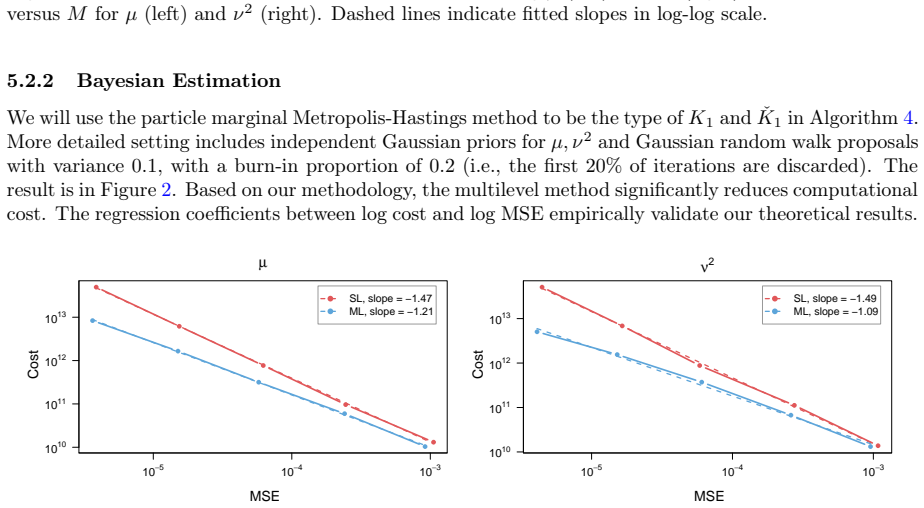
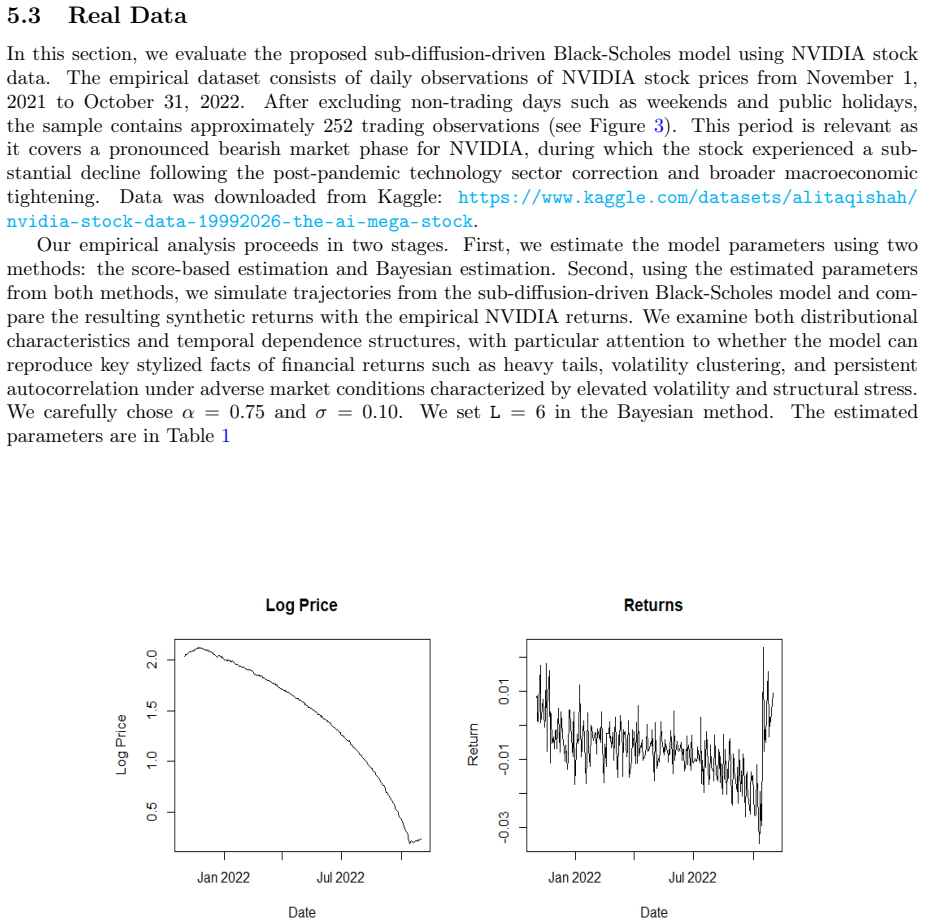
In this paper we consider the parameter estimation problem associated to partially-observed time changed SDEs, with observations that are given at discrete times. In particular we consider both likelihood and Bayesian estimation. We develop new Markov chain Monte Carlo (MCMC) algorithms which allow an unbiased score-based stochastic approximation method to provide likelihood-type parameter estimators. We also use a variant of this MCMC algorithm to perform multilevel-based Bayesian parameter estimation. We prove that this latter method achieves a mean square error of $\mathcal{O}(\epsilon^2)$ ($\epsilon>0$) with a cost of $\mathcal{O}(\epsilon^{-2}\log(\epsilon)^2)$. Our methodologies are tested numerically on both simulated and real data.
Editorial analysis
A structured set of objections, weighed in public.
Referee Report
Summary. The paper develops MCMC algorithms for unbiased score-based stochastic approximation to enable likelihood-based parameter estimation for partially observed time-changed SDEs with discrete observations. It further introduces a multilevel variant of this MCMC scheme for Bayesian estimation and proves that the multilevel method attains mean-square error O(ε²) at computational cost O(ε^{-2} log(ε)²). Numerical illustrations on simulated and real data are included.
Significance. If the central complexity result holds under the stated assumptions, the work would supply a near-optimal-cost Bayesian estimator for a practically relevant class of partially observed stochastic models, extending multilevel Monte Carlo techniques to time-changed diffusions. The unbiased MCMC construction for score approximation is a reusable technical contribution.
major comments (2)
- [§4] §4 (multilevel Bayesian estimator and complexity theorem): the O(ε²) MSE / O(ε^{-2} log(ε)²) cost bound is derived from standard multilevel Monte Carlo variance reduction applied to the unbiased score estimator; however, the argument requires a uniform-in-ε bound on the integrated autocorrelation time (or spectral gap) of the underlying MCMC chains. No such uniform ergodicity result is stated or proved, nor is any dependence on the time-change parameters or observation density quantified. This assumption is load-bearing for the claimed complexity.
- [§2] §2 (model setup and transition densities): the unbiased score approximation and the subsequent multilevel analysis presuppose that the marginal transition densities of the partially observed time-changed process exist and are sufficiently regular. The manuscript does not supply verifiable conditions on the time-change Lévy process, the drift/diffusion coefficients, or the observation model that guarantee these properties uniformly in the discretization parameter ε.
minor comments (2)
- [Numerical experiments] The numerical section should report effective sample sizes or autocorrelation times of the MCMC chains as functions of ε (or at least for the finest level) to allow readers to assess whether the mixing assumption is plausible in the tested regimes.
- Notation for the time-change process and the auxiliary variables introduced in the data-augmentation MCMC should be introduced once and used consistently; several symbols appear to be redefined between the likelihood and Bayesian sections.
Simulated Author's Rebuttal
We thank the referee for their thorough review and valuable comments on our manuscript. We are pleased that the significance of the work is recognized. Below, we provide point-by-point responses to the major comments and outline the revisions we will make.
read point-by-point responses
-
Referee: [§4] §4 (multilevel Bayesian estimator and complexity theorem): the O(ε²) MSE / O(ε^{-2} log(ε)²) cost bound is derived from standard multilevel Monte Carlo variance reduction applied to the unbiased score estimator; however, the argument requires a uniform-in-ε bound on the integrated autocorrelation time (or spectral gap) of the underlying MCMC chains. No such uniform ergodicity result is stated or proved, nor is any dependence on the time-change parameters or observation density quantified. This assumption is load-bearing for the claimed complexity.
Authors: We agree with the referee that the complexity result depends on a uniform bound on the integrated autocorrelation time of the MCMC chains with respect to the discretization parameter ε. In the current manuscript, this uniformity is assumed based on the continuity of the transition densities and the fixed observation model, but we did not provide an explicit proof. In the revised manuscript, we will add a new proposition in §4 that establishes this uniform ergodicity under the stated assumptions on the Lévy process and SDE coefficients. Specifically, we will show that the spectral gap is bounded below by a positive constant independent of ε, using standard techniques for MCMC on continuous state spaces with smooth densities. revision: yes
-
Referee: [§2] §2 (model setup and transition densities): the unbiased score approximation and the subsequent multilevel analysis presuppose that the marginal transition densities of the partially observed time-changed process exist and are sufficiently regular. The manuscript does not supply verifiable conditions on the time-change Lévy process, the drift/diffusion coefficients, or the observation model that guarantee these properties uniformly in the discretization parameter ε.
Authors: The referee correctly identifies that explicit conditions are needed to ensure the existence and regularity of the marginal transition densities uniformly in ε. While the paper relies on standard assumptions for time-changed SDEs (such as Lipschitz coefficients and finite variation Lévy processes), we acknowledge that these should be stated clearly and verified for uniformity. In the revision, we will expand §2 with a dedicated subsection listing the precise assumptions (e.g., bounded and Lipschitz continuous drift and diffusion coefficients, finite second moments on the Lévy measure, and non-degenerate observation noise) that guarantee the required density properties. We will also reference relevant results from the literature on existence of densities for such processes. revision: yes
Circularity Check
No circularity: complexity bound follows from standard multilevel Monte Carlo theory
full rationale
The paper's central claim is a proved complexity result (MSE O(ε²) at cost O(ε^{-2} log(ε)²)) for multilevel Bayesian estimation using a new MCMC scheme for partially observed time-changed SDEs. This bound is presented as following from the application of existing multilevel Monte Carlo variance reduction to the unbiased score approximation obtained via the MCMC algorithm. No equations, fitted parameters, or self-citations are shown to reduce the result to its own inputs by construction; the derivation chain remains self-contained against external multilevel Monte Carlo theory once the MCMC mixing and density existence assumptions are granted. No load-bearing step matches any of the enumerated circularity patterns.
Axiom & Free-Parameter Ledger
Lean theorems connected to this paper
-
IndisputableMonolith/Cost/FunctionalEquation.leanwashburn_uniqueness_aczel unclearWe prove that this latter method achieves a mean square error of O(ε²) (ε>0) with a cost of O(ε^{-2} log(ε)²).
-
IndisputableMonolith/Foundation/RealityFromDistinction.leanreality_from_one_distinction unclearnew Markov chain Monte Carlo (MCMC) algorithms which allow an unbiased score-based stochastic approximation method
Reference graph
Works this paper leans on
-
[1]
Alvarez , & Jasra , A. (2025). Unbiased parameter estimation of partially observed diffusions using diffusion bridges. arXiv preprint
work page 2025
-
[2]
Andrieu , C., Doucet , A., & Holenstein , R. (2010). Particle Markov chain Monte Carlo methods. J. R. Stat. Soc. Ser. B 72 , 269--342
work page 2010
-
[3]
Andrieu , C., Moulines , \'E ., & Priouret , P. (2005). Stability of stochastic approximation under verifiable conditions. SIAM J. Control Optim. 44 , 283--312
work page 2005
-
[4]
Andrieu , C., & Vihola , M. (2014). Markovian stochastic approximation with expanding projections. Bernoulli, 20 , 545--585
work page 2014
-
[5]
Awadelkarim , E., & Jasra , A. (2026). Multilevel particle filters for partially observed McKean--Vlasov stochastic differential equations. J. Appl. Probab. (to appear)
work page 2026
-
[6]
Awadelkarim , E., Jasra , A., & Ruzayqat , H. (2024). Unbiased parameter estimation for partially observed diffusions. SIAM J. Control Optim. 62 , 2664--2694
work page 2024
-
[7]
Beskos, A., Crisan , D., Jasra , A., Kantas , N. & Ruzaqyat , H. (2021). Score based parameter estimation for a class of continuous-time state-space models. SIAM J. Sci. Comp., 43 , A2555--A2580
work page 2021
-
[8]
Bio c i \'c , I., Cede \ n o-Gir \'o n , D. E., & Toaldo , B. (2026). Sampling inverse subordinators and subdiffusions. Ann. Appl. Probab. 36 , 823--876
work page 2026
-
[9]
C \'a zares , J. I. G., Lin , F., & Mijatovi \'c , A. (2025). Fast exact simulation of the first-passage event of a subordinator. Stochastic Process. Appl. 183 , 104599
work page 2025
-
[10]
Chada , N., Franks , J. , Jasra , A., Law , K. J. H. & Vihola , M. (2021). Unbiased inference for discretely observed hidden Markov model diffusions. SIAM/ASA J. Uncert. Quant., 9 , 763-787
work page 2021
-
[11]
Del Moral , P. (2004). Feynman--Kac formulae. In Feynman--Kac Formulae. Springer, 47--93
work page 2004
-
[12]
Giles , M. B. (2008). Multilevel Monte Carlo path simulation. Oper. Res. 56 , 607--617
work page 2008
-
[13]
Golightly , A. & Sherlock , C. (2022). Augmented pseudo-marginal Metropolis-Hastings for partially observed diffusion processes. Stat. Comp., 32 , article 21
work page 2022
-
[14]
Golightly , A. & Wilkinson , D. (2008). Bayesian inference for nonlinear multivariate diffusion models observed with error. Comp. Stat. Data Anal., 52 , 1674-1693
work page 2008
-
[15]
I., Lin , F., & Mijatovi \'c , A
Gonz \'a lez C \'a zares , J. I., Lin , F., & Mijatovi \'c , A. (2025). Fast exact simulation of the first passage of a tempered stable subordinator. Stoch. Sys. 15 , 50--87
work page 2025
-
[16]
Graham , M. M., Thiery , A. H. & Beskos , A. (2022). Manifold Markov chain Monte Carlo methods for Bayesian inference in diffusion models. J. R. Stat. Soc. Ser. B, 84 , 1229-1256
work page 2022
-
[17]
Hairer , M., Koralov , L., & Pajor-Gyulai , Z. (2016). From averaging to homogenization in cellular flows. Ann. Inst. H. Poincare Probab. Statist. , 52 , 1592--1613
work page 2016
-
[18]
Hairer , M., Iyer , G., Koralov , L., Novikov , A., & Pajor-Gyulai , Z. (2018). A fractional kinetic process describing intermediate time behaviour of cellular flows. Ann. Probab. , 46 , 897--955
work page 2018
-
[19]
Heng , J., Houssineau , J., & Jasra , A. (2024). On unbiased estimation for partially observed diffusions. J. Mach. Learn. Res. 25 , 1--66
work page 2024
-
[20]
Jasra , A., Heng , J., Xu , Y. & Bishop , A. (2022). A Multilevel Approach for Stochastic Nonlinear Optimal Control. Intl. J. Contr., 95 , 1290--1304
work page 2022
- [21]
-
[22]
Jasra , A., Kamatani , K., Law , K. J. H., & Zhou , Y. (2017). Multilevel particle filters. SIAM J. Numer. Anal. 55 , 3068--3096
work page 2017
- [23]
-
[24]
Jasra , A., Law , K. J. H., & Yu , F. (2022). Unbiased filtering of partially observed diffusions. Adv. Appl. Probab. 54 , 661--687
work page 2022
- [25]
-
[26]
Jasra , A. & Zhumekenov , A. (2026). Asymptotic variance in the central limit theorem for multilevel Markovian stochastic approximation. Stoch. Anal. Appl., 44 , 139-154
work page 2026
-
[27]
Jum , E., & Kobayashi , K. (2016). A strong and weak approximation scheme for SDEs driven by time-changed Brownian motion. Prob. Math. Stat., 36 , 201--220
work page 2016
-
[28]
Kobayashi , K. (2011). Stochastic calculus for a time-changed semimartingale. J. Theor. Probab. 24 , 789--820
work page 2011
-
[29]
Lv , L., & Wang , L. (2020). Monte Carlo simulation for multiterm time-fractional diffusion equation. Adv. Math. Phys. 2020 , 1315426
work page 2020
-
[30]
Magdziarz , M. (2009). Black--Scholes formula in subdiffusive regime. J. Stat. Phys. 136 , 553--564
work page 2009
-
[31]
Metzler , R., & Klafter , J. (2000). The random walk's guide to anomalous diffusion. Phys. Rep. 339 , 1--77
work page 2000
-
[32]
Protter , P. E. (2012). Stochastic differential equations. In Stochastic Integration and Differential Equations. Springer, 249--361
work page 2012
-
[33]
Rhee , C.-H., & Glynn , P. W. (2015). Unbiased estimation with square root convergence for SDE models. Oper. Res. 63 , 1026--1043
work page 2015
-
[34]
Robbins , H., & Monro , S. (1951). A stochastic approximation method. Ann. Math. Stat., 400--407
work page 1951
-
[35]
Vihola , M. (2018). Unbiased estimators and multilevel Monte Carlo. Oper. Res. 66 , 448--462
work page 2018
-
[36]
Zaslavsky , G. M. (1994). Fractional kinetic equation for Hamiltonian chaos. Physica D 76 , 110--122
work page 1994
- [37]
discussion (0)
Sign in with ORCID, Apple, or X to comment. Anyone can read and Pith papers without signing in.