Recognition: 2 theorem links
· Lean TheoremMeasurement-Adapted Eigentask Representations for Photon-Limited Optical Readout
Pith reviewed 2026-05-12 03:53 UTC · model grok-4.3
The pith
Eigentasks order optical sensor features by their resolvability under noise to provide better low-dimensional representations for inference.
A machine-rendered reading of the paper's core claim, the machinery that carries it, and where it could break.
Core claim
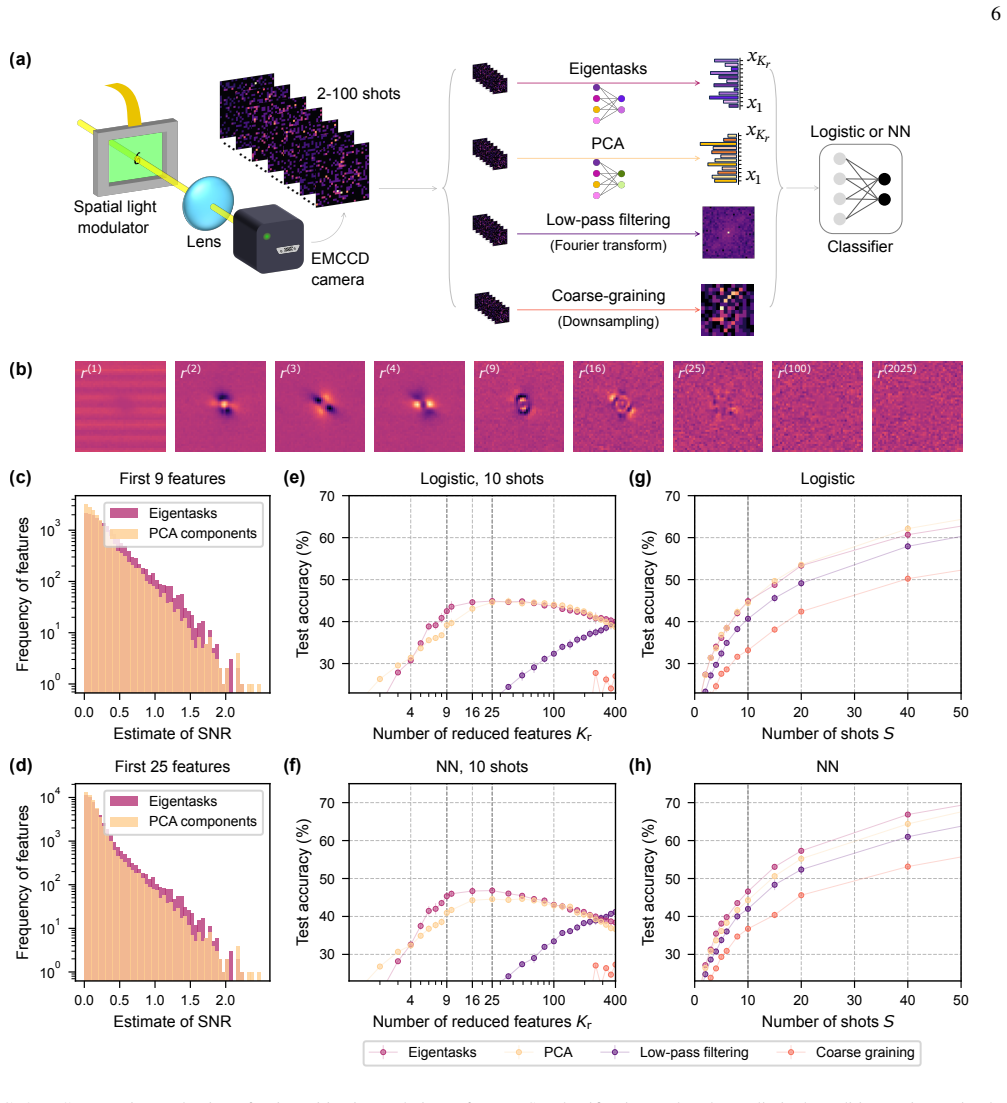
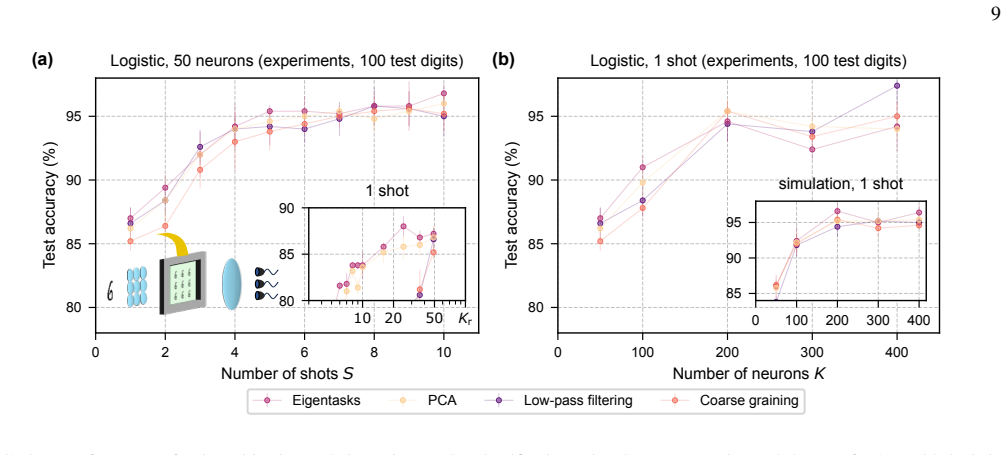
Eigentasks provide a measurement-adapted representation for optical sensor outputs by ordering readout features according to their resolvability under noise. On experimental data from lens-based imaging and single-photon neural network reanalysis, they outperform PCA and filtering compression most in photon-limited, few-shot, and difficult classification tasks, improving sample-efficient learning.
What carries the argument
The eigentask representation, which orders high-dimensional readout features by resolvability under modeled noise to form an adapted basis for downstream tasks.
If this is right
- Better accuracy in photon-limited regimes for optical classification.
- Gains of about 10 percentage points in few-shot classification as class count rises.
- Improved sample efficiency for learning from limited optical data.
- A strategy for optical inference under tight photon budget and acquisition time constraints.
Where Pith is reading between the lines
- The noise-model ordering could extend to other physical sensing systems facing similar measurement limits.
- Combining eigentasks with adaptive or learned noise models might address cases where the assumed noise does not match reality.
- This method underscores the value of physics-informed feature selection over purely data-driven compression in sensor applications.
Load-bearing premise
That strictly ordering features by resolvability under the noise model produces the most useful representation for any downstream task without task-specific adjustments.
What would settle it
If eigentask representations do not outperform PCA in accuracy on a new photon-limited classification experiment using identical dimensions and classifiers, the central advantage would be disproven.
Figures


read the original abstract
Optical readout in low-light imaging is fundamentally limited by measurement noise, including photon shot noise, detector noise, and quantization error. In this regime, downstream inference depends not only on the optical front end, but also on how noisy high-dimensional sensor measurements are represented before classification or decision-making. Here we show that eigentasks provide a measurement-adapted representation for optical sensor outputs by ordering readout features according to their resolvability under noise. Using experimental data from a lens-based optical imaging system and a reanalysis of published data from a single-photon-detection neural network, we find that eigentask representations frequently outperform standard baselines including principal component analysis and filtering-based compression. The advantage is most pronounced in photon-limited, few-shot, and higher-difficulty classification regimes. In few-shot MPEG-7 classification, for example, the advantage over other methods reaches about 10 percentage points as the number of classes increases. In these settings, eigentasks yield more informative low-dimensional features and improve sample-efficient downstream learning. These results identify measurement-adapted representation as a promising strategy for optical inference when photon budget, acquisition time, and task complexity are constrained.
Editorial analysis
A structured set of objections, weighed in public.
Referee Report
Summary. The manuscript introduces eigentasks as a measurement-adapted representation for photon-limited optical readouts. Features from sensor outputs are ordered by their individual resolvability under a composite noise model (shot noise, detector noise, quantization). Experiments on lens-based imaging data and reanalysis of single-photon neural network datasets (including MPEG-7) show that low-dimensional eigentask representations outperform PCA and filtering baselines in classification accuracy, with the largest gains in few-shot and high-class-count regimes (approximately 10 percentage points in the latter). The approach is presented as task-agnostic and label-free, improving sample efficiency for downstream inference.
Significance. If the central empirical claims hold under the stated noise model, the work supplies a concrete, measurement-driven alternative to generic dimensionality reduction for noisy optical data. The emphasis on experimental validation and reanalysis of published single-photon data, together with the absence of free parameters in the core ordering, strengthens the case for practical utility in photon-budget-constrained settings. The reported advantage in few-shot, high-difficulty regimes is a potentially useful finding for optical sensing applications.
major comments (2)
- [Experimental Results] Experimental Results section: the claim that eigentask ordering is useful for arbitrary downstream tasks rests on classification experiments only. No regression, detection, or reconstruction tasks are reported; if discriminative information lies primarily in lower-resolvability directions, the top-k selection could discard task-relevant signal, undermining the generality asserted in the abstract.
- [Methods] Methods (noise model and resolvability definition): the resolvability metric is central to the ordering. The manuscript should explicitly derive or state the precise functional form (e.g., whether it is an SNR ratio, eigenvalue of the inverse noise covariance, or mutual-information proxy) and confirm that no data-dependent parameters enter the ordering itself, as any implicit estimation from the collected measurements would introduce a form of task-dependent tuning.
minor comments (2)
- [Figures] Figure captions and axis labels should explicitly indicate the number of shots or photons per pixel for each curve to allow direct comparison of photon-limited performance.
- [Introduction] The introduction should include a brief comparison to prior noise-aware dimensionality-reduction techniques (e.g., weighted PCA or SNR-based feature selection) to clarify the incremental contribution of the resolvability ordering.
Simulated Author's Rebuttal
We thank the referee for the detailed and constructive feedback on our manuscript. We have carefully considered the major comments and provide point-by-point responses below. We believe these clarifications and planned revisions will strengthen the paper.
read point-by-point responses
-
Referee: [Experimental Results] Experimental Results section: the claim that eigentask ordering is useful for arbitrary downstream tasks rests on classification experiments only. No regression, detection, or reconstruction tasks are reported; if discriminative information lies primarily in lower-resolvability directions, the top-k selection could discard task-relevant signal, undermining the generality asserted in the abstract.
Authors: We agree that our experimental validation is limited to classification tasks, which are representative of many photon-limited optical sensing applications. The eigentask representation is constructed in a task-agnostic manner by ordering features based solely on their resolvability under the noise model, without using any labels or task-specific information. This design ensures that the top-k features retain the most distinguishable signal components under noise, which should benefit a wide range of downstream inference tasks. However, we acknowledge that without explicit experiments on regression or detection, the generality remains an assertion supported by the method's construction rather than comprehensive empirical evidence. In the revised manuscript, we will expand the discussion to address potential applications to other tasks and include a caveat regarding the scope of current experiments. We do not believe this invalidates the abstract's claims, as the method is presented as a general representation strategy, but we will tone down any overly broad assertions if needed. revision: partial
-
Referee: [Methods] Methods (noise model and resolvability definition): the resolvability metric is central to the ordering. The manuscript should explicitly derive or state the precise functional form (e.g., whether it is an SNR ratio, eigenvalue of the inverse noise covariance, or mutual-information proxy) and confirm that no data-dependent parameters enter the ordering itself, as any implicit estimation from the collected measurements would introduce a form of task-dependent tuning.
Authors: We appreciate this comment and will revise the Methods section to provide a clear derivation of the resolvability metric. The resolvability for each feature is defined as the signal-to-noise ratio, specifically the ratio of the feature's signal variance to the sum of variances from shot noise, detector noise, and quantization noise. This can be shown to be equivalent to selecting directions with the largest eigenvalues in the inverse of the noise covariance matrix. The computation relies exclusively on the known physical parameters of the optical system and sensor (e.g., photon flux, detector characteristics), with no estimation or fitting from the experimental data itself. Thus, the ordering is completely determined by the measurement model and introduces no task-dependent or data-dependent parameters. We will include the explicit mathematical formulation and a proof of its independence from data in the revised version. revision: yes
Circularity Check
No significant circularity: eigentask ordering derived independently from noise model
full rationale
The paper constructs eigentasks by ordering readout features according to their resolvability under an explicit measurement noise model (photon shot noise, detector noise, quantization error). This ordering uses only the forward measurement model and contains no downstream task labels or fitted parameters that would make the representation equivalent to task performance by construction. Empirical comparisons to PCA and filtering baselines are performed on held-out classification tasks using experimental data, providing external validation rather than a self-referential derivation. No load-bearing self-citations, uniqueness theorems, or ansatzes are invoked to justify the core representation; the method remains self-contained against the stated noise model and independent benchmarks.
Axiom & Free-Parameter Ledger
invented entities (1)
-
eigentasks
no independent evidence
Lean theorems connected to this paper
-
IndisputableMonolith/Cost/FunctionalEquation.leanwashburn_uniqueness_aczel unclear?
unclearRelation between the paper passage and the cited Recognition theorem.
eigentasks are ordered according to the signal-to-noise ratio (SNR) of their observation... generalized eigenvalue problem V r(k) = 1/α²_k G r(k)
-
IndisputableMonolith/Foundation/AlexanderDuality.leanalexander_duality_circle_linking unclear?
unclearRelation between the paper passage and the cited Recognition theorem.
ordering readout features according to their resolvability under noise... outperform PCA and filtering-based compression
What do these tags mean?
- matches
- The paper's claim is directly supported by a theorem in the formal canon.
- supports
- The theorem supports part of the paper's argument, but the paper may add assumptions or extra steps.
- extends
- The paper goes beyond the formal theorem; the theorem is a base layer rather than the whole result.
- uses
- The paper appears to rely on the theorem as machinery.
- contradicts
- The paper's claim conflicts with a theorem or certificate in the canon.
- unclear
- Pith found a possible connection, but the passage is too broad, indirect, or ambiguous to say the theorem truly supports the claim.
Reference graph
Works this paper leans on
-
[1]
Research was sponsored by the Army Research Office and was accomplished under Grant Number W911NF-25-1-0261. The views and conclusions contained in this document are those of the authors and should not be interpreted as representing the official policies, either expressed or implied, of the Army Research Office or the U.S. Government. The U.S. Government ...
-
[2]
EMCCD gain calibration and photon-budget estimation For the lens-based experiments, the EMCCD gain was calibrated from the shot-to-shot fluctuations of the raw camera readout. In the large-gain limit, the photon-induced pixel valuesX ph satisfy [44, 45, 55]: E[Xph] =ηλg,Var[X ph] = 2ηλg 2,(A1) whereλis the mean incident photon number during one exposure,η...
-
[3]
The covariance matrix is defined by taking the expectation value over the inputsV=E u[Σ(u)]
Estimation of eigentasks and the transformation matrix of eigentask learning For a specific inputu, the covariances are given by the covariance matrixΣ(u)∈R K×K withΣ kk′ = CovX [ζk(u), ζk′(u)] = EX [ζk(u)ζk′(u)]. The covariance matrix is defined by taking the expectation value over the inputsV=E u[Σ(u)]. The Gram matrix is defined byG=E u[x(u)x(u)T]. In ...
-
[4]
Estimation of principal components and the transformation matrix of PCA Similar to eigentasks, we also estimate principal components and the transformation based on the training set with the maxi- mum number of shotsS max collected and apply them to the full dataset with fewer shots. Firstly, theS max-shot mean of features ¯X(u)are calculated and the mean...
-
[5]
Fourier-domain low-pass filtering and spatial coarse graining In Fourier-domain low-pass filtering, we apply the Fourier transform to the averaged features ¯X(u)and extract the real and imaginary parts of the low-frequency components as input to the output layer. For output features from EMCCD two- dimensional pixel arrays, the features can be expressed a...
-
[6]
Dataset-specific data splits and evaluation protocols For each input imageu (n), we collected up toS max repeated stochastic measurements{X (s)(u(n))}Smax s=1 , whereX (s) ∈R K denotes the raw sensor readout from a single shot. To emulate operation on a smaller sampling budgetS≤S max, we formed theS-shot feature vector ¯X(u (n)) = 1 S SX s=1 X (s)(u(n)),(...
-
[7]
Downstream classifiers, optimization, and reporting For eachK r, features were normalized using statistics computed from the training subset only. For eigentask and PCA, we first computed the full ordered set of transformed features¯Y, normalized these features, and then retained the leadingKr components. For low-pass filtering, the full Fourier-transform...
-
[8]
Estimation of empirical per-feature SNRs After learning the transform with matrixWand biasbfrom the training set, we quantified how noise is redistributed by the transformed features using an empirical per-feature SNR estimate. For each inputuin the test set, we applied the learned transform to each single-shot readoutX(s)(u)to obtain the noise-mitigated ...
-
[9]
A. Ettinger and T. Wittmann, Chapter 5 - fluorescence live cell imaging, inQuantitative Imaging in Cell Biology, Methods in Cell Biology, V ol. 123, edited by J. C. Waters and T. Wittman (Academic Press, 2014) pp. 77–94
work page 2014
-
[10]
P. P. Laissue, R. A. Alghamdi, P. Tomancak, E. G. Reynaud, and H. Shroff, Assessing phototoxicity in live fluorescence imaging, Nature Methods14, 657 (2017)
work page 2017
-
[11]
J. Icha, M. Weber, J. C. Waters, and C. Norden, Phototoxicity in live fluorescence microscopy, and how to avoid it, BioEssays39, 1700003 (2017)
work page 2017
- [12]
-
[13]
T. Klein and R. Huber, High-speed OCT light sources and systems [Invited], Biomedical Optics Express8, 828 (2017)
work page 2017
-
[14]
J. Zhang, J. Newman, Z. Wang, Y . Qian, P. Feliciano-Ramos, W. Guo, T. Honda, Z. S. Chen, C. Linghu, R. Etienne-Cummings, E. Fos- sum, E. Boyden, and M. Wilson, Pixel-wise programmability enables dynamic high-SNR cameras for high-speed microscopy, Nature Communications15, 4480 (2024)
work page 2024
-
[15]
J. Platisa, X. Ye, A. M. Ahrens, C. Liu, I. A. Chen, I. G. Davison, L. Tian, V . A. Pieribone, and J. L. Chen, High-speed low-light in vivo two-photon voltage imaging of large neuronal populations, Nature Methods20, 1095 (2023)
work page 2023
-
[16]
G. Healey and R. Kondepudy, Radiometric CCD camera calibration and noise estimation, IEEE Transactions on Pattern Analysis and Machine Intelligence16, 267 (1994)
work page 1994
-
[17]
A. El Gamal and H. Eltoukhy, CMOS image sensors, IEEE Circuits and Devices Magazine21, 6 (2005)
work page 2005
-
[18]
J. R. Janesick, T. Elliott, S. Collins, M. M. Blouke, and J. Freeman, Scientific charge-coupled devices, Optical Engineering26, 692 (1987)
work page 1987
- [19]
-
[20]
A. Foi, M. Trimeche, V . Katkovnik, and K. Egiazarian, Practical Poissonian-Gaussian Noise Modeling and Fitting for Single-Image Raw-Data, IEEE Transactions on Image Processing17, 1737 (2008)
work page 2008
-
[21]
J. Farrell, F. Xiao, and S. Kavusi, Resolution and light sensitivity tradeoff with pixel size, inDigital Photography II, V ol. 6069 (SPIE,
-
[22]
S. H. Chan, H. K. Weerasooriya, W. Zhang, P. Abshire, I. Gyongy, and R. K. Henderson, Resolution limit of single-photon lidar, in Proceedings of the IEEE/CVF Conference on Computer Vision and Pattern Recognition(2024) pp. 25307–25316
work page 2024
-
[23]
J. R. Schott, A. Gerace, C. E. Woodcock, S. Wang, Z. Zhu, R. H. Wynne, and C. E. Blinn, The impact of improved signal-to-noise ratios on algorithm performance: Case studies for Landsat class instruments, Remote Sensing of Environment Landsat 8 Science Results,185, 37 (2016)
work page 2016
-
[24]
S. Dodge and L. Karam, Understanding how image quality affects deep neural networks, in2016 Eighth International Conference on Quality of Multimedia Experience (QoMEX)(2016) pp. 1–6
work page 2016
-
[25]
D. Hendrycks and T. Dietterich, Benchmarking Neural Network Robustness to Common Corruptions and Perturbations, inInternational Conference on Learning Representations(2018)
work page 2018
-
[26]
J. Rapp, J. Tachella, Y . Altmann, S. McLaughlin, and V . K. Goyal, Advances in Single-Photon Lidar for Autonomous Vehicles: Working Principles, Challenges, and Recent Advances, IEEE Signal Processing Magazine37, 62 (2020)
work page 2020
-
[27]
L. Bian, H. Song, L. Peng, X. Chang, X. Yang, R. Horstmeyer, L. Ye, C. Zhu, T. Qin, D. Zheng, and J. Zhang, High-resolution single- photon imaging with physics-informed deep learning, Nature Communications14, 5902 (2023)
work page 2023
-
[28]
R. C. Gonzalez,Digital image processing(Pearson education india, 2009)
work page 2009
-
[29]
J. P. Cunningham and Z. Ghahramani, Linear Dimensionality Reduction: Survey, Insights, and Generalizations, Journal of Machine Learning Research16, 2859 (2015)
work page 2015
-
[30]
B. Rasti, P. Scheunders, P. Ghamisi, G. Licciardi, and J. Chanussot, Noise Reduction in Hyperspectral Imagery: Overview and Applica- tion, Remote Sensing10, 10.3390/rs10030482 (2018)
-
[31]
F. Hu, G. Angelatos, S. A. Khan, M. Vives, E. T¨ureci, L. Bello, G. E. Rowlands, G. J. Ribeill, and H. E. T¨ureci, Tackling Sampling Noise in Physical Systems for Machine Learning Applications: Fundamental Limits and Eigentasks, Physical Review X13, 041020 (2023)
work page 2023
-
[32]
A. M. Polloreno, Restrictions on physical stochastic reservoir computers, Physical Review Applied24, 014031 (2025)
work page 2025
-
[33]
Y . Wang, C. Oh, J. Liu, L. Jiang, and S. Zhou, Advancing quantum imaging through learning theory, Nature Communications17, 1124 (2026). 15
work page 2026
-
[34]
Turin, An introduction to matched filters, IRE Transactions on Information Theory6, 311 (1960)
G. Turin, An introduction to matched filters, IRE Transactions on Information Theory6, 311 (1960)
work page 1960
-
[35]
˙I. ¨Olc ¸er and A.¨Onc¨u, Adaptive Temporal Matched Filtering for Noise Suppression in Fiber Optic Distributed Acoustic Sensing, Sensors 17, 10.3390/s17061288 (2017)
- [36]
-
[37]
S. A. Khan, R. Kaufman, B. Mesits, M. Hatridge, and H. E. T ¨ureci, Practical Trainable Temporal Postprocessor for Multistate Quantum Measurement, PRX Quantum5, 020364 (2024)
work page 2024
-
[41]
C. M. Bishop, Training with Noise is Equivalent to Tikhonov Regularization, Neural Computation7, 108 (1995)
work page 1995
-
[42]
P. Milanfar and M. Delbracio, Denoising: A powerful building block for imaging, inverse problems and machine learning, Philosophical Transactions of the Royal Society A: Mathematical, Physical and Engineering Sciences383, 20240326 (2025)
work page 2025
- [43]
-
[44]
I. T. Jolliffe and J. Cadima, Principal component analysis: A review and recent developments, Philosophical Transactions of the Royal Society A: Mathematical, Physical and Engineering Sciences374, 20150202 (2016)
work page 2016
-
[45]
M. Greenacre, P. J. F. Groenen, T. Hastie, A. I. D’Enza, A. Markos, and E. Tuzhilina, Principal component analysis, Nature Reviews Methods Primers2, 100 (2022)
work page 2022
-
[47]
G. Hughes, On the mean accuracy of statistical pattern recognizers, IEEE Transactions on Information Theory14, 55 (1968)
work page 1968
-
[50]
D. J. Field, Relations between the statistics of natural images and the response properties of cortical cells, JOSA A4, 2379 (1987)
work page 1987
-
[51]
P. Pope, C. Zhu, A. Abdelkader, M. Goldblum, and T. Goldstein, The Intrinsic Dimension of Images and Its Impact on Learning, in International Conference on Learning Representations(2020)
work page 2020
-
[54]
K. B. W. Harpsøe, M. I. Andersen, and P. Kjægaard, Bayesian photon counting with electron-multiplying charge coupled devices (EMC- CDs), Astronomy & Astrophysics537, A50 (2012)
work page 2012
-
[56]
L. G. Wright, T. Onodera, M. M. Stein, T. Wang, D. T. Schachter, Z. Hu, and P. L. McMahon, Deep physical neural networks trained with backpropagation, Nature601, 549 (2022)
work page 2022
-
[57]
Z. Xue, T. Zhou, Z. Xu, S. Yu, Q. Dai, and L. Fang, Fully forward mode training for optical neural networks, Nature632, 280 (2024)
work page 2024
-
[58]
A. Momeni, B. Rahmani, B. Scellier, L. G. Wright, P. L. McMahon, C. C. Wanjura, Y . Li, A. Skalli, N. G. Berloff, T. Onodera, I. Oguz, F. Morichetti, P. del Hougne, M. Le Gallo, A. Sebastian, A. Mirhoseini, C. Zhang, D. Markovi ´c, D. Brunner, C. Moser, S. Gigan, F. Marquardt, A. Ozcan, J. Grollier, A. J. Liu, D. Psaltis, A. Al `u, and R. Fleury, Training...
work page 2025
-
[60]
C. Zhou and S. K. Nayar, Computational cameras: convergence of optics and processing, IEEE Transactions on Image Processing20, 3322 (2011)
work page 2011
-
[61]
J. N. Mait, G. W. Euliss, and R. A. Athale, Computational imaging, Advances in Optics and Photonics10, 409 (2018)
work page 2018
-
[62]
T. Chen, M. M. Sohoni, S. A. Khan, J. Laydevant, S.-Y . Ma, T. Wang, P. L. McMahon, and H. E. T¨ureci, Measurement-adapted eigentask representations for photon-limited optical readout: data, precomputed results, and code snapshot (2026)
work page 2026
-
[63]
Measurement-Adapted Eigentask Representations for Photon-Limited Optical Readout
M. Hirsch, R. J. Wareham, M. L. Martin-Fernandez, M. P. Hobson, and D. J. Rolfe, A Stochastic Model for Electron Multiplication Charge-Coupled Devices – From Theory to Practice, PLOS ONE8, e53671 (2013). 1 Supplemental Material for “Measurement-Adapted Eigentask Representations for Photon-Limited Optical Readout” Tianyang Chen, Mandar M. Sohoni, Saeed A. ...
work page 2013
- [64]
-
[65]
M. Bober, MPEG-7 visual shape descriptors, IEEE Transactions on Circuits and Systems for Video Technology11, 716 (2001)
work page 2001
-
[66]
J. W. Goodman and M. E. Cox, Introduction to fourier optics (1969)
work page 1969
-
[67]
A. G. Basden, C. A. Haniff, and C. D. Mackay, Photon counting strategies with low-light-level CCDs, Monthly Notices of the Royal Astronomical Society345, 985 (2003)
work page 2003
-
[68]
E. Lantz, J.-L. Blanchet, L. Furfaro, and F. Devaux, Multi-imaging and Bayesian estimation for photon counting with EMCCDs, Monthly Notices of the Royal Astronomical Society386, 2262 (2008)
work page 2008
- [69]
-
[70]
Toninelli,Quantum-enhanced imaging and sensing with spatially correlated biphotons, Ph.D
E. Toninelli,Quantum-enhanced imaging and sensing with spatially correlated biphotons, Ph.D. thesis, University of Glasgow (2020)
work page 2020
-
[71]
P4,https://www.princetoninstruments.com/ products/proem-family/pro-em(2020), accessed: 2026-05-06
Teledyne Princeton Instruments, ProEM-HS: 512BX3 Datasheet, Rev. P4,https://www.princetoninstruments.com/ products/proem-family/pro-em(2020), accessed: 2026-05-06
work page 2020
-
[72]
G. Hughes, On the mean accuracy of statistical pattern recognizers, IEEE Transactions on Information Theory14, 55 (1968). 14
work page 1968
-
[73]
G. V . Trunk, A Problem of Dimensionality: A Simple Example, IEEE Transactions on Pattern Analysis and Machine IntelligencePAMI- 1, 306 (1979)
work page 1979
-
[74]
J. Hua, Z. Xiong, J. Lowey, E. Suh, and E. R. Dougherty, Optimal number of features as a function of sample size for various classification rules, Bioinformatics21, 1509 (2005)
work page 2005
-
[75]
S.-Y . Ma, T. Wang, J. Laydevant, L. G. Wright, and P. L. McMahon, Quantum-limited stochastic optical neural networks operating at a few quanta per activation, Nature Communications16, 359 (2025)
work page 2025
discussion (0)
Sign in with ORCID, Apple, or X to comment. Anyone can read and Pith papers without signing in.