Recognition: 2 theorem links
· Lean TheoremBeyond Topological Invariants: Order Parameters from Dominant Fock-state Patterns
Pith reviewed 2026-05-12 03:20 UTC · model grok-4.3
The pith
Patterns extracted from dominant Fock states yield order parameters that split each topological sector into two distinct phases in the extended Su-Schrieffer-Heeger model.
A machine-rendered reading of the paper's core claim, the machinery that carries it, and where it could break.
Core claim
Order parameters constructed from generic patterns in the dominant Fock states of the many-body ground state provide a refined classification of phases. In the extended Su-Schrieffer-Heeger model the standard winding number is insufficient to distinguish all phases, and the new order parameters reveal that each topological sector splits into two distinct phases. The same parameters quantify the depth of a phase, remain robust under disorder, and serve as a finite-size diagnostic for the Berezinskii-Kosterlitz-Thouless transition in the interacting XXZ model.
What carries the argument
Extraction of generic patterns from the dominant Fock states of the ground-state wavefunction, which defines real-space order parameters that capture phase distinctions beyond non-local topological invariants.
If this is right
- Each topological sector in the extended Su-Schrieffer-Heeger model splits into two phases that the new order parameters distinguish.
- The order parameters quantify the depth of a phase in addition to locating its boundaries.
- The construction remains effective for locating transitions in the presence of disorder.
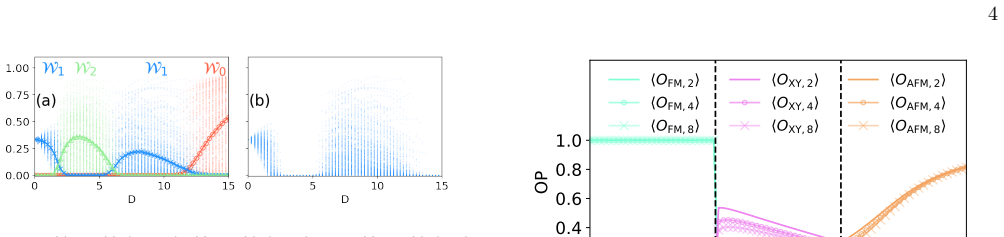
- The same order parameters provide a practical finite-size indicator for the Berezinskii-Kosterlitz-Thouless transition in the spin-1/2 XXZ chain.
Where Pith is reading between the lines
- The method may supply a route to phase classification in models where standard topological invariants are known to be incomplete.
- It could be tested on other interacting lattice models to check whether dominant-Fock-state patterns continue to resolve sub-structures missed by winding numbers or Chern numbers.
- Because the construction is local and real-space based, it may extend naturally to open or driven systems where non-local invariants become ill-defined.
Load-bearing premise
That recurring patterns among the highest-probability Fock states of the ground-state wavefunction always supply a robust, system-independent order parameter that captures the essential physics.
What would settle it
Numerical computation of the proposed order parameters on finite extended Su-Schrieffer-Heeger chains across the parameter space; if the parameters do not detect additional transitions inside the sectors already separated by the winding number, or if they lose their ability to locate the BKT transition in the XXZ model under increasing system size, the central claim would be falsified.
Figures



read the original abstract
We introduce a general scheme for constructing order parameters (OPs) by extracting generic patterns from the dominant Fock states of many-body ground states. While topological phases are traditionally characterized by non-local invariants, we demonstrate that our real-space OPs provide a more refined classification. In the extended Su-Schrieffer-Heeger model, we show that the standard winding number is insufficient to fully distinguish all phases; our OPs reveal a hidden sub-structure where each topological sector splits into two distinct phases. Beyond identifying the phase boundaries, these OPs quantify the depth of a phase, and remain robust in characterizing transitions in disordered systems. Furthermore, our approach provides a practical finite-size diagnostic for the Berezinskii-Kosterlitz-Thouless transition in the interacting spin-1/2 XXZ model. The presented framework offers a broadly applicable tool for uncovering the phase diagrams of diverse interacting and non-interacting quantum many-body systems.
Editorial analysis
A structured set of objections, weighed in public.
Referee Report
Summary. The manuscript introduces a general scheme to construct order parameters by extracting generic patterns from the dominant Fock states of many-body ground-state wavefunctions. In the extended Su-Schrieffer-Heeger model, these order parameters are shown to split each topological sector (labeled by the standard winding number) into two distinct sub-phases. The approach is further applied to disordered systems, where it remains robust, and is used as a finite-size diagnostic for the Berezinskii-Kosterlitz-Thouless transition in the interacting spin-1/2 XXZ chain.
Significance. If the sub-phases identified by the Fock-state patterns correspond to physically distinct regimes, the method would supply a practical, real-space tool for refining phase diagrams in interacting and disordered many-body systems where conventional topological invariants are insufficient. The finite-size BKT diagnostic is a concrete strength. However, the significance is limited by the absence of cross-checks against independent observables, which leaves open whether the reported sub-structure reflects new physics or merely re-labels wavefunction features within the same phase.
major comments (2)
- [§4] §4 (extended SSH model results): The central claim that each winding-number sector splits into two distinct phases rests exclusively on changes in the identity and pattern of dominant Fock components. No data are presented demonstrating that any measurable quantity—many-body gap, dimerization order parameter, entanglement spectrum, or transport—exhibits a discontinuity, singularity, or qualitative change across the proposed intra-sector boundaries. Without such evidence the sub-phases cannot be distinguished from intra-phase variations.
- [§5] §5 (XXZ model): While the order parameters are asserted to provide a practical finite-size diagnostic for the BKT transition, the manuscript does not compare their scaling or crossing points against established diagnostics such as the spin stiffness or the entanglement entropy scaling. This comparison is required to establish that the Fock-pattern diagnostic adds information beyond existing methods.
minor comments (2)
- [§2] The notation for the order parameters (e.g., how the pattern-extraction threshold is defined) should be made fully explicit in §2 so that the construction can be reproduced without reference to the specific numerical implementation.
- [Figures 3–5] Figure captions for the phase diagrams should explicitly state the system sizes used and whether the intra-sector lines remain stable under finite-size scaling.
Simulated Author's Rebuttal
We thank the referee for their careful reading of the manuscript and for the constructive feedback. We address each major comment below and indicate the revisions we will make to strengthen the presentation of our results.
read point-by-point responses
-
Referee: §4 (extended SSH model results): The central claim that each winding-number sector splits into two distinct phases rests exclusively on changes in the identity and pattern of dominant Fock components. No data are presented demonstrating that any measurable quantity—many-body gap, dimerization order parameter, entanglement spectrum, or transport—exhibits a discontinuity, singularity, or qualitative change across the proposed intra-sector boundaries. Without such evidence the sub-phases cannot be distinguished from intra-phase variations.
Authors: We agree that additional cross-checks with conventional observables would strengthen the physical interpretation of the sub-phases. The order parameters we introduce are themselves constructed from the dominant Fock-state occupations, which are directly accessible in the ground-state wave function. In the revised manuscript we will add a discussion relating the intra-sector boundaries to changes in real-space dimerization correlations and the many-body gap, demonstrating that the Fock-pattern transitions coincide with qualitative reorganizations of the wave function. This revision will clarify that the sub-structure is not merely a re-labeling but reflects distinct ordering patterns within each topological sector, while preserving the method's utility in regimes where standard invariants are insufficient. revision: partial
-
Referee: §5 (XXZ model): While the order parameters are asserted to provide a practical finite-size diagnostic for the BKT transition, the manuscript does not compare their scaling or crossing points against established diagnostics such as the spin stiffness or the entanglement entropy scaling. This comparison is required to establish that the Fock-pattern diagnostic adds information beyond existing methods.
Authors: We appreciate the suggestion to benchmark against established diagnostics. In the revised manuscript we will include a direct comparison of the finite-size scaling behavior and crossing points of our Fock-state order parameters with those obtained from the spin stiffness and the entanglement entropy scaling in the XXZ chain. This addition will show that the Fock-pattern diagnostic provides a computationally lightweight alternative that relies only on the dominant components of the ground-state wave function, offering complementary information especially useful for larger systems or when full entanglement calculations become prohibitive. revision: yes
Circularity Check
No significant circularity; OPs constructed directly from ground-state Fock patterns without reduction to fitted inputs or self-citations
full rationale
The paper's central construction extracts generic patterns from the dominant Fock states of the many-body ground-state wavefunction to define real-space order parameters. This starts from the wavefunction itself and does not presuppose the phase labels or topological invariants it is later compared against. No equations reduce the new OPs to quantities defined by the authors' prior work, and the claims about sub-structure within winding-number sectors and the BKT diagnostic follow from direct application to the extended SSH and XXZ models. The derivation remains self-contained; any self-citations in the full text are not load-bearing for the core scheme.
Axiom & Free-Parameter Ledger
axioms (1)
- domain assumption Dominant Fock states of the many-body ground state contain generic patterns sufficient to define order parameters that classify phases more finely than topological invariants.
Lean theorems connected to this paper
-
IndisputableMonolith/Cost/FunctionalEquation.leanwashburn_uniqueness_aczel unclearWe introduce a general scheme for constructing order parameters (OPs) by extracting generic patterns from the dominant Fock states of many-body ground states.
-
IndisputableMonolith/Foundation/RealityFromDistinction.leanreality_from_one_distinction unclearour OPs reveal a hidden sub-structure where each topological sector splits into two distinct phases
Reference graph
Works this paper leans on
-
[1]
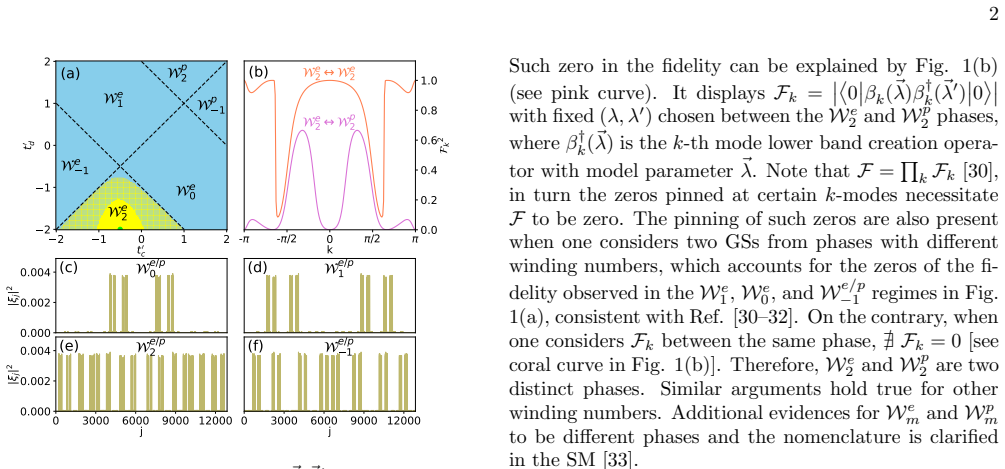
The oper- ator in Eq. (4) effectively screens out all the Fock states that have no configuration associated with thet d hop- ping. Therefore, the more number oft d hopping terms the OP includes, the more accurate it should describe the W e 2 phase. For the case ofW e 0/W e 1/W e −1, one can repeat simi- lar procedure illustrated above, and find out that t...
-
[2]
To calcu- late the many-body GS expectation values of the OPs in Eqs
is a random number sam- pled from a uniform distribution, andD m is the disorder strength for the respective type of hoppings. To calcu- late the many-body GS expectation values of the OPs in Eqs. (9-11),⟨O⟩= P i fi⟨ψi|O|ψi⟩is used, wheref i is the Fermi-Dirac distribution and|ψ i⟩is thei-th eigenstate of the single-particle Hamiltonian in Eq. (14). Figur...
work page 2020
-
[3]
S. Furukawa, G. Misguich, and M. Oshikawa, Systematic derivation of order parameters through reduced density matrices, Phys. Rev. Lett.96, 047211 (2006)
work page 2006
-
[4]
S.-A. Cheong and C. L. Henley, Correlation density ma- trix: An unbiased analysis of exact diagonalizations, Phys. Rev. B79, 212402 (2009)
work page 2009
-
[5]
C. L. Henley and H. J. Changlani, Density-matrix based numerical methods for discovering order and correlations in interacting systems, J. Stat. Mech.: Theory Exp.2014 (11), P11002
work page 2014
-
[6]
S.-J. Gu, W. C. Yu, and H.-Q. Lin, Construct order pa- rameters from the reduced density matrix spectra, Ann. Phys. (N.Y.)336, 118 (2013)
work page 2013
-
[7]
W. C. Yu, Y. C. Li, P. D. Sacramento, and H.-Q. Lin, Reduced density matrix and order parameters of a topo- logical insulator, Phys. Rev. B94, 245123 (2016)
work page 2016
-
[8]
W. C. Yu, P. D. Sacramento, Y. C. Li, D. G. Angelakis, and H.-Q. Lin, Detection of topological phases by quasilo- cal operators, Phys. Rev. B99, 115113 (2019)
work page 2019
-
[9]
I. Arraut and W. C. Yu, Order parameter conditions from mutual information and symmetry conditions, Int. J. Mod. Phys. B39, 2550083 (2025)
work page 2025
-
[10]
W. C. Yu, S.-J. Gu, and H.-Q. Lin, Density matrix spec- tra and order parameters in the 1D extended Hubbard model, Eur. Phys. J. B89, 212 (2016)
work page 2016
-
[11]
It is harder to obtain truly non-zero value in our case, since there is no symmetry breaking like the one in Lan- dau’s framework
-
[12]
See Supplemental Materials for remarks on the scheme, which includes Refs. [5, 42–55]
- [13]
-
[14]
C. Y. Wong, T. H. Hui, P. D. Sacramento, and W. C. Yu, Entanglement in quenched extended Su-Schrieffer- Heeger model with anomalous dynamical quantum phase transitions, Phys. Rev. B110, 054312 (2024)
work page 2024
-
[15]
S. Rufo, N. Lopes, M. A. Continentino, and M. A. R. Griffith, Multicritical behavior in topological phase tran- sitions, Phys. Rev. B100, 195432 (2019)
work page 2019
- [16]
-
[17]
L. Li, Z. Xu, and S. Chen, Topological phases of gen- eralized Su-Schrieffer-Heeger models, Phys. Rev. B89, 085111 (2014)
work page 2014
- [18]
- [19]
-
[20]
B. P´ erez-Gonz´ alez, M. Bello, A. G´ omez-Le´ on, and G. Platero, Interplay between long-range hopping and disorder in topological systems, Phys. Rev. B99, 035146 (2019)
work page 2019
-
[21]
E. G. Cinnirella, A. Nava, G. Campagnano, and D. Giu- liano, Fate of high winding number topological phases in the disordered extended Su-Schrieffer-Heeger model, Phys. Rev. B109, 035114 (2024)
work page 2024
-
[22]
C. Li, R. Wang, Q. Gong, and Y. Li, Manipulating wind- ing numbers and multiple topological bound states via long-range coupling in chiral photonic lattices, Phys. Rev. Res.6, 043087 (2024)
work page 2024
-
[23]
H. Liu, X. Huang, M. Yan, J. Lu, W. Deng, and Z. Liu, Acoustic topological metamaterials of large wind- ing number, Phys. Rev. Appl.19, 054028 (2023)
work page 2023
-
[24]
D. Wang, Y. Deng, J. Ji, M. Oudich, W. A. Benal- cazar, G. Ma, and Y. Jing, Realization of aZ-classified chiral-symmetric higher-order topological insulator in a coupling-inverted acoustic crystal, Phys. Rev. Lett.131, 157201 (2023)
work page 2023
-
[25]
C. Leefmans, A. Dutt, J. Williams, L. Yuan, M. Parto, F. Nori, S. Fan, and A. Marandi, Topological dissipation in a time-multiplexed photonic resonator network, Nat. Phys.18, 442 (2022)
work page 2022
- [26]
-
[27]
J. Song and E. Prodan, AIII and BDI topological systems at strong disorder, Phys. Rev. B89, 224203 (2014)
work page 2014
-
[28]
L. Lin, Y. Ke, and C. Lee, Real-space representation of the winding number for a one-dimensional chiral- symmetric topological insulator, Phys. Rev. B103, 224208 (2021)
work page 2021
-
[29]
M. Sadrzadeh, R. Jafari, and A. Langari, Dynami- cal topological quantum phase transitions at criticality, Phys. Rev. B103, 144305 (2021)
work page 2021
- [30]
-
[31]
The non-zero fidelity region shrinks as the system size increases due to Anderson orthogonality catastrophe [30, 56]. See SM for more details
-
[32]
Y. Zeng, B. Zhou, and S. Chen, Exact zeros of fidelity in finite-size systems as a signature for probing quantum phase transitions, Phys. Rev. E109, 064130 (2024)
work page 2024
-
[33]
Z. Huang and A. V. Balatsky, Dynamical quantum phase transitions: Role of topological nodes in wave function overlaps, Phys. Rev. Lett.117, 086802 (2016)
work page 2016
-
[34]
P. D. Sacramento, B. Mera, and N. Paunkovi´ c, Vanish- ing k-space fidelity and phase diagram’s bulk–edge–bulk correspondence, Ann. Phys. (N.Y.)401, 40 (2019)
work page 2019
-
[35]
See Supplemental Materials for (1) additional evidences for insufficiency of the winding number, and (2) nomen- clature of theW e m andW p m phase, which includes Refs. [57–60]
-
[36]
See Supplemental Materials for examples of dominant Fock states of theW p/e 2 phase in the ESSH Model
-
[37]
See Supplemental Materials for derivation of the ground state expectation value of the non-interacting ESSH model, which includes Ref. [61]
-
[38]
See Supplemental Materials for generalization of the non- interacting SSH model result
-
[39]
H.-C. Hsu and T.-W. Chen, Topological Anderson in- sulating phases in the long-range Su-Schrieffer-Heeger model, Phys. Rev. B102, 205425 (2020)
work page 2020
-
[40]
I. Mondragon-Shem, T. L. Hughes, J. Song, and E. Pro- dan, Topological criticality in the chiral-symmetric AIII class at strong disorder, Phys. Rev. Lett.113, 046802 (2014)
work page 2014
-
[41]
L. Justino and T. R. de Oliveira, Bell inequalities and entanglement at quantum phase transitions in theXXZ model, Phys. Rev. A85, 052128 (2012)
work page 2012
-
[42]
H. Cheraghi, M. J. Tafreshi, and S. Mahdavifar, String orders in the Luttinger liquid phase of one-dimensional spin-1/2 systems, Phys. A Stat. Mech. Appl.516, 212 (2019)
work page 2019
-
[43]
See Supplemental Materials for domiant Fock states and the choice of OPs in the XXZ model
-
[44]
A. Osterloh, L. Amico, G. Falci, and R. Fazio, Scaling of entanglement close to a quantum phase transition, Na- ture416, 608 (2002)
work page 2002
-
[45]
T. J. Osborne and M. A. Nielsen, Entanglement in a sim- ple quantum phase transition, Phys. Rev. A66, 032110 (2002)
work page 2002
- [46]
-
[47]
Y.-C. Li, W. C. Yu, and H.-Q. Lin, Detecting quantum phase transitions in spin chains, inEntanglement in Spin Chains: From Theory to Quantum Technology Applica- tions, edited by A. Bayat, S. Bose, and H. Johannesson (Springer International Publishing, Cham, 2022) pp. 13– 40
work page 2022
-
[48]
Gu, Fidelity approach to quantum phase transi- tions, Int
S.-J. Gu, Fidelity approach to quantum phase transi- tions, Int. J. Mod. Phys. B24, 4371 (2010)
work page 2010
-
[49]
P. Zanardi and N. Paunkovi´ c, Ground state overlap and quantum phase transitions, Phys. Rev. E74, 031123 (2006)
work page 2006
-
[50]
H. T. Quan, Z. Song, X. F. Liu, P. Zanardi, and C. P. Sun, Decay of Loschmidt echo enhanced by quantum crit- icality, Phys. Rev. Lett.96, 140604 (2006)
work page 2006
- [51]
-
[52]
H.-K. Tang, M. A. Marashli, and W. C. Yu, Unveiling quantum phase transitions by fidelity mapping, Phys. Rev. B104, 075142 (2021)
work page 2021
-
[53]
W. C. Yu, C. Cheng, and P. D. Sacramento, Energy bonds as correlators for long-range symmetry-protected topological models and models with long-range topolog- ical order, Phys. Rev. B101, 245131 (2020)
work page 2020
-
[54]
Y.-F. Yang, J. Chen, C. Cheng, and H.-G. Luo, Enhanced superconductivity and various edge modes in modulated t−Jchains, Phys. Rev. B105, 165123 (2022)
work page 2022
- [55]
-
[56]
R. Mondaini, S. Tarat, and R. T. Scalettar, Quantum critical points and the sign problem, Science375, 418 (2022). 7
work page 2022
- [57]
-
[58]
P. W. Anderson, Infrared catastrophe in Fermi gases with local scattering potentials, Phys. Rev. Lett.18, 1049 (1967)
work page 1967
-
[59]
G. E. Volovik, Exotic Lifshitz transitions in topological materials, Phys. Usp.61, 89 (2018)
work page 2018
-
[60]
W. Wu, M. S. Scheurer, S. Chatterjee, S. Sachdev, A. Georges, and M. Ferrero, Pseudogap and Fermi- surface topology in the two-dimensional Hubbard model, Phys. Rev. X8, 021048 (2018)
work page 2018
-
[61]
K.-S. Chen, Z. Y. Meng, T. Pruschke, J. Moreno, and M. Jarrell, Lifshitz transition in the two-dimensional Hubbard model, Phys. Rev. B86, 165136 (2012)
work page 2012
- [62]
-
[63]
Beyond Topological Invariants: Order Parameters from Dominant Fock-state Patterns
K. Sch¨ onhammer, Deviations from Wick’s theorem in the canonical ensemble, Phys. Rev. A96, 012102 (2017). 8 Supplemental Material for “Beyond Topological Invariants: Order Parameters from Dominant Fock-state Patterns” Remarks on the scheme Tools for determining critical points.—If the phase boundary is unknown, various techniques can be used to estimate ...
work page 2017
-
[64]
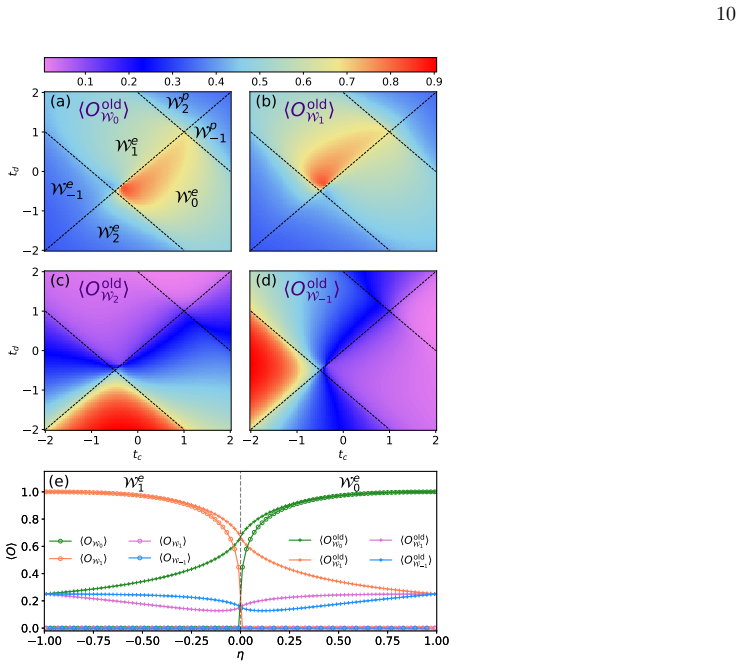
also has a counterpart phase, namelyW p 1 (W p 0 ) [see the rightmost plot in Fig. 5(b)]. Evidence 3: Opposite behavior of physical quantities betweenW e m andW p m phases.—In addition, theW p m and W e m phases exhibit distinct behavior in real-space, reinforcing the necessity for classifying them as different phases. Consider the OPs found in previous w...
-
[65]
Similarly,⟨O W2 ⟩and⟨O W−1 ⟩are always zero in the whole region
phase. Similarly,⟨O W2 ⟩and⟨O W−1 ⟩are always zero in the whole region. Furthermore, when one enters theW e 1 (W e
-
[66]
e” carries the meaning of electron- like, while “p
phase fromW e 0 (W e 1),⟨O W0 ⟩(⟨O W1 ⟩) drops from a finite value to zero abruptly. Such a sharp change not only appears in this original SSH model, but also in the extended SSH model. It also holds true for the generalized version of the SSH model, where an arbitrary number of further neighbor hoppings and winding numbers are present (Fig. 7). Nomenclat...
discussion (0)
Sign in with ORCID, Apple, or X to comment. Anyone can read and Pith papers without signing in.