Recognition: 2 theorem links
· Lean TheoremLearning-Based Spectrum Cartography in Low Earth Orbit Satellite Networks: An Overview
Pith reviewed 2026-05-12 04:49 UTC · model grok-4.3
The pith
Attention mechanisms enable adaptive fusion of heterogeneous LEO measurements for spectrum cartography tasks including localization and resource allocation.
A machine-rendered reading of the paper's core claim, the machinery that carries it, and where it could break.
Core claim
Attention-based learning serves as a principled operator for adaptive and reliability-aware fusion of measurements in LEO satellite networks, enabling effective spectrum cartography that encompasses localization, radio map reconstruction, and resource allocation under dynamic orbital conditions where conventional approaches fall short.
What carries the argument
Attention mechanisms as the operator that adaptively fuses heterogeneous measurements by weighting them according to reliability and context for both spatial inference and decision-making.
If this is right
- Spectrum cartography tasks in LEO can shift from fixed physical models to measurement-driven inference that adapts to real-time data quality.
- Resource allocation decisions become map-informed and more robust by incorporating attention-weighted reconstructions directly.
- A single framework handles localization, mapping, and allocation through the same fusion operator instead of separate pipelines.
- Simulations demonstrate improved handling of sparse observations without requiring complete orbital geometry knowledge upfront.
Where Pith is reading between the lines
- The same attention fusion approach may generalize to multi-orbit satellite systems where measurement reliability patterns differ across layers.
- Real deployments could test whether the unified framework reduces the need for separate calibration steps in changing propagation environments.
- Extensions might explore combining attention outputs with predictive models to anticipate coverage gaps before they occur.
Load-bearing premise
The highly dynamic orbital geometry, complex propagation, and reliability variations in LEO measurements create challenges that traditional methods cannot handle well, while attention-based learning can provide effective solutions as shown in the reviewed work.
What would settle it
A controlled simulation or field test of LEO localization and radio mapping where attention-based fusion yields no accuracy or reliability gains over standard interpolation under high orbital dynamics and heterogeneous noise.
Figures






read the original abstract
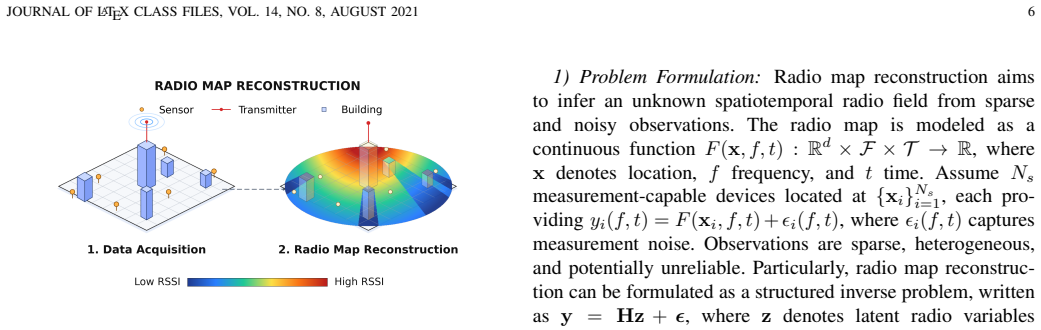
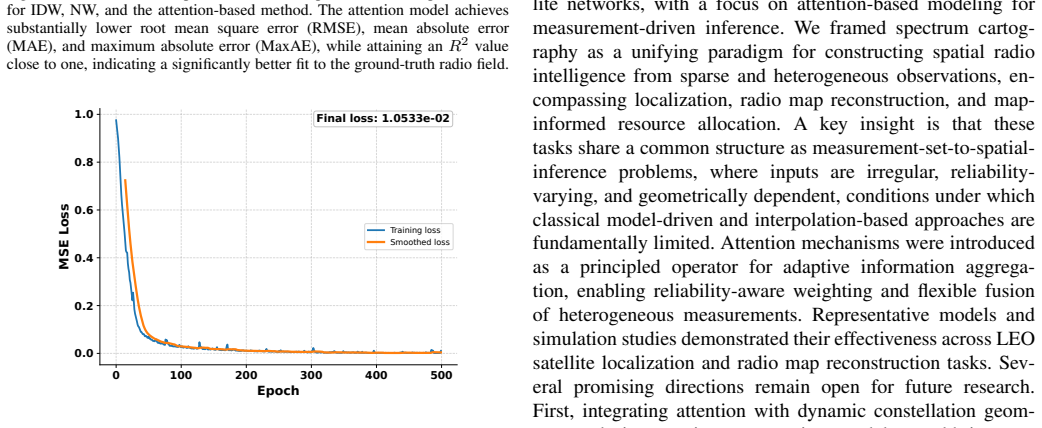
Low earth orbit (LEO) satellite networks are emerging as a key infrastructure for global connectivity and space-based sensing. Many tasks in such systems can be formulated as measurement-set-to-spatial-inference problems, where spatial variables are inferred from sparse and heterogeneous wireless observations. Spectrum cartography provides a unifying framework for this paradigm, encompassing representative tasks such as satellite-assisted localization and radio map reconstruction, as well as map-informed resource allocation. Yet the highly dynamic orbital geometry, complex propagation conditions, and reliability-varying nature of LEO measurements pose fundamental challenges for traditional model-driven and interpolation-based methods. This article surveys the literature from 1964 to 2026 on learning-based spectrum cartography as applied to LEO satellite networks, with a particular focus on attention mechanisms as a principled operator for adaptive and reliability-aware measurement fusion across localization, radio map reconstruction, and resource allocation tasks. We review modeling foundations and key challenges of representative tasks, and analyze how attention-based learning enables flexible fusion of heterogeneous measurements for both inference and map-informed decision-making. Representative formulations and simulation studies are provided to illustrate the framework and demonstrate its effectiveness, offering a unified perspective for measurement-driven inference and decision-making in LEO satellite networks.
Editorial analysis
A structured set of objections, weighed in public.
Referee Report
Summary. The manuscript is an overview surveying learning-based spectrum cartography in LEO satellite networks. It frames tasks such as satellite-assisted localization, radio map reconstruction, and map-informed resource allocation as measurement-set-to-spatial-inference problems. The paper identifies challenges from dynamic orbital geometry, complex propagation, and reliability-varying measurements that affect traditional model-driven and interpolation methods. It positions attention mechanisms as a principled operator for adaptive, reliability-aware fusion of heterogeneous measurements, reviews modeling foundations and literature from 1964 to 2026, analyzes attention-based learning for inference and decision-making, and includes representative formulations plus simulation studies to illustrate the framework and its effectiveness.
Significance. If the synthesis and illustrations hold, this provides a unified perspective that could help organize research on measurement-driven tasks in emerging LEO infrastructure for global connectivity and space-based sensing. Highlighting attention for flexible fusion across localization, mapping, and allocation tasks may guide integration of learning methods with domain-specific challenges, especially where measurements are sparse and heterogeneous.
minor comments (3)
- [Abstract] Abstract: the claimed literature coverage 'from 1964 to 2026' includes a future date; clarify the actual temporal scope and cutoff used for the survey.
- [Simulation studies section] The effectiveness of attention-based fusion is illustrated via representative formulations and simulation studies, but the manuscript should explicitly state the baselines, quantitative metrics (e.g., error bars, R² values), and comparison conditions used in those studies to allow readers to assess the claimed advantages over traditional methods.
- [Literature review] Ensure that all cited works in the survey are consistently referenced with full bibliographic details and that any self-referential claims about the framework are clearly distinguished from the reviewed external literature.
Simulated Author's Rebuttal
We thank the referee for the positive and accurate summary of our manuscript, as well as for the recommendation of minor revision. We are pleased that the unified perspective on attention-based learning for spectrum cartography in LEO satellite networks is recognized as potentially valuable for organizing research in this emerging area. No specific major comments were provided in the report.
Circularity Check
No significant circularity in survey/overview paper
full rationale
This paper is explicitly an overview and survey of existing literature on learning-based spectrum cartography for LEO satellite networks, spanning 1964-2026. It synthesizes prior work on tasks like localization, radio map reconstruction, and resource allocation, highlighting attention mechanisms as a flexible fusion operator based on reviewed studies and illustrative simulations. No new derivations, equations, or predictions are introduced that reduce to the paper's own fitted inputs, self-definitions, or self-citation chains. The central positioning rests on external literature rather than internal construction, making the derivation chain self-contained against external benchmarks with no load-bearing circular steps.
Axiom & Free-Parameter Ledger
Lean theorems connected to this paper
-
IndisputableMonolith/Cost/FunctionalEquation.leanwashburn_uniqueness_aczel unclearattention mechanisms as a principled operator for adaptive and reliability-aware measurement fusion across localization, radio map reconstruction, and resource allocation tasks
-
IndisputableMonolith/Foundation/RealityFromDistinction.leanreality_from_one_distinction unclearNadaraya-Watson estimator ... attention can be viewed as a data-dependent weighted aggregation operator
Reference graph
Works this paper leans on
-
[1]
X. Luo, H.-H. Chen, and Q. Guo, “LEO/VLEO satellite communi- cations in 6G and beyond networks–technologies, applications, and challenges,”IEEE Network, vol. 38, no. 5, pp. 273–285, 2024
work page 2024
-
[2]
G. Chander and S. Singh. Powering AI-native 6G research with the NVIDIA Sionna research kit. NVIDIA. [Online]. Available: https://developer.nvidia.com/blog/ powering-ai-native-6g-research-with-the-nvidia-sionna-research-kit/
-
[3]
S. Zhang, M. Feizarefi, and A. Mirzaei, “AI-native integrated sensing and communications for self-organizing wireless networks: Architec- tures, learning paradigms, and system-level design,”arXiv preprint arXiv:2601.02398, 2025
-
[4]
Fundamen- tals of LEO-based localization,
D.-R. Emenonye, H. S. Dhillon, and R. Michael Buehrer, “Fundamen- tals of LEO-based localization,”IEEE Transactions on Information Theory, vol. 71, no. 7, pp. 5277–5311, 2025
work page 2025
-
[5]
A survey on nongeostationary satellite systems: The communication perspective,
H. Al-Hraishawi, H. Chougrani, S. Kisseleff, E. Lagunas, and S. Chatzinotas, “A survey on nongeostationary satellite systems: The communication perspective,”IEEE Communications Surveys & Tuto- rials, vol. 25, no. 1, pp. 101–132, 2022
work page 2022
-
[6]
The low earth orbit satellite population and impacts of the SpaceX Starlink constellation,
J. C. McDowell, “The low earth orbit satellite population and impacts of the SpaceX Starlink constellation,”The Astrophysical Journal Let- ters, vol. 892, no. 2, p. L36, 2020
work page 2020
-
[7]
Future space networks: Toward the next giant leap for humankind,
M. Y . Abdelsadek, A. U. Chaudhry, T. Darwish, E. Erdogan, G. Karabulut-Kurt, P. G. Madoery, O. B. Yahia, and H. Yanikomeroglu, “Future space networks: Toward the next giant leap for humankind,” IEEE Transactions on Communications, vol. 71, no. 2, pp. 949–1007, 2023
work page 2023
-
[8]
M. Hui, S. Zhai, D. Wang, T. Hui, W. Wang, P. Du, and F. Gong, “A review of LEO satellite communication payloads for integrated com- munication, navigation, and remote sensing: Opportunities, challenges, future directions,”IEEE Internet of Things Journal, 2025
work page 2025
-
[9]
D. Shahaf, C. Guestrin, E. Horvitz, and J. Leskovec, “Information cartography,”Communications of the ACM, vol. 58, no. 11, pp. 62– 73, 2015
work page 2015
-
[10]
Spectrum shortage for radio sensing? leveraging ambient 5G signals for human activity detection,
K. Song, M. Zingraff, and H. Zeng, “Spectrum shortage for radio sensing? leveraging ambient 5G signals for human activity detection,” inIEEE INFOCOM 2026-IEEE Conference on Computer Communi- cations. IEEE, 2026, pp. 1–10
work page 2026
-
[11]
Practical downlink communication for backscatter tags with commodity radios,
Z. Xu, J. Li, and W. Gong, “Practical downlink communication for backscatter tags with commodity radios,” inIEEE INFOCOM 2026- IEEE Conference on Computer Communications. IEEE, 2026, pp. 1–10
work page 2026
-
[12]
UA V-aided radio map construction exploiting environment semantics,
W. Liu and J. Chen, “UA V-aided radio map construction exploiting environment semantics,”IEEE Transactions on Wireless Communica- tions, vol. 22, no. 9, pp. 6341–6355, 2023
work page 2023
-
[13]
Radio map estimation in the real-world: Empirical validation and analysis,
R. Shrestha, T. N. Ha, P. Q. Viet, and D. Romero, “Radio map estimation in the real-world: Empirical validation and analysis,” in 2023 IEEE Conference on Antenna Measurements and Applications (CAMA). IEEE, 2023, pp. 169–174
work page 2023
-
[14]
Doppler positioning of LEO satellites based on orbit error compensation and weighting,
D. Wang, H. Qin, and Z. Huang, “Doppler positioning of LEO satellites based on orbit error compensation and weighting,”IEEE Transactions on Instrumentation and Measurement, vol. 72, pp. 1–11, 2023
work page 2023
-
[15]
Revisiting Doppler positioning perfor- mance with LEO satellites,
C. Shi, Y . Zhang, and Z. Li, “Revisiting Doppler positioning perfor- mance with LEO satellites,”GPS Solutions, vol. 27, no. 3, p. 126, 2023
work page 2023
-
[16]
Toward massive satellite signals of opportunity positioning: Challenges, methods, and experiments,
G. Fan, X. Chen, Z. Chen, R. Zhang, P. Wu, Q. Wei, W. Xu, J. Dai, and L. Cao, “Toward massive satellite signals of opportunity positioning: Challenges, methods, and experiments,”Space: Science & Technology, vol. 4, p. 0191, 2024
work page 2024
-
[17]
F. S. Prol, R. M. Ferre, Z. Saleem, P. Välisuo, C. Pinell, E. S. Lohan, M. Elsanhoury, M. Elmusrati, S. Islam, K. Çelikbilek, K. Selvan, J. Yliaho, K. Rutledge, A. Ojala, L. Ferranti, J. Praks, M. Z. H. Bhuiyan, S. Kaasalainen, and H. Kuusniemi, “Position, navigation, and timing (PNT) through low earth orbit (LEO) satellites: A survey on current status, c...
work page 2022
-
[18]
Survey on opportunistic PNT with signals from LEO communication satellites,
W. Stock, R. T. Schwarz, C. A. Hofmann, and A. Knopp, “Survey on opportunistic PNT with signals from LEO communication satellites,” IEEE Communications Surveys & Tutorials, vol. 27, no. 1, pp. 77–107, 2025
work page 2025
-
[19]
A. H. Sayed, A. Tarighat, and N. Khajehnouri, “Network-based wire- less location: Challenges faced in developing techniques for accurate wireless location information,”IEEE Signal Processing Magazine, vol. 22, no. 4, pp. 24–40, 2005
work page 2005
-
[20]
Survey of cellular mobile radio localization methods: From 1G to 5G,
J. A. del Peral-Rosado, R. Raulefs, J. A. López-Salcedo, and G. Seco- Granados, “Survey of cellular mobile radio localization methods: From 1G to 5G,”IEEE Communications Surveys & Tutorials, vol. 20, no. 2, pp. 1124–1148, 2017
work page 2017
-
[21]
Passive inter-satellite localization accuracy optimization in low earth orbit satellite networks,
Y . Zhu, M. Chen, S. Wang, Y . Hu, Y . Liu, C. Yin, and T. Q. Quek, “Passive inter-satellite localization accuracy optimization in low earth orbit satellite networks,”IEEE Transactions on Wireless Communications, 2025
work page 2025
-
[22]
Data-driven radio environment map es- timation using graph neural networks,
A. Shibli and T. Zanouda, “Data-driven radio environment map es- timation using graph neural networks,” in2024 IEEE International Conference on Communications Workshops (ICC Workshops). IEEE, 2024, pp. 650–655
work page 2024
-
[23]
Practical radio environment mapping with geostatistics,
C. Phillips, M. Ton, D. Sicker, and D. Grunwald, “Practical radio environment mapping with geostatistics,” in2012 IEEE International Symposium on Dynamic Spectrum Access Networks. IEEE, 2012, pp. 422–433
work page 2012
-
[24]
Radio environment maps: The survey of construction methods,
M. Pesko, T. Javornik, A. Kosir, M. Stular, and M. Mohorcic, “Radio environment maps: The survey of construction methods,”KSII Trans- actions on Internet and Information Systems, vol. 8, no. 11, pp. 3789– 3809, 2014
work page 2014
-
[25]
E. D. Kaplan and C. Hegarty,Understanding GPS/GNSS: Principles and applications. Artech House, 2017
work page 2017
-
[26]
R. B. Langleyet al., “Dilution of precision,”GPS World, vol. 10, no. 5, pp. 52–59, 1999
work page 1999
-
[27]
arXiv preprint arXiv:1511.08458 (2015)
K. O’shea and R. Nash, “An introduction to convolutional neural networks,”arXiv preprint arXiv:1511.08458, 2015
-
[28]
The graph neural network model,
F. Scarselli, M. Gori, A. C. Tsoi, M. Hagenbuchner, and G. Monfardini, “The graph neural network model,”IEEE Transactions on Neural Networks, vol. 20, no. 1, pp. 61–80, 2009
work page 2009
-
[29]
Neural machine translation by jointly learning to align and translate,
D. Bahdanau, “Neural machine translation by jointly learning to align and translate,”International Conference on Learning Representations, 2015
work page 2015
-
[30]
Learning Phrase Representations using RNN Encoder-Decoder for Statistical Machine Translation
K. Cho, B. Van Merriënboer, C. Gulcehre, D. Bahdanau, F. Bougares, H. Schwenk, and Y . Bengio, “Learning phrase representations us- ing RNN encoder-decoder for statistical machine translation,”arXiv preprint arXiv:1406.1078, 2014
work page internal anchor Pith review arXiv 2014
-
[31]
A. Vaswani, N. Shazeer, N. Parmar, J. Uszkoreit, L. Jones, A. N. Gomez, Ł. Kaiser, and I. Polosukhin, “Attention is all you need,” Advances in Neural Information Processing Systems, vol. 30, 2017
work page 2017
-
[32]
E. A. Nadaraya, “On estimating regression,”Theory of Probability & Its Applications, vol. 9, no. 1, pp. 141–142, 1964
work page 1964
-
[33]
G. S. Watson, “Smooth regression analysis,”Sankhy ¯a: The Indian Journal of Statistics, Series A, pp. 359–372, 1964
work page 1964
-
[34]
M. Zaheer, S. Kottur, S. Ravanbakhsh, B. Poczos, R. R. Salakhutdi- nov, and A. J. Smola, “Deep sets,”Advances in Neural Information Processing Systems, vol. 30, 2017
work page 2017
-
[35]
Set transformer: A framework for attention-based permutation-invariant neural networks,
J. Lee, Y . Lee, J. Kim, A. Kosiorek, S. Choi, and Y . W. Teh, “Set transformer: A framework for attention-based permutation-invariant neural networks,” inInternational Conference on Machine Learning. PMLR, 2019, pp. 3744–3753
work page 2019
-
[36]
Attention mechanisms in computer vision: A survey,
M.-H. Guo, T.-X. Xu, J.-J. Liu, Z.-N. Liu, P.-T. Jiang, T.-J. Mu, S.- H. Zhang, R. R. Martin, M.-M. Cheng, and S.-M. Hu, “Attention mechanisms in computer vision: A survey,”Computational Visual Media, vol. 8, no. 3, pp. 331–368, 2022
work page 2022
-
[37]
Spatial transformers for radio map estima- tion,
P. Q. Viet and D. Romero, “Spatial transformers for radio map estima- tion,” inICC 2025-IEEE International Conference on Communications. IEEE, 2025, pp. 6155–6160
work page 2025
-
[38]
Accelerating Regularized Attention Kernel Regression for Spectrum Cartography
L. Tao and C. W. Tan, “Accelerating regularized attention kernel regression for spectrum cartography,”arXiv preprint arXiv:2604.25138, 2026
work page internal anchor Pith review Pith/arXiv arXiv 2026
-
[39]
X. Chen, J. Wang, and Q. Huang, “Dynamic spectrum cartography: Reconstructing spatial-spectral-temporal radio frequency map via ten- sor completion,”IEEE Transactions on Signal Processing, vol. 73, pp. 1184–1199, 2025
work page 2025
-
[40]
Deep spectrum cartography: Completing radio map tensors using learned neural models,
S. Shrestha, X. Fu, and M. Hong, “Deep spectrum cartography: Completing radio map tensors using learned neural models,”IEEE Transactions on Signal Processing, vol. 70, pp. 1170–1184, 2022
work page 2022
-
[41]
Kriging: A method of interpolation for geographical information systems,
M. A. Oliver and R. Webster, “Kriging: A method of interpolation for geographical information systems,”International Journal of Geograph- ical Information System, vol. 4, no. 3, pp. 313–332, 1990
work page 1990
-
[42]
Domain-factored un- trained deep prior for spectrum cartography,
S. Timilsina, S. Shrestha, L. Cheng, and X. Fu, “Domain-factored un- trained deep prior for spectrum cartography,”IEEE Signal Processing Letters, vol. 32, pp. 3440–3444, 2025
work page 2025
-
[43]
Radio map prediction from noisy environment information and sparse observations,
F. Jaensch, Ç. Yapar, G. Caire, and B. Demir, “Radio map prediction from noisy environment information and sparse observations,”arXiv preprint arXiv:2602.11950, 2026. JOURNAL OF LATEX CLASS FILES, VOL. 14, NO. 8, AUGUST 2021 27
-
[44]
Radio map estimation: A data-driven approach to spectrum cartography,
D. Romero and S.-J. Kim, “Radio map estimation: A data-driven approach to spectrum cartography,”IEEE Signal Processing Magazine, vol. 39, no. 6, pp. 53–72, 2022
work page 2022
-
[45]
Spectrum cartography techniques, challenges, opportunities, and ap- plications: A survey,
Y . S. Reddy, A. Kumar, O. J. Pandey, and L. R. Cenkeramaddi, “Spectrum cartography techniques, challenges, opportunities, and ap- plications: A survey,”Pervasive and Mobile Computing, vol. 79, p. 101511, 2022
work page 2022
-
[46]
RadioUNet: Fast radio map estimation with convolutional neural networks,
R. Levie, Ç. Yapar, G. Kutyniok, and G. Caire, “RadioUNet: Fast radio map estimation with convolutional neural networks,”IEEE Transac- tions on Wireless Communications, vol. 20, no. 6, pp. 4001–4015, 2021
work page 2021
-
[47]
Spectrum surveying: Ac- tive radio map estimation with autonomous UA Vs,
R. Shrestha, D. Romero, and S. P. Chepuri, “Spectrum surveying: Ac- tive radio map estimation with autonomous UA Vs,”IEEE Transactions on Wireless Communications, vol. 22, no. 1, pp. 627–641, 2022
work page 2022
-
[48]
Stochastic semiparametric regression for spectrum cartography,
D. Romero, S.-J. Kim, and G. B. Giannakis, “Stochastic semiparametric regression for spectrum cartography,” in2015 IEEE 6th International Workshop on Computational Advances in Multi-Sensor Adaptive Pro- cessing (CAMSAP). IEEE, 2015, pp. 513–516
work page 2015
-
[49]
Spectrum cartography using adaptive radial basis functions: Experimental validation,
H. Ids, M. Hamid, T. Jordbru, L. R. Cenkeramaddi, B. Beferull-Lozano et al., “Spectrum cartography using adaptive radial basis functions: Experimental validation,” in2017 IEEE 18th International Workshop on Signal Processing Advances in Wireless Communications (SPAWC). IEEE, 2017, pp. 1–4
work page 2017
-
[50]
Location-free spectrum cartography,
Y . Teganya, D. Romero, L. M. L. Ramos, and B. Beferull-Lozano, “Location-free spectrum cartography,”IEEE Transactions on Signal Processing, vol. 67, no. 15, pp. 4013–4026, 2019
work page 2019
-
[51]
Radio map prediction from aerial images and application to coverage optimization,
F. Jaensch, G. Caire, and B. Demir, “Radio map prediction from aerial images and application to coverage optimization,”IEEE Transactions on Wireless Communications, vol. 25, pp. 308–320, 2026
work page 2026
-
[52]
B. Schölkopf and A. J. Smola,Learning with kernels: Support vector machines, regularization, optimization, and beyond. MIT Press, 2002
work page 2002
-
[53]
Informed spectrum usage in cognitive radio networks: Interference cartography,
A. B. H. Alaya-Feki, S. B. Jemaa, B. Sayrac, P. Houze, and E. Moulines, “Informed spectrum usage in cognitive radio networks: Interference cartography,” in2008 IEEE 19th International Symposium on Personal, Indoor and Mobile Radio Communications, 2008, pp. 1–5
work page 2008
-
[54]
Interference cartography for hierarchical dynamic spectrum access,
A. Ben Hadj Alaya-Feki, B. Sayrac, S. Ben Jemaa, and E. Moulines, “Interference cartography for hierarchical dynamic spectrum access,” in2008 3rd IEEE Symposium on New Frontiers in Dynamic Spectrum Access Networks, 2008, pp. 1–5
work page 2008
-
[55]
An efficient radio map learning scheme based on kernel density function,
Z. Xu, B. Huang, and B. Jia, “An efficient radio map learning scheme based on kernel density function,”IEEE Transactions on Vehicular Technology, vol. 70, no. 12, pp. 13 315–13 324, 2021
work page 2021
-
[56]
The sampling-assisted pathloss radio map prediction competition,
Ç. Yapar, S. Bakirtzis, A. Lutu, I. Wassell, J. Zhang, and G. Caire, “The sampling-assisted pathloss radio map prediction competition,” in2025 IEEE 35th International Workshop on Machine Learning for Signal Processing (MLSP). IEEE, 2025, pp. 1–6
work page 2025
-
[57]
Z. Li, H. Wang, Z. Shen, S. Zhang, H. Jiang, and Z. Liu, “A secure wireless transmission scheme: Reconstructing spatial radio environ- ment map and redirecting electromagnetic signal propagation path,” IEEE Open Journal of the Communications Society, 2025
work page 2025
-
[58]
A Gaussian splatting approach to continuous radio map construction,
A. Chen, S. Mao, Z. Li, H. Zhang, D. Niyato, and Z. Han, “A Gaussian splatting approach to continuous radio map construction,” inIEEE INFOCOM 2025-IEEE Conference on Computer Communi- cations Workshops (INFOCOM WKSHPS). IEEE, 2025, pp. 1–6
work page 2025
-
[59]
Engineering radio maps for wireless resource management,
S. Bi, J. Lyu, Z. Ding, and R. Zhang, “Engineering radio maps for wireless resource management,”IEEE Wireless Communications, vol. 26, no. 2, pp. 133–141, 2019
work page 2019
-
[60]
Advances in machine learning-driven cognitive radio for wireless networks: A survey,
N. A. Khalek, D. H. Tashman, and W. Hamouda, “Advances in machine learning-driven cognitive radio for wireless networks: A survey,”IEEE Communications Surveys & Tutorials, vol. 26, no. 2, pp. 1201–1237, 2023
work page 2023
-
[61]
Radio environment map construction: A mini-review,
O. E. Dare, K. Okokpujie, and E. Adetiba, “Radio environment map construction: A mini-review,” in2023 2nd International Conference on Multidisciplinary Engineering and Applied Science (ICMEAS), vol. 1. IEEE, 2023, pp. 1–7
work page 2023
-
[62]
J. Wang, Q. Zhu, Z. Lin, J. Chen, G. Ding, Q. Wu, G. Gu, and Q. Gao, “Sparse Bayesian learning-based hierarchical construction for 3D radio environment maps incorporating channel shadowing,”IEEE Transactions on Wireless Communications, vol. 23, no. 10, pp. 14 560– 14 574, 2024
work page 2024
-
[63]
A two-dimensional interpolation function for irregularly- spaced data,
D. Shepard, “A two-dimensional interpolation function for irregularly- spaced data,” inProceedings of the 1968 23rd ACM National Confer- ence, 1968, pp. 517–524
work page 1968
-
[64]
Fix,Discriminatory analysis: Nonparametric discrimination, consis- tency properties
E. Fix,Discriminatory analysis: Nonparametric discrimination, consis- tency properties. USAF School of Aviation Medicine, 1985, vol. 1
work page 1985
-
[65]
C. De Boor and C. De Boor,A practical guide to splines. Springer New York, 1978, vol. 27
work page 1978
-
[66]
A brief description of natural neighbour interpolation,
R. Sibson, “A brief description of natural neighbour interpolation,” Interpreting Multivariate Data, pp. 21–36, 1981
work page 1981
-
[67]
Neural network parameterized Bayesian nonstationary radio map estimation with uncertain location,
H. Liu, L. Ziao, Z. Zhang, and K. Chen, “Neural network parameterized Bayesian nonstationary radio map estimation with uncertain location,” inIEEE INFOCOM 2026-IEEE Conference on Computer Communi- cations. IEEE, 2026, pp. 1–10
work page 2026
-
[68]
A dif- fusion framework for accurate fine-grained radio map reconstruction,
Z. Ye, F. Wu, C. Zhang, Y . Shao, W. Fan, B. Tang, and Y . Liu, “A dif- fusion framework for accurate fine-grained radio map reconstruction,” inIEEE Global Communications Conference (GLOBECOM). IEEE, 2025, pp. 1–6
work page 2025
-
[69]
Self-supervised learning informed radio environment map estimation with few sam- ples,
M. Jianping, Z. Zhang, J. Chen, K. Chen, and S. Cui, “Self-supervised learning informed radio environment map estimation with few sam- ples,” inIEEE Global Communications Conference (GLOBECOM). IEEE, 2025, pp. 1–6
work page 2025
-
[70]
Radio- V AE: Generating probabilistic radio map via variational autoencoder with UNet,
P. Yang, N. Zhang, Z. Zhang, J. Chen, K. Chen, and S. Cui, “Radio- V AE: Generating probabilistic radio map via variational autoencoder with UNet,” inIEEE Global Communications Conference (GLOBE- COM). IEEE, 2025, pp. 1–6
work page 2025
-
[71]
H. Liu, K. Chen, Z. Zhang, L. Wang, and S. Cui, “Land feature aware radio environment map construction using radio oriented heterogeneous multitask Gaussian process,” inIEEE Global Communications Confer- ence (GLOBECOM). IEEE, 2025, pp. 1–6
work page 2025
-
[72]
UrbanMIMOMap: A ray-traced MIMO CSI dataset with precoding-aware maps and bench- marks,
H. Jia, X. Wang, N. Cheng, R. Sun, and C. Li, “UrbanMIMOMap: A ray-traced MIMO CSI dataset with precoding-aware maps and bench- marks,” inIEEE Global Communications Conference (GLOBECOM). IEEE, 2025, pp. 1–6
work page 2025
-
[73]
OpenPathNet: An open-source RF multipath data generator for AI-driven wireless systems,
L. Liu, X. Chen, and W. Zhang, “OpenPathNet: An open-source RF multipath data generator for AI-driven wireless systems,”arXiv preprint arXiv:2512.17286, 2025
-
[74]
J. G. Walker, “Satellite constellations,”Journal of the British Inter- planetary Society, vol. 37, p. 559, Dec. 1984
work page 1984
-
[75]
Delay is not an option: Low latency routing in space,
M. Handley, “Delay is not an option: Low latency routing in space,” inProceedings of the 17th ACM Workshop on Hot Topics in Networks, 2018, pp. 85–91
work page 2018
-
[76]
B. Hofmann-Wellenhof, H. Lichtenegger, and J. Collins,Global posi- tioning system: Theory and practice. Springer Science & Business Media, 2012
work page 2012
-
[77]
An algebraic solution of the GPS equations,
S. Bancroft, “An algebraic solution of the GPS equations,”IEEE Transactions on Aerospace and Electronic Systems, no. 1, pp. 56–59, 2007
work page 2007
-
[78]
The global positioning system: Signals, measurements, and performance,
P. K. Enge, “The global positioning system: Signals, measurements, and performance,”International Journal of Wireless Information Networks, vol. 1, no. 2, pp. 83–105, 1994
work page 1994
-
[79]
A satellite Doppler navigation system,
W. Guier and G. Weiffenbach, “A satellite Doppler navigation system,” Proceedings of the IRE, vol. 48, no. 4, pp. 507–516, 2007
work page 2007
-
[80]
Statistical theory of passive location systems,
D. J. Torrieri, “Statistical theory of passive location systems,”IEEE Transactions on Aerospace and Electronic Systems, no. 2, pp. 183– 198, 2007
work page 2007
discussion (0)
Sign in with ORCID, Apple, or X to comment. Anyone can read and Pith papers without signing in.