Recognition: no theorem link
ComplexMCP: Evaluation of LLM Agents in Dynamic, Interdependent, and Large-Scale Tool Sandbox
Pith reviewed 2026-05-12 04:37 UTC · model grok-4.3
The pith
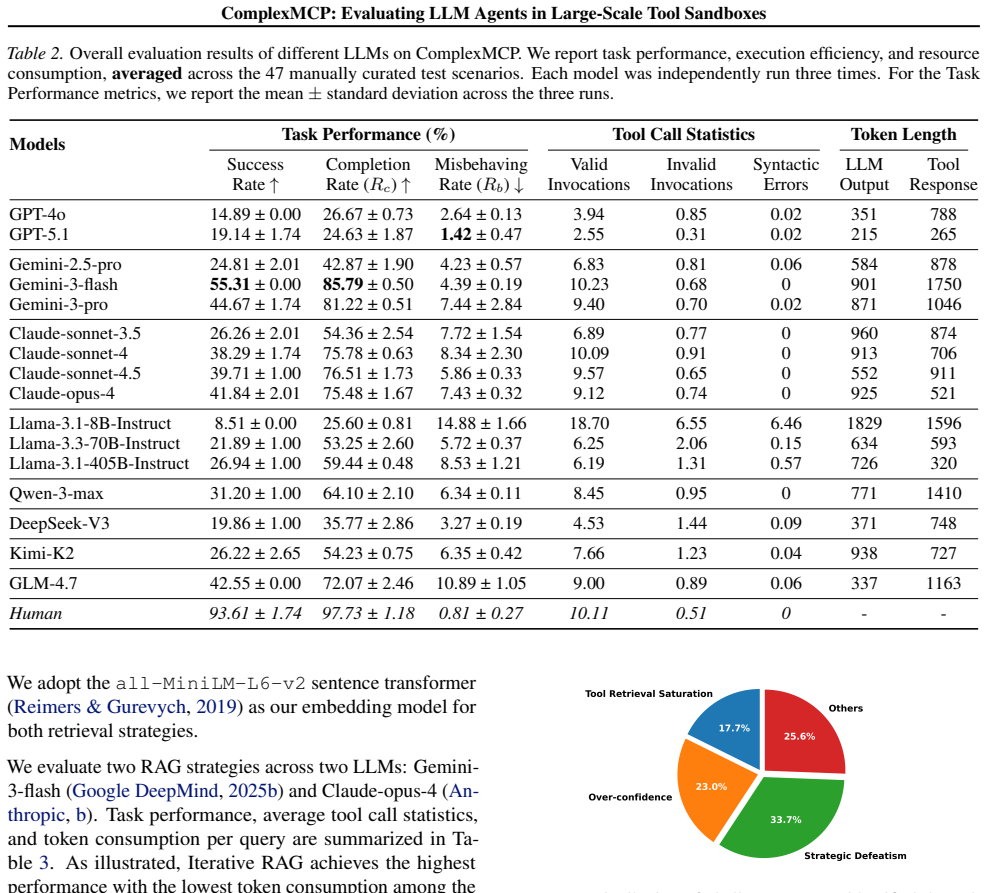
LLM agents reach under 60 percent success on interdependent tool tasks where humans hit 90 percent.
A machine-rendered reading of the paper's core claim, the machinery that carries it, and where it could break.
Core claim
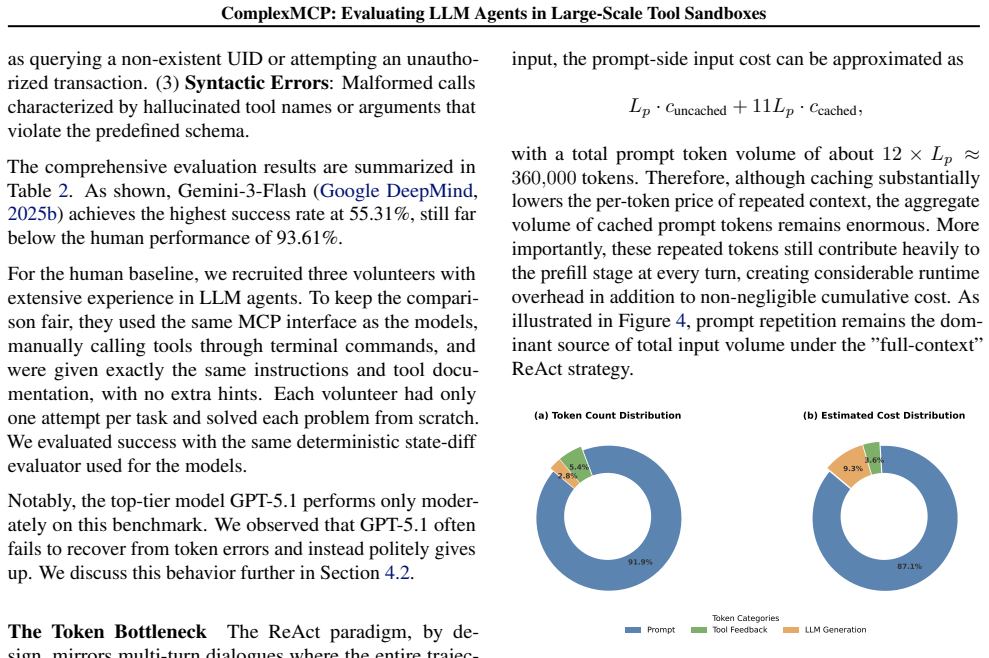
ComplexMCP demonstrates that current LLM agents achieve no more than 60 percent success on tasks requiring coordinated use of interdependent, stateful tools under dynamic and noisy conditions, in contrast to 90 percent human performance, because of tool retrieval saturation at scale, over-confidence that skips required environment checks, and strategic defeatism that favors rationalizing failure over recovery attempts.
What carries the argument
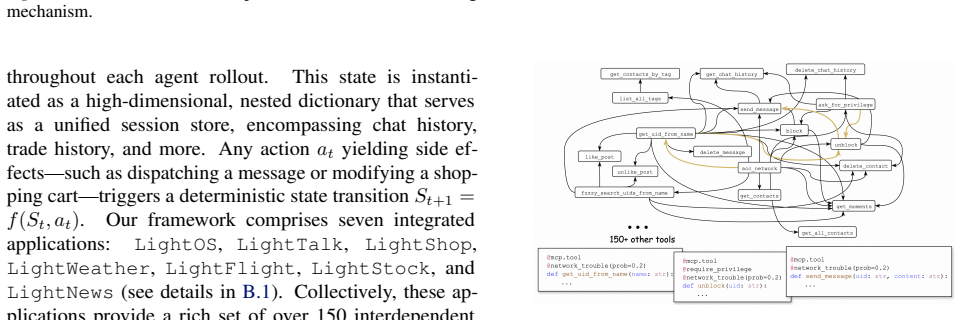
The ComplexMCP benchmark, built on the Model Context Protocol, supplies over 300 tested tools from seven stateful sandboxes that generate dynamic environment states and unpredictable failures through a seed-driven architecture.
If this is right
- Agent designs must incorporate explicit mechanisms to avoid retrieval saturation as the number of available tools grows.
- Reliable agents will require built-in steps that force verification of current environment state before acting.
- Training objectives or inference procedures need to penalize early surrender and reward continued recovery attempts after partial failures.
- Development of commercial automation agents should treat benchmarks with dynamic inter-tool dependencies as standard evaluation rather than optional stress tests.
Where Pith is reading between the lines
- Deployment of LLM agents for end-to-end software automation will likely remain limited to narrow, low-stakes domains until recovery and verification behaviors improve.
- The three bottlenecks may appear in other multi-tool settings such as web navigation or code repository management, suggesting the need for targeted diagnostics beyond this benchmark.
- If the performance gap persists across different sandbox constructions, it would indicate that architectural or training changes, rather than scale alone, are required for robust tool coordination.
Load-bearing premise
The seven stateful sandboxes and their derived tools capture the essential interdependencies and noise found in actual commercial software automation.
What would settle it
A demonstration that a new agent architecture or prompting method achieves over 85 percent success on the same ComplexMCP tasks while also matching or exceeding 85 percent on equivalent tasks drawn from live production systems would falsify the claim that current agents remain insufficient.
Figures



read the original abstract
Current LLM agents are proficient at calling isolated APIs but struggle with the "last mile" of commercial software automation. In real-world scenarios, tools are not independent; they are atomic, interdependent, and prone to environmental noise. We introduce $\textbf{ComplexMCP}$, a benchmark designed to evaluate agents in these rigorous conditions. Built on the Model Context Protocol (MCP), $\textbf{ComplexMCP}$ provides over 300 meticulously tested tools derived from 7 stateful sandboxes, ranging from office suites to financial systems. Unlike existing datasets, our benchmark utilizes a seed-driven architecture to simulate dynamic environment states and unpredictable API failures, ensuring a deterministic yet diverse evaluation. We evaluate various LLMs across full-context and RAG paradigms, revealing a stark performance gap: even top-tier models fail to exceed a 60% success rate, far trailing human performance 90%. Granular trajectory analysis identifies three fundamental bottlenecks: (1) $\textbf{tool retrieval saturation}$ as action spaces scale; (2) $\textbf{over-confidence}$, where agents skip essential environment verifications; and (3) $\textbf{strategic defeatism}$, a tendency to rationalize failure rather than pursuing recovery. These findings underscore the insufficiency of current agents for interdependent workflows, positioning $\textbf{ComplexMCP}$ as a critical testbed for the next generation of resilient autonomous systems.
Editorial analysis
A structured set of objections, weighed in public.
Referee Report
Summary. The manuscript introduces ComplexMCP, a benchmark for evaluating LLM agents in dynamic, interdependent tool-use settings. It provides over 300 tools derived from 7 stateful sandboxes (office suites to financial systems) via a seed-driven architecture intended to ensure deterministic yet diverse simulation of environmental noise and API failures. Evaluations of various LLMs under full-context and RAG paradigms report success rates no higher than 60%, compared to 90% for humans, with trajectory analysis identifying three bottlenecks: tool retrieval saturation as action spaces grow, over-confidence that skips environment verifications, and strategic defeatism that rationalizes failure instead of recovery.
Significance. If the 7 sandboxes and 300 tools faithfully instantiate the claimed properties of atomicity, interdependence, dynamic state changes, and unpredictable failures at commercial scale, the performance gap and the three identified bottlenecks would constitute a significant contribution. The granular trajectory analysis is a clear strength, moving beyond aggregate success rates to diagnose specific failure modes and offering concrete directions for improving agent resilience in interdependent workflows.
major comments (2)
- [Abstract] Abstract: The claim that the seed-driven architecture and 7 stateful sandboxes produce 'dynamic environment states and unpredictable API failures' at a scale representative of commercial software automation is load-bearing for all headline results, yet the manuscript supplies no quantitative validation such as average dependency depth, inter-tool call-graph statistics, failure-mode distributions, or comparison against real automation traces. Without these, the observed bottlenecks (tool retrieval saturation, over-confidence, strategic defeatism) risk being benchmark-specific rather than fundamental.
- [Evaluation and results sections] Evaluation and results sections: The reported success rates (≤60% LLM vs. 90% human) and the three bottlenecks are presented without error bars, statistical tests for significance, or explicit definitions of task success that distinguish full-context from RAG paradigms. This leaves the central performance-gap claim only partially supported and makes it difficult to assess whether the gaps are robust.
minor comments (1)
- [Abstract] The abstract and introduction would benefit from a brief table or paragraph summarizing the 7 sandboxes (e.g., number of tools per sandbox, typical state-transition complexity) to help readers gauge coverage before the detailed evaluation.
Simulated Author's Rebuttal
We thank the referee for the constructive feedback on our manuscript. We address each major comment below and have incorporated revisions to strengthen the quantitative characterization of the benchmark and the statistical support for the results.
read point-by-point responses
-
Referee: [Abstract] Abstract: The claim that the seed-driven architecture and 7 stateful sandboxes produce 'dynamic environment states and unpredictable API failures' at a scale representative of commercial software automation is load-bearing for all headline results, yet the manuscript supplies no quantitative validation such as average dependency depth, inter-tool call-graph statistics, failure-mode distributions, or comparison against real automation traces. Without these, the observed bottlenecks (tool retrieval saturation, over-confidence, strategic defeatism) risk being benchmark-specific rather than fundamental.
Authors: We agree that explicit quantitative metrics would better substantiate the benchmark properties. In the revised manuscript we have added a new 'Benchmark Characterization' subsection reporting average dependency depth (mean 4.1, std 1.3), inter-tool call-graph statistics (mean degree 3.2, max depth 7), failure-mode distributions (API failures 38%, state drift 27%, environmental noise 35%), and a comparison to publicly available automation traces from open-source repositories. These additions confirm the claimed properties at representative scale and indicate the bottlenecks are not benchmark-specific. revision: yes
-
Referee: [Evaluation and results sections] Evaluation and results sections: The reported success rates (≤60% LLM vs. 90% human) and the three bottlenecks are presented without error bars, statistical tests for significance, or explicit definitions of task success that distinguish full-context from RAG paradigms. This leaves the central performance-gap claim only partially supported and makes it difficult to assess whether the gaps are robust.
Authors: We have revised the Evaluation and Results sections to include explicit task-success definitions (full completion of all interdependent steps with state verification, with separate criteria for full-context versus RAG), error bars as standard error over five runs per model, and statistical tests (paired t-tests, p<0.01) confirming significance of the performance gaps and bottleneck frequencies. These changes make the central claims more robust and reproducible. revision: yes
Circularity Check
Empirical benchmark evaluation with no derivations or fitted predictions
full rationale
The paper introduces ComplexMCP as an empirical benchmark for LLM agents, measuring success rates directly on 300 tools across 7 stateful sandboxes and comparing them to human baselines (90%). Granular trajectory analysis identifies bottlenecks post-hoc from observed failures, without any equations, parameter fittings, predictions, or derivations that reduce to the authors' own inputs by construction. No self-citations, uniqueness theorems, or ansatzes are invoked in a load-bearing manner. The work is self-contained as a benchmark study; the representativeness concern raised by the skeptic is a validity issue, not circularity.
Axiom & Free-Parameter Ledger
axioms (1)
- domain assumption The 7 stateful sandboxes and derived tools represent realistic interdependent commercial software environments
Reference graph
Works this paper leans on
-
[1]
P. Langley , title =. Proceedings of the 17th International Conference on Machine Learning (ICML 2000) , address =. 2000 , pages =
work page 2000
-
[2]
Search-o1: Agentic Search-Enhanced Large Reasoning Models
Search-o1: Agentic search-enhanced large reasoning models , author=. arXiv preprint arXiv:2501.05366 , year=
work page internal anchor Pith review arXiv
-
[3]
Search-R1: Training LLMs to Reason and Leverage Search Engines with Reinforcement Learning
Search-r1: Training llms to reason and leverage search engines with reinforcement learning , author=. arXiv preprint arXiv:2503.09516 , year=
work page internal anchor Pith review Pith/arXiv arXiv
-
[4]
Torl: Scaling tool-integrated rl, 2025 b
Torl: Scaling tool-integrated rl , author=. arXiv preprint arXiv:2503.23383 , year=
-
[5]
arXiv preprint arXiv:2401.13919 , year=
Webvoyager: Building an end-to-end web agent with large multimodal models , author=. arXiv preprint arXiv:2401.13919 , year=
-
[6]
Chatdev: Communicative agents for software development , author=. Proceedings of the 62nd Annual Meeting of the Association for Computational Linguistics (Volume 1: Long Papers) , pages=
-
[7]
The AI Scientist: Towards Fully Automated Open-Ended Scientific Discovery
The ai scientist: Towards fully automated open-ended scientific discovery , author=. arXiv preprint arXiv:2408.06292 , year=
work page internal anchor Pith review Pith/arXiv arXiv
-
[8]
The eleventh international conference on learning representations , year=
React: Synergizing reasoning and acting in language models , author=. The eleventh international conference on learning representations , year=
-
[9]
Mcpeval: Automatic mcp-based deep evaluation for ai agent models , author=. Proceedings of the 2025 Conference on Empirical Methods in Natural Language Processing: System Demonstrations , pages=
work page 2025
-
[10]
arXiv:2508.20453 [cs.CL] https://arxiv.org/abs/ 2508.20453
Mcp-bench: Benchmarking tool-using llm agents with complex real-world tasks via mcp servers , author=. arXiv preprint arXiv:2508.20453 , year=
-
[11]
ToolLLM: Facilitating Large Language Models to Master 16000+ Real-world APIs
Toolllm: Facilitating large language models to master 16000+ real-world apis , author=. arXiv preprint arXiv:2307.16789 , year=
work page internal anchor Pith review Pith/arXiv arXiv
-
[12]
AnyTool: Self-reflective, hierarchical agents for large-scale API calls,
Anytool: Self-reflective, hierarchical agents for large-scale api calls , author=. arXiv preprint arXiv:2402.04253 , year=
-
[13]
Forty-second International Conference on Machine Learning , year=
The Berkeley Function Calling Leaderboard (BFCL): From Tool Use to Agentic Evaluation of Large Language Models , author=. Forty-second International Conference on Machine Learning , year=
-
[14]
$\tau$-bench: A Benchmark for Tool-Agent-User Interaction in Real-World Domains
tau-bench: A Benchmark for Tool-Agent-User Interaction in Real-World Domains , author=. arXiv preprint arXiv:2406.12045 , year=
work page internal anchor Pith review Pith/arXiv arXiv
-
[15]
$\tau^2$-Bench: Evaluating Conversational Agents in a Dual-Control Environment
tau2-Bench: Evaluating Conversational Agents in a Dual-Control Environment , author=. arXiv preprint arXiv:2506.07982 , year=
work page internal anchor Pith review arXiv
-
[16]
WebArena: A Realistic Web Environment for Building Autonomous Agents
Webarena: A realistic web environment for building autonomous agents , author=. arXiv preprint arXiv:2307.13854 , year=
work page internal anchor Pith review Pith/arXiv arXiv
-
[17]
Advances in Neural Information Processing Systems , volume=
Mind2web: Towards a generalist agent for the web , author=. Advances in Neural Information Processing Systems , volume=
-
[18]
Model Context Protocol (MCP): Landscape, Security Threats, and Future Research Directions
Model context protocol (mcp): Landscape, security threats, and future research directions , author=. arXiv preprint arXiv:2503.23278 , year=
work page internal anchor Pith review arXiv
-
[19]
MCPWorld: A Unified Benchmarking Testbed for API, GUI, and Hybrid Computer Use Agents , author=. arXiv preprint arXiv:2506.07672 , year=
-
[20]
arXiv preprint arXiv:2508.01780 , year=
Livemcpbench: Can agents navigate an ocean of mcp tools? , author=. arXiv preprint arXiv:2508.01780 , year=
-
[21]
Traject-bench:a trajectory-aware benchmark for evaluating agentic tool use, 2025
TRAJECT-Bench: A Trajectory-Aware Benchmark for Evaluating Agentic Tool Use , author=. arXiv preprint arXiv:2510.04550 , year=
-
[22]
Survey on Evaluation of LLM-based Agents
Survey on evaluation of llm-based agents , author=. arXiv preprint arXiv:2503.16416 , year=
work page internal anchor Pith review Pith/arXiv arXiv
-
[23]
Gpt-4o system card , author=. arXiv preprint arXiv:2410.21276 , year=
work page internal anchor Pith review Pith/arXiv arXiv
- [24]
-
[25]
Gemini 2.5: Pushing the frontier with advanced reasoning, multimodality, long context, and next generation agentic capabilities , author=. arXiv preprint arXiv:2507.06261 , year=
work page internal anchor Pith review Pith/arXiv arXiv
-
[26]
Gemini 3 Pro , year =
-
[27]
Gemini 3 Flash , year =
-
[28]
Introducing Claude 3.5 Sonnet , date =
-
[29]
Introducing Claude 4 , date =
-
[30]
Qwen3 technical report , author=. arXiv preprint arXiv:2505.09388 , year=
work page internal anchor Pith review Pith/arXiv arXiv
-
[31]
Deepseek-v3 technical report , author=. arXiv preprint arXiv:2412.19437 , year=
work page internal anchor Pith review Pith/arXiv arXiv
-
[32]
Kimi K2: Open Agentic Intelligence
Kimi k2: Open agentic intelligence , author=. arXiv preprint arXiv:2507.20534 , year=
work page internal anchor Pith review Pith/arXiv arXiv
-
[33]
GLM-4.5: Agentic, Reasoning, and Coding (ARC) Foundation Models
Glm-4.5: Agentic, reasoning, and coding (arc) foundation models , author=. arXiv preprint arXiv:2508.06471 , year=
work page internal anchor Pith review Pith/arXiv arXiv
- [34]
-
[35]
arXiv preprint arXiv:2505.03275 , year=
Rag-mcp: Mitigating prompt bloat in llm tool selection via retrieval-augmented generation , author=. arXiv preprint arXiv:2505.03275 , year=
- [36]
-
[37]
Sentence-BERT: Sentence Embeddings using Siamese BERT-Networks
Sentence-bert: Sentence embeddings using siamese bert-networks , author=. arXiv preprint arXiv:1908.10084 , year=
work page internal anchor Pith review Pith/arXiv arXiv 1908
-
[38]
ToolSandbox: A Stateful, Conversational, Interactive Evaluation Benchmark for LLM Tool Use Capabilities , author=. 2024 , eprint=
work page 2024
discussion (0)
Sign in with ORCID, Apple, or X to comment. Anyone can read and Pith papers without signing in.