Recognition: 2 theorem links
· Lean TheoremWell-posedness of a generalized Stokes operator on domains with cylindrical ends via layer-potentials
Pith reviewed 2026-05-12 03:43 UTC · model grok-4.3
The pith
Under positivity assumptions on V and V0 the generalized Stokes operator Ξ and its layer potentials become invertible on domains with cylindrical ends.
A machine-rendered reading of the paper's core claim, the machinery that carries it, and where it could break.
Core claim
The central claim is that the generalized Stokes operator Ξ_{V,V0} = (L + V ∇; ∇* -V0) is Fredholm on manifolds with straight cylindrical ends under positivity of V and V0, and invertible under stronger positivity. The associated single-layer potential S and boundary operator ½ + K are likewise Fredholm or invertible. Invertibility supplies the well-posedness of the Dirichlet problem for the linear Stokes system and, by a fixed-point argument, for the generalized Navier-Stokes system with small data.
What carries the argument
Layer potentials (single-layer S and double-layer ½ + K) constructed on the ambient manifold M containing Ω, together with Fredholm theory for pseudodifferential operators on manifolds with cylindrical ends applied to the generalized Stokes operator Ξ.
Load-bearing premise
The positivity conditions imposed on the lower-order terms V and V0 are what guarantee that Ξ, S and ½ + K are Fredholm and then invertible.
What would settle it
Explicit construction of a pair V, V0 violating the positivity hypotheses on a concrete cylinder such that the Dirichlet problem for the corresponding Stokes system loses uniqueness or existence in the natural Sobolev spaces.
Figures
read the original abstract
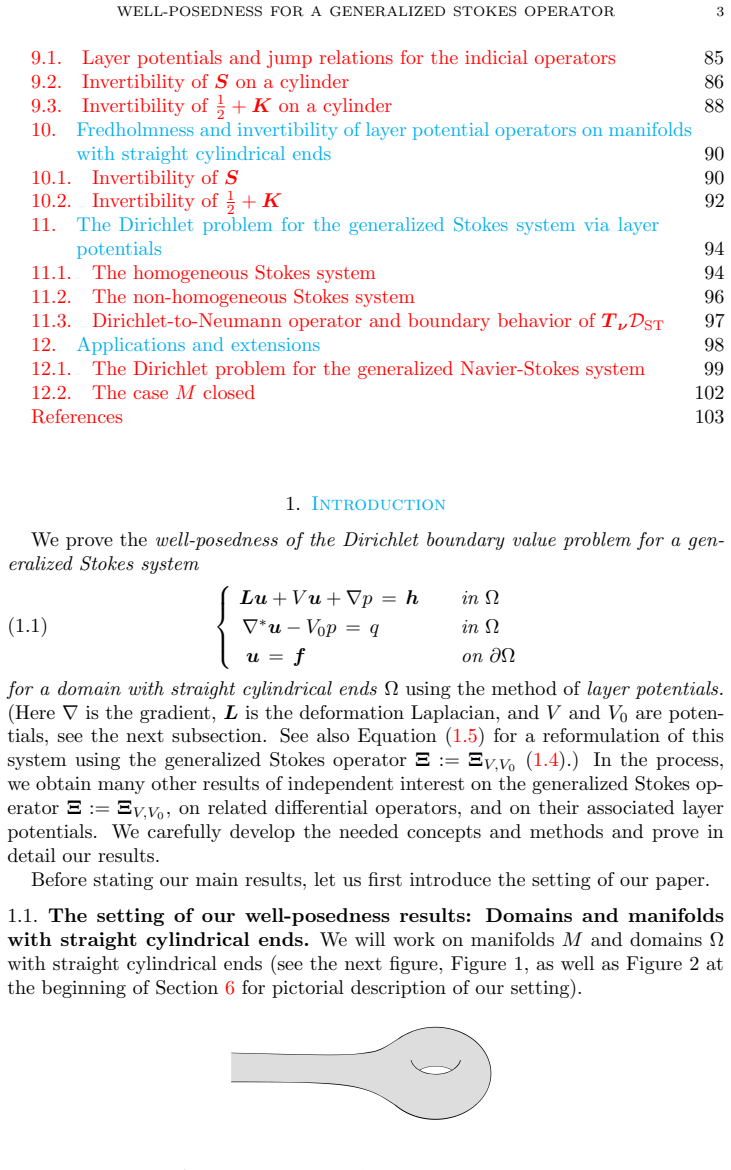
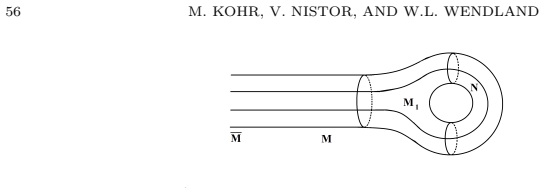
We study the \emph{generalized Stokes operator} \begin{equation*} \bsXi \ede \bsXi _{V,V_0} \ede \left(\begin{array}{ccc} \bsL + V & \nabla \\ \nabla^* & -V_0 \end{array}\right) \end{equation*} on a \emph{domain with straight cylindrical ends} $\Omega$ using \emph{the method of layer potentials} on $M \supset \Omega$. The operator $\bsXi_{0, 0}$ is the classical Stokes operator. Under suitable positivity assumptions on $V$ and $V_{0}$, we prove that $\bsXi$ is Fredholm. This allows us then to define the single- and double-layer potentials $\bsS$ and $\frac12 + \bsK$. Under further positivity assumptions, we prove that $\bsS$ and $\frac12 + \bsK$ are also Fredholm. Under slightly stronger assumptions on $V$ and $V_{0}$, we prove \emph{the invertibility} of the operators $\bsXi$, $\bsS$, and $\frac12 + \bsK$. The invertibility of these operators leads to \emph{well-posedness results} for the associated (linear) Stokes boundary value problem with Dirichlet boundary conditions on $\Omega$. The proofs of these results required us to develop many related tools. In particular, we develop an ``algebra tool kit'' to deal with \emph{limit and jump relations of layer potentials.} We also develop Green formulas and energy estimates for our generalized Stokes operator $\bsXi$ on manifolds with straight cylindrical ends, which requires a careful geometric study of the related differential operators, such as the deformation operator $\Def$. For completeness, we review suitable classes of pseudodifferential operators on manifolds with straight cylindrical ends that were studied in some previous papers of ours (including ``The Stokes operator on manifolds with cylindrical ends,'' J. Diff. Equations, 2024). As an application, we prove the well-posedness result for the Dirichlet problem for the generalized Navier-Stokes system with small data on a domain with cylindrical ends.
Editorial analysis
A structured set of objections, weighed in public.
Referee Report
Summary. The paper claims that under suitable positivity assumptions on potentials V and V0, the generalized Stokes operator Ξ_{V,V0} is Fredholm on domains Ω with straight cylindrical ends, established via layer potentials on an extension M ⊃ Ω. Under further positivity, the single-layer operator S and double-layer operator ½ + K are Fredholm; under slightly stronger assumptions they are invertible. This yields well-posedness for the Dirichlet Stokes BVP on Ω and, as an application, well-posedness for the generalized Navier-Stokes system with small data.
Significance. If the central claims hold, the work extends layer-potential techniques for Stokes-type operators to a generalized setting with potentials on non-compact domains with cylindrical ends, supplying new well-posedness results and an application to small-data Navier-Stokes. The development of Green formulas, energy estimates involving the deformation operator Def, and an algebra toolkit for limit/jump relations of layer potentials is a concrete technical contribution, as is the review of the relevant pseudodifferential-operator classes.
major comments (2)
- [Energy estimates and Fredholm property of Ξ] The section establishing the Fredholm property of Ξ under positivity (via Green formulas and energy estimates for Def): positivity yields coercivity on compact sets, but the essential spectrum on a manifold with straight cylindrical ends is governed by the model operator on the infinite cylinder. The manuscript does not explicitly verify that positivity excludes zero from the continuous spectrum for all Fourier modes along the axis; this spectral fact is load-bearing for the subsequent Fredholm/invertibility statements on S and ½ + K.
- [Invertibility statements and well-posedness theorems] The passage from Fredholmness to invertibility of Ξ, S, and ½ + K under the slightly stronger assumptions on V and V0: the precise form of the stronger assumptions and the argument that the kernels are trivial (or that the index vanishes) are stated at a high level but not accompanied by the detailed kernel analysis or index computation needed to confirm the claim.
minor comments (2)
- [Introduction and notation] The notation for the classical Stokes case (V = V0 = 0) versus the generalized case is introduced clearly in the abstract but could be reinforced with a short comparative table or remark in the introduction.
- [Background on pseudodifferential operators] The review of pseudodifferential-operator classes on cylindrical-end manifolds draws heavily on the authors' prior work; a one-paragraph self-contained recap of the key mapping properties used would improve readability.
Simulated Author's Rebuttal
We thank the referee for the careful reading and constructive comments on our manuscript. We address each major comment below and will revise the manuscript to incorporate the suggested clarifications.
read point-by-point responses
-
Referee: [Energy estimates and Fredholm property of Ξ] The section establishing the Fredholm property of Ξ under positivity (via Green formulas and energy estimates for Def): positivity yields coercivity on compact sets, but the essential spectrum on a manifold with straight cylindrical ends is governed by the model operator on the infinite cylinder. The manuscript does not explicitly verify that positivity excludes zero from the continuous spectrum for all Fourier modes along the axis; this spectral fact is load-bearing for the subsequent Fredholm/invertibility statements on S and ½ + K.
Authors: We agree that the verification that positivity excludes zero from the continuous spectrum of the model operator on the infinite cylinder, for every Fourier mode, requires a more explicit treatment. In the revised manuscript we will insert a new subsection (immediately following the energy estimates for Def) that performs the Fourier decomposition along the cylindrical axis, computes the resulting family of ODE operators on the cross-section, and shows that the quadratic form induced by the positivity assumptions on V and V0 is strictly positive for all frequencies. This will make the exclusion of zero from the essential spectrum fully rigorous and self-contained. revision: yes
-
Referee: [Invertibility statements and well-posedness theorems] The passage from Fredholmness to invertibility of Ξ, S, and ½ + K under the slightly stronger assumptions on V and V0: the precise form of the stronger assumptions and the argument that the kernels are trivial (or that the index vanishes) are stated at a high level but not accompanied by the detailed kernel analysis or index computation needed to confirm the claim.
Authors: We acknowledge that the transition from Fredholmness to invertibility is presented at a high level. In the revision we will expand the relevant section to state the stronger positivity assumptions explicitly (strict positivity plus a quantitative lower bound on the potentials) and to supply a detailed kernel analysis: any element of the kernel satisfies an energy identity that forces it to vanish identically, using the improved coercivity together with a unique-continuation argument adapted to the generalized Stokes operator. We will also record that the index is zero under the basic positivity assumptions (via the layer-potential representation and a homotopy argument already present in the manuscript), so that trivial kernel implies invertibility. These additions will be placed immediately before the well-posedness theorems. revision: yes
Circularity Check
Minor self-citation for background pseudodifferential classes; core positivity-based Fredholm and invertibility proofs are self-contained.
full rationale
The paper develops original Green formulas, energy estimates involving the deformation operator Def, and an algebra toolkit for jump relations of layer potentials on manifolds with cylindrical ends. These support the new claims that suitable positivity assumptions on V and V0 make Ξ Fredholm (and invertible under stronger assumptions), with the same for S and ½ + K. The explicit self-citation to prior work (including the 2024 J. Diff. Equations paper) is confined to reviewing classes of pseudodifferential operators 'for completeness,' serving as non-load-bearing background rather than the justification for the positivity-driven invertibility results. No derivation step reduces by construction to a fitted parameter, self-definition, or unverified self-citation chain; the central well-posedness statements for the Stokes and Navier-Stokes problems rest on the paper's own estimates and layer-potential constructions.
Axiom & Free-Parameter Ledger
axioms (2)
- domain assumption Suitable positivity assumptions on V and V0 ensure the Fredholm property of Ξ and invertibility of the layer potentials.
- standard math The background theory of pseudodifferential operators on manifolds with straight cylindrical ends, as developed in prior work, applies directly to the generalized Stokes operator.
Lean theorems connected to this paper
-
IndisputableMonolith/Foundation/RealityFromDistinction.leanreality_from_one_distinction unclearGreen formulas and energy estimates for our generalized Stokes operator Ξ on manifolds with straight cylindrical ends
Reference graph
Works this paper leans on
-
[1]
[4]Amann, H.Function spaces on singular manifolds.Math
[3]Amann, H.Compact embeddings of vector-valued Sobolev and Besov spaces.Glasnik Matematicki 35(2000), 161–177. [4]Amann, H.Function spaces on singular manifolds.Math. Nachr. 286, 5-6 (2013), 436–475. [5]Amann, H.Function spaces on uniformly regular and singular riemannian manifolds. preprint,
work page 2000
-
[2]
[6]Ammann, B., Große, N., and Nistor, V.Analysis and boundary value problems on singular domains: An approach via bounded geometry.C.R. Acad. Sci. Paris, Ser.I 357 (2019), 487–493. [7]Ammann, B., Große, N., and Nistor, V.The strong Legendre condition and the well- posedness of mixed Robin problems on manifolds with bounded geometry.Rev. Roumaine Math. Pur...
work page 2019
-
[3]
[16]Beals, R.Characterization of pseudodifferential operator and application.Duke Math. J. 44(1977), 45–57. [17]Behzadan, A., and Holst, M.Multiplication in Sobolev spaces, revisited.Ark. Mat. 59, 2 (2021), 275–306. [18]Benavides, G., Nochetto, R., and Shakipov, M.L p-based Sobolev theory for PDEs on closed manifolds of classC m. Preprint https://arxiv.or...
-
[4]
Id/No 103157. [24]Borrelli, W., Briet, P., Krej ˇciˇr´ık, D., and Ourmi`eres-Bonafos, T.Spectral properties of relativistic quantum waveguides.Ann. Henri Poincar´ e 23, 11 (2022), 4069–4114. [25]Bourgeois, L., Fliss, S., Fritsch, J.-F., Hazard, C., and Recoquillay, A.Scattering in a partially open waveguide: the forward problem.IMA Journal of Applied Math...
work page 2022
-
[5]
[34]Coriasco, S., Schrohe, E., and Seiler, J.Realizations of differential operators on conic manifolds with boundary.Ann. Global Anal. Geom. 31, 3 (2007), 223–285. [35]Costabel, M.Boundary integral operators on Lipschitz domains: Elementary results.SIAM J. Math. Anal. 19(1988), 613–626. [36]Costabel, M., and Wendland, W. L.Strong ellipticity of boundary i...
work page 2007
-
[6]
Smoothness and asymptotics of solutions. [39]Dindo ˘s, M., and Mitrea, M.The stationary Navier-Stokes system in nonsmooth manifolds: The Poisson problem in Lipschitz andc 1 domains.Arch. Rational Mech. Anal. 174(2004), 1–47. [40]Ebin, D. G., and Marsden, J.Groups of diffeomorphisms and the motion of an incom- pressible fluid.Ann. Math. (2) 92(1970), 102–1...
work page 2004
-
[7]
2nd Edition. [42]Exner, P., Freitas, P., and Krej ˇciˇr´ık, D.A lower bound to the spectral threshold in curved tubes.Proc. R. Soc. Lond., Ser. A, Math. Phys. Eng. Sci. 460, 2052 (2004), 3457–
work page 2052
-
[8]
[43]Fabes, E., Kenig, C., and Verchota, G.The Dirichlet problem for the Stokes system on Lipschitz domains.Duke Math. J. 57(1988), 769–793. [44]Fritzsch, K., Grieser, D., and Schrohe, E.The Calder´ on projector for fibred cusp operators.ArXiv:2006.04645v1(2020). [45]Galdi, G. P.An introduction to the mathematical theory of the Navier-Stokes equations. Ste...
-
[9]
[46]Girault, V., and Sequeira, A.A well-posed problem for the exterior Stokes equations in two and three dimensions.Arch. Ration. Mech. Anal. 114, 4 (1991), 313–333. [47]Grieser, D.Basics of theb-calculus. InApproaches to singular analysis. Based on the workshop, Berlin, Germany, April 8–10,
work page 1991
-
[10]
Basel: Birkh¨ auser, 2001, pp. 30–84. [48]Große, N., Kohr, M., and Nistor, V.TheL 2-unique continuation property on manifolds with bounded geometry and the deformation operator.Forum Math. 38(2026), 259–272. [49]Große, N., and Nistor, V.Uniform Shapiro-Lopatinski Conditions and Boundary Value Problems on Manifolds with Bounded Geometry.Potential Anal. 53,...
work page 2001
-
[11]
[52]H ¨ormander, L.The analysis of linear partial differential operators. I. Classics in Mathe- matics. Springer, Berlin. Reprint of the second (1990) edition. [53]H ¨ormander, L.The analysis of linear partial differential operators. III. Classics in Math- ematics. Springer, Berlin,
work page 1990
-
[12]
Pseudo-differential operators, Reprint of the 1994 edition. [54]Hsiao, G. C., and Wendland, W. L.Boundary Integral Equations. 2nd edition. Springer Nature Switzerland,
work page 1994
-
[13]
[55]Jerison, D., and Kenig, C.The inhomogeneous Dirichlet problem in Lipschitz domains. J. Funct. Anal. 130, 1 (1995), 161–219. [56]Kapanadze, D., and Schulze, B.-W.Crack theory and edge singularities, vol. 561 of Mathematics and its Applications. Kluwer Academic Publishers Group, Dordrecht,
work page 1995
-
[14]
[57]Karageorghis, A., Lesnic, D., and Marin, L.The method of fundamental solutions for Brinkman flows. I: Exterior domains.J. Eng. Math. 126(2021),
work page 2021
-
[15]
[58]Karageorghis, A., Lesnic, D., and Marin, L.The method of fundamental solutions for Brinkman flows. II: Interior domains.J. Eng. Math. 127(2021),
work page 2021
-
[16]
[59]Khavinson, D., Putinar, M., and Shapiro, H.Poincar´ e’s variational problem in potential theory.Arch. Rational Mech. Anal. 185(2007), 143–184. WELL-POSEDNESS FOR A GENERALIZED STOKES OPERATOR 103 [60]Kohr, G., and Mocanu, P.Special Topics in Complex Analysis (in Romanian). Cluj University Press, Cluj-Napoca,
work page 2007
-
[17]
[61]Kohr, M., Lanza de Cristoforis, M., Mikhailov, S., and W.L. Wendland, W.Integral potential method for transmission problem with Lipschitz interface inR 3 for the Stokes and Darcy-Forchheimer-Brinkman PDE systems.Z. Angew. Math. Phys. 67:116, 5 (2016), 1–30. [62]Kohr, M., Lanza de Cristoforis, M., and Wendland, W.Nonlinear Neumann- transmission problem...
work page 2016
-
[18]
[64]Kohr, M., Mikhailov, S. E., and Wendland, W. L.Transmission problems for the Navier- Stokes and Darcy-Forchheimer-Brinkman systems in Lipschitz domains on compact Rie- mannian manifolds.J. Math. Fluid Mech. 19, 2 (2017), 203–238. [65]Kohr, M., Mikhailov, S. E., and Wendland, W. L.Dirichlet and transmission problems for anisotropic Stokes and Navier-St...
-
[19]
[73]Kr ´al, J., and Wendland, W.Some examples concerning applicability of the Fredholm– Radon method in potential theory.Apl. Mat. 31(1986), 293–308. [74]Krej ˇciˇr´ık, D., and Zuazua, E.The asymptotic behaviour of the heat equation in a twisted Dirichlet-Neumann waveguide.J. Differ. Equations 250, 5 (2011), 2334–2346. [75]Labarca-Figueroa, I., and Hiptma...
work page 1986
-
[20]
[77]Lanza de Cristoforis, M.A nonvariational form of the Neumann problem for H¨ older continuous harmonic functions.J. Diff. Equations 424(2025), 263–329. [78]Lanza de Cristoforis, M.A nonvariational form of the acoustic single layer potential. Communications on pure and Applied Analysis 26(2026), 217–243. [79]Lauter, R., and Moroianu, S.Fredholm theory f...
work page 2025
-
[21]
[80]Lauter, R., and Seiler, J.Pseudodifferential analysis on manifolds with boundary - a comparison ofb-calculus and cone algebra. InOper. Theory Adv. Appl., vol. 125 ofAdv. Partial Differ. Equ.2001, pp. 131–166. [81]Lewis, J., and Parenti, C.Pseudodifferential operators of Mellin type.Comm. Part. Diff. Eq. 8(1983), 477–544. 104 M. KOHR, V. NISTOR, AND W....
work page 2001
-
[22]
[88]Medkov ´a, D.Integral equation method for the first and second problems of the Stokes system.Potential Anal. 39, 4 (2013), 389–409. [89]Medkov ´a, D.Integral equations method and the transmission problem for the Stokes sys- tem.Kragujevac J. Math. 39, 1 (2015), 53–71. [90]Medkov ´a, D.The Dirichlet problem for the Brinkman system in exterior domains.J...
-
[23]
[95]Melrose, R., and Mendoza, G.Elliptic operators of totally characteristic type.Preprint, Math. Sci. Res. Institute (MSRI)(1983), 47–83. [96]Mitrea, D., Mitrea, I., and Mitrea, M.Geometric Harmonic Analysis V. Fredholm The- ory and Finer Estimates for Integral Operators, with Aapplications to Boundary Problems, vol. 76 ofDev. Math.Cham: Springer,
work page 1983
-
[24]
[97]Mitrea, M., and Monniaux, S.On the analyticity of the semigroup generated by the Stokes operator with Neumann-type boundary conditions on Lipschitz subdomains of Riemannian manifolds.Trans. Am. Math. Soc. 361, 6 (2009), 3125–3157. [98]Mitrea, M., and Nistor, V.Boundary value problems and layer potentials on manifolds with cylindrical ends.Czechoslovak...
work page 2009
-
[25]
[101]Munnier, A.Invertibility criteria for the biharmonic single-layer potential.Integral Equa- tions Oper. Theory 96, 1 (2024),
work page 2024
-
[26]
Application to the collision problem of rigid bodies in a perfect fluid.SIAM J
[102]Munnier, A., and Ramdani, K.Asymptotic analysis of a Neumann problem in a domain with cusp. Application to the collision problem of rigid bodies in a perfect fluid.SIAM J. Math. Anal. 47, 6 (2015), 4360–4403. [103]Nistor, V.Pseudodifferential operators on non-compact manifolds and analysis on polyhe- dral domains. InProceedings of the Workshop on Spe...
work page 2015
-
[27]
WELL-POSEDNESS FOR A GENERALIZED STOKES OPERATOR 105 [108]Pierfelice, V.The incompressible Navier-Stokes equations on non-compact manifolds.J. Geom. Anal. 27, 1 (2017), 577–617. [109]Qiao, Y.Double layer potentials on three-dimensional wedges and pseudodifferential oper- ators on Lie groupoids.J. Math. Anal. Appl. 462, 1 (2018), 428–447. [110]Qiao, Y., an...
work page 2017
-
[28]
[111]Qiao, Y., and Nistor, V.Single and double layer potentials on domains with conical points I: Straight cones.Integral Equations Operator Theory 72(2012), 419–448. [112]Roidos, N., and Schrohe, E.Existence and maximalL p-regularity of solutions for the porous medium equation on manifolds with conical singularities.Commun. Partial Differ. Equations 41, ...
work page 2012
-
[29]
Berlin: Springer, 2010, pp. 473–511. [116]Ruzhansky, M., and Turunen, V.Pseudo-Differential Operators and Symmetries: Back- ground Analysis and Advanced Topics
work page 2010
-
[30]
[118]Sayas, F.-J., and Selgas, V.Variational views of stokeslets and stresslets.S⃗eMA J. 63, 1 (2014), 65–90. [119]Schneider, C.Beyond Sobolev and Besov. Regularity of solutions of PDEs and their traces in function spaces, vol. 2291 ofLect. Notes Math.Cham: Springer,
work page 2014
-
[31]
[120]Schrohe, E.Spectral invariance, ellipticity, and the Fredholm property for pseudodifferen- tial operators on weighted Sobolev spaces.Ann. Global Anal. Geom. 10, 3 (1992), 237–254. [121]Schrohe, E.Fr´ echet algebra techniques for boundary value problems on noncompact man- ifolds: Fredholm criteria and functional calculus via spectral invariance.Math. ...
work page 1992
-
[32]
W.Mellin and Green operators of the corner calculus.J
[124]Schulze, B.-W., and Wong, M. W.Mellin and Green operators of the corner calculus.J. Pseudo-Differ. Oper. Appl. 2, 4 (2011), 467–507. [125]Seeley, R. T.Singular integrals on compact manifolds.Amer. J. Math. 81(1959), 658–690. [126]Seiler, J.Continuity of edge and corner pseudodifferential operators.Math. Nachr. 205 (1999), 163–182. [127]Shen, Z.Resolv...
work page 2011
-
[33]
Paris: Soci´ et´ e Math´ ematique de France, 1992, pp
´Ecole d’´ et´ e (Nantes, juin 1991). Paris: Soci´ et´ e Math´ ematique de France, 1992, pp. 35–108. [129]Strichartz, R.Analysis of the Laplacian on the complete Riemannian manifold.J. Funct. Anal. 52, 1 (1983), 48–79. [130]Taylor, M.Partial differential equations I. Basic theory, second ed., vol. 115 ofApplied Mathematical Sciences. Springer, New York,
work page 1991
-
[34]
[133]Triebel, H.Characterizations of function spaces on a complete Riemannian manifold with bounded geometry.Math. Nachr. 130(1987), 321–346. 106 M. KOHR, V. NISTOR, AND W.L. WENDLAND [134]Varnhorn, W.The Stokes Equations, vol. 76 ofMath. Res. (Berlin). Berlin: Akademie Verlag,
work page 1987
-
[35]
[136]Varnhorn, W.The boundary value problems of the Stokes resolvent equations inndimen- sions.Math. Nachr. 269-270(2004), 210–230. [137]Wendland, W. L.On the construction of the Stokes flow in a domain with cylindrical ends. Math. Methods Appl. Sci. 47, 12 (2024), 10000–10005. [138]Wloka, J., Rowley, B., and Lawruk, B.Boundary Value Problems for Elliptic...
work page 2004
discussion (0)
Sign in with ORCID, Apple, or X to comment. Anyone can read and Pith papers without signing in.