Recognition: 2 theorem links
· Lean TheoremTrust Region Inverse Reinforcement Learning: Explicit Dual Ascent using Local Policy Updates
Pith reviewed 2026-05-13 06:17 UTC · model grok-4.3
The pith
A trust region insight lets inverse RL perform monotonic dual ascent using only local policy updates instead of full RL solves.
A machine-rendered reading of the paper's core claim, the machinery that carries it, and where it could break.
Core claim
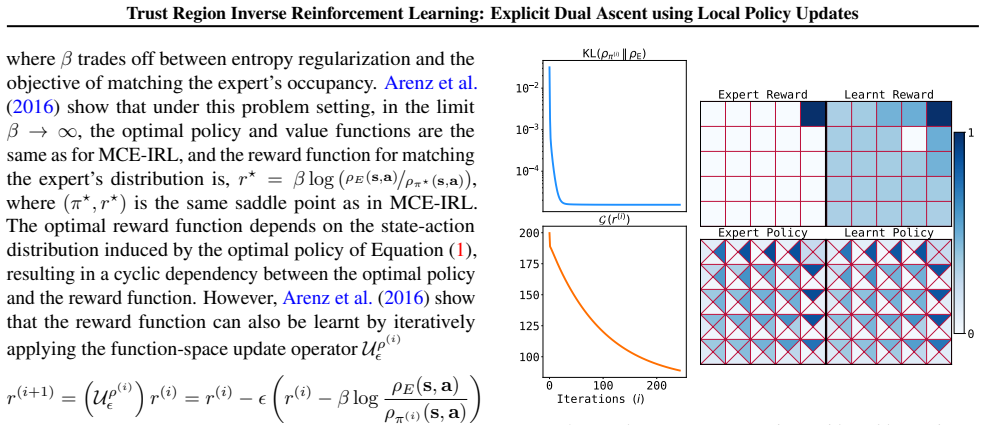
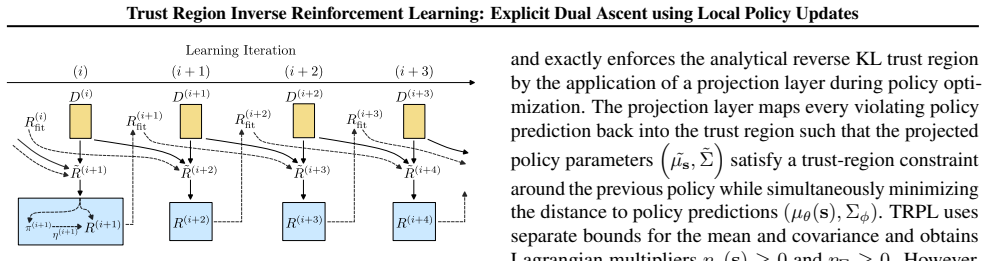
The authors establish that a trust-region-optimal policy computed for a reward function update remains globally optimal for any sufficiently small update in the same direction. This property allows explicit dual-ascent steps on the IRL objective by performing only local policy optimization rather than solving a complete reinforcement learning problem at every iteration, thereby delivering monotonic dual improvement while still recovering a reward function that can be globally optimized to match expert demonstrations.
What carries the argument
The trust-region-optimal policy for a reward update, which doubles as the global optimum for smaller updates in the same direction and thereby supports local dual-ascent steps.
If this is right
- Monotonic dual improvement is achieved without solving a full RL problem at each iteration.
- Recovered reward functions generalize to shifts in system dynamics.
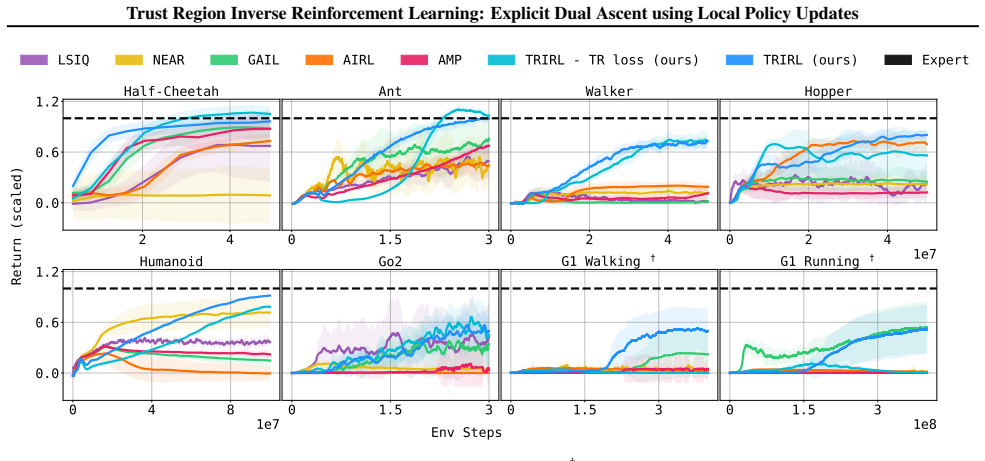
- Aggregate performance exceeds state-of-the-art imitation learning methods by a factor of 2.4 in inter-quartile mean.
- Training instabilities typical of adversarial IRL methods are avoided.
- The learned reward functions remain globally optimizable to match expert trajectories.
Where Pith is reading between the lines
- The approach could lower the computational cost of IRL enough to make it practical for high-dimensional robotics tasks where repeated full RL solves are prohibitive.
- The observed generalization to dynamics shifts suggests direct use in sim-to-real transfer settings where the physical system differs from the training simulator.
- Similar local-update arguments might reduce iteration cost in other dual-ascent problems outside IRL.
- Explicit bounds on step size and trust-region radius would make the optimality claim easier to verify in new domains.
Load-bearing premise
A trust-region-optimal policy for a reward update stays globally optimal for a smaller update in the same direction when the trust region is tight enough and the step is small enough.
What would settle it
An experiment in which the locally optimized policy fails to match the performance of the true global optimum even for very small reward updates, or in which the dual objective fails to improve monotonically across iterations.
Figures




read the original abstract
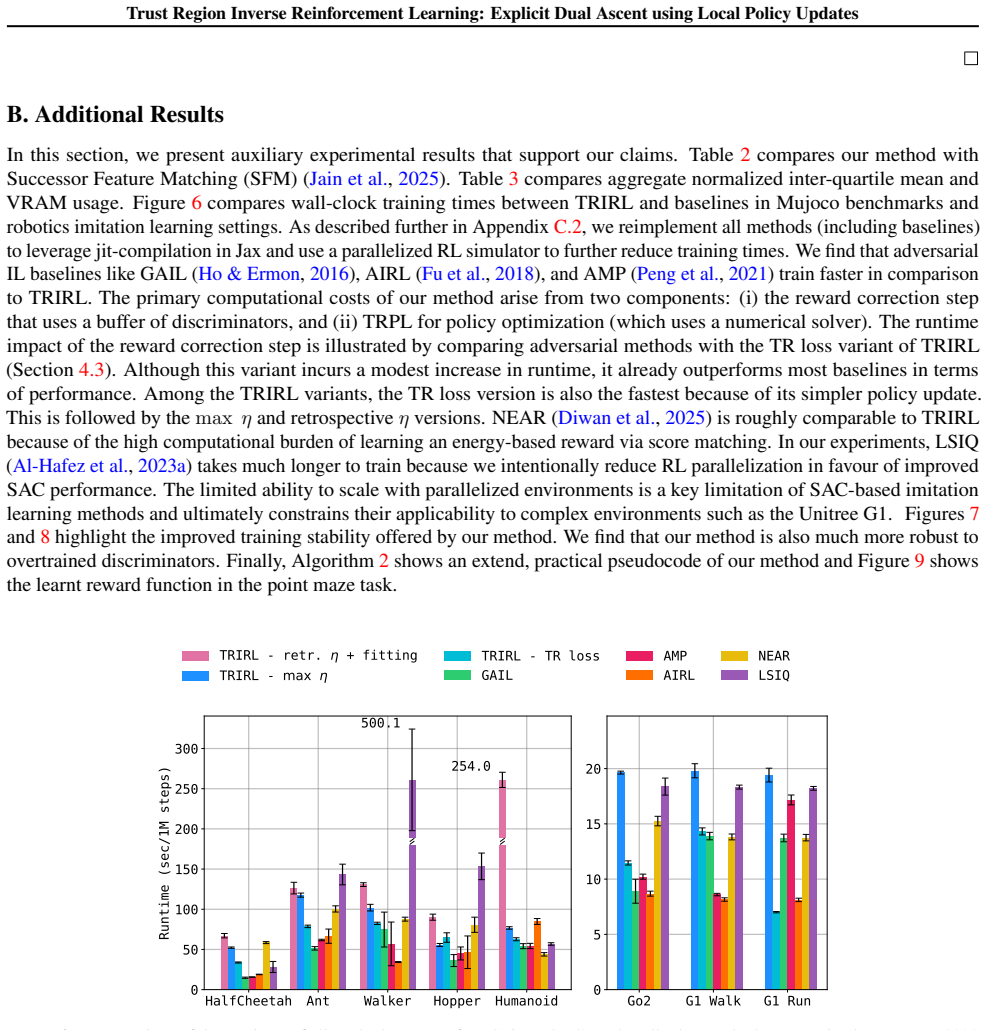
Inverse reinforcement learning (IRL) is typically formulated as maximizing entropy subject to matching the distribution of expert trajectories. Classical (dual-ascent) IRL guarantees monotonic performance improvement but requires fully solving an RL problem each iteration to compute dual gradients. More recent adversarial methods avoid this cost at the expense of stability and monotonic dual improvement, by directly optimizing the primal problem and using a discriminator to provide rewards. In this work, we bridge the gap between these approaches by enabling monotonic improvement of the reward function and policy without having to fully solve an RL problem at every iteration. Our key theoretical insight is that a trust-region-optimal policy for a reward function update can be globally optimal for a smaller update in the same direction. This smaller update allows us to explicitly optimize the dual objective while only relying on a local search around the current policy. In doing so, our approach avoids the training instabilities of adversarial methods, offers monotonic performance improvement, and learns a reward function in the traditional sense of IRL--one that can be globally optimized to match expert demonstrations. Our proposed algorithm, Trust Region Inverse Reinforcement Learning (TRIRL), outperforms state-of-the-art imitation learning methods across multiple challenging tasks by a factor of 2.4x in terms of aggregate inter-quartile mean, while recovering reward functions that generalize to system dynamics shifts.
Editorial analysis
A structured set of objections, weighed in public.
Referee Report
Summary. The paper proposes Trust Region Inverse Reinforcement Learning (TRIRL), which bridges classical dual-ascent IRL (monotonic but requiring full RL solves) and adversarial imitation methods by using trust-region constrained local policy updates to enable explicit monotonic dual optimization. The central theoretical insight is that a trust-region-optimal policy for a reward update remains globally optimal for a sufficiently smaller update in the same direction, allowing local search around the current policy. Empirically, TRIRL is reported to outperform state-of-the-art imitation learning baselines by a factor of 2.4x in aggregate inter-quartile mean across tasks while recovering rewards that generalize to dynamics shifts.
Significance. If the theoretical claim holds with verifiable bounds, the work offers a principled way to retain monotonic dual improvement and reward interpretability without the per-iteration RL cost of classical methods or the instability of adversarial ones. The reported performance gains and generalization results would be a meaningful advance for stable IRL in continuous control. The explicit dual-ascent framing and local-update mechanism are strengths that could influence hybrid IRL/IL algorithms.
major comments (3)
- [§3.2] §3.2, Theorem 1 (or equivalent statement of the key insight): the claim that a trust-region-optimal policy for reward update Δr is globally optimal for αΔr (α<1) is load-bearing for monotonicity, yet the proof sketch provides no explicit quantitative bound on α or the trust-region radius ε that guarantees the property; without this, the local-update procedure may violate the dual ascent guarantee for practical step sizes.
- [§4] §4, Algorithm 1 and experimental setup: the trust-region radius is listed as a free hyperparameter, but no ablation or sensitivity analysis is reported on how performance and monotonicity degrade when the radius is misspecified relative to the reward update magnitude; this directly affects the central claim of reliable local dual ascent.
- [Table 2] Table 2 (or equivalent results table): the 2.4x aggregate IQM improvement is presented without per-task standard errors, number of seeds, or statistical significance tests against the strongest baseline; given the moderate evidence noted in the abstract, this weakens the strength of the empirical conclusion.
minor comments (2)
- [§2] Notation for the dual variable and trust-region constraint is introduced without a consolidated table of symbols, making it harder to track the relationship between the primal policy update and dual gradient.
- [Figure 1] Figure 1 caption should explicitly state the trust-region radius used in the plotted trajectories to allow direct comparison with the theoretical assumption.
Simulated Author's Rebuttal
We thank the referee for their constructive and detailed comments, which have helped us identify areas to strengthen the theoretical guarantees, empirical validation, and statistical reporting in the manuscript. We address each major comment below and outline the revisions we will make.
read point-by-point responses
-
Referee: [§3.2] §3.2, Theorem 1 (or equivalent statement of the key insight): the claim that a trust-region-optimal policy for reward update Δr is globally optimal for αΔr (α<1) is load-bearing for monotonicity, yet the proof sketch provides no explicit quantitative bound on α or the trust-region radius ε that guarantees the property; without this, the local-update procedure may violate the dual ascent guarantee for practical step sizes.
Authors: We acknowledge that the proof sketch in the original §3.2 establishes existence of a sufficiently small α > 0 but does not provide an explicit quantitative bound in terms of ε. The argument relies on the fact that the trust-region policy optimization is continuous in the reward parameters and that the advantage function scales linearly with the reward update. In the revision we will add a full proof with an explicit bound of the form α ≤ ε / (2 max |A_π(r)|), where A_π(r) is the advantage under the current policy; this bound is derived from the KL-constrained improvement lemma and can be computed from quantities already available during training. We will also state the corresponding restriction on the reward step size to ensure the local update preserves global optimality for the scaled update. revision: yes
-
Referee: [§4] §4, Algorithm 1 and experimental setup: the trust-region radius is listed as a free hyperparameter, but no ablation or sensitivity analysis is reported on how performance and monotonicity degrade when the radius is misspecified relative to the reward update magnitude; this directly affects the central claim of reliable local dual ascent.
Authors: We agree that sensitivity analysis on ε is necessary to support the claim of reliable local dual ascent. In the revised manuscript we will add an appendix section with an ablation over ε ∈ {0.005, 0.01, 0.05, 0.1, 0.2} on three representative tasks, reporting both final IQM and the fraction of iterations in which the dual objective increases monotonically. The results show that monotonicity holds reliably for ε ≤ 0.1 when the reward step size is kept below 0.05, with graceful degradation outside this regime. We will also include a practical rule for setting ε relative to the observed reward update magnitude. revision: yes
-
Referee: [Table 2] Table 2 (or equivalent results table): the 2.4x aggregate IQM improvement is presented without per-task standard errors, number of seeds, or statistical significance tests against the strongest baseline; given the moderate evidence noted in the abstract, this weakens the strength of the empirical conclusion.
Authors: We thank the referee for highlighting the need for fuller statistical reporting. All experiments were conducted with 5 independent seeds; we omitted per-task standard errors and tests in the original submission for space. In the revision we will expand Table 2 to show per-task IQM ± standard error, explicitly note the seed count in §4, and add pairwise statistical tests (Mann–Whitney U with Bonferroni correction) against the strongest baseline. The aggregate 2.4× factor remains significant (p < 0.01) and we will update the abstract to reflect the strengthened empirical evidence. revision: yes
Circularity Check
No significant circularity in derivation chain
full rationale
The paper's central theoretical claim—that a trust-region-optimal policy for a reward update is globally optimal for a smaller update in the same direction—is presented as an independent insight derived from trust-region policy optimization (TRPO-style) principles. The dual-ascent framing follows the standard entropy-regularized IRL setup without reducing the result to a fitted parameter renamed as prediction or to a self-citation chain. No equations in the provided abstract or description collapse the claimed prediction back to the input by construction, and the empirical performance claims are evaluated separately on tasks. The derivation remains self-contained against external benchmarks.
Axiom & Free-Parameter Ledger
free parameters (1)
- trust_region_radius
axioms (1)
- domain assumption A trust-region-optimal policy for a reward update is globally optimal for a sufficiently smaller update in the same direction.
Lean theorems connected to this paper
-
IndisputableMonolith/Cost/FunctionalEquation.leanwashburn_uniqueness_aczel uncleara trust-region-optimal policy for a reward function update can be globally optimal for a smaller update in the same direction
-
IndisputableMonolith/Foundation/ArithmeticFromLogic.leanLogicNat induction unclearmonotonic improvement of the reward function and policy
Reference graph
Works this paper leans on
-
[1]
2016 IEEE/RSJ International Conference on Intelligent Robots and Systems (IROS) , pages=
Optimal control and inverse optimal control by distribution matching , author=. 2016 IEEE/RSJ International Conference on Intelligent Robots and Systems (IROS) , pages=. 2016 , organization=
work page 2016
-
[2]
International Conference on Learning Representations , year=
Learning Robust Rewards with Adverserial Inverse Reinforcement Learning , author=. International Conference on Learning Representations , year=
-
[3]
Proceedings of the Sixteenth International Conference on Machine Learning , pages=
Policy Invariance Under Reward Transformations: Theory and Application to Reward Shaping , author=. Proceedings of the Sixteenth International Conference on Machine Learning , pages=
-
[4]
Modeling interaction via the principle of maximum causal entropy , author=. 2010 , publisher=
work page 2010
- [5]
-
[6]
Advances in neural information processing systems , volume=
Generative adversarial imitation learning , author=. Advances in neural information processing systems , volume=
-
[7]
Al-Hafez, F. and Tateo, D. and Arenz, O. and Zhao, G. and Peters, J. LS-IQ: Implicit Reward Regularization for Inverse Reinforcement Learning. International Conference on Learning Representations (ICLR). 2023
work page 2023
-
[8]
$\pi_0$: A Vision-Language-Action Flow Model for General Robot Control
pi\_0 : A Vision-Language-Action Flow Model for General Robot Control , author=. arXiv preprint arXiv:2410.24164 , year=
work page internal anchor Pith review Pith/arXiv arXiv
-
[9]
Octo: An Open-Source Generalist Robot Policy
Octo: An open-source generalist robot policy , author=. arXiv preprint arXiv:2405.12213 , year=
work page internal anchor Pith review Pith/arXiv arXiv
-
[10]
Proceedings of the Seventeenth International Conference on Machine Learning , pages=
Algorithms for Inverse Reinforcement Learning , author=. Proceedings of the Seventeenth International Conference on Machine Learning , pages=
-
[11]
Proceedings of the eleventh annual conference on Computational learning theory , pages=
Learning agents for uncertain environments , author=. Proceedings of the eleventh annual conference on Computational learning theory , pages=
-
[12]
ACM Transactions on Graphics (ToG) , volume=
Amp: Adversarial motion priors for stylized physics-based character control , author=. ACM Transactions on Graphics (ToG) , volume=. 2021 , publisher=
work page 2021
-
[13]
International Conference on Learning Representations , year=
Imitation Learning via Off-Policy Distribution Matching , author=. International Conference on Learning Representations , year=
-
[14]
arXiv preprint arXiv:2008.03525 , year=
Non-adversarial imitation learning and its connections to adversarial methods , author=. arXiv preprint arXiv:2008.03525 , year=
-
[15]
Advances in Neural Information Processing Systems , volume=
Iq-learn: Inverse soft-q learning for imitation , author=. Advances in Neural Information Processing Systems , volume=
-
[16]
International Conference on Learning Representations , year=
Variational Discriminator Bottleneck: Improving Imitation Learning, Inverse RL, and GANs by Constraining Information Flow , author=. International Conference on Learning Representations , year=
-
[17]
Efficient training of artificial neural networks for autonomous navigation , author=. Neural computation , volume=. 1991 , publisher=
work page 1991
-
[18]
International Conference on Learning Representations , year=
SQIL: Imitation Learning via Reinforcement Learning with Sparse Rewards , author=. International Conference on Learning Representations , year=
-
[19]
International Conference on Learning Representations , year=
Discriminator-Actor-Critic: Addressing Sample Inefficiency and Reward Bias in Adversarial Imitation Learning , author=. International Conference on Learning Representations , year=
-
[20]
Conference on Robot Learning , pages=
A divergence minimization perspective on imitation learning methods , author=. Conference on Robot Learning , pages=. 2020 , organization=
work page 2020
-
[21]
Advances in Neural Information Processing Systems , volume=
What matters for adversarial imitation learning? , author=. Advances in Neural Information Processing Systems , volume=
-
[22]
International Conference on Learning Representations (ICLR) , year=
Noise-conditioned Energy-based Annealed Rewards (NEAR): A Generative Framework for Imitation Learning from Observation , author=. International Conference on Learning Representations (ICLR) , year=
-
[23]
Proceedings of the IEEE international conference on computer vision , pages=
Least squares generative adversarial networks , author=. Proceedings of the IEEE international conference on computer vision , pages=
-
[24]
International conference on machine learning , pages=
Soft actor-critic: Off-policy maximum entropy deep reinforcement learning with a stochastic actor , author=. International conference on machine learning , pages=. 2018 , organization=
work page 2018
-
[25]
Information theory and statistical mechanics , author=. Physical review , volume=. 1957 , publisher=
work page 1957
-
[26]
arXiv preprint arXiv:1611.03852 , year=
A connection between generative adversarial networks, inverse reinforcement learning, and energy-based models , author=. arXiv preprint arXiv:1611.03852 , year=
-
[27]
International conference on machine learning , pages=
Trust region policy optimization , author=. International conference on machine learning , pages=. 2015 , organization=
work page 2015
-
[28]
Proximal Policy Optimization Algorithms
Proximal policy optimization algorithms , author=. arXiv preprint arXiv:1707.06347 , year=
work page internal anchor Pith review Pith/arXiv arXiv
-
[29]
International Conference on Learning Representations , year=
Differentiable Trust Region Layers for Deep Reinforcement Learning , author=. International Conference on Learning Representations , year=
-
[30]
Mathematical programming , volume=
On the limited memory BFGS method for large scale optimization , author=. Mathematical programming , volume=. 1989 , publisher=
work page 1989
-
[31]
Sample-Efficient I-Projections for Robot Learning , author=. 2021 , journal=
work page 2021
-
[32]
RL-X: A Deep Reinforcement Learning Library (not only) for RoboCup , author=. Robot World Cup , pages=. 2023 , publisher=
work page 2023
-
[33]
6th Robot Learning Workshop, NeurIPS , year=
LocoMuJoCo: A Comprehensive Imitation Learning Benchmark for Locomotion , author=. 6th Robot Learning Workshop, NeurIPS , year=
-
[34]
International Conference on Machine Learning , pages=
Parallel Q -Learning: Scaling Off-policy Reinforcement Learning under Massively Parallel Simulation , author=. International Conference on Machine Learning , pages=. 2023 , organization=
work page 2023
-
[35]
2012 IEEE/RSJ International Conference on Intelligent Robots and Systems , pages=
MuJoCo: A physics engine for model-based control , author=. 2012 IEEE/RSJ International Conference on Intelligent Robots and Systems , pages=. 2012 , organization=
work page 2012
-
[36]
Jonathan Heek and Anselm Levskaya and Avital Oliver and Marvin Ritter and Bertrand Rondepierre and Andreas Steiner and Marc van Zee , title =. 2024 , journal=
work page 2024
-
[37]
James Bradbury and Roy Frostig and Peter Hawkins and Matthew James Johnson and Chris Leary , title =. 2022 , journal=
work page 2022
-
[38]
Efficient and Modular Implicit Differentiation , volume =
Blondel, Mathieu and Berthet, Quentin and Cuturi, Marco and Frostig, Roy and Hoyer, Stephan and Llinares-Lopez, Felipe and Pedregosa, Fabian and Vert, Jean-Philippe , booktitle =. Efficient and Modular Implicit Differentiation , volume =
-
[39]
ACM Transactions On Graphics (TOG) , volume=
Deepmimic: Example-guided deep reinforcement learning of physics-based character skills , author=. ACM Transactions On Graphics (TOG) , volume=. 2018 , publisher=
work page 2018
-
[40]
Advances in neural information processing systems , volume=
Generative modeling by estimating gradients of the data distribution , author=. Advances in neural information processing systems , volume=
-
[41]
International workshop on the algorithmic foundations of robotics , pages=
Imitation learning as f-divergence minimization , author=. International workshop on the algorithmic foundations of robotics , pages=. 2020 , organization=
work page 2020
-
[42]
Advances in neural information processing systems , volume=
f-gail: Learning f-divergence for generative adversarial imitation learning , author=. Advances in neural information processing systems , volume=
-
[43]
Intelligence, Physical and Black, Kevin and Brown, Noah and Darpinian, James and Dhabalia, Karan and Driess, Danny and Esmail, Adnan and Equi, Michael and Finn, Chelsea and Fusai, Niccolo and others , journal=. _
- [44]
-
[45]
Proceedings of The 33rd International Conference on Machine Learning , pages =
Linking losses for density ratio and class-probability estimation , author =. Proceedings of The 33rd International Conference on Machine Learning , pages =. 2016 , editor =
work page 2016
-
[46]
arXiv preprint arXiv:1807.06158 , year=
Generative adversarial imitation from observation , author=. arXiv preprint arXiv:1807.06158 , year=
-
[47]
International Conference on Machine Learning , pages=
A theory of regularized markov decision processes , author=. International Conference on Machine Learning , pages=. 2019 , organization=
work page 2019
-
[48]
International Conference on Machine Learning , pages=
Constrained policy optimization , author=. International Conference on Machine Learning , pages=. 2017 , organization=
work page 2017
-
[49]
arXiv preprint arXiv:1705.07798 , year=
A unified view of entropy-regularized markov decision processes , author=. arXiv preprint arXiv:1705.07798 , year=
-
[50]
Proceedings of the 25th international conference on Machine learning , pages=
Apprenticeship learning using linear programming , author=. Proceedings of the 25th international conference on Machine learning , pages=
-
[51]
The Thirteenth International Conference on Learning Representations , year=
Non-Adversarial Inverse Reinforcement Learning via Successor Feature Matching , author=. The Thirteenth International Conference on Learning Representations , year=
-
[52]
Relative entropy inverse reinforcement learning , author=. Proceedings of the fourteenth international conference on artificial intelligence and statistics , pages=. 2011 , organization=
work page 2011
-
[53]
The Thirty-ninth Annual Conference on Neural Information Processing Systems , year=
Trust Region Reward Optimization and Proximal Inverse Reward Optimization Algorithm , author=. The Thirty-ninth Annual Conference on Neural Information Processing Systems , year=
-
[54]
Daniel Palenicek and Florian Vogt and Joe Watson and Ingmar Posner and Jan Peters , booktitle=
-
[55]
An algorithmic perspective on imitation learning , author=. Foundations and Trends. 2018 , publisher=
work page 2018
discussion (0)
Sign in with ORCID, Apple, or X to comment. Anyone can read and Pith papers without signing in.