Recognition: no theorem link
The R-Process Alliance: The R-Process Enhancement of Stars from Chemodynamically Tagged Groups in the Milky Way Halo
Pith reviewed 2026-05-13 03:02 UTC · model grok-4.3
The pith
High-resolution spectra confirm two stars as r-II and date their r-process material to over 10 Gyr with no actinide boost.
A machine-rendered reading of the paper's core claim, the machinery that carries it, and where it could break.
Core claim
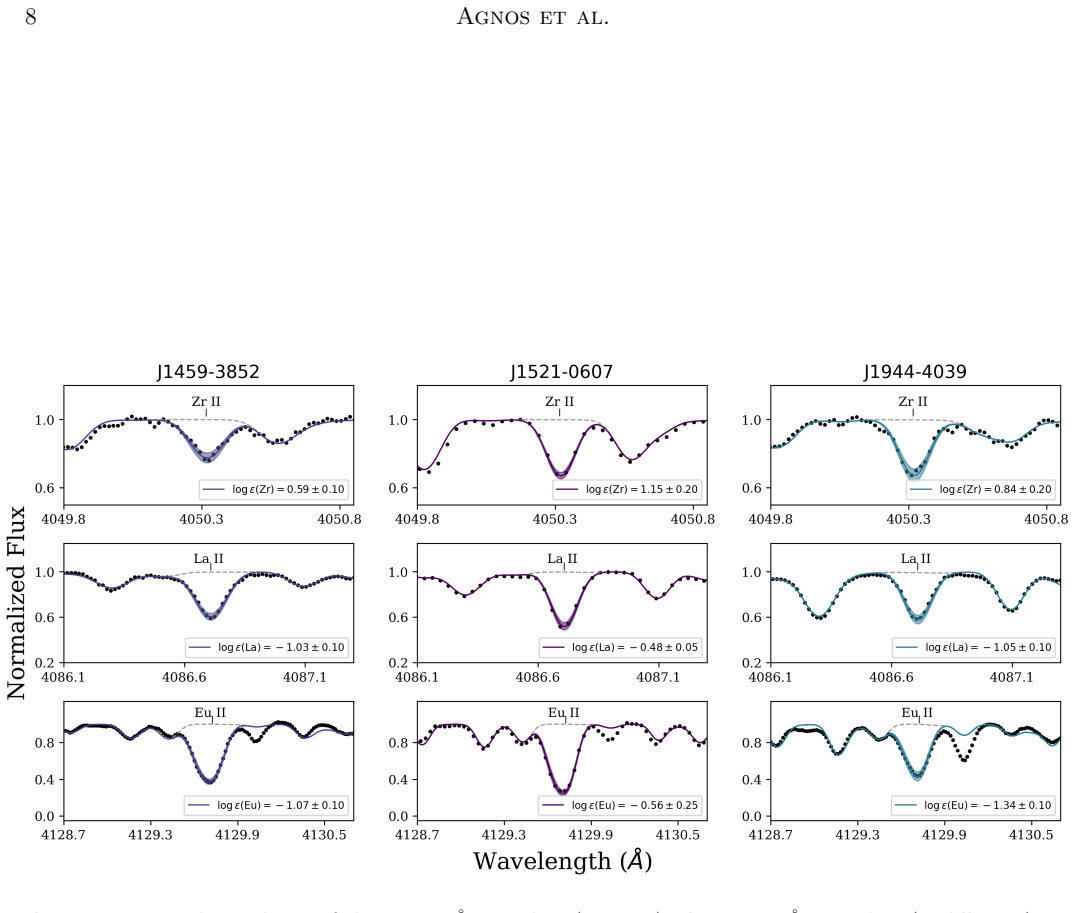
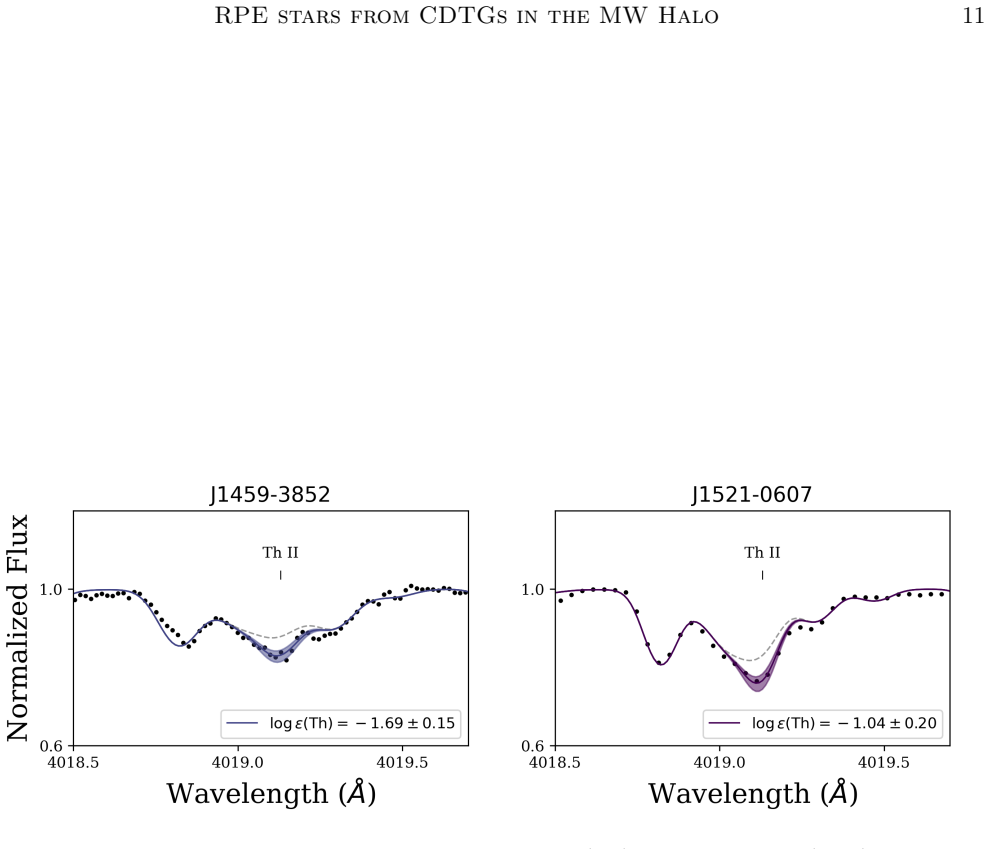
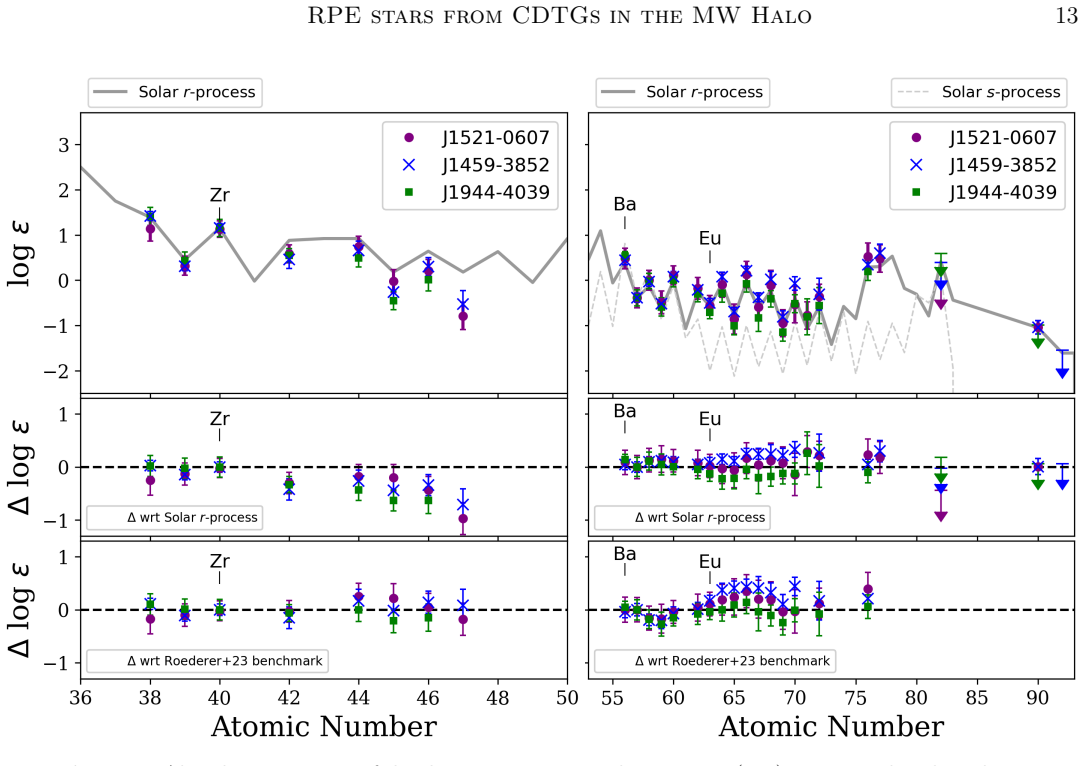
The authors analyze high-resolution, high signal-to-noise spectra of three metal-poor stars and derive abundances for 29 heavy elements. They confirm that 2MASS J14592981−3852558 and J15211026−0607566 qualify as r-II stars while 2MASS J19445483−4039459 falls just below the r-I threshold. Thorium-based dating shows the r-process material in the two r-II stars is older than 10 Gyr with no actinide boost; the r-II stars also display slight fission-fragment enhancement relative to the third star. The differing elemental patterns suggest the stars did not share a single birth environment, although each pattern is compatible with formation inside the Thamnos progenitor.
What carries the argument
Thorium radioactive age dating applied to detailed heavy-element abundance patterns measured from high-resolution MIKE spectra.
If this is right
- The two r-II stars show slight fission-fragment enhancement relative to the third star.
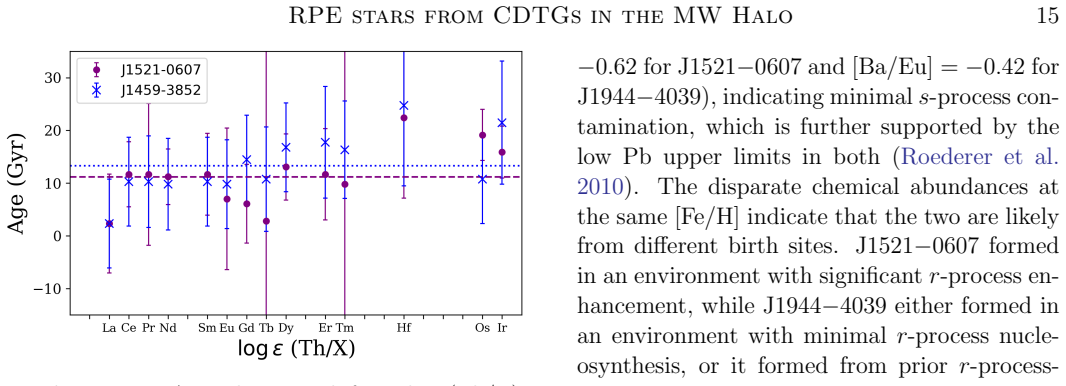
- Thorium dating places the r-process enrichment in the two r-II stars at more than 10 Gyr old.
- Neither r-II star exhibits an actinide boost.
- The three stars display distinct elemental patterns, indicating they did not form in the same environment.
- Each star's abundance pattern remains consistent with an origin inside the Thamnos progenitor.
Where Pith is reading between the lines
- These results imply that at least some r-process events occurred inside dwarf galaxies that were later accreted by the Milky Way.
- Additional high-resolution observations of other Thamnos-associated stars could test whether a single r-process site produced the observed patterns.
- The lack of actinide boost constrains the possible neutron-star merger or collapsar models that operated more than 10 Gyr ago.
- If the Thamnos link holds, it supplies a concrete example of how chemodynamic tagging can connect individual stars to specific accretion events.
Load-bearing premise
The stars' tentative membership in chemodynamically tagged groups and the Thamnos structure rests on earlier snapshot data that may not survive fuller kinematic or chemical checks.
What would settle it
New thorium abundance measurements that yield ages under 10 Gyr or kinematic data placing any of the three stars outside the Thamnos velocity and position range would falsify the reported ages and common-origin claim.
Figures

read the original abstract
As part of the ongoing work of the $R$-Process Alliance (RPA), detailed abundance measurements of 29 heavy elements in three metal-poor stars, 2MASS J14592981$-$3852558, 2MASS J19445483$-$4039459, and 2MASS J15211026$-$0607566, are presented based on an analysis of high-resolution ($R\sim 80,000$), high signal-to-noise ``portrait'' spectra from the Magellan Inamori Kyocera Echelle (MIKE) spectrograph on the Magellan-Clay Telescope at Las Campanas Observatory. The selected targets were identified as $r$-process-enhanced metal-poor stars in previous RPA snapshot analyses. They have also been linked to possible chemodynamically tagged groups, indicating that the stars may have formed in dwarf galaxies that were later accreted into the Milky Way halo. These stars have also been tentatively linked to the Thamnos structure. The detailed chemical abundances in this work confirm that 2MASS J14592981$-$3852558 and J15211026$-$0607566 are $r$-II stars, while 2MASS J19445483$-$4039459 is found to lie just below the threshold for $r$-I status. The $r$-II stars show signs of slight enhancement in fission fragments compared to 2MASS J19445483$-$4039459. Based on radioactive age dating with Th, the $r$-process material in the two $r$-II stars is found to be old (with ages $>10$ Gyr); neither star shows signs of an actinide boost. The varying elemental compositions suggest that these stars likely did not originate in the same environment, though each could be consistent with originating in the Thamnos progenitor.
Editorial analysis
A structured set of objections, weighed in public.
Referee Report
Summary. The manuscript reports high-resolution (R~80,000) MIKE spectra and detailed abundances for 29 heavy elements in three metal-poor stars previously flagged as r-process enhanced in RPA snapshot work. It confirms 2MASS J14592981−3852558 and J15211026−0607566 as r-II stars, places 2MASS J19445483−4039459 just below the r-I threshold, derives Th-based ages >10 Gyr with no actinide boost for the r-II stars, notes slight fission-fragment differences, and interprets the varying patterns as evidence against a shared environment while remaining consistent with a Thamnos progenitor via prior chemodynamic tagging.
Significance. If the prior group assignments hold, the work supplies precise, multi-element data that can constrain r-process yields and timing in accreted dwarf-galaxy environments, adding to the RPA catalog with falsifiable age estimates. The absence of actinide boost and the >10 Gyr ages are useful benchmarks, but the interpretive power for Thamnos is limited by the lack of new verification of membership.
major comments (1)
- [Abstract and Discussion] Abstract and Discussion: The central interpretive claim that the abundance patterns are 'consistent with originating in the Thamnos progenitor' and that the stars 'likely did not originate in the same environment' rests on tentative prior chemodynamic group assignments that receive no new kinematic or chemical verification in this work. The new high-resolution abundances stand independently, but the contextual anchor to an accreted structure is not load-bearing tested here and would be weakened if the earlier snapshot identifications prove spurious.
minor comments (2)
- [Abstract] Abstract: The statement of 'slight enhancement in fission fragments' is not quantified (no specific elements, ratios, or comparison values are given); this should be tied to explicit abundance ratios or table entries for clarity.
- [Abstract] Abstract: No uncertainties or error bars are mentioned for the reported ages or abundances, even though the full analysis presumably includes them; the abstract should at minimum note that uncertainties are derived and reported in the text/tables.
Simulated Author's Rebuttal
We thank the referee for their careful review and recommendation for minor revision. We have revised the manuscript to address the concern by clarifying the basis of our interpretive statements.
read point-by-point responses
-
Referee: The central interpretive claim that the abundance patterns are 'consistent with originating in the Thamnos progenitor' and that the stars 'likely did not originate in the same environment' rests on tentative prior chemodynamic group assignments that receive no new kinematic or chemical verification in this work. The new high-resolution abundances stand independently, but the contextual anchor to an accreted structure is not load-bearing tested here and would be weakened if the earlier snapshot identifications prove spurious.
Authors: We appreciate the referee's observation that the Thamnos association draws from prior chemodynamic tagging in snapshot analyses rather than new kinematic or membership verification here. The statement that the stars 'likely did not originate in the same environment' is grounded in the differences among the new high-resolution abundance patterns (including fission-fragment variations) reported in this work, which are independent of the group assignments. The phrasing 'consistent with originating in the Thamnos progenitor' notes compatibility with the earlier tagging but does not claim independent confirmation. We have revised the abstract and discussion to state explicitly that the Thamnos link originates from prior chemodynamic studies (cited in the manuscript) and that the present abundances and Th-based ages stand alone as new results. These changes preserve the value of the multi-element data while making the scope of the contextual interpretation clear. revision: yes
Circularity Check
No circularity; new spectroscopic abundances and ages are independent of prior citations
full rationale
The paper derives its core results—abundances of 29 heavy elements, r-II/r-I classifications, slight fission-fragment enhancements, and Th-based ages >10 Gyr with no actinide boost—directly from new high-resolution MIKE spectra of three stars using standard abundance techniques. These measurements do not reduce to fitted parameters, self-definitions, or prior outputs. Prior RPA snapshot identifications and tentative chemodynamic/Thamnos linkages are cited only for target selection and contextual interpretation; the paper explicitly labels the linkages as tentative and does not use them to compute or force the abundance or age values. No equations, ansatzes, or uniqueness theorems are invoked that collapse back to self-citations or inputs.
Axiom & Free-Parameter Ledger
axioms (1)
- domain assumption Standard assumptions in stellar atmosphere modeling and spectral line formation for abundance derivation from high-resolution spectra
Reference graph
Works this paper leans on
-
[1]
Abolfathi, B., Aguado, D. S., Aguilar, G., et al.\ 2018, , 235, 42. doi:10.3847/1538-4365/aa9e8a
-
[2]
& Thielemann, F.-K.\ 2013, Journal of Physics G Nuclear Physics, 40, 013201
Arcones, A. & Thielemann, F.-K.\ 2013, Journal of Physics G Nuclear Physics, 40, 013201. doi:10.1088/0954-3899/40/1/013201
-
[3]
Arlandini, C., K \"a ppeler, F., Wisshak, K., et al.\ 1999, , 525, 2, 886. doi:10.1086/307938
-
[4]
Asplund, M., Grevesse, N., Sauval, A. J., et al.\ 2009, , 47, 481. doi:10.1146/annurev.astro.46.060407.145222
-
[5]
& Zwicky, F.\ 1934, Physical Review, 46, 76
Baade, W. & Zwicky, F.\ 1934, Physical Review, 46, 76. doi:10.1103/PhysRev.46.76.2
-
[6]
Bandyopadhyay, A., Ezzeddine, R., Allende Prieto, C., et al.\ 2024, , 274, 2, 39. doi:10.3847/1538-4365/ad6f0f
-
[7]
doi:10.1088/0004-637X/807/1/50
Bechtol, K., Drlica-Wagner, A., Balbinot, E., et al.\ 2015, , 807, 50. doi:10.1088/0004-637X/807/1/50
-
[8]
Beers, T. C. & Christlieb, N.\ 2005, , 43, 531. doi:10.1146/annurev.astro.42.053102.134057
-
[9]
doi:10.1051/0004-6361/201832842
Behar, E., Nilsson, H., Henri, P., et al.\ 2018, , 616, A21. doi:10.1051/0004-6361/201832842
-
[10]
Bernstein, R., Shectman, S. A., Gunnels, S. M., et al.\ 2003, , 4841, 1694. doi:10.1117/12.461502
-
[11]
M., Tumlinson, J., Geha, M., et al
Brown, T. M., Tumlinson, J., Geha, M., et al.\ 2014, , 796, 91. doi:10.1088/0004-637X/796/2/91
-
[12]
Burbidge, E. M., Burbidge, G. R., Fowler, W. A., et al.\ 1957, Reviews of Modern Physics, 29, 4, 547. doi:10.1103/RevModPhys.29.547
-
[13]
Burris, D. L., Pilachowski, C. A., Armandroff, T. E., et al.\ 2000, , 544, 1, 302. doi:10.1086/317172
-
[14]
Cain, M., Frebel, A., Ji, A. P., et al.\ 2020, , 898, 40. doi:10.3847/1538-4357/ab97ba
-
[15]
doi:10.1051/0004-6361/202244469
Contursi, G., de Laverny, P., Recio-Blanco, A., et al.\ 2023, , 670, A106. doi:10.1051/0004-6361/202244469
-
[16]
Cowperthwaite, P. S., Berger, E., Villar, V. A., et al.\ 2017, , 848, L17. doi:10.3847/2041-8213/aa8fc7
-
[17]
Curtis, S., Mösta, P., Wu, Z., et al.\ 2022, , 518, 5313. doi:10.1093/mnras/stac3128
-
[18]
Cui, X.-Q., Zhao, Y.-H., Chu, Y.-Q., et al.\ 2012, Research in Astronomy and Astrophysics, 12, 1197. doi:10.1088/1674-4527/12/9/003
-
[19]
doi:10.1051/0004-6361/202451978
Dodd, E., Ruiz-Lara, T., Helmi, A., et al.\ 2025, , 698, A277. doi:10.1051/0004-6361/202451978
-
[20]
Ezzeddine, R., Rasmussen, K., Frebel, A., et al.\ 2020, , 898, 150. doi:10.3847/1538-4357/ab9d1a
-
[21]
doi:10.1088/0004-637X/712/2/1359
Farouqi, K., Kratz, K.-L., Pfeiffer, B., et al.\ 2010, , 712, 1359. doi:10.1088/0004-637X/712/2/1359
-
[22]
Fitzpatrick, M., Placco, V., Bolton, A., et al.\ 2025, Astronomical Data Analysis Software and Systems XXXIII, 541, 461. doi:10.26624/CETF5821
-
[23]
Frebel, A. & Norris, J. E.\ 2015, , 53, 631. doi:10.1146/annurev-astro-082214-122423
-
[24]
Frebel, A.\ 2019, Annals of Physics, 410, 167909. doi:10.1016/j.aop.2019.167909
-
[25]
doi:10.1146/annurev-nucl-101917-021141
Frebel, A.\ 2018, Annual Review of Nuclear and Particle Science, 68, 237. doi:10.1146/annurev-nucl-101917-021141
-
[26]
Gaia Collaboration, Prusti, T., de Bruijne, J. H. J., et al.\ 2016, , 595, A1. doi:10.1051/0004-6361/201629272
-
[27]
doi:10.1051/0004-6361/201832865
Gaia Collaboration, Katz, D., Antoja, T., et al.\ 2018, , 616, A11. doi:10.1051/0004-6361/201832865
-
[28]
Gaia Collaboration, Vallenari, A., Brown, A. G. A., et al.\ 2023, , 674, A1. doi:10.1051/0004-6361/202243940
-
[29]
& Arnould, M.\ 2001, , 379, 1113
Goriely, S. & Arnould, M.\ 2001, , 379, 1113. doi:10.1051/0004-6361:20011368
-
[30]
Gudin, D., Shank, D., Beers, T. C., et al.\ 2021, , 908, 79. doi:10.3847/1538-4357/abd7ed
-
[31]
Hansen, T. T., Holmbeck, E. M., Beers, T. C., et al.\ 2018, , 858, 92. doi:10.3847/1538-4357/aabacc
-
[32]
Hattori, K., Okuno, A., & Roederer, I. U.\ 2023, , 946, 48. doi:10.3847/1538-4357/acb93b
-
[33]
doi:10.1051/0004-6361:20020434
Hill, V., Plez, B., Cayrel, R., et al.\ 2002, , 387, 560. doi:10.1051/0004-6361:20020434
-
[34]
Hill, V., Christlieb, N., Beers, T. C., et al.\ 2017, , 607, A91. doi:10.1051/0004-6361/201629092
-
[35]
Holden, N.E.\ 1990, Pure Appl. Chem. , 62, 941
work page 1990
-
[36]
Holmbeck, E. M., Sprouse, T. M., Mumpower, M. R., et al.\ 2019, , 870, 23. doi:10.3847/1538-4357/aaefef
-
[37]
Holmbeck, E. M., Beers, T. C., Roederer, I. U., et al.\ 2018, , 859, L24. doi:10.3847/2041-8213/aac722
-
[38]
Holmbeck, E. M., Frebel, A., McLaughlin, G. C., et al.\ 2021, , 909, 21. doi:10.3847/1538-4357/abd720
-
[39]
Holmbeck, E. M., Hansen, T. T., Beers, T. C., et al.\ 2020, , 249, 30. doi:10.3847/1538-4365/ab9c19
-
[40]
Holmbeck, E. M. & Andrews, J. J.\ 2024, , 963, 110. doi:10.3847/1538-4357/ad1e52
-
[41]
Iwamoto, K., Brachwitz, F., Nomoto, K., et al.\ 1999, , 125, 439. doi:10.1086/313278
-
[42]
Ji, A. P. & Frebel, A.\ 2018, , 856, 138. doi:10.3847/1538-4357/aab14a
-
[43]
P., Frebel, A., Chiti, A., et al.\ 2016, , 531, 610
Ji, A. P., Frebel, A., Chiti, A., et al.\ 2016, , 531, 610. doi:10.1038/nature17425
-
[44]
Ji, A. P., Frebel, A., Simon, J. D., et al.\ 2016, , 830, 93. doi:10.3847/0004-637X/830/2/93
-
[45]
Kelson, D. D., Illingworth, G. D., van Dokkum, P. G., et al.\ 2000, , 531, 1, 184. doi:10.1086/308440
-
[46]
Kelson, D. D.\ 2003, , 115, 808, 688. doi:10.1086/375502
-
[47]
Koposov, S. E., Casey, A. R., Belokurov, V., et al.\ 2015, , 811, 62. doi:10.1088/0004-637X/811/1/62
-
[48]
H., Helmi, A., Massari, D., et al.\ 2019, , 631, L9
Koppelman, H. H., Helmi, A., Massari, D., et al.\ 2019, , 631, L9. doi:10.1051/0004-6361/201936738
-
[49]
H., Helmi, A., Massari, D., et al.\ 2019, , 625, A5
Koppelman, H. H., Helmi, A., Massari, D., et al.\ 2019, , 625, A5. doi:10.1051/0004-6361/201834769
-
[50]
doi:10.1088/0004-6256/146/5/134
Kordopatis, G., Gilmore, G., Steinmetz, M., et al.\ 2013, , 146, 134. doi:10.1088/0004-6256/146/5/134
-
[51]
Kunder, A., Kordopatis, G., Steinmetz, M., et al. 2017, , 153, 75. doi:10.3847/1538-3881/153/2/75
-
[52]
Lattimer, J. M. & Schramm, D. N.\ 1974, , 192, L145. doi:10.1086/181612
-
[53]
Limberg, G., Rossi, S., Beers, T. C., et al.\ 2021, , 907, 10. doi:10.3847/1538-4357/abcb87
-
[54]
& Ramirez-Ruiz, E.\ 2018, , 860, 89
Macias, P. & Ramirez-Ruiz, E.\ 2018, , 860, 89. doi:10.3847/1538-4357/aac3e0
-
[55]
A., Sharma, S., et al.\ 2022, , 926, 107
Malhan, K., Ibata, R. A., Sharma, S., et al.\ 2022, , 926, 107. doi:10.3847/1538-4357/ac4d2a
-
[56]
doi:10.1051/0004-6361/201424017
Mashonkina, L., Christlieb, N., & Eriksson, K.\ 2014, , 569, A43. doi:10.1051/0004-6361/201424017
-
[57]
doi:10.1146/annurev.astro.41.071601.170033
Massey, P.\ 2003, , 41, 15. doi:10.1146/annurev.astro.41.071601.170033
-
[58]
Matijevi c , G., Chiappini, C., Grebel, E. K., et al.\ 2017, , 603, A19. doi:10.1051/0004-6361/201730417
-
[59]
Metzger, B. D. & Berger, E.\ 2012, , 746, 48. doi:10.1088/0004-637X/746/1/48
-
[60]
doi:10.1088/0004-637X/810/2/109
Nishimura, N., Takiwaki, T., & Thielemann, F.-K.\ 2015, , 810, 109. doi:10.1088/0004-637X/810/2/109
-
[61]
Obergaulinger, M. & Aloy, M. \'A .\ 2022, , 512, 2489. doi:10.1093/mnras/stac613
-
[62]
Obergaulinger, M. & Reichert, M.\ 2023, arXiv:2303.12458. doi:10.48550/arXiv.2303.12458
-
[63]
Placco, V. M., Frebel, A., Beers, T. C., et al.\ 2014, , 797, 1, 21. doi:10.1088/0004-637X/797/1/21
-
[64]
Placco, V. M., Beers, T. C., Santucci, R. M., et al.\ 2018, , 155, 256. doi:10.3847/1538-3881/aac20c
-
[65]
Placco, V. M., Santucci, R. M., Beers, T. C., et al.\ 2019, , 870, 2, 122. doi:10.3847/1538-4357/aaf3b9
-
[66]
Placco, V. M., Sneden, C., Roederer, I. U., et al.\ 2021, Research Notes of the American Astronomical Society, 5, 4, 92. doi:10.3847/2515-5172/abf651
-
[67]
Placco, V. M., Sneden, C., Roederer, I. U., et al.\ 2021, Astrophysics Source Code Library. ascl:2104.027
work page 2021
-
[68]
Placco, V. M., Holmbeck, E. M., Frebel, A., et al.\ 2017, , 844, 18. doi:10.3847/1538-4357/aa78ef
-
[69]
M., Almeida-Fernandes, F., Holmbeck, E
Placco, V. M., Almeida-Fernandes, F., Holmbeck, E. M., et al.\ 2023, , 959, 1, 60. doi:10.3847/1538-4357/ad077e
-
[70]
Qian, Y.-Z., Vogel, P., & Wasserburg, G. J.\ 1998, , 506, 868. doi:10.1086/306285
-
[71]
Racca, M., Hansen, T. T., Roederer, I. U., et al.\ 2025, , 704, A282. doi:10.1051/0004-6361/202556947
-
[72]
doi:10.1051/0004-6361/202346556
Roberti, L., Pignatari, M., Psaltis, A., et al.\ 2023, , 677, A22. doi:10.1051/0004-6361/202346556
-
[73]
Roederer, I. U., Cowan, J. J., Karakas, A. I., et al.\ 2010, , 724, 2, 975. doi:10.1088/0004-637X/724/2/975
-
[74]
U., Hattori, K., & Valluri, M.\ 2018a, , 156, 179
Roederer, I. U., Hattori, K., & Valluri, M.\ 2018a, , 156, 179. doi:10.3847/1538-3881/aadd9c
-
[75]
Roederer, I. U., Sakari, C. M., Placco, V. M., et al.\ 2018b, , 865, 2, 129. doi:10.3847/1538-4357/aadd92
-
[76]
Roederer, I. U., Cowan, J. J., Pignatari, M., et al.\ 2022, , 936, 1, 84. doi:10.3847/1538-4357/ac85bc
-
[77]
Roederer, I. U., Vassh, N., Holmbeck, E. M., et al.\ 2023, Science, 382, 6675, 1177. doi:10.1126/science.adf1341
-
[78]
Roederer, I. U., Beers, T. C., Hattori, K., et al.\ 2024, , 971, 2, 158. doi:10.3847/1538-4357/ad57bf
-
[79]
Roederer, I. U.\ 2009, , 137, 272. doi:10.1088/0004-6256/137/1/272
-
[80]
Sakari, C. M., Roederer, I. U., Placco, V. M., et al.\ 2019, , 874, 148. doi:10.3847/1538-4357/ab0c02
discussion (0)
Sign in with ORCID, Apple, or X to comment. Anyone can read and Pith papers without signing in.