Recognition: 2 theorem links
· Lean TheoremCausal Fairness for Survival Analysis
Pith reviewed 2026-05-13 02:36 UTC · model grok-4.3
The pith
A causal framework decomposes survival disparities into direct, indirect, and spurious pathways to explain their origins and evolution.
A machine-rendered reading of the paper's core claim, the machinery that carries it, and where it could break.
Core claim
The central claim is that disparities in survival data can be decomposed into direct, indirect, and spurious causal contributions by formalizing assumptions about censoring and lack of confounding in a graphical model, recovering the conditional survival function given covariates, applying the Causal Reduction Theorem to reframe the problem for pathway analysis, and performing non-parametric estimation of the resulting effects.
What carries the argument
The Causal Reduction Theorem, which reframes the survival fairness problem into a form that permits explicit decomposition of disparities along direct, indirect, and spurious pathways.
Load-bearing premise
The graphical model assumptions about censoring being independent of the outcome given covariates and the absence of unmeasured confounding are sufficient to recover the conditional survival functions needed for decomposition.
What would settle it
A simulation experiment in which known direct, indirect, and spurious effects are injected into synthetic survival data and the method's estimated pathway contributions fail to recover the injected values.
Figures


read the original abstract
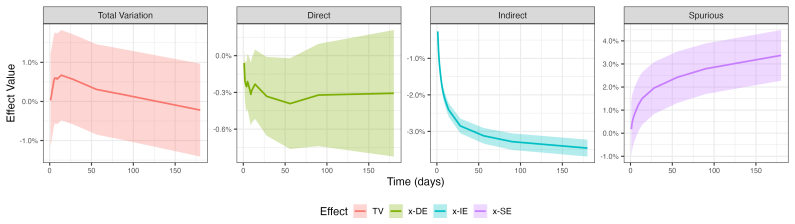
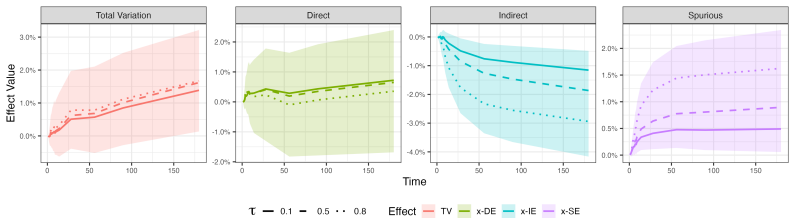
In the data-driven era, large-scale datasets are routinely collected and analyzed using machine learning (ML) and artificial intelligence (AI) to inform decisions in high-stakes domains such as healthcare, employment, and criminal justice, raising concerns about the fairness behavior of these systems. Existing works in fair ML cover tasks such as bias detection, fair prediction, and fair decision-making, but largely focus on static settings. At the same time, fairness in temporal contexts, particularly survival/time-to-event (TTE) analysis, remains relatively underexplored, with current approaches to fair survival analysis adopting statistical fairness definitions, which, even with unlimited data, cannot disentangle the causal mechanisms that generate disparities. To address this gap, we develop a causal framework for fairness in TTE analysis, enabling the decomposition of disparities in survival into contributions from direct, indirect, and spurious pathways. This provides a human-understandable explanation of why disparities arise and how they evolve over time. Our non-parametric approach proceeds in four steps: (1) formalizing the necessary assumptions about censoring and lack of confounding using a graphical model; (2) recovering the conditional survival function given covariates; (3) applying the Causal Reduction Theorem to reframe the problem in a form amenable to causal pathway decomposition; (4) estimating the effects efficiently. Finally, our approach is used to analyze the temporal evolution of racial disparities in outcome after admission to an intensive care unit (ICU).
Editorial analysis
A structured set of objections, weighed in public.
Referee Report
Summary. The paper claims to develop a causal framework for fairness in survival/time-to-event analysis that decomposes observed disparities into direct, indirect, and spurious pathway contributions. It proceeds non-parametrically in four steps: (1) formalizing censoring and no-confounding assumptions via a graphical model, (2) recovering the conditional survival function S(t|X), (3) invoking the Causal Reduction Theorem to enable pathway decomposition, and (4) efficient estimation, with an application to temporal racial disparities in ICU data.
Significance. If the identification assumptions hold, the work meaningfully extends causal fairness methods to temporal settings by supplying human-interpretable, time-evolving explanations of disparity mechanisms that purely statistical fairness definitions cannot provide. The explicit use of the Causal Reduction Theorem together with a non-parametric pipeline is a strength, as is the concrete ICU demonstration that shows how the decomposition can be computed in practice.
major comments (2)
- [Abstract and §2–3] Abstract and four-step outline (§2–3): the central claim that the graphical model renders censoring conditionally independent of event time and blocks all backdoor paths is required for step (2) to recover an identifiable S(t|X) and for step (3) to apply the Causal Reduction Theorem. The manuscript provides no sensitivity analysis, partial-identification bounds, or robustness checks against informative censoring or unmeasured confounding, which are load-bearing for observational TTE data.
- [§5] Results and estimation section (§5): the reported temporal evolution of racial disparities contains no error bars, bootstrap intervals, or cross-validation diagnostics on the decomposed effects, leaving the quantitative claims about pathway contributions without uncertainty quantification.
minor comments (2)
- [Notation] Notation: distinguish more clearly between the observed conditional survival function and the interventional quantities that appear after the Causal Reduction Theorem is applied.
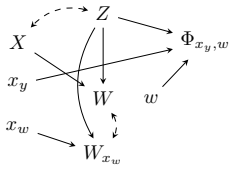
- [Figure 1] The graphical model figure would benefit from explicit labels on the direct, indirect, and spurious paths to improve readability.
Simulated Author's Rebuttal
We thank the referee for their constructive feedback and for recognizing the significance of extending causal fairness methods to survival analysis. We address the two major comments point by point below and commit to revisions that strengthen the manuscript's robustness and empirical rigor.
read point-by-point responses
-
Referee: Abstract and four-step outline (§2–3): the central claim that the graphical model renders censoring conditionally independent of event time and blocks all backdoor paths is required for step (2) to recover an identifiable S(t|X) and for step (3) to apply the Causal Reduction Theorem. The manuscript provides no sensitivity analysis, partial-identification bounds, or robustness checks against informative censoring or unmeasured confounding, which are load-bearing for observational TTE data.
Authors: We agree that these assumptions are foundational and that the lack of sensitivity analysis represents a limitation in the current version. Our framework is explicitly non-parametric and relies on the graphical model for identification. In the revised manuscript, we will add a new subsection in the discussion that explores the implications of violating the censoring and no-confounding assumptions, including simple sensitivity analyses (e.g., varying the strength of potential unmeasured confounders) and partial identification bounds for the pathway contributions where analytically tractable. revision: yes
-
Referee: Results and estimation section (§5): the reported temporal evolution of racial disparities contains no error bars, bootstrap intervals, or cross-validation diagnostics on the decomposed effects, leaving the quantitative claims about pathway contributions without uncertainty quantification.
Authors: We concur that uncertainty quantification is essential for interpreting the empirical results. The original manuscript prioritized presenting the decomposition methodology and qualitative trends in the ICU data. For the revision, we will recompute the estimates with bootstrap resampling to provide 95% confidence intervals for each pathway contribution over time and include cross-validation results for the non-parametric estimators used in Section 5. revision: yes
Circularity Check
Derivation relies on external Causal Reduction Theorem and graphical model assumptions; no internal reduction to fitted quantities
full rationale
The four-step non-parametric approach formalizes censoring/no-confounding assumptions via a graphical model, recovers the conditional survival function S(t|X), invokes the Causal Reduction Theorem to enable pathway decomposition, and estimates effects. No equation or step equates a claimed prediction to a fitted parameter by construction, nor renames a known result. The theorem and identification results are treated as external inputs rather than derived within the paper, so the central fairness decomposition does not collapse to self-definition or self-citation load-bearing. This yields only a minor score for possible incidental self-citations that do not carry the main claim.
Axiom & Free-Parameter Ledger
axioms (1)
- domain assumption Assumptions about censoring and lack of confounding hold as formalized in the graphical model.
Lean theorems connected to this paper
-
IndisputableMonolith/Foundation/RealityFromDistinction.leanreality_from_one_distinction unclear?
unclearRelation between the paper passage and the cited Recognition theorem.
Theorem 1 (Reduced Standard Fairness Model): ... the structural mechanism of the random variable Φ is then given by f_Φ(x,z,w)=ϕ(P(T|X=x,Z=z,W=w)). Therefore, the variable Φ is a deterministic function of X,Z,W...
-
IndisputableMonolith/Foundation/AbsoluteFloorClosure.leanabsolute_floor_iff_bare_distinguishability unclear?
unclearRelation between the paper passage and the cited Recognition theorem.
Our non-parametric approach proceeds in four steps: (1) formalizing the necessary assumptions about censoring and lack of confounding using a graphical model; (2) recovering the conditional survival function...
What do these tags mean?
- matches
- The paper's claim is directly supported by a theorem in the formal canon.
- supports
- The theorem supports part of the paper's argument, but the paper may add assumptions or extra steps.
- extends
- The paper goes beyond the formal theorem; the theorem is a base layer rather than the whole result.
- uses
- The paper appears to rely on the theorem as machinery.
- contradicts
- The paper's claim conflicts with a theorem or certificate in the canon.
- unclear
- Pith found a possible connection, but the passage is too broad, indirect, or ambiguous to say the theorem truly supports the claim.
Reference graph
Works this paper leans on
-
[1]
O. Aalen. Nonparametric inference for a family of counting processes.The Annals of Statistics, pages 701–726, 1978
work page 1978
-
[2]
J. Angwin, J. Larson, S. Mattu, and L. Kirchner. Machine bias: There’s soft- ware used across the country to predict future criminals. and it’s biased against blacks.ProPublica, 5 2016. URL https://www.propublica.org/article/ machine-bias-risk-assessments-in-criminal-sentencing
work page 2016
-
[3]
H. Bang and J. M. Robins. Doubly robust estimation in missing data and causal inference models.Biometrics, 61(4):962–973, 2005
work page 2005
-
[4]
F. D. Blau and L. M. Kahn. The gender earnings gap: learning from international comparisons. The American Economic Review, 82(2):533–538, 1992
work page 1992
-
[5]
F. D. Blau and L. M. Kahn. The gender wage gap: Extent, trends, and explanations.Journal of economic literature, 55(3):789–865, 2017
work page 2017
-
[6]
R. Braekers and N. Veraverbeke. A copula-graphic estimator for the conditional survival function under dependent censoring.Canadian Journal of Statistics, 33(3):429–447, 2005
work page 2005
-
[7]
T. Brennan, W. Dieterich, and B. Ehret. Evaluating the predictive validity of the compas risk and needs assessment system.Criminal Justice and Behavior, 36(1):21–40, 2009
work page 2009
-
[8]
J. Buolamwini and T. Gebru. Gender shades: Intersectional accuracy disparities in commercial gender classification. In S. A. Friedler and C. Wilson, editors,Proceedings of the 1st Conference on Fairness, Accountability and Transparency, volume 81 ofProceedings of Machine Learning Research, pages 77–91, NY , USA, 2018
work page 2018
-
[9]
T. Chen and C. Guestrin. Xgboost: A scalable tree boosting system. InProceedings of the 22nd acm sigkdd international conference on knowledge discovery and data mining, pages 785–794, 2016
work page 2016
-
[10]
V . Chernozhukov, D. Chetverikov, M. Demirer, E. Duflo, C. Hansen, W. Newey, and J. Robins. Double/debiased machine learning for treatment and structural parameters, 2018
work page 2018
-
[11]
S. Chiappa. Path-specific counterfactual fairness. InProceedings of the AAAI Conference on Artificial Intelligence, volume 33, pages 7801–7808, 2019
work page 2019
-
[12]
E. Creager, D. Madras, T. Pitassi, and R. Zemel. Causal modeling for fairness in dynamical systems. InInternational conference on machine learning, pages 2185–2195. PMLR, 2020
work page 2020
-
[13]
A. Datta, M. C. Tschantz, and A. Datta. Automated experiments on ad privacy settings: A tale of opacity, choice, and discrimination.Proceedings on Privacy Enhancing Technologies, 2015 (1):92–112, Apr. 2015. doi: 10.1515/popets-2015-0007
-
[14]
J. P. Fine and R. J. Gray. A proportional hazards model for the subdistribution of a competing risk.Journal of the American statistical association, 94(446):496–509, 1999
work page 1999
-
[15]
I. O. Gallegos, R. A. Rossi, J. Barrow, M. M. Tanjim, S. Kim, F. Dernoncourt, T. Yu, R. Zhang, and N. K. Ahmed. Bias and fairness in large language models: A survey.Computational Linguistics, 50(3):1097–1179, 2024
work page 2024
- [16]
-
[17]
H. Ishwaran, U. B. Kogalur, E. H. Blackstone, and M. S. Lauer. Random survival forests.The Annals of Applied Statistics, 2(3):841–860, Sept. 2008. doi: 10.1214/08-AOAS169
-
[18]
E. L. Kaplan and P. Meier. Nonparametric estimation from incomplete observations.Journal of the American statistical association, 53(282):457–481, 1958
work page 1958
-
[19]
A. E. Khandani, A. J. Kim, and A. W. Lo. Consumer credit-risk models via machine-learning algorithms.Journal of Banking & Finance, 34(11):2767–2787, 2010. 10
work page 2010
-
[20]
J. P. Klein and M. L. Moeschberger.Survival Analysis. Statistics for Biology and Health. Springer, New York, NY , 1 edition, September 1999
work page 1999
-
[21]
W. A. Knaus, D. P. Wagner, E. A. Draper, J. E. Zimmerman, M. Bergner, P. G. Bastos, C. A. Sirio, D. J. Murphy, T. Lotring, A. Damiano, et al. The apache iii prognostic system: risk prediction of hospital mortality for critically iii hospitalized adults.Chest, 100(6):1619–1636, 1991
work page 1991
-
[22]
M. J. Kusner, J. Loftus, C. Russell, and R. Silva. Counterfactual fairness.Advances in neural information processing systems, 30, 2017
work page 2017
-
[23]
T. Lange and J. V . Hansen. Direct and indirect effects in a survival context.Epidemiology, 22 (4):575–581, 2011
work page 2011
- [24]
-
[25]
J. F. Mahoney and J. M. Mohen. Method and system for loan origination and underwriting, Oct. 23 2007. US Patent 7,287,008
work page 2007
-
[26]
S. K. McGowan, K. A. Sarigiannis, S. C. Fox, M. A. Gottlieb, and E. Chen. Racial disparities in icu outcomes: a systematic review.Critical care medicine, 50(1):1–20, 2022
work page 2022
-
[27]
R. Nabi, D. Malinsky, and I. Shpitser. Learning optimal fair policies. InInternational conference on machine learning, pages 4674–4682. PMLR, 2019
work page 2019
-
[28]
W. Nelson. Theory and applications of hazard plotting for censored failure data.Technometrics, 14(4):945–966, 1972
work page 1972
-
[29]
D. Pager. The mark of a criminal record.American journal of sociology, 108(5):937–975, 2003
work page 2003
-
[30]
Pearl.Causality: Models, Reasoning, and Inference
J. Pearl.Causality: Models, Reasoning, and Inference. Cambridge University Press, New York,
-
[31]
D. Pessach and E. Shmueli. A review on fairness in machine learning.ACM Computing Surveys (CSUR), 55(3):1–44, 2022
work page 2022
- [32]
-
[33]
D. Ple ˇcko and E. Bareinboim. Causal fairness analysis: A causal toolkit for fair machine learning.Foundations and Trends® in Machine Learning, 17(3):304–589, 2024
work page 2024
-
[34]
D. Plecko, P. Secombe, A. Clarke, A. Fiske, S. Toby, D. Duff, D. Pilcher, L. A. Celi, R. Bellomo, and E. Bareinboim. An algorithmic approach for causal health equity: A look at race differentials in intensive care unit (icu) outcomes.arXiv preprint arXiv:2501.05197, 2025
-
[35]
M. M. Rahman and S. Purushotham. Fair and interpretable models for survival analysis. In Proceedings of the 28th ACM SIGKDD Conference on Knowledge Discovery and Data Mining, pages 1452–1462, 2022
work page 2022
-
[36]
P. Royston and M. K. Parmar. Restricted mean survival time: an alternative to the hazard ratio for the design and analysis of randomized trials with a time-to-event outcome.BMC medical research methodology, 13(1):152, 2013
work page 2013
-
[37]
P. Secombe, J. Millar, E. Litton, S. Chavan, T. Hensman, G. K. Hart, A. Slater, R. Herkes, S. Huckson, and D. V . Pilcher. Thirty years of anzics core: a clinical quality success story. Critical Care and Resuscitation, 25(1):43–46, 2023
work page 2023
-
[38]
M. Y . Shaheen. Applications of artificial intelligence (ai) in healthcare: A review.ScienceOpen Preprints, 2021
work page 2021
-
[39]
I. Shpitser and J. Pearl. What counterfactuals can be tested. InProceedings of the Twenty-third Conference on Uncertainty in Artificial Intelligence, page 352–359, 2007. 11
work page 2007
-
[40]
R. Sonabend, F. Pfisterer, A. Mishler, M. Schauer, L. Burk, S. Mukherjee, and S. V ollmer. Flexible group fairness metrics for survival analysis.arXiv preprint arXiv:2206.03256, 2022
-
[41]
P. J. Stow, G. K. Hart, T. Higlett, C. George, R. Herkes, D. McWilliam, R. Bellomo, A. D. M. Committee, et al. Development and implementation of a high-quality clinical database: the australian and new zealand intensive care society adult patient database.Journal of critical care, 21(2):133–141, 2006
work page 2006
-
[42]
L. Sweeney. Discrimination in online ad delivery. Technical Report 2208240, SSRN, Jan. 28
-
[43]
URLhttp://dx.doi.org/10.2139/ssrn.2208240
-
[44]
L. T. Sweeney and C. Haney. The influence of race on sentencing: A meta-analytic review of experimental studies.Behavioral Sciences & the Law, 10(2):179–195, 1992
work page 1992
-
[45]
T. J. VanderWeele. Causal mediation analysis with survival data.Epidemiology, 22(4):582–585, 2011
work page 2011
- [46]
-
[47]
J. Zhang and E. Bareinboim. Fairness in decision-making—the causal explanation formula. In Proceedings of the AAAI Conference on Artificial Intelligence, volume 32, 2018. 12 Technical Appendices forCausal F airness for Survival Analysis The source code for reproducing all the experiments can be found in our anonymized code reposi- tory https://anonymous.4...
work page 2018
discussion (0)
Sign in with ORCID, Apple, or X to comment. Anyone can read and Pith papers without signing in.