Recognition: no theorem link
Digital Identity for Agentic Systems: Toward a Portable Authorization Standard for Autonomous Agents
Pith reviewed 2026-05-13 01:58 UTC · model grok-4.3
The pith
Autonomous agents need explicit authorization payloads that any receiver can interpret the same way across trust boundaries.
A machine-rendered reading of the paper's core claim, the machinery that carries it, and where it could break.
Core claim
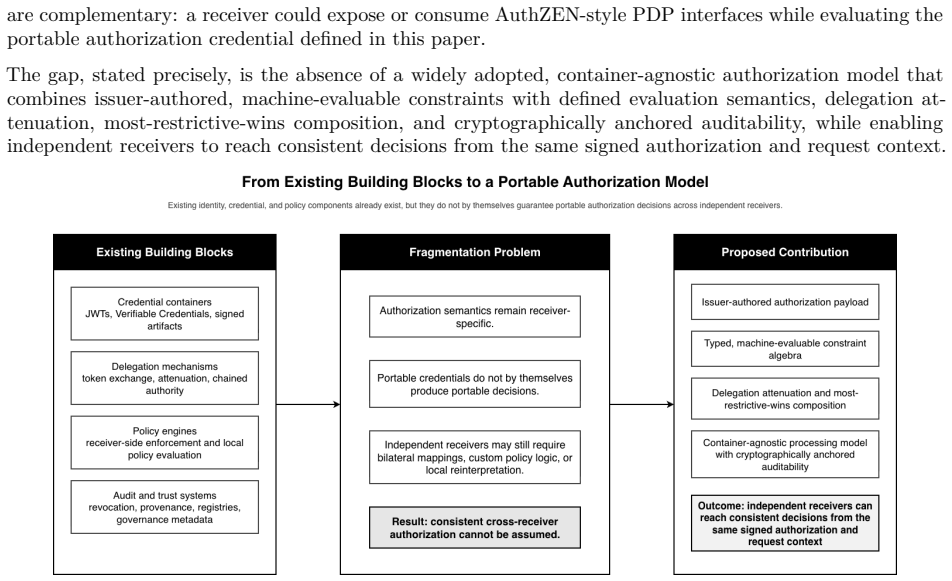
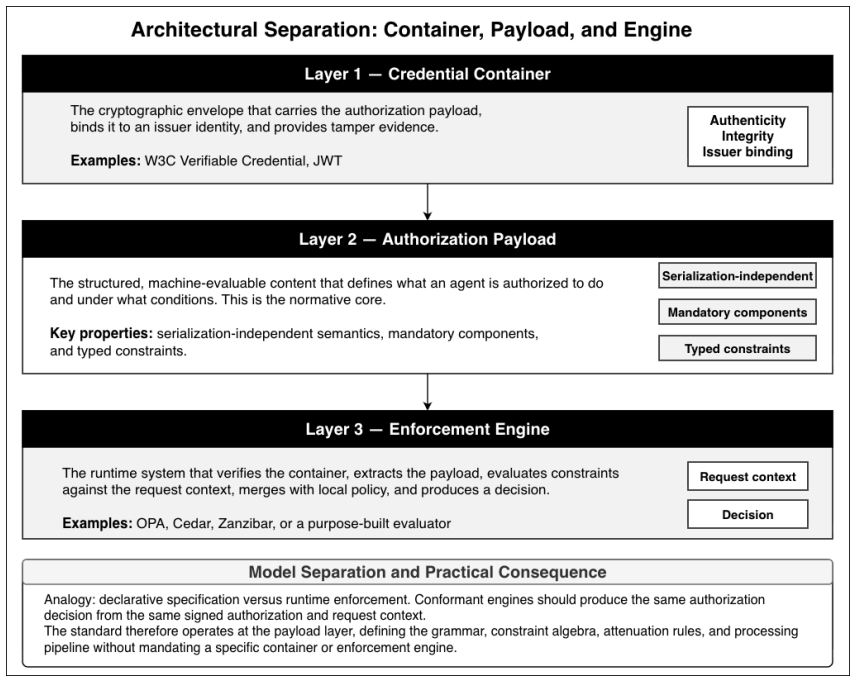
The paper claims that a portable authorization model for autonomous agents can be built from issuer-authored authorization payloads, typed constraint algebra, decision-consistent evaluation semantics, delegation attenuation, governed semantic resolution, fail-closed processing, and pre-flight discovery. By keeping credential containers, authorization payload semantics, and enforcement engines distinct, different technical profiles preserve a single authorization meaning as agents move between organizations.
What carries the argument
The separation of credential containers from authorization payload semantics and enforcement engines, which carries the common authorization meaning across profiles such as JWT/JWS or Verifiable Credentials.
If this is right
- Agents can delegate authority only with explicit attenuation so limits travel with the delegation.
- Fail-closed processing blocks any action whose permission is not clearly granted.
- Pre-flight discovery lets an agent learn its effective permissions before starting a workflow.
- Insurance and supply-chain workflows gain consistent enforcement without building new point-to-point integrations.
- Existing identity formats can be reused while the authorization rules stay portable and auditable.
Where Pith is reading between the lines
- Agent platforms may need to embed the evaluation semantics directly so that constraints are checked before any external call is made.
- Audit logs could record the exact constraint algebra that produced each decision, easing regulatory review of agent actions.
- The model suggests that revocation lists or status checks can be tied to the authorization payload rather than the underlying credential alone.
- Testing with real cross-organization agent runs would show whether the semantic resolution rules prevent conflicting interpretations in practice.
Load-bearing premise
Independent receivers will apply the typed constraint rules and evaluation semantics in exactly the same way without extra shared standards or implementation agreements.
What would settle it
Two separate implementations receive identical authorization payloads for the same agent action and reach different allow-or-deny decisions.
Figures




read the original abstract
Enterprise AI is shifting from copilots to autonomous agents capable of executing workflows, negotiating outcomes, and making decisions with limited human oversight. As these systems extend across organizational boundaries, identity alone is insufficient: an agent's authority must also be explicit, constrained, auditable, revocable, and consistently interpretable by independent receivers. This paper analyzes representative enterprise use cases in insurance claims processing and supply chain integrity to surface structural gaps in existing identity and access models. It proposes a portable authorization model for autonomous agents based on issuer-authored authorization payloads, typed constraint algebra, decision-consistent evaluation semantics, delegation attenuation, governed semantic resolution, fail-closed processing, and pre-flight discovery. The model separates credential containers, authorization payload semantics, and enforcement engines, allowing profiles such as JWT/JWS, Verifiable Credentials, OAuth Rich Authorization Requests, or policy-engine bindings to preserve a common authorization meaning across trust boundaries.
Editorial analysis
A structured set of objections, weighed in public.
Referee Report
Summary. The paper analyzes gaps in existing identity and access models for autonomous enterprise AI agents operating across organizational boundaries, using insurance claims processing and supply chain integrity as motivating use cases. It proposes a portable authorization model built on issuer-authored authorization payloads, typed constraint algebra, decision-consistent evaluation semantics, delegation attenuation, governed semantic resolution, fail-closed processing, and pre-flight discovery. The model separates credential containers (e.g., JWT/JWS, Verifiable Credentials, OAuth RAR) from payload semantics and enforcement engines to enable consistent authorization meaning and decisions across trust boundaries.
Significance. If the proposed components can be formalized and shown to produce identical decisions at independent receivers, the work would offer a practical path toward interoperable authorization standards for agentic systems. The use-case analysis usefully surfaces real enterprise requirements for constrained, auditable, and revocable authority; the separation of concerns is a sound architectural principle that could reduce fragmentation if the semantics are made precise.
major comments (2)
- [Proposed portable authorization model (as described in the abstract and model overview)] The central claim that profiles such as JWT/JWS, Verifiable Credentials, and OAuth Rich Authorization Requests 'preserve a common authorization meaning across trust boundaries' rests on the unformalized 'typed constraint algebra' and 'decision-consistent evaluation semantics'. No operators, typing rules, axioms, or canonical evaluation procedure are supplied for the algebra, so nothing enforces that two independent receivers compute the same outcome for a given payload even under fail-closed processing. This directly weakens the assertion of consistent interpretation without additional standardization.
- [Proposed portable authorization model (as described in the abstract and model overview)] Delegation attenuation and governed semantic resolution are listed as core mechanisms yet receive no operational definitions or rules for how attenuation is computed or how semantic resolution is governed. Without these, the claim that the model supports revocable and constrained authority across receivers cannot be evaluated.
minor comments (2)
- [Use-case analysis] The use-case descriptions in insurance claims and supply chain would be strengthened by at least one concrete example showing a specific failure mode of an existing model (e.g., JWT scope or VC attribute) that the proposed elements would resolve.
- [Throughout] Terminology such as 'pre-flight discovery' and 'fail-closed processing' should be defined on first use or in a glossary to aid readers unfamiliar with the proposed terminology.
Simulated Author's Rebuttal
We thank the referee for the detailed and constructive review. The comments correctly identify areas where the manuscript would benefit from greater precision in the proposed model's formal elements. We address each major comment below and will revise the manuscript to incorporate additional detail.
read point-by-point responses
-
Referee: [Proposed portable authorization model (as described in the abstract and model overview)] The central claim that profiles such as JWT/JWS, Verifiable Credentials, and OAuth Rich Authorization Requests 'preserve a common authorization meaning across trust boundaries' rests on the unformalized 'typed constraint algebra' and 'decision-consistent evaluation semantics'. No operators, typing rules, axioms, or canonical evaluation procedure are supplied for the algebra, so nothing enforces that two independent receivers compute the same outcome for a given payload even under fail-closed processing. This directly weakens the assertion of consistent interpretation without additional standardization.
Authors: We agree that the manuscript introduces the typed constraint algebra and decision-consistent evaluation semantics at a conceptual level without supplying a complete set of operators, typing rules, or a canonical evaluation procedure. The paper's primary contribution is the architectural separation of credential containers from payload semantics and the identification of required properties (including fail-closed processing) to support portability. To strengthen the central claim, the revised manuscript will include an expanded model section that defines a core set of operators for the constraint algebra, basic typing rules, and a high-level canonical evaluation procedure sufficient to demonstrate decision consistency under the stated semantics. revision: yes
-
Referee: [Proposed portable authorization model (as described in the abstract and model overview)] Delegation attenuation and governed semantic resolution are listed as core mechanisms yet receive no operational definitions or rules for how attenuation is computed or how semantic resolution is governed. Without these, the claim that the model supports revocable and constrained authority across receivers cannot be evaluated.
Authors: We concur that operational definitions are necessary to evaluate the claims about delegation attenuation and governed semantic resolution. The manuscript currently presents these as essential mechanisms for supporting revocable and constrained authority but does not provide the computational rules or governance procedures. In the revision we will add dedicated subsections that supply operational definitions, including rules for computing attenuation (such as constraint intersection and reduction) and governance for semantic resolution (such as reference to issuer-controlled vocabularies or discovery registries). This will make the support for cross-boundary revocable authority more rigorously assessable. revision: yes
Circularity Check
Conceptual proposal with no derivation chain or self-referential reduction
full rationale
The manuscript is a design proposal that introduces concepts such as issuer-authored authorization payloads, typed constraint algebra, delegation attenuation, and governed semantic resolution to address gaps in existing identity models. No equations, fitted parameters, or predictive derivations are present. The text does not invoke self-citations as load-bearing justifications, nor does it define any element in terms of another element it claims to derive. The separation of credential containers, payload semantics, and enforcement engines is presented as an architectural choice rather than a result forced by prior definitions or fits. This is a standard non-circular outcome for a standards-oriented proposal paper.
Axiom & Free-Parameter Ledger
axioms (2)
- domain assumption Enterprise AI is shifting from copilots to autonomous agents capable of executing workflows with limited human oversight.
- domain assumption Existing identity and access models have structural gaps for agent authority across organizational boundaries.
invented entities (4)
-
typed constraint algebra
no independent evidence
-
delegation attenuation
no independent evidence
-
governed semantic resolution
no independent evidence
-
fail-closed processing
no independent evidence
Reference graph
Works this paper leans on
-
[1]
M. Jones, J. Bradley, and N. Sakimura, “JSON Web Token (JWT),” RFC 7519, IETF, May 2015. A vailable: https://www.rfc-editor.org/rfc/rfc7519
work page 2015
-
[2]
The OAuth 2.0 Authorization Framework,
D. Hardt, “The OAuth 2.0 Authorization Framework,” RFC 6749, IETF, October 2012. A vailable: https://www.rfc-editor.org/rfc/rfc6749
work page 2012
-
[3]
OAuth 2.0 Rich Authorization Requests,
T. Lodderstedt, D. Fett, and J. Schaar, “OAuth 2.0 Rich Authorization Requests,” RFC 9396, IETF, May 2023. A vailable: https://www.rfc-editor.org/rfc/rfc9396 44
work page 2023
-
[4]
M. Jones, A. Nadalin, B. Campbell, J. Bradley, and C. Mortimore, “OAuth 2.0 Token Exchange,” RFC 8693, IETF, January 2020. A vailable: https://www.rfc-editor.org/rfc/rfc8693
work page 2020
-
[5]
OAuth 2.0 Demonstrat- ing Proof-of-Possession at the Application Layer (DPoP),
D. Fett, B. Campbell, J. Bradley, T. Lodderstedt, M. Jones, and D. Waite, “OAuth 2.0 Demonstrat- ing Proof-of-Possession at the Application Layer (DPoP),” RFC 9449, IETF, September 2023. A vailable: https://www.rfc-editor.org/rfc/rfc9449
work page 2023
-
[6]
M. Jones, N. Sakimura, and J. Bradley, “JSON Web Key (JWK),” RFC 7517, IETF, May 2015. A vailable: https://www.rfc-editor.org/rfc/rfc7517
work page 2015
-
[7]
Verifiable Credentials Data Model v2.0,
World Wide Web Consortium (W3C), “Verifiable Credentials Data Model v2.0,” W3C Recommendation,
-
[8]
A vailable: https://www.w3.org/TR/vc-data-model-2.0/
-
[9]
Well-Known Uniform Resource Identifiers (URIs),
M. Nottingham, “Well-Known Uniform Resource Identifiers (URIs),” RFC 8615, IETF, May 2019. A vail- able: https://www.rfc-editor.org/rfc/rfc8615 Informative References
work page 2019
-
[10]
Agent Identity Protocol: Agentic Authentication and Authorized Policy Enforcement,
J. Cao and C. Arango Gutierrez, “Agent Identity Protocol: Agentic Authentication and Authorized Policy Enforcement,” Internet-Draft draft-aip-agent-identity-protocol-00, IETF, March 2026. A vailable: https://datatracker.ietf.org/doc/html/draft-aip-agent-identity-protocol-00
work page 2026
-
[11]
Agentic JWT: A Secure Delegation Protocol for Autonomous AI Agents,
S. Ramachandran, N. Kothapalli, et al., “Agentic JWT: A Secure Delegation Protocol for Autonomous AI Agents,” arXiv, 2025. A vailable: https://arxiv.org/abs/2509.13603
-
[12]
User-Controlled Authorization Network (UCAN) Specification,
B. Zelenka et al., “User-Controlled Authorization Network (UCAN) Specification,” Version 1.0.0-rc.1,
-
[13]
A vailable: https://github.com/ucan-wg/spec
-
[14]
Biscuit Authorization Token: Specification and Documentation,
Biscuit Auth, “Biscuit Authorization Token: Specification and Documentation,” accessed April 2026. A vailable: https://www.biscuitsec.org/
work page 2026
-
[15]
eXtensible Access Control Markup Language (XACML) Version 3.0,
OASIS, “eXtensible Access Control Markup Language (XACML) Version 3.0,” OASIS Standard, January
-
[16]
A vailable: https://www.oasis-open.org/committees/tc_home.php?wg_abbrev=xacml
-
[17]
Open Policy Agent, “Policy Language Reference,” accessed April 2026. A vailable: https://www.openpolicyagent.org/docs/latest/policy-language/
work page 2026
-
[18]
Cedar Policy Language Reference Guide,
Cedar Policy, “Cedar Policy Language Reference Guide,” accessed April 2026. A vailable: https://docs.cedarpolicy.com/
work page 2026
-
[19]
Zanzibar: Google’s Consistent, Global Authoriza- tion System,
R. Pang, R. Caceres, M. Burrows, Z. Chen, P. Dave, N. Germer, A. Golynski, K. Graney, N. Kang, L. Kissner, J. Korn, A. Parmar, C. Richards, and M. Wang, “Zanzibar: Google’s Consistent, Global Authoriza- tion System,” in Proceedings of the 2019 USENIX Annual Technical Conference (USENIX ATC ’19) , 2019. A vailable: https://www.usenix.org/conference/atc19/p...
work page 2019
-
[20]
Authorization - Model Context Protocol,
Anthropic and contributors, “Authorization - Model Context Protocol,” Model Context Protocol Speci- fication, 2025. A vailable: https://modelcontextprotocol.io/specification/2025-06-18/basic/authorization
work page 2025
-
[21]
SPIFFE Project, “SPIFFE ID Specification,” accessed April 2026. A vailable: https://spiffe.io/docs/latest/spiffe-specs/spiffe-id/
work page 2026
-
[22]
Agent Discovery: The Agent Card,
Google, “Agent Discovery: The Agent Card,” Agent2Agent (A2A) Protocol Specification, accessed April
-
[23]
A vailable: https://google-a2a.github.io/A2A/latest/topics/agent-discovery/
-
[24]
Project NANDA, “Project NANDA Repository,” accessed April 2026. A vailable: https://github.com/projnanda/projnanda
work page 2026
-
[25]
OpenID Foundation, “Authorization API 1.0,” OpenID Final Specification, January 2026. A vailable: https://openid.net/specs/authorization-api-1_0.html
work page 2026
-
[26]
R. Iannella and S. Villata, “ODRL Information Model 2.2,” W3C Recommendation, February 2018. A vailable: https://www.w3.org/TR/odrl-model/ 45
work page 2018
-
[27]
Authorization Capabilities for Linked Data v0.3,
W3C Credentials Community Group, “Authorization Capabilities for Linked Data v0.3,” draft specifi- cation, accessed April 2026. A vailable: https://w3c-ccg.github.io/zcap-spec/
work page 2026
-
[28]
W3C Credentials Community Group, “Incubation Specifications,” accessed April 2026. A vailable: https://w3c-ccg.org/specifications/incubation/
work page 2026
-
[29]
OpenID Shared Signals Framework Specification 1.0,
OpenID Foundation, “OpenID Shared Signals Framework Specification 1.0,” OpenID Final Specification, August 2025. A vailable: https://openid.net/specs/openid-sharedsignals-framework-1_0-final.html
work page 2025
-
[30]
Building infrastructure for the Internet of Agents,
AGNTCY, “Building infrastructure for the Internet of Agents,” accessed April 2026. A vailable: https://agntcy.org/
work page 2026
-
[31]
Cedar Profile for OAuth 2.0 Rich Authorization Requests,
S. Cecchetti, “Cedar Profile for OAuth 2.0 Rich Authorization Requests,” Internet-Draft draft-cecchetti- oauth-rar-cedar-02, IETF, February 2024. A vailable: https://www.ietf.org/archive/id/draft-cecchetti-oauth- rar-cedar-02.html
work page 2024
-
[32]
Authenticated Delegation and Authorized AI Agents,
T. South, S. Marro, T. Hardjono, R. Mahari, C. D. Whitney, D. Greenwood, A. Chan, and A. Pent- land, “Authenticated Delegation and Authorized AI Agents,” arXiv:2501.09674, January 2025. A vailable: https://arxiv.org/abs/2501.09674 46
discussion (0)
Sign in with ORCID, Apple, or X to comment. Anyone can read and Pith papers without signing in.