Recognition: 2 theorem links
· Lean TheoremBlack Hole Ringdown Seen in Photon Polarization Swings
Pith reviewed 2026-05-13 01:37 UTC · model grok-4.3
The pith
Polarization angle swings in light near black holes lock directly to the ringdown quasi-normal modes.
A machine-rendered reading of the paper's core claim, the machinery that carries it, and where it could break.
Core claim
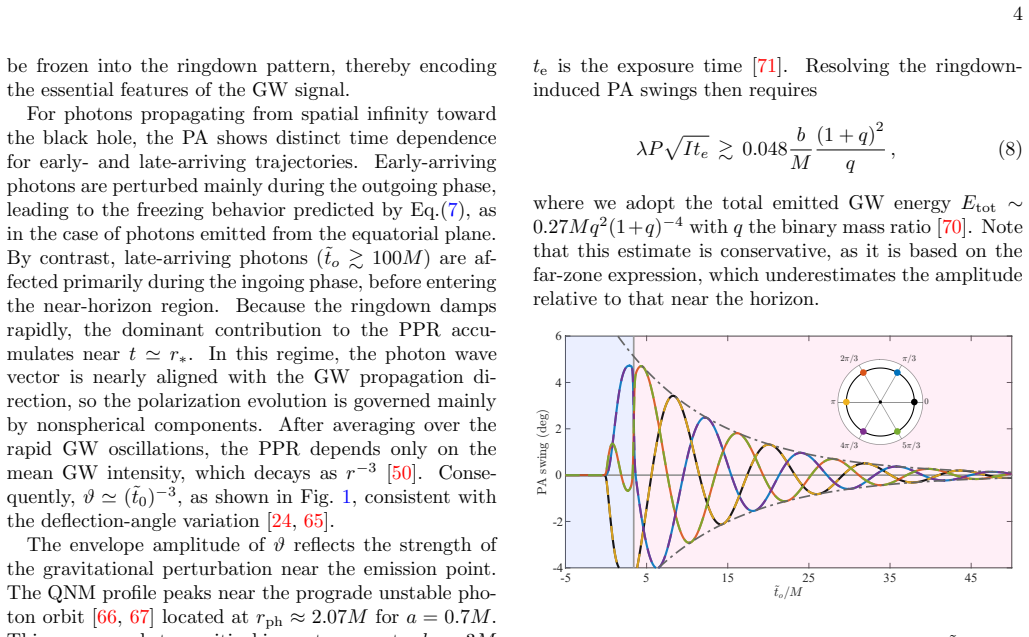
The authors develop a covariant perturbative framework for polarized photon propagation in generic curved spacetimes and derive a compact expression for the observable polarization-angle swing during Kerr ringdown, explicitly demonstrating its time-domain locking to the quasi-normal modes. Dynamical ray-tracing calculations for a broad class of photon trajectories confirm that photons grazing the strong-field region exhibit an achromatic, damped PA oscillation that tracks the ringdown, with a phase set by the mode's angular structure and swing amplitude reaching about 10 degrees, leaving distinctive signatures in spatially resolved autocorrelations.
What carries the argument
The covariant perturbative framework for polarized photon propagation in curved spacetimes, which produces a compact expression for the polarization-angle swing locked in time to quasi-normal modes.
If this is right
- Photons passing near the black hole display achromatic damped oscillations in polarization angle that directly follow the ringdown time evolution.
- The phase of each polarization swing is fixed by the angular structure of the underlying quasi-normal mode.
- Swing amplitudes reach approximately 10 degrees for photons grazing the strong-field region.
- Spatially resolved autocorrelations of the polarization data carry distinctive ringdown signatures.
- The effect supplies a new polarimetric channel for observing black hole mergers and ringdown.
Where Pith is reading between the lines
- High-resolution polarimetric telescopes could detect these swings to measure black hole spin and mass independently of gravitational-wave data.
- The polarization locking may combine with existing multi-messenger observations to test the no-hair theorem in the ringdown phase.
- Similar polarization imprints could appear around other compact objects or in modified gravity theories that alter quasi-normal mode spectra.
Load-bearing premise
The perturbative framework for polarized photon propagation accurately captures the dominant effect in the strong-field region without significant higher-order corrections or unaccounted plasma contributions.
What would settle it
Detection of light from a black hole merger that shows either no polarization-angle oscillation or one whose phase and damping fail to match the predicted quasi-normal mode frequencies and angular structure would falsify the locking result.
Figures


read the original abstract
Light propagating through a perturbed spacetime could imprint the underlying gravitational waveform directly onto electromagnetic observables. In this Letter, we develop a covariant perturbative framework for polarized photon propagation in generic curved spacetimes, and derive a compact expression for the observable polarization-angle (PA) swing during Kerr ringdown, explicitly demonstrating its time-domain locking to the quasi-normal modes. We confirm this behavior using dynamical ray-tracing calculations for a broad class of photon trajectories. Photons grazing the strong-field region exhibit an achromatic, damped PA oscillation that tracks the ringdown, with a phase set by the mode's angular structure. The swing amplitude can reach $\sim 10^{\circ}$ and leaves distinctive signatures in spatially resolved autocorrelations. These results open a new polarimetric window onto black hole mergers and ringdown.
Editorial analysis
A structured set of objections, weighed in public.
Referee Report
Summary. The paper claims to introduce a covariant perturbative framework for polarized photon propagation in curved spacetimes and derives a compact expression for the polarization angle (PA) swing during Kerr black hole ringdown, demonstrating its time-domain locking to quasi-normal modes (QNMs). This is confirmed through dynamical ray-tracing calculations for a broad class of photon trajectories, revealing an achromatic, damped PA oscillation that tracks the ringdown with phase determined by the mode's angular structure, amplitudes reaching approximately 10 degrees, and distinctive signatures in spatially resolved autocorrelations.
Significance. Assuming the result is robust, this provides a new way to observe black hole ringdown signatures in electromagnetic polarization data, which could be detectable with future instruments. The derivation of a compact, explicit expression and the numerical confirmation via ray-tracing are notable strengths that could enable new tests of strong-field gravity and multi-messenger studies of black hole mergers.
major comments (1)
- [Dynamical ray-tracing calculations] It is not explicitly stated whether the ray-tracing integrates the exact geodesic and parallel transport equations in the full perturbed metric or uses the linearized equations from the perturbative framework. This detail is load-bearing for validating the confirmation of the analytic result, particularly for trajectories grazing the strong-field region where higher-order corrections might be relevant.
minor comments (2)
- The abstract could benefit from a brief mention of the specific QNM modes considered (e.g., l=2, m=2) to provide more context for the phase setting.
- Ensure all equations in the derivation are numbered and referenced clearly in the text for ease of following the compact expression.
Simulated Author's Rebuttal
We thank the referee for their positive assessment of our work and for the constructive comment, which helps strengthen the presentation of our results. We address the point below.
read point-by-point responses
-
Referee: It is not explicitly stated whether the ray-tracing integrates the exact geodesic and parallel transport equations in the full perturbed metric or uses the linearized equations from the perturbative framework. This detail is load-bearing for validating the confirmation of the analytic result, particularly for trajectories grazing the strong-field region where higher-order corrections might be relevant.
Authors: We thank the referee for highlighting this important clarification. In the dynamical ray-tracing calculations presented in the manuscript, we integrate the exact geodesic and parallel transport equations in the full perturbed Kerr metric that includes the time-dependent ringdown perturbation (i.e., the exact equations, not the linearized perturbative framework). This choice ensures that the numerical results serve as an independent validation of the analytic perturbative expression, including for strong-field trajectories. We will revise the manuscript to state this explicitly, adding a sentence in the numerical methods section describing the integration scheme and confirming that the full metric is used. revision: yes
Circularity Check
No significant circularity; derivation and confirmation are independent
full rationale
The paper develops a covariant perturbative framework for polarized photon propagation, derives a compact PA-swing expression locked to QNMs, and confirms the behavior via dynamical ray-tracing on a broad class of trajectories. No load-bearing step reduces by construction to a fitted input, self-citation chain, or renamed ansatz; the analytic result and numerical verification are presented as separate. The derivation chain is therefore self-contained against external benchmarks.
Axiom & Free-Parameter Ledger
axioms (2)
- domain assumption Kerr metric describes the spacetime of a rotating black hole
- domain assumption Perturbative treatment of photon polarization in curved spacetime is valid
Lean theorems connected to this paper
-
IndisputableMonolith/Foundation/RealityFromDistinction.leanreality_from_one_distinction unclear?
unclearRelation between the paper passage and the cited Recognition theorem.
derive a compact expression for the observable polarization-angle (PA) swing during Kerr ringdown... ϑ(to) = |A| cos(ω_R to − Φ) e^{−ω_I to}
-
IndisputableMonolith/Foundation/AbsoluteFloorClosure.leanabsolute_floor_iff_bare_distinguishability unclear?
unclearRelation between the paper passage and the cited Recognition theorem.
Covariant perturbative framework... k^α ∇_α Θ_μν = R_μναβ k^α ξ^β + k^ρ ∇_[μ h_ν]ρ
What do these tags mean?
- matches
- The paper's claim is directly supported by a theorem in the formal canon.
- supports
- The theorem supports part of the paper's argument, but the paper may add assumptions or extra steps.
- extends
- The paper goes beyond the formal theorem; the theorem is a base layer rather than the whole result.
- uses
- The paper appears to rely on the theorem as machinery.
- contradicts
- The paper's claim conflicts with a theorem or certificate in the canon.
- unclear
- Pith found a possible connection, but the passage is too broad, indirect, or ambiguous to say the theorem truly supports the claim.
Reference graph
Works this paper leans on
-
[1]
Quasinormal modes of black holes and black branes
E. Berti, V. Cardoso, and A. O. Starinets, “Quasinormal modes of black holes and black branes,” Class. Quant. Grav.26(2009) 163001, arXiv:0905.2975 [gr-qc]
work page internal anchor Pith review Pith/arXiv arXiv 2009
-
[2]
Modeling Ringdown: Beyond the Fundamental Quasi-Normal Modes
L. London, D. Shoemaker, and J. Healy, “Modeling ringdown: Beyond the fundamental quasinormal modes,”Phys. Rev. D90no. 12, (2014) 124032, arXiv:1404.3197 [gr-qc]. [Erratum: Phys.Rev.D 94, 069902 (2016)]
work page Pith review arXiv 2014
-
[3]
Is the gravitational-wave ringdown a probe of the event horizon?
V. Cardoso, E. Franzin, and P. Pani, “Is the gravitational-wave ringdown a probe of the event horizon?,”Phys. Rev. Lett.116no. 17, (2016) 171101, arXiv:1602.07309 [gr-qc]. [Erratum: Phys.Rev.Lett. 117, 089902 (2016)]
work page Pith review arXiv 2016
-
[4]
Testing the no-hair theorem with GW150914,
M. Isi, M. Giesler, W. M. Farr, M. A. Scheel, and S. A. Teukolsky, “Testing the no-hair theorem with GW150914,”Phys. Rev. Lett.123no. 11, (2019) 111102,arXiv:1905.00869 [gr-qc]
-
[5]
M. Giesler, M. Isi, M. A. Scheel, and S. Teukolsky, “Black Hole Ringdown: The Importance of Overtones,”Phys. Rev. X9no. 4, (2019) 041060, arXiv:1903.08284 [gr-qc]
-
[6]
S. Bhagwat, M. Cabero, C. D. Capano, B. Krishnan, and D. A. Brown, “Detectability of the subdominant mode in a binary black hole ringdown,”Phys. Rev. D 102no. 2, (2020) 024023,arXiv:1910.13203 [gr-qc]. [7]LIGO Scientific, VirgoCollaboration, B. P. Abbott et al., “Observation of Gravitational Waves from a Binary Black Hole Merger,”Phys. Rev. Lett.116 no. 6...
-
[7]
TianQin: a space-borne gravitational wave detector
M. Punturoet al., “The Einstein Telescope: A third-generation gravitational wave observatory,” Class. Quant. Grav.27(2010) 194002. [12]TianQinCollaboration, J. Luoet al., “TianQin: a space-borne gravitational wave detector,”Class. Quant. Grav.33no. 3, (2016) 035010, arXiv:1512.02076 [astro-ph.IM]
work page Pith review arXiv 2010
-
[8]
Laser Interferometer Space Antenna
W.-R. Hu and Y.-L. Wu, “The Taiji Program in Space for gravitational wave physics and the nature of gravity,”Natl. Sci. Rev.4no. 5, (2017) 685–686. [14]LISACollaboration, P. Amaro-Seoaneet al., “Laser Interferometer Space Antenna,”arXiv:1702.00786 [astro-ph.IM]
work page internal anchor Pith review Pith/arXiv arXiv 2017
-
[9]
Cosmic Explorer: The U.S. Contribution to Gravitational-Wave Astronomy beyond LIGO
D. Reitzeet al., “Cosmic Explorer: The U.S. Contribution to Gravitational-Wave Astronomy beyond LIGO,”Bull. Am. Astron. Soc.51no. 7, (2019) 035,arXiv:1907.04833 [astro-ph.IM]
work page internal anchor Pith review Pith/arXiv arXiv 2019
-
[10]
The influence of gravitation on the propagation of light,
G. Skrotskii, “The influence of gravitation on the propagation of light,” inSoviet Physics Doklady, vol. 2, p. 226. 1957
work page 1957
-
[11]
Electromagnetic waves in gravitational fields,
J. Plebanski, “Electromagnetic waves in gravitational fields,”Physical Review118no. 5, (1960) 1396
work page 1960
-
[12]
Gravitational lensing statistics,
P. Schneider, “Gravitational lensing statistics,” in Gravitational Lenses: Proceedings of a Conference Held in Hamburg, Germany 9–13 September 1991, pp. 196–208, Springer. 2005
work page 1991
-
[13]
N. Balazs, “Effect of a gravitational field, due to a rotating body, on the plane of polarization of an electromagnetic wave,”Physical Review110no. 1, (1958) 236
work page 1958
-
[14]
Influence of Gravitation on the Propagation of Electromagnetic Radiation,
B. Mashhoon, “Influence of Gravitation on the Propagation of Electromagnetic Radiation,”Phys. Rev. D11(1975) 2679–2684
work page 1975
-
[15]
On the rotation of polarization by a gravitational lens,
V. Faraoni, “On the rotation of polarization by a gravitational lens,”Astron. Astrophys.272(1993) 385, arXiv:astro-ph/9211012
work page internal anchor Pith review arXiv 1993
-
[16]
Gravitational wave induced rotation of the plane of polarization of pulsar signals,
A. R. Prasanna and S. Mohanty, “Gravitational wave induced rotation of the plane of polarization of pulsar signals,”EPL57(2002) 651–655, arXiv:astro-ph/0110606
-
[17]
The rotation of polarization by gravitational waves,
V. Faraoni, “The rotation of polarization by gravitational waves,”New Astron.13(2008) 178–181, arXiv:0709.0386 [astro-ph]
-
[18]
Dynamical Lensing Tomography of Black Hole Ringdowns,
Z. Zhong, V. Cardoso, and Y. Chen, “Dynamical Lensing Tomography of Black Hole Ringdowns,”Phys. Rev. Lett.134no. 21, (2025) 211402, 7 arXiv:2408.10303 [gr-qc]
-
[19]
Stirring, not shaking: binary black holes’ effects on electromagnetic fields,
C. Palenzuela, M. Anderson, L. Lehner, S. L. Liebling, and D. Neilsen, “Stirring, not shaking: binary black holes’ effects on electromagnetic fields,”Phys. Rev. Lett.103(2009) 081101,arXiv:0905.1121 [astro-ph.HE]
-
[20]
Relativistic Mergers of Supermassive Black Holes and their Electromagnetic Signatures,
T. Bode, R. Haas, T. Bogdanovic, P. Laguna, and D. Shoemaker, “Relativistic Mergers of Supermassive Black Holes and their Electromagnetic Signatures,” Astrophys. J.715(2010) 1117–1131,arXiv:0912.0087 [gr-qc]
-
[21]
What is the Most Promising Electromagnetic Counterpart of a Neutron Star Binary Merger?,
B. D. Metzger and E. Berger, “What is the Most Promising Electromagnetic Counterpart of a Neutron Star Binary Merger?,”Astrophys. J.746(2012) 48, arXiv:1108.6056 [astro-ph.HE]
-
[22]
Binary black hole mergers in magnetized disks: simulations in full general relativity,
B. D. Farris, R. Gold, V. Paschalidis, Z. B. Etienne, and S. L. Shapiro, “Binary black hole mergers in magnetized disks: simulations in full general relativity,”Phys. Rev. Lett.109(2012) 221102, arXiv:1207.3354 [astro-ph.HE]
-
[23]
General Relativistic Simulations of Magnetized Plasmas around Merging Supermassive Black Holes,
B. Giacomazzo, J. G. Baker, M. C. Miller, C. S. Reynolds, and J. R. van Meter, “General Relativistic Simulations of Magnetized Plasmas around Merging Supermassive Black Holes,”Astrophys. J. Lett.752 (2012) L15,arXiv:1203.6108 [astro-ph.HE]
-
[24]
R. Gold, V. Paschalidis, M. Ruiz, S. L. Shapiro, Z. B. Etienne, and H. P. Pfeiffer, “Accretion disks around binary black holes of unequal mass: General relativistic MHD simulations of postdecoupling and merger,”Phys. Rev. D90no. 10, (2014) 104030, arXiv:1410.1543 [astro-ph.GA]
-
[25]
Short Gamma-Ray Bursts from the Merger of Two Black Holes,
R. Perna, D. Lazzati, and B. Giacomazzo, “Short Gamma-Ray Bursts from the Merger of Two Black Holes,”Astrophys. J. Lett.821no. 1, (2016) L18, arXiv:1602.05140 [astro-ph.HE]
-
[26]
Electromagnetic Signatures from Supermassive Binary Black Holes Approaching Merger,
E. M. Guti´ errez, L. Combi, S. C. Noble, M. Campanelli, J. H. Krolik, F. G. L. Armengol, and F. Garc´ ıa, “Electromagnetic Signatures from Supermassive Binary Black Holes Approaching Merger,”Astrophys. J.928no. 2, (2022) 137, arXiv:2112.09773 [astro-ph.HE]
-
[27]
Merger of Spinning, Accreting Supermassive Black Hole Binaries,
L. Ennoggi, M. Campanelli, J. Krolik, S. C. Noble, Y. Zlochower, and M. C. de Simone, “Merger of Spinning, Accreting Supermassive Black Hole Binaries,”Phys. Rev. Lett.136no. 11, (2026) 111401, arXiv:2509.10319 [astro-ph.HE]
-
[28]
Imaging bright-spots in the accretion flow near the black hole horizon of Sgr A*,
A. E. Broderick and A. Loeb, “Imaging bright spots in the accretion flow near the black hole horizon of Sgr A*,”Mon. Not. Roy. Astron. Soc.363(2005) 353–362, arXiv:astro-ph/0506433
-
[29]
Black Hole Flares: Ejection of Accreted Magnetic Flux through 3D Plasmoid-mediated Reconnection,
B. Ripperda, M. Liska, K. Chatterjee, G. Musoke, A. A. Philippov, S. B. Markoff, A. Tchekhovskoy, and Z. Younsi, “Black Hole Flares: Ejection of Accreted Magnetic Flux through 3D Plasmoid-mediated Reconnection,”Astrophys. J. Lett.924no. 2, (2022) L32,arXiv:2109.15115 [astro-ph.HE]
-
[30]
Orbital motion near Sagittarius A∗ . Constraints from polarimetric ALMA observations,
M. Wielgus, M. Moscibrodzka, J. Vos, Z. Gelles, I. Marti-Vidal, J. Farah, N. Marchili, C. Goddi, and H. Messias, “Orbital motion near Sagittarius A* - Constraints from polarimetric ALMA observations,” Astron. Astrophys.665(2022) L6,arXiv:2209.09926 [astro-ph.HE]
-
[31]
Polarization properties of extragalactic radio sources,
D. Saikia and C. Salter, “Polarization properties of extragalactic radio sources,”IN: Annual review of astronomy and astrophysics. Volume 26 (A89-14601 03-90). Palo Alto, CA, Annual Reviews, Inc., 1988, p. 93-144.26(1988) 93–144
work page 1988
-
[32]
The inner jet of an active galactic nucleus as revealed by a radio-to-γ-ray outburst,
A. P. Marscher, S. G. Jorstad, F. D. D’Arcangelo, P. S. Smith, G. G. Williams, V. M. Larionov, H. Oh, A. R. Olmstead, M. F. Aller, H. D. Aller,et al., “The inner jet of an active galactic nucleus as revealed by a radio-to-γ-ray outburst,”Nature452no. 7190, (2008) 966–969
work page 2008
-
[33]
Optical and infrared polarization of active extragalactic objects,
H. Stockman, “Optical and infrared polarization of active extragalactic objects,”In: Annual review of astronomy and astrophysics. Volume 18.(A81-20334 07-90) Palo Alto, Calif., Annual Reviews, Inc., 1980, p. 321-361.18(1980) 321–361
work page 1980
-
[34]
The optical polarization properties of quasars,
C. Impey and S. Tapia, “The optical polarization properties of quasars,”Astrophysical Journal, Part 1 (ISSN 0004-637X), vol. 354, May 1, 1990, p. 124-139. Research supported by the Space Telescope Science Institute.354(1990) 124–139
work page 1990
-
[35]
Stability of a schwarzschild singularity,
T. Regge and J. A. Wheeler, “Stability of a schwarzschild singularity,”Physical Review108no. 4, (1957) 1063
work page 1957
-
[36]
Stability of the schwarzschild metric,
C. Vishveshwara, “Stability of the schwarzschild metric,”Physical Review D1no. 10, (1970) 2870
work page 1970
-
[37]
Quasi-normal modes of stars and black holes,
K. D. Kokkotas and B. G. Schmidt, “Quasi-normal modes of stars and black holes,”Living Reviews in Relativity2no. 1, (1999) 2
work page 1999
-
[38]
Gravitational Wave Experiments and Early Universe Cosmology
M. Maggiore, “Gravitational wave experiments and early universe cosmology,”Phys. Rept.331(2000) 283–367,arXiv:gr-qc/9909001
work page Pith review arXiv 2000
-
[39]
Stochastic Gravitational Wave Backgrounds,
N. Christensen, “Stochastic Gravitational Wave Backgrounds,”Rept. Prog. Phys.82no. 1, (2019) 016903,arXiv:1811.08797 [gr-qc]
-
[40]
Self-force and radiation reaction in general relativity
L. Barack and A. Pound, “Self-force and radiation reaction in general relativity,”Rept. Prog. Phys.82 no. 1, (2019) 016904,arXiv:1805.10385 [gr-qc]
work page Pith review arXiv 2019
-
[41]
Covariant magnetoionic theory I: Ray propagation,
A. Broderick and R. Blandford, “Covariant magnetoionic theory I: Ray propagation,”Mon. Not. Roy. Astron. Soc.342(2003) 1280, arXiv:astro-ph/0302190
-
[42]
Covariant magnetoionic theory. 2. Radiative transfer,
A. Broderick and R. Blandford, “Covariant magnetoionic theory. 2. Radiative transfer,”Mon. Not. Roy. Astron. Soc.349(2004) 994, arXiv:astro-ph/0311360
-
[43]
General relativistic polarized radiative transfer: building a dynamics-observations interface,
R. V. Shcherbakov and L. Huang, “General relativistic polarized radiative transfer: building a dynamics-observations interface,”Mon. Not. Roy. Astron. Soc.410(2011) 1052,arXiv:1007.4831 [astro-ph.HE]
-
[44]
S. Kopeikin and B. Mashhoon, “Gravitomagnetic effects in the propagation of electromagnetic waves in variable gravitational fields of arbitrary moving and spinning bodies,”Phys. Rev. D65(2002) 064025, arXiv:gr-qc/0110101
-
[45]
Propagation of light in the field of stationary and radiative gravitational multipoles,
S. Kopeikin, P. Korobkov, and A. Polnarev, “Propagation of light in the field of stationary and radiative gravitational multipoles,”Class. Quant. Grav.23(2006) 4299–4322,arXiv:gr-qc/0603064
-
[46]
Faraday effect of light caused by plane gravitational wave,
A. A. Shoom, “Faraday effect of light caused by plane gravitational wave,”Gen. Rel. Grav.56no. 8, (2024) 97,arXiv:2206.08867 [gr-qc]
-
[47]
Detecting Parity-Violating Gravitational Wave Backgrounds with Pulsar Polarization Arrays
Q. Liang, K. Nomura, and H. Omiya, “Detecting Parity-Violating Gravitational Wave Backgrounds with Pulsar Polarization Arrays,”arXiv:2511.07956 8 [gr-qc]
work page internal anchor Pith review Pith/arXiv arXiv
-
[48]
W. Kinnersley, “Type d vacuum metrics,”Journal of Mathematical Physics10no. 7, (1969) 1195–1203
work page 1969
-
[49]
S. A. Teukolsky, “Perturbations of a rotating black hole. 1. Fundamental equations for gravitational electromagnetic and neutrino field perturbations,” Astrophys. J.185(1973) 635–647
work page 1973
-
[50]
Vector Potential and Metric Perturbations of a Rotating Black Hole,
P. L. Chrzanowski, “Vector Potential and Metric Perturbations of a Rotating Black Hole,”Phys. Rev. D 11(1975) 2042–2062
work page 1975
-
[51]
Electromagnetic fields in curved spaces - a constructive procedure,
J. M. Cohen and L. S. Kegeles, “Electromagnetic fields in curved spaces - a constructive procedure,”Phys. Rev. D10(1974) 1070–1084
work page 1974
-
[52]
CONSTRUCTIVE PROCEDURE FOR PERTURBATIONS OF SPACE-TIMES,
L. S. Kegeles and J. M. Cohen, “CONSTRUCTIVE PROCEDURE FOR PERTURBATIONS OF SPACE-TIMES,”Phys. Rev. D19(1979) 1641–1664
work page 1979
-
[53]
J. M. Bardeen, W. H. Press, and S. A. Teukolsky, “Rotating black holes: Locally nonrotating frames, energy extraction, and scalar synchrotron radiation,” Astrophys. J.178(1972) 347
work page 1972
-
[54]
Spectral decomposition of the perturbation response of the Schwarzschild geometry,
E. W. Leaver, “Spectral decomposition of the perturbation response of the Schwarzschild geometry,” Phys. Rev. D34(1986) 384–408
work page 1986
-
[55]
Relativistic images of Schwarzschild black hole lensing,
K. S. Virbhadra, “Relativistic images of Schwarzschild black hole lensing,”Phys. Rev. D79(2009) 083004, arXiv:0810.2109 [gr-qc]
-
[56]
Shadows and strong gravitational lensing: a brief review,
P. V. P. Cunha and C. A. R. Herdeiro, “Shadows and strong gravitational lensing: a brief review,”Gen. Rel. Grav.50no. 4, (2018) 42,arXiv:1801.00860 [gr-qc]
-
[57]
S. E. Gralla and A. Lupsasca, “Lensing by Kerr Black Holes,”Phys. Rev. D101no. 4, (2020) 044031, arXiv:1910.12873 [gr-qc]
-
[58]
Polarized image of equatorial emission in the Kerr geometry,
Z. Gelles, E. Himwich, D. C. M. Palumbo, and M. D. Johnson, “Polarized image of equatorial emission in the Kerr geometry,”Phys. Rev. D104no. 4, (2021) 044060,arXiv:2105.09440 [gr-qc]
-
[59]
Light deflection by gravitational waves from localized sources,
T. Damour and G. Esposito-Farese, “Light deflection by gravitational waves from localized sources,”Phys. Rev. D58(1998) 044003,arXiv:gr-qc/9802019
-
[60]
New approach to the quasinormal modes of a black hole,
V. Ferrari and B. Mashhoon, “New approach to the quasinormal modes of a black hole,”Physical Review D30no. 2, (1984) 295
work page 1984
-
[61]
Black hole normal modes: a semianalytic approach,
B. F. Schutz and C. M. Will, “Black hole normal modes: a semianalytic approach,”The Astrophysical Journal291(1985) L33–L36
work page 1985
-
[62]
Maximum observable blueshift from circular equatorial Kerr orbiters,
D. E. A. Gates, S. Hadar, and A. Lupsasca, “Maximum observable blueshift from circular equatorial Kerr orbiters,”Phys. Rev. D102no. 10, (2020) 104041,arXiv:2009.03310 [gr-qc]
-
[63]
Polarization patterns of the hot spots plunging into a Kerr black hole,
B. Chen, Y. Hou, Y. Song, and Z. Zhang, “Polarization patterns of the hot spots plunging into a Kerr black hole,”Phys. Rev. D111no. 8, (2025) 083045,arXiv:2407.14897 [astro-ph.HE]
-
[64]
Inspiral, merger and ringdown of unequal mass black hole binaries: a multipolar analysis
E. Berti, V. Cardoso, J. A. Gonzalez, U. Sperhake, M. Hannam, S. Husa, and B. Bruegmann, “Inspiral, merger and ringdown of unequal mass black hole binaries: A Multipolar analysis,”Phys. Rev. D76 (2007) 064034,arXiv:gr-qc/0703053
work page Pith review arXiv 2007
-
[65]
S. B. Howell,Handbook of CCD astronomy, vol. 2. Cambridge University Press, 2000
work page 2000
-
[66]
S. Hadar, M. D. Johnson, A. Lupsasca, and G. N. Wong, “Photon Ring Autocorrelations,”Phys. Rev. D 103no. 10, (2021) 104038,arXiv:2010.03683 [gr-qc]
-
[67]
Photon Ring Astrometry for Superradiant Clouds,
Y. Chen, X. Xue, R. Brito, and V. Cardoso, “Photon Ring Astrometry for Superradiant Clouds,”Phys. Rev. Lett.130no. 11, (2023) 111401,arXiv:2211.03794 [gr-qc]
-
[68]
Extreme Lensing Induces Spectro-temporal Correlations in Black-hole Signals,
S. Hadar, S. Harikesh, and D. Chelouche, “Extreme lensing induces spectrotemporal correlations in black-hole signals,”Phys. Rev. D107no. 12, (2023) 124057,arXiv:2305.11247 [gr-qc]
-
[69]
Z. Zhang, Y. Hou, M. Guo, Y. Mizuno, and B. Chen, “Autocorrelation signatures in time-resolved black hole flare images: Secondary peaks and convergence structure,”Phys. Rev. D112no. 8, (2025) 083024, arXiv:2503.17200 [astro-ph.HE]
-
[70]
Correlations of Simulated Black-Hole Movies Reveal Extreme-Lensing Signatures,
B. Bezdˇ ekov´ a, S. Hadar, G. Wong, and M. Wielgus, “Correlations of Simulated Black-Hole Movies Reveal Extreme-Lensing Signatures,”arXiv:2512.09641 [astro-ph.HE]
-
[71]
D. Ball, L. Sironi, and F. ¨Ozel, “Electron and Proton Acceleration in Trans-Relativistic Magnetic Reconnection: Dependence on Plasma Beta and Magnetization,”Astrophys. J.862no. 1, (2018) 80, arXiv:1803.05556 [astro-ph.HE]
-
[72]
L. Comisso and L. Sironi, “The interplay of magnetically-dominated turbulence and magnetic reconnection in producing nonthermal particles,” Astrophys. J.886(2019) 122,arXiv:1909.01420 [astro-ph.HE]
-
[73]
Local Three-dimensional Magnetohydrodynamic Simulations of Accretion Disks,
J. F. Hawley, C. F. Gammie, and S. A. Balbus, “Local Three-dimensional Magnetohydrodynamic Simulations of Accretion Disks,”Astrophys. J.440(1995) 742
work page 1995
-
[74]
Instability, turbulence, and enhanced transport in accretion disks,
S. A. Balbus and J. F. Hawley, “Instability, turbulence, and enhanced transport in accretion disks,”Reviews of modern physics70no. 1, (1998) 1
work page 1998
-
[75]
Non-linear x-ray variability in x-ray binaries and active galaxies,
P. Uttley, I. McHardy, and S. Vaughan, “Non-linear x-ray variability in x-ray binaries and active galaxies,” Monthly Notices of the Royal Astronomical Society 359no. 1, (2005) 345–362. [82]GRAVITYCollaboration, M. Baub¨ ocket al., “Modeling the orbital motion of Sgr A*’s near-infrared flares,”Astron. Astrophys.635(2020) A143, arXiv:2002.08374 [astro-ph.HE]
-
[76]
Detection, measurement, and gravitational radiation,
L. S. Finn, “Detection, measurement, and gravitational radiation,”Physical Review D46no. 12, (1992) 5236
work page 1992
-
[77]
C. Cutler and E. E. Flanagan, “Gravitational waves from merging compact binaries: How accurately can one extract the binary’s parameters from the inspiral waveform?,”Physical Review D49no. 6, (1994) 2658
work page 1994
-
[78]
On gravitational-wave spectroscopy of massive black holes with the space interferometer LISA
E. Berti, V. Cardoso, and C. M. Will, “On gravitational-wave spectroscopy of massive black holes with the space interferometer LISA,”Phys. Rev. D73 (2006) 064030,arXiv:gr-qc/0512160
work page Pith review arXiv 2006
-
[79]
An Analytic representation for the quasi normal modes of Kerr black holes,
E. W. Leaver, “An Analytic representation for the quasi normal modes of Kerr black holes,”Proc. Roy. Soc. Lond. A402(1985) 285–298
work page 1985
-
[80]
Polarization features of x-ray radiation emitted near black holes,
“Polarization features of x-ray radiation emitted near black holes,”Astrophysical Journal, Part 1, vol. 235, Jan. 1, 1980, p. 224-244. Research supported by the Science Research Council and University of Texas235 (1980) 224–244
work page 1980
discussion (0)
Sign in with ORCID, Apple, or X to comment. Anyone can read and Pith papers without signing in.