Recognition: no theorem link
Computed Tomography Reconstruction Algorithm Using Markov Random Field Model
Pith reviewed 2026-05-13 01:29 UTC · model grok-4.3
The pith
A Markov random field Bayesian algorithm reconstructs CT images more accurately than filtered back projection when X-ray dose or view count is limited.
A machine-rendered reading of the paper's core claim, the machinery that carries it, and where it could break.
Core claim
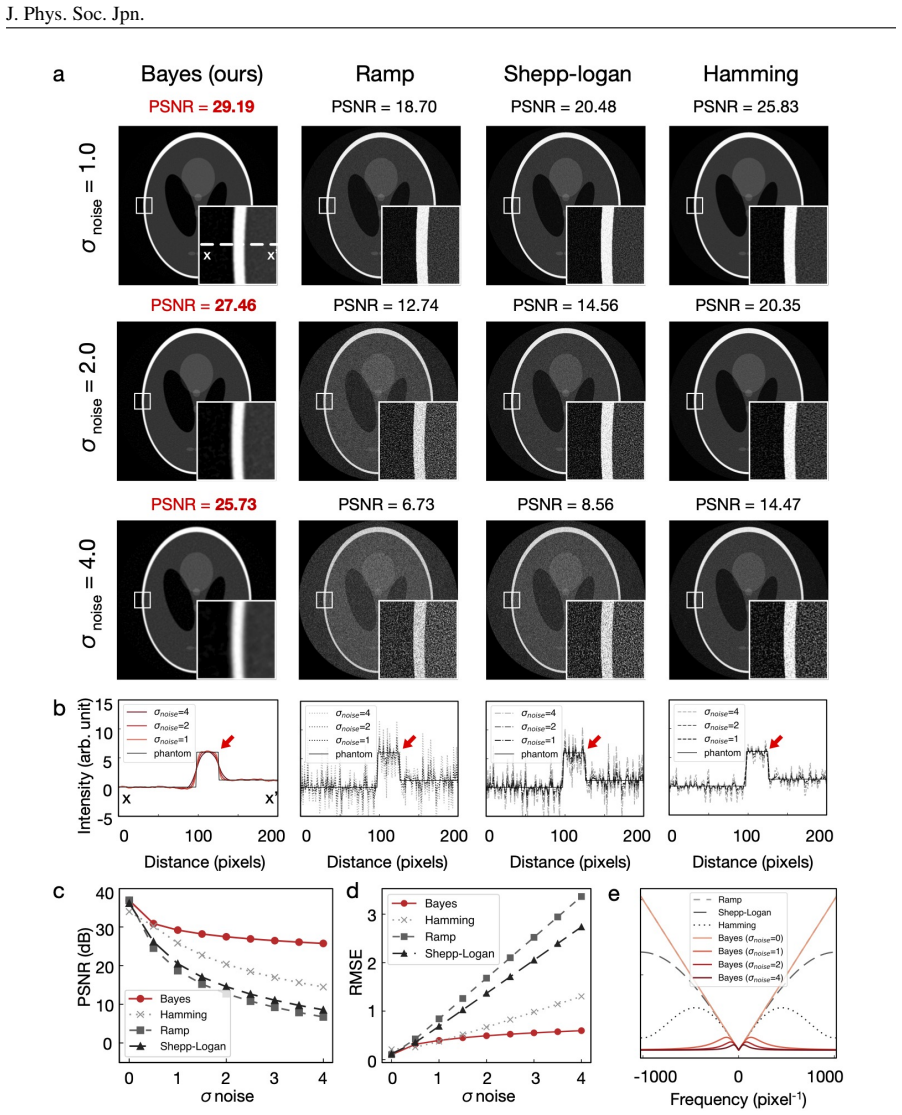
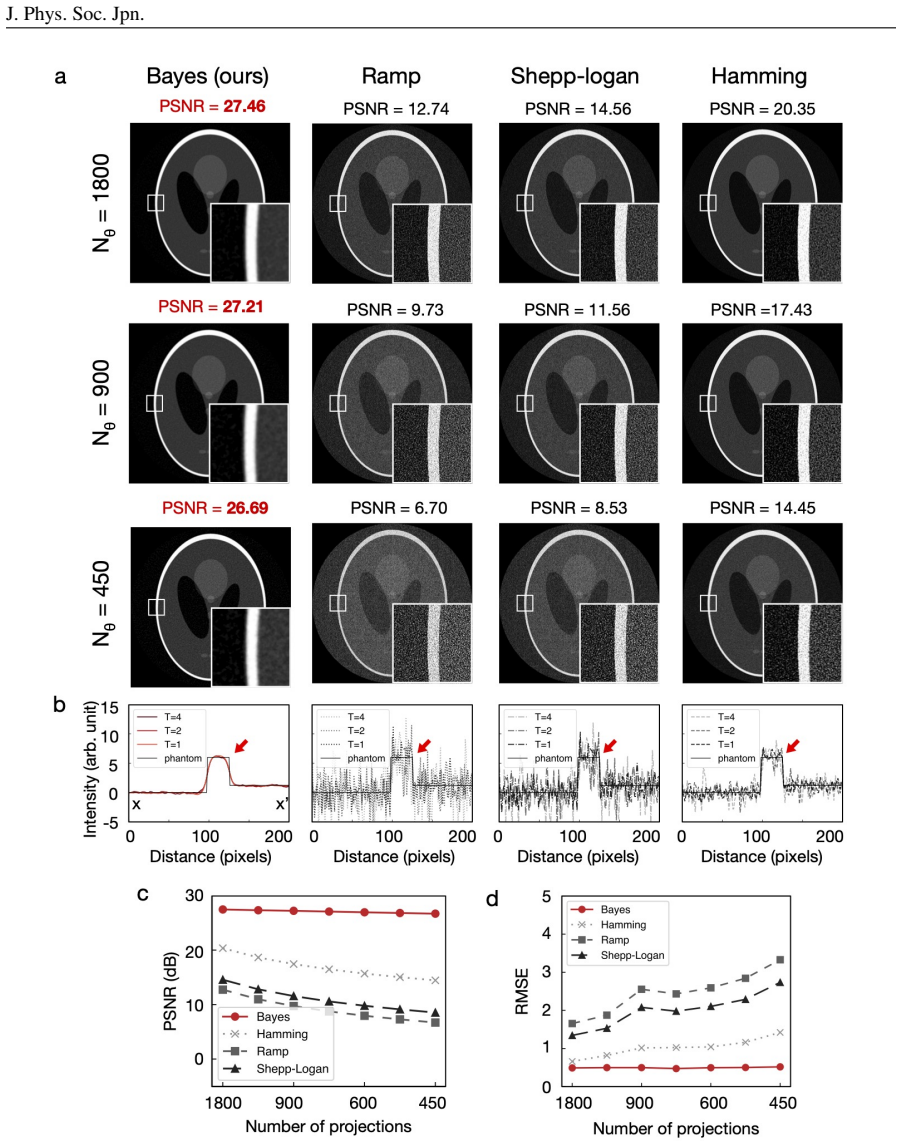
The authors develop a Bayesian CT reconstruction method that incorporates a Markov random field model to represent the statistical structure of the images. By estimating hyperparameters through minimization of the Bayesian free energy, the algorithm adapts to the noise characteristics of the projection data. Simulations demonstrate superior performance over filtered back projection under both low-dose and sparse-view conditions.
What carries the argument
Markov random field prior in a Bayesian framework, with hyperparameters optimized by Bayesian free energy minimization, to model and reconstruct CT images from projections.
If this is right
- The method produces higher quality reconstructions from noisy or incomplete projection data.
- It enables adaptive tuning without manual hyperparameter selection.
- CT becomes viable for dose-sensitive applications.
- Time-constrained measurements with limited views are supported.
- Overall, it broadens the practical range of CT imaging.
Where Pith is reading between the lines
- The approach may extend to other inverse problems in imaging where similar statistical priors apply.
- Real-world validation on experimental data rather than simulations could confirm the gains.
- Integration with machine learning could further enhance the prior model.
Load-bearing premise
The Markov random field model accurately captures the statistical structure of actual CT images, and minimizing the Bayesian free energy reliably estimates hyperparameters that match the real noise in the projections.
What would settle it
Performing the reconstruction on actual experimental CT projection data with known ground truth images and comparing quantitative metrics like mean squared error or structural similarity index against filtered back projection results under matched low-dose and sparse-view settings.
Figures

read the original abstract
X-ray computed tomography (CT) reveals the materials' internal structures non-destructively from a tilt series of projected images. Filtered back projection (FBP) is a widely-adopted reconstruction algorithm in CT owing to its small computational cost. Under low-dose or sparse-view conditions, however, FBP often amplifies noise, severely degrading the reconstructed images. In this study, we evaluated the performance of a Bayesian CT reconstruction algorithm based on the Markov random field model under such adverse conditions. Through simulations, we demonstrated that the proposed algorithm shows higher reconstruction performance than FBP under both low-dose and sparse-view conditions. The hyperparameters are estimated by minimizing the Bayesian free energy, enabling adaptive reconstruction that reflects the noise characteristics of the observed projection data. These results suggest that the proposed algorithm can broaden the applicability of CT to dose-sensitive applications and time-constrained measurements, where only limited observed projection data are available.
Editorial analysis
A structured set of objections, weighed in public.
Referee Report
Summary. The paper proposes a Bayesian CT reconstruction algorithm that employs a Markov random field (MRF) prior to improve image quality over filtered back-projection (FBP) under low-dose and sparse-view conditions. Hyperparameters are estimated adaptively by minimizing the Bayesian free energy derived from the observed projection data, and the method is evaluated via simulations demonstrating superior performance.
Significance. If the simulation results prove robust with quantitative validation, the adaptive hyperparameter estimation via free-energy minimization could offer a practical way to tailor reconstructions to noise characteristics, extending CT utility in dose-limited or time-constrained settings such as medical imaging or industrial inspection.
major comments (2)
- [Abstract] Abstract: the central claim of 'higher reconstruction performance than FBP' is unsupported by any quantitative metrics (e.g., RMSE, PSNR, SSIM), error bars, specific simulation parameters (photon flux for low-dose, projection count for sparse-view), or baseline details, rendering the performance assertion unverifiable.
- [Hyperparameter Estimation] Hyperparameter estimation section: minimizing Bayesian free energy is defined in terms of the same MRF prior and data likelihood; without explicit equations demonstrating that the procedure is independent of the fitted quantities rather than self-consistent by construction, the adaptivity claim risks circularity.
minor comments (1)
- [Abstract] The abstract would benefit from a brief statement of the specific MRF neighborhood and potential functions used.
Simulated Author's Rebuttal
We thank the referee for their thoughtful review and constructive comments on our manuscript. We have carefully considered each point and provide our responses below. We believe the revisions will strengthen the paper.
read point-by-point responses
-
Referee: [Abstract] Abstract: the central claim of 'higher reconstruction performance than FBP' is unsupported by any quantitative metrics (e.g., RMSE, PSNR, SSIM), error bars, specific simulation parameters (photon flux for low-dose, projection count for sparse-view), or baseline details, rendering the performance assertion unverifiable.
Authors: We agree with the referee that the abstract should provide more specific quantitative support for our claims to make them verifiable. Although the manuscript includes simulation results with performance comparisons in the main text, we will revise the abstract to include key quantitative metrics such as RMSE, PSNR, and SSIM values, along with specific simulation parameters (e.g., photon flux for low-dose cases and number of projections for sparse-view). Error bars from multiple simulations will also be mentioned where applicable. This will be incorporated in the revised version. revision: yes
-
Referee: [Hyperparameter Estimation] Hyperparameter estimation section: minimizing Bayesian free energy is defined in terms of the same MRF prior and data likelihood; without explicit equations demonstrating that the procedure is independent of the fitted quantities rather than self-consistent by construction, the adaptivity claim risks circularity.
Authors: We appreciate this important clarification. The minimization of the Bayesian free energy (which approximates the negative log evidence) is performed with respect to the hyperparameters, while marginalizing or integrating over the image variables using the MRF prior and likelihood. This is not circular because the free energy is a function of the hyperparameters only after the integration. To address the concern, we will add explicit mathematical derivations and equations in the revised manuscript to demonstrate the independence and show the optimization procedure step by step, clarifying that it is not self-consistent by construction but follows standard variational Bayesian inference principles. revision: yes
Circularity Check
No significant circularity detected
full rationale
The paper describes a Bayesian reconstruction algorithm using an MRF prior, with hyperparameters estimated via minimization of the Bayesian free energy to adapt to observed noise. This is a standard, non-circular procedure in statistical image processing: the free energy is computed from the joint model and data to optimize hyperparameters, without redefining inputs or forcing predictions by construction. Performance is demonstrated via independent simulations against FBP under low-dose and sparse-view conditions. No equations, self-citations, or steps in the abstract or description reduce the central claims to tautologies, fitted renamings, or load-bearing self-references. The derivation chain is self-contained and externally benchmarked.
Axiom & Free-Parameter Ledger
free parameters (1)
- MRF hyperparameters
axioms (2)
- domain assumption Markov random field model accurately captures local pixel dependencies in CT images
- domain assumption Bayesian free energy minimization recovers noise-appropriate hyperparameters
Reference graph
Works this paper leans on
-
[1]
A. C. Kak and M. Slaney,Principles of Computerized Tomographic Imaging(SIAM, Philadelphia, 2001)
work page 2001
-
[2]
G. T. Herman,Fundamentals of Computerized Tomography(Springer, London, 2009)
work page 2009
-
[3]
M. J. Willemink and P. B. No¨el, Eur. Radiol.29, 2185–2195 (2019)
work page 2019
-
[4]
E. Y . Sidky and X. Pan, Phys. Med. Biol.53, 4777–4807 (2008)
work page 2008
-
[5]
Natterer,The Mathematics of Computerized Tomography(SIAM, Philadelphia, 2001)
F. Natterer,The Mathematics of Computerized Tomography(SIAM, Philadelphia, 2001)
work page 2001
-
[6]
G. N. Ramachandran and A. V . Lakshminarayanan, Proc. Natl. Acad. Sci. USA68, 2236 (1971)
work page 1971
-
[7]
L. A. Shepp and B. F. Logan, IEEE Trans. Nucl. Sci.21, 21 (1974)
work page 1974
-
[8]
F. J. Harris, Proc. IEEE66, 51 (1978)
work page 1978
-
[9]
K. Lange and J. A. Fessler, IEEE Trans. Image Process.4, 1430–1438 (1995)
work page 1995
-
[10]
S. Geman and D. Geman, IEEE Trans. Pattern Anal. Mach. Intell.6, 721–741 (1984)
work page 1984
- [11]
-
[12]
Y . Nakanishi-Ohno, K. Nagata, H. Shouno, and M. Okada, J. Phys. A: Math. Theor.47, 045001 (2014)
work page 2014
-
[13]
H. Sakamoto, Y . Nakanishi-Ohno, and M. Okada, J. Phys. Soc. Jpn.85, 063801 (2016)
work page 2016
-
[14]
S. Katakami, H. Sakamoto, S. Murata, and M. Okada, J. Phys. Soc. Jpn.86, 064801 (2017)
work page 2017
- [15]
- [16]
-
[17]
C. M. Bishop,Pattern Recognition and Machine Learning(Springer, New York, 2006)
work page 2006
- [18]
-
[19]
A. N. Tikhonov and V . Y . Arsenin,Solutions of Ill-Posed Problems(Winston, Washing- ton, 1977)
work page 1977
-
[20]
S. Z. Li,Markov Random Field Modeling in Image Analysis, 3rd ed. (Springer, London, 2009). 17/17
work page 2009
discussion (0)
Sign in with ORCID, Apple, or X to comment. Anyone can read and Pith papers without signing in.