Recognition: no theorem link
Allegory of the Cave: Measurement-Grounded Vision-Language Learning
Pith reviewed 2026-05-13 06:37 UTC · model grok-4.3
The pith
Vision-language models reason more accurately when given raw camera measurements instead of rendered RGB images.
A machine-rendered reading of the paper's core claim, the machinery that carries it, and where it could break.
Core claim
Part of VLM grounding error arises from information lost during RGB rendering; preserving measurement-domain evidence through RAW-derived inputs, camera-conditioned grounding, and Exposure-Bracketed Supervision Aggregation improves multimodal reasoning, as shown by PRISM-VL-8B reaching 0.6120 BLEU, 0.4571 ROUGE-L, and 82.66% LLM-Judge accuracy, gains of +0.1074 BLEU, +0.1071 ROUGE-L, and +4.46 percentage points over the RGB Qwen3-VL-8B baseline.
What carries the argument
Measurement-grounded vision-language learning, realized as PRISM-VL via RAW-derived Meas.-XYZ inputs, camera-conditioned grounding, and Exposure-Bracketed Supervision Aggregation that transfers supervision from RGB proxies to measurement observations.
If this is right
- VLMs will exhibit stronger performance on low-light, HDR, and visibility-sensitive tasks when supplied with direct sensor measurements.
- Hallucination rates in vision-language outputs will decrease when models can access unrendered camera evidence.
- Supervision can be effectively transferred from abundant RGB instruction data to measurement-domain observations.
- Future VLM interfaces will need explicit camera-parameter conditioning to exploit measurement-domain information.
- Benchmark construction for VLMs should include controlled low-light and HDR cases to expose rendering-induced errors.
Where Pith is reading between the lines
- The same principle may apply to other raw sensor streams such as depth or event-camera data once appropriate grounding mechanisms exist.
- Hardware-software co-design for cameras could prioritize direct measurement access for downstream AI models.
- If the gains hold after stricter controls on training variables, the approach would motivate re-examination of the entire ISP pipeline as an information bottleneck.
- Extending the method to real-time on-device inference would require lightweight measurement-domain encoders that fit within mobile power budgets.
Load-bearing premise
The reported performance gains are caused by the measurement-grounded inputs and supervision aggregation rather than differences in training data curation, model tweaks, or benchmark construction.
What would settle it
Retraining the RGB baseline with identical data curation, model size, and training procedure but without measurement inputs or bracketed aggregation, then observing whether the gains disappear or remain.
Figures


read the original abstract
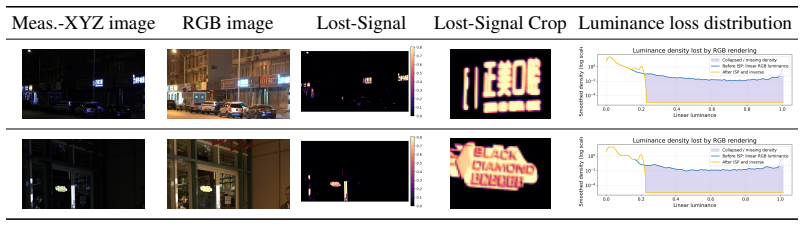
Vision-language models typically reason over post-ISP RGB images, although RGB rendering can clip, suppress, or quantize sensor evidence before inference. We study whether grounding improves when the visual interface is moved closer to the underlying camera measurement. We formulate measurement-grounded vision-language learning and instantiate it as PRISM-VL, which combines RAW-derived Meas.-XYZ inputs, camera-conditioned grounding, and Exposure-Bracketed Supervision Aggregation for transferring supervision from RGB proxies to measurement-domain observations. Using a quality-controlled 150K instruction-tuning set and a held-out benchmark targeting low-light, HDR, visibility-sensitive, and hallucination-sensitive cases, PRISM-VL-8B reaches 0.6120 BLEU, 0.4571 ROUGE-L, and 82.66\% LLM-Judge accuracy, improving over the RGB Qwen3-VL-8B baseline by +0.1074 BLEU, +0.1071 ROUGE-L, and +4.46 percentage points. These results suggest that part of VLM grounding error arises from information lost during RGB rendering, and that preserving measurement-domain evidence can improve multimodal reasoning.
Editorial analysis
A structured set of objections, weighed in public.
Referee Report
Summary. The manuscript presents PRISM-VL, a measurement-grounded vision-language model that uses RAW-derived Meas.-XYZ inputs, camera-conditioned grounding, and Exposure-Bracketed Supervision Aggregation to transfer supervision from RGB proxies. On a held-out benchmark focused on low-light, HDR, visibility-sensitive, and hallucination-sensitive cases, the 8B model achieves 0.6120 BLEU, 0.4571 ROUGE-L, and 82.66% LLM-Judge accuracy, surpassing the RGB-based Qwen3-VL-8B baseline by +0.1074 BLEU, +0.1071 ROUGE-L, and +4.46 percentage points. The authors conclude that some VLM grounding errors originate from information loss in RGB rendering and that measurement-domain evidence can enhance multimodal reasoning.
Significance. Should the empirical gains prove attributable to the proposed measurement-grounding mechanisms rather than unablated differences in data or training, the work would be significant for identifying RGB post-processing as a contributor to VLM errors in challenging conditions. This could motivate new directions in VLM design that incorporate raw sensor data, potentially leading to more robust models for real-world applications involving variable lighting and dynamic range.
major comments (2)
- [Abstract] The performance improvements are attributed to measurement-grounded inputs and supervision aggregation, yet the abstract provides no details on ablation studies that hold the 150K tuning set and supervision fixed while varying only the input domain (RGB vs. Meas.-XYZ) or the aggregation method. This omission leaves open the possibility that differences in data curation or training details explain the observed deltas, undermining the causal claim.
- [Experimental Setup] The comparison is to an external Qwen3-VL-8B baseline; without a controlled re-training of the baseline on the same 150K set using RGB inputs, the contribution of the measurement-domain interface cannot be isolated, which is load-bearing for the central hypothesis that RGB rendering causes grounding error.
minor comments (2)
- [Abstract] The acronym 'PRISM-VL' is introduced without expansion or brief description of its components, which would aid initial readability.
- [Abstract] The 'quality-controlled 150K instruction-tuning set' is referenced without specifying data sources, filtering criteria, or exact construction details, limiting assessment of reproducibility.
Simulated Author's Rebuttal
We thank the referee for the constructive comments. The concerns about isolating the contribution of measurement-grounding are important for validating our central hypothesis. We provide point-by-point responses below and commit to revisions that address these issues.
read point-by-point responses
-
Referee: [Abstract] The performance improvements are attributed to measurement-grounded inputs and supervision aggregation, yet the abstract provides no details on ablation studies that hold the 150K tuning set and supervision fixed while varying only the input domain (RGB vs. Meas.-XYZ) or the aggregation method. This omission leaves open the possibility that differences in data curation or training details explain the observed deltas, undermining the causal claim.
Authors: We agree that the abstract should reference the ablation studies to strengthen the causal claim. The manuscript includes ablation studies that hold the 150K tuning set and supervision fixed while varying the input domain (RGB vs. Meas.-XYZ) and the aggregation method. These ablations demonstrate that the performance gains are attributable to the measurement-grounded approach rather than data curation differences. We will revise the abstract to include a concise description of these ablations. revision: yes
-
Referee: [Experimental Setup] The comparison is to an external Qwen3-VL-8B baseline; without a controlled re-training of the baseline on the same 150K set using RGB inputs, the contribution of the measurement-domain interface cannot be isolated, which is load-bearing for the central hypothesis that RGB rendering causes grounding error.
Authors: This is a valid point. To isolate the effect of the input domain, we will add a controlled experiment where we fine-tune the Qwen3-VL-8B baseline on the same 150K set but using standard RGB inputs. This will allow direct comparison to PRISM-VL under identical training conditions. We acknowledge that the current comparison to the off-the-shelf baseline may conflate the effects of fine-tuning with the measurement-grounding benefits. The revision will include this additional baseline. revision: yes
Circularity Check
No circularity in derivation chain
full rationale
The paper is an empirical study that formulates measurement-grounded vision-language learning as PRISM-VL and reports performance numbers on a held-out benchmark. No equations, derivations, fitted parameters renamed as predictions, or self-citation chains appear in the text. The central claim rests on direct comparison of BLEU/ROUGE/LLM-Judge scores against an external RGB baseline using a quality-controlled 150K tuning set and custom low-light/HDR test cases. Because the result is obtained by standard supervised fine-tuning and evaluation rather than any self-definitional reduction or ansatz smuggled via prior work, the derivation chain is self-contained.
Axiom & Free-Parameter Ledger
axioms (1)
- domain assumption RGB rendering can clip, suppress, or quantize sensor evidence before inference
invented entities (1)
-
PRISM-VL
no independent evidence
Reference graph
Works this paper leans on
-
[2]
Flamingo: a Visual Language Model for Few-Shot Learning
URL https://arxiv. org/abs/2204.14198. Shuai Bai, Yuxuan Cai, Ruizhe Chen, Keqin Chen, Xiong-Hui Chen, Zesen Cheng, Lianghao Deng, Wei Ding, Rongyao Fang, Chang Gao, Chunjiang Ge, Wenbin Ge, Zhifang Guo, Qidong Huang, Qidong Huang, Fei Huang, Binyuan Hui, Shutong Jiang, Zhaohai Li, Mingsheng Li, Mei Li, Kaixin Li, Zicheng Lin, Junyang Lin, Xuejing Liu, Ji...
work page internal anchor Pith review Pith/arXiv arXiv
-
[3]
ShareGPT4V: Improving Large Multi-Modal Models with Better Captions
URLhttps://arxiv.org/abs/2311.12793. Wenliang Dai, Junnan Li, Dongxu Li, Anthony Meng Huat Tiong, Junqi Zhao, Weisheng Wang, Boyang Li, Pascale Fung, and Steven Hoi. InstructBLIP: Towards general-purpose vision-language models with instruction tuning. arXiv preprint arXiv:2305.06500,
work page internal anchor Pith review arXiv
-
[4]
InstructBLIP: Towards General-purpose Vision-Language Models with Instruction Tuning
URL https://arxiv. org/abs/2305.06500. Duc-Tien Dang-Nguyen, Cecilia Pasquini, Valentina Conotter, and Giulia Boato. RAISE: A raw images dataset for digital image forensics. InProceedings of the ACM Multimedia Systems Conference, Portland, Oregon,
work page internal anchor Pith review Pith/arXiv arXiv
-
[6]
MME: A Comprehensive Evaluation Benchmark for Multimodal Large Language Models
URLhttps://arxiv.org/abs/2306.13394. Junnan Li, Dongxu Li, Silvio Savarese, and Steven Hoi. BLIP-2: Bootstrapping language-image pre- training with frozen image encoders and large language models. arXiv preprint arXiv:2301.12597, 2023a. URLhttps://arxiv.org/abs/2301.12597. Lei Li, Yuwei Yin, Shicheng Li, Liang Chen, Peiyi Wang, Shuhuai Ren, Mukai Li, Yazh...
work page internal anchor Pith review Pith/arXiv arXiv
-
[7]
Haotian Liu, Chunyuan Li, Qingyang Wu, and Yong Jae Lee. Visual instruction tuning. arXiv preprint arXiv:2304.08485, 2023a. URLhttps://arxiv.org/abs/2304.08485. 10 Yuan Liu, Haodong Duan, Yuanhan Zhang, Bo Li, Songyang Zhang, Wangbo Zhao, Yike Yuan, Jiaqi Wang, Conghui He, Ziwei Liu, Kai Chen, and Dahua Lin. MMBench: Is your multi- modal model an all-arou...
work page internal anchor Pith review Pith/arXiv arXiv
-
[9]
URLhttps://arxiv.org/abs/2103.00020. Peng Wang, Shuai Bai, Sinan Tan, Shijie Wang, Zhihao Fan, Jinze Bai, Keqin Chen, Xuejing Liu, Jialin Wang, Wenbin Ge, Yang Fan, Kai Dang, Mengfei Du, Xuancheng Ren, Rui Men, Dayiheng Liu, Chang Zhou, Jingren Zhou, and Junyang Lin. Qwen2-VL: Enhancing vision-language model’s perception of the world at any resolution. ar...
work page internal anchor Pith review Pith/arXiv arXiv
-
[10]
URL https://arxiv.org/abs/2409.12191. Weiyun Wang, Zhangwei Gao, Lixin Gu, Hengjun Pu, Long Cui, Xingguang Wei, Zhaoyang Liu, Linglin Jing, Shenglong Ye, Jie Shao, Zhaokai Wang, Zhe Chen, Hongjie Zhang, Ganlin Yang, Haomin Wang, Qi Wei, Jinhui Yin, Wenhao Li, Erfei Cui, Guanzhou Chen, Zichen Ding, Changyao Tian, Zhenyu Wu, Jingjing Xie, Zehao Li, Bowen Ya...
work page internal anchor Pith review Pith/arXiv arXiv
-
[11]
URL https://api.semanticscholar.org/CorpusID:280710824. Xiang Yue, Yuansheng Ni, Kai Zhang, Tianyu Zheng, Ruoqi Liu, Ge Zhang, Samuel Stevens, Dongfu Jiang, Weiming Ren, Yuxuan Sun, Cong Wei, Botao Yu, Ruibin Yuan, Renliang Sun, Ming Yin, Boyuan Zheng, Zhenzhu Yang, Yibo Liu, Wenhao Huang, Huan Sun, Yu Su, and Wenhu Chen. MMMU: A massive multi-discipline ...
work page internal anchor Pith review arXiv
-
[12]
URL https://arxiv.org/abs/2311. 16502. Jinguo Zhu, Weiyun Wang, Zhe Chen, Zhaoyang Liu, Shenglong Ye, Lixin Gu, Yuchen Duan, Hao Tian, Weijie Su, Jie Shao, Zhangwei Gao, Erfei Cui, Yue Cao, Yangzhou Liu, Haomin Wang, Weiye Xu, Hao Li, Jiahao Wang, Han Lv, De-Hua Chen, Songze Li, Yinan He, Tan Jiang, Jiapeng Luo, Yi Wang, Conghui He, Botian Shi, Xingcheng ...
work page internal anchor Pith review Pith/arXiv arXiv
discussion (0)
Sign in with ORCID, Apple, or X to comment. Anyone can read and Pith papers without signing in.