Recognition: no theorem link
SAGE: Scalable Automated Robustness Augmentation for LLM Knowledge Evaluation
Pith reviewed 2026-05-13 04:51 UTC · model grok-4.3
The pith
SAGE uses fine-tuned models to build large-scale robust LLM knowledge benchmarks at lower cost than human annotation.
A machine-rendered reading of the paper's core claim, the machinery that carries it, and where it could break.
Core claim
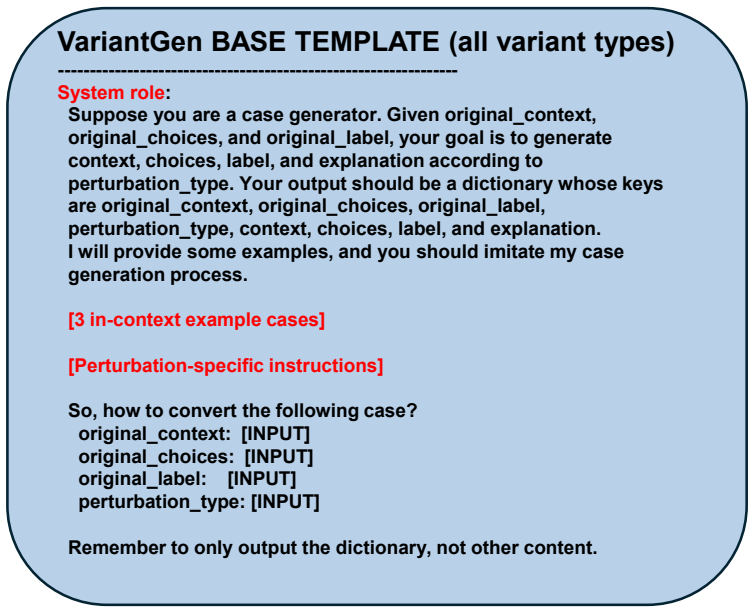
SAGE consists of VariantQual, a rubric-based verifier trained on human-labeled seed data, and VariantGen, a variant generator initialized with supervised fine-tuning and further optimized with reinforcement learning using VariantQual as the reward model. Experiments on HellaSwag show that SAGE constructs a large-scale robustness-augmented benchmark with quality comparable to the human-annotated HellaSwag-Pro at substantially lower cost, while the fine-tuned models further generalize to MMLU without benchmark-specific fine-tuning.
What carries the argument
VariantQual, the rubric-based verifier trained on human seed data that serves as a reward model to guide reinforcement learning of the VariantGen generator for producing high-quality question variants.
If this is right
- A large-scale robustness-augmented benchmark can be built for HellaSwag with quality matching human-annotated versions.
- This construction happens at substantially lower cost than manual human annotation.
- The fine-tuned models generalize their robustness improvements to other benchmarks such as MMLU without benchmark-specific fine-tuning.
- The pipeline offers a scalable automated route to more reliable knowledge evaluation tests for LLMs.
Where Pith is reading between the lines
- The same verifier-guided generation process could be applied to augment benchmarks in domains other than knowledge evaluation.
- Generalization to MMLU suggests the training teaches transferable handling of question variations rather than benchmark-specific tricks.
- Ongoing application of the method could support dynamic updates to benchmarks as new model behaviors emerge.
- Testing the full pipeline on additional knowledge benchmarks would confirm whether the cost and quality gains hold more broadly.
Load-bearing premise
The verifier trained on limited human seed data will keep giving accurate and unbiased quality judgments when used at large scale to create the full benchmark.
What would settle it
If the automatically generated benchmark shows different patterns of model performance drops on variants than the human-annotated version, or if the fine-tuned models fail to generalize to MMLU, the central claims would not hold.
Figures




read the original abstract
Large Language Models (LLMs) achieve strong performance on standard knowledge evaluation benchmarks, yet recent work shows that their knowledge capabilities remain brittle under question variants that test the same knowledge in different forms. Robustness augmentation of existing knowledge evaluation benchmarks is therefore necessary, but current LLM-assisted generate-then-verify pipelines are costly and difficult to scale due to low-yield variant generation and unreliable variant verification. We propose SAGE (Scalable Automated Generation of Robustness BEnchmarks), a framework for scalable robustness augmentation of knowledge evaluation benchmarks using fine-tuned smaller models. SAGE consists of VariantQual, a rubric-based verifier trained on human-labeled seed data, and VariantGen, a variant generator initialized with supervised fine-tuning and further optimized with reinforcement learning using VariantQual as the reward model. Experiments on HellaSwag show that SAGE constructs a large-scale robustness-augmented benchmark with quality comparable to the human-annotated HellaSwag-Pro at substantially lower cost, while the fine-tuned models further generalize to MMLU without benchmark-specific fine-tuning.
Editorial analysis
A structured set of objections, weighed in public.
Referee Report
Summary. The manuscript introduces SAGE, a framework for scalable automated robustness augmentation of LLM knowledge evaluation benchmarks. SAGE consists of VariantQual, a rubric-based verifier trained on limited human-labeled seed data, and VariantGen, a variant generator initialized via supervised fine-tuning and further optimized via reinforcement learning using VariantQual as the reward model. Experiments on HellaSwag claim that SAGE produces a large-scale robustness-augmented benchmark whose quality is comparable to the human-annotated HellaSwag-Pro at substantially lower cost, while the fine-tuned models generalize to MMLU without benchmark-specific fine-tuning.
Significance. If the quality-comparability claim is substantiated, the work would be significant for enabling cost-effective construction of large robust evaluation sets that address brittleness in LLM knowledge assessment. The approach of using a learned verifier as an RL reward for generation is a practical scaling strategy, though its validity hinges on the verifier's reliability.
major comments (2)
- [Experiments on HellaSwag] The headline claim that the SAGE-augmented benchmark has quality comparable to human-annotated HellaSwag-Pro is load-bearing and rests on VariantQual providing accurate, unbiased judgments at scale. The manuscript must report concrete human evaluation results on the final generated set (e.g., agreement rates with human annotators, precision/recall of VariantQual on held-out seed data, and side-by-side quality ratings versus HellaSwag-Pro), including statistical details and baselines; without these the central claim cannot be assessed.
- [VariantGen optimization] Using VariantQual as the RL reward for VariantGen creates a risk of reward hacking, where generated variants achieve high verifier scores yet fail human quality standards. The paper should include targeted analysis (e.g., human judgments on a sample of high-reward variants, ablation of the RL stage, or detection of systematic blind spots in VariantQual) to rule out this failure mode; otherwise the cost-saving and generalization claims are undermined.
minor comments (2)
- [Abstract] The abstract states experimental outcomes but omits all quantitative metrics, cost figures, and quality-comparison details; adding these would strengthen the summary.
- Clarify the exact rubric used by VariantQual and the size/composition of the human-labeled seed data to allow reproducibility assessment.
Simulated Author's Rebuttal
Thank you for the detailed and constructive review of our manuscript. We appreciate the referee's emphasis on strengthening the empirical validation of our claims. We address each major comment below and have updated the manuscript accordingly.
read point-by-point responses
-
Referee: [Experiments on HellaSwag] The headline claim that the SAGE-augmented benchmark has quality comparable to human-annotated HellaSwag-Pro is load-bearing and rests on VariantQual providing accurate, unbiased judgments at scale. The manuscript must report concrete human evaluation results on the final generated set (e.g., agreement rates with human annotators, precision/recall of VariantQual on held-out seed data, and side-by-side quality ratings versus HellaSwag-Pro), including statistical details and baselines; without these the central claim cannot be assessed.
Authors: We agree that the central claim requires concrete human evaluation results on the final generated set to be properly assessed. In the revised manuscript, we have added a new human evaluation subsection reporting agreement rates with human annotators, precision and recall of VariantQual on held-out seed data, side-by-side quality ratings versus HellaSwag-Pro, including statistical details and baselines. These results support the quality comparability of the SAGE-augmented benchmark to HellaSwag-Pro. revision: yes
-
Referee: [VariantGen optimization] Using VariantQual as the RL reward for VariantGen creates a risk of reward hacking, where generated variants achieve high verifier scores yet fail human quality standards. The paper should include targeted analysis (e.g., human judgments on a sample of high-reward variants, ablation of the RL stage, or detection of systematic blind spots in VariantQual) to rule out this failure mode; otherwise the cost-saving and generalization claims are undermined.
Authors: We recognize the potential issue of reward hacking in the RL optimization of VariantGen. To address this, the revised manuscript now includes targeted analyses: human judgments on samples of high-reward variants, an ablation study of the RL stage, and an examination for systematic blind spots in VariantQual. These additions demonstrate that the optimization does not lead to the described failure mode and bolster the cost-saving and generalization claims. revision: yes
Circularity Check
No significant circularity; derivation grounded in external human data
full rationale
The paper trains VariantQual on external human-labeled seed data and validates the generated benchmark's quality by direct comparison to the independently human-annotated HellaSwag-Pro. RL optimization of VariantGen uses VariantQual as reward, but the final claims rest on external benchmarks (HellaSwag-Pro, MMLU) rather than self-referential definitions or fitted parameters renamed as predictions. No self-citations, uniqueness theorems, or ansatzes are invoked as load-bearing steps. The chain is self-contained against external human judgments.
Axiom & Free-Parameter Ledger
axioms (1)
- domain assumption Human-labeled seed data provides sufficient and unbiased ground truth for training a scalable variant quality verifier
invented entities (2)
-
VariantQual
no independent evidence
-
VariantGen
no independent evidence
Reference graph
Works this paper leans on
-
[1]
Communications of the ACM , volume=
Commonsense reasoning and commonsense knowledge in artificial intelligence , author=. Communications of the ACM , volume=. 2015 , publisher=
work page 2015
-
[2]
2011 IEEE 11th International Conference on Data Mining Workshops , pages=
Isanette: A common and common sense knowledge base for opinion mining , author=. 2011 IEEE 11th International Conference on Data Mining Workshops , pages=. 2011 , organization=
work page 2011
-
[3]
Proceedings of the 57th annual meeting of the association for computational linguistics , pages=
Hellaswag: Can a machine really finish your sentence? , author=. Proceedings of the 57th annual meeting of the association for computational linguistics , pages=
-
[4]
Commonsenseqa: A question answering challenge targeting commonsense knowledge , author=. Proceedings of the 2019 Conference of the North American Chapter of the Association for Computational Linguistics: Human Language Technologies, Volume 1 (Long and Short Papers) , pages=
work page 2019
-
[5]
Proceedings of the AAAI conference on artificial intelligence , volume=
Piqa: Reasoning about physical commonsense in natural language , author=. Proceedings of the AAAI conference on artificial intelligence , volume=
-
[6]
Proceedings of the 2018 conference on empirical methods in natural language processing , pages=
Can a suit of armor conduct electricity? a new dataset for open book question answering , author=. Proceedings of the 2018 conference on empirical methods in natural language processing , pages=
work page 2018
-
[7]
Benchmarking chinese commonsense reasoning of llms: From chinese-specifics to reasoning-memorization correlations , author=. Proceedings of the 62nd Annual Meeting of the Association for Computational Linguistics (Volume 1: Long Papers) , pages=
-
[8]
Findings of the Association for Computational Linguistics: ACL 2025 , pages=
Hellaswag-pro: A large-scale bilingual benchmark for evaluating the robustness of llms in commonsense reasoning , author=. Findings of the Association for Computational Linguistics: ACL 2025 , pages=
work page 2025
-
[9]
Proceedings of the 2017 conference on empirical methods in natural language processing , pages=
Adversarial examples for evaluating reading comprehension systems , author=. Proceedings of the 2017 conference on empirical methods in natural language processing , pages=
work page 2017
-
[10]
Proceedings of the 2021 Conference on Empirical Methods in Natural Language Processing , pages=
Shortcutted commonsense: Data spuriousness in deep learning of commonsense reasoning , author=. Proceedings of the 2021 Conference on Empirical Methods in Natural Language Processing , pages=
work page 2021
-
[11]
Universal adversarial triggers for attacking and analyzing NLP , author=. Proceedings of the 2019 conference on empirical methods in natural language processing and the 9th international joint conference on natural language processing (EMNLP-IJCNLP) , pages=
work page 2019
-
[12]
Nature Machine Intelligence , volume=
Shortcut learning in deep neural networks , author=. Nature Machine Intelligence , volume=. 2020 , publisher=
work page 2020
-
[13]
Findings of the Association for Computational Linguistics: ACL 2024 , pages=
It’s not easy being wrong: Large language models struggle with process of elimination reasoning , author=. Findings of the Association for Computational Linguistics: ACL 2024 , pages=
work page 2024
-
[14]
Findings of the Association for Computational Linguistics: EMNLP 2021 , pages=
Beyond the tip of the iceberg: Assessing coherence of text classifiers , author=. Findings of the Association for Computational Linguistics: EMNLP 2021 , pages=
work page 2021
-
[15]
How Much Consistency Is Your Accuracy Worth? , author=. Proceedings of the 6th BlackboxNLP Workshop: Analyzing and Interpreting Neural Networks for NLP , pages=
-
[16]
Proceedings of the 2022 Conference on Empirical Methods in Natural Language Processing , pages=
Does self-rationalization improve robustness to spurious correlations? , author=. Proceedings of the 2022 Conference on Empirical Methods in Natural Language Processing , pages=
work page 2022
-
[17]
Self-instruct: Aligning language models with self-generated instructions , author=. Proceedings of the 61st annual meeting of the association for computational linguistics (volume 1: long papers) , pages=
-
[18]
WizardLM: Empowering large pre-trained language models to follow complex instructions
Wizardlm: Empowering large language models to follow complex instructions , author=. arXiv preprint arXiv:2304.12244 , year=
work page internal anchor Pith review arXiv
-
[19]
Distilling script knowledge from large language models for constrained language planning , author=. Proceedings of the 61st Annual Meeting of the Association for Computational Linguistics (Volume 1: Long Papers) , pages=
-
[20]
Proximal Policy Optimization Algorithms
Proximal policy optimization algorithms , author=. arXiv preprint arXiv:1707.06347 , year=
work page internal anchor Pith review Pith/arXiv arXiv
-
[21]
Advances in neural information processing systems , volume=
Training language models to follow instructions with human feedback , author=. Advances in neural information processing systems , volume=
-
[22]
Advances in neural information processing systems , volume=
Direct preference optimization: Your language model is secretly a reward model , author=. Advances in neural information processing systems , volume=
-
[23]
DeepSeekMath: Pushing the Limits of Mathematical Reasoning in Open Language Models
Deepseekmath: Pushing the limits of mathematical reasoning in open language models , author=. arXiv preprint arXiv:2402.03300 , year=
work page internal anchor Pith review Pith/arXiv arXiv
-
[24]
Rubrics as Rewards: Reinforcement Learning Beyond Verifiable Domains
Rubrics as rewards: Reinforcement learning beyond verifiable domains , author=. arXiv preprint arXiv:2507.17746 , year=
work page internal anchor Pith review arXiv
-
[25]
Qwen Team , title =. CoRR , volume =. 2025 , url =. doi:10.48550/ARXIV.2505.09388 , eprinttype =. 2505.09388 , timestamp =
work page internal anchor Pith review Pith/arXiv arXiv doi:10.48550/arxiv.2505.09388 2025
-
[26]
Gpt-4 technical report , author=. arXiv preprint arXiv:2303.08774 , year=
work page internal anchor Pith review Pith/arXiv arXiv
- [27]
-
[28]
The llama 3 herd of models , author=. arXiv preprint arXiv:2407.21783 , year=
work page internal anchor Pith review Pith/arXiv arXiv
-
[29]
DeepSeek LLM: Scaling Open-Source Language Models with Longtermism
Deepseek llm: Scaling open-source language models with longtermism , author=. arXiv preprint arXiv:2401.02954 , year=
work page internal anchor Pith review Pith/arXiv arXiv
-
[30]
A framework for few-shot language model evaluation , author=. Zenodo , year=
-
[31]
Findings of the Association for Computational Linguistics: ACL 2024 , pages=
Exploring Reversal Mathematical Reasoning Ability for Large Language Models , author=. Findings of the Association for Computational Linguistics: ACL 2024 , pages=
work page 2024
-
[32]
The Thirteenth International Conference on Learning Representations,
Kaijing Ma and Xeron Du and Yunran Wang and Haoran Zhang and Zhoufutu Wen and Xingwei Qu and Jian Yang and Jiaheng Liu and Minghao Liu and Xiang Yue and Wenhao Huang and Ge Zhang , title =. The Thirteenth International Conference on Learning Representations,. 2025 , url =
work page 2025
-
[33]
Back to the future: Unsupervised backprop-based decoding for counterfactual and abductive commonsense reasoning , author=. Proceedings of the 2020 Conference on Empirical Methods in Natural Language Processing (EMNLP) , pages=
work page 2020
-
[34]
Counterfactual story reasoning and generation , author=. Proceedings of the 2019 Conference on Empirical Methods in Natural Language Processing and the 9th International Joint Conference on Natural Language Processing (EMNLP-IJCNLP) , pages=
work page 2019
-
[35]
Reasoning or reciting? exploring the capabilities and limitations of language models through counterfactual tasks , author=. Proceedings of the 2024 Conference of the North American Chapter of the Association for Computational Linguistics: Human Language Technologies (Volume 1: Long Papers) , pages=
work page 2024
-
[36]
Say what you mean! large language models speak too positively about negative commonsense knowledge , author=. Proceedings of the 61st Annual Meeting of the Association for Computational Linguistics (Volume 1: Long Papers) , pages=
-
[37]
Taxonomy of educational objectives , author=. Affective domain , year=
-
[38]
Advances in neural information processing systems , volume=
Language models are few-shot learners , author=. Advances in neural information processing systems , volume=
-
[39]
9th International Conference on Learning Representations,
Dan Hendrycks and Collin Burns and Steven Basart and Andy Zou and Mantas Mazeika and Dawn Song and Jacob Steinhardt , title =. 9th International Conference on Learning Representations,. 2021 , url =
work page 2021
-
[40]
“going on a vacation” takes longer than “going for a walk”: A study of temporal commonsense understanding , author=. Proceedings of the 2019 Conference on Empirical Methods in Natural Language Processing and the 9th International Joint Conference on Natural Language Processing (EMNLP-IJCNLP) , pages=
work page 2019
-
[41]
Proceedings of the 2021 Conference on Empirical Methods in Natural Language Processing , pages=
Rica: Evaluating robust inference capabilities based on commonsense axioms , author=. Proceedings of the 2021 Conference on Empirical Methods in Natural Language Processing , pages=
work page 2021
-
[42]
Proceedings of the 2023 Conference on Empirical Methods in Natural Language Processing , pages=
CRoW: Benchmarking commonsense reasoning in real-world tasks , author=. Proceedings of the 2023 Conference on Empirical Methods in Natural Language Processing , pages=
work page 2023
-
[43]
Social IQa: Commonsense reasoning about social interactions , author=. Proceedings of the 2019 conference on empirical methods in natural language processing and the 9th international joint conference on natural language processing (EMNLP-IJCNLP) , pages=
work page 2019
-
[44]
Findings of the Association for Computational Linguistics: ACL 2024 , pages=
Evaluating mathematical reasoning of large language models: A focus on error identification and correction , author=. Findings of the Association for Computational Linguistics: ACL 2024 , pages=
work page 2024
-
[45]
Llamafactory: Unified efficient fine-tuning of 100+ language models , author=. Proceedings of the 62nd annual meeting of the association for computational linguistics (volume 3: system demonstrations) , pages=
-
[46]
Proceedings of the AAAI Conference on Artificial Intelligence , volume=
Swift: a scalable lightweight infrastructure for fine-tuning , author=. Proceedings of the AAAI Conference on Artificial Intelligence , volume=
discussion (0)
Sign in with ORCID, Apple, or X to comment. Anyone can read and Pith papers without signing in.