Recognition: no theorem link
Hyperfine-Resolved Rovibrational and Rotational Spectroscopy of OH^+ (X ³Sigma^-)
Pith reviewed 2026-05-13 03:55 UTC · model grok-4.3
The pith
A global fit of new and prior data refines the spectroscopic constants of OH+ especially in the ground vibrational state.
A machine-rendered reading of the paper's core claim, the machinery that carries it, and where it could break.
Core claim
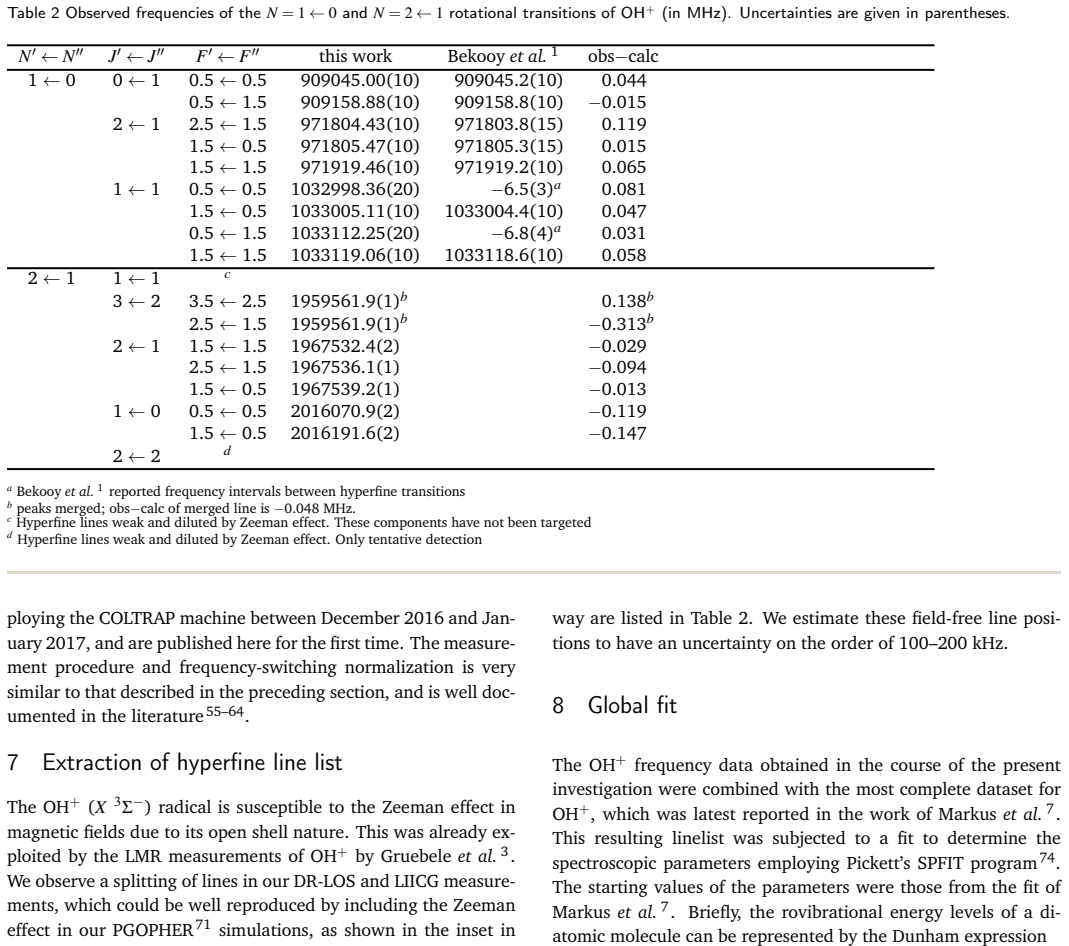
The OH+ (X ^3Σ^-) radical cation was studied in a 4 K 22-pole ion trap using high-resolution IR and THz radiation. The fundamental vibrational band near 3 μm and the N=1 ← 0 rotational transition near 1 THz were extended and refined. The spin manifold of the N=2 ← 1 transition near 2 THz was recorded for the first time with microwave accuracy. Although all hyperfine components of the pure rotational lines show substantial Zeeman splittings, simulation of their contours yielded reliable field-free center frequencies. A global fit merging the new data with existing rovibrational and rotational transitions produced improved spectroscopic constants, most notably those describing the ground vibra
What carries the argument
Global least-squares fit of combined rovibrational and pure-rotational transition frequencies, with Zeeman contour simulations used to recover field-free line centers.
If this is right
- The refined constants give more accurate predictions for additional rotational and rovibrational lines not yet observed.
- Ground-state parameters are now known to higher precision, improving the reliability of low-energy transition frequencies.
- The global fit demonstrates how new high-accuracy data can be merged with older measurements to reduce uncertainties across the dataset.
- Hyperfine constants for the lowest rotational levels are better constrained, aiding assignment of complex spectra.
Where Pith is reading between the lines
- The improved constants can serve as benchmarks for testing ab initio calculations of the OH+ potential energy surface and spin-orbit coupling.
- The contour-simulation method for handling Zeeman effects in trapped ions may be useful for other paramagnetic species studied in similar apparatus.
- Astronomical searches for OH+ in cold interstellar regions can now use narrower frequency windows based on the updated constants.
- Extension of the same experimental approach to vibrationally excited states or to OD+ would further test the consistency of the fitted parameters.
Load-bearing premise
The simulation of Zeeman-split line contours accurately recovers the field-free center frequencies without residual systematic bias from the magnetic field or trap conditions.
What would settle it
A direct measurement of one of the N=1←0 or N=2←1 hyperfine components in a zero-magnetic-field apparatus that yields a center frequency differing from the value extracted by contour simulation would falsify the accuracy of the reported constants.
Figures
read the original abstract
The OH$^+$ ($X ^3\Sigma^-$) radical cation has been investigated by combining a 4 K 22-pole ion trap apparatus with high-resolution IR and THz radiation sources. Applying different types of action spectroscopic methods, the fundamental vibrational band in the 3 $\mu$m range and the spin manifold of the $N=1 \leftarrow 0$ rotational transition around 1 THz have been extended and refined. Additionally, the spin manifold of the $N=2 \leftarrow 1$ rotational transition, scattered around 2 THz, has been measured for the first time with microwave accuracy. Although all hyperfine components of the pure rotational transitions are affected by considerable Zeeman splittings, a simulation of their contours allowed us to extract the field-free center frequencies with high accuracy. A global fit combining rovibrational and pure rotational transitions from the literature with those newly obtained in this work was performed, leading to improvements in the spectroscopic constants of OH$^+$, particularly those in the ground vibrational state.
Editorial analysis
A structured set of objections, weighed in public.
Referee Report
Summary. The manuscript reports action spectroscopy measurements of OH+ (X 3Σ−) in a 4 K 22-pole ion trap using IR and THz sources. The fundamental rovibrational band is extended and refined, the hyperfine components of the N=1←0 rotational transition (~1 THz) are remeasured, and the N=2←1 rotational transition (~2 THz) is observed for the first time. Zeeman-split line contours are simulated to extract field-free center frequencies, which are then incorporated with literature data into a global fit that yields improved spectroscopic constants, especially for the v=0 state.
Significance. If the extracted frequencies prove accurate, the work supplies higher-precision constants for an astrophysically important ion, strengthening predictions for THz observations and laboratory studies. The first microwave-accuracy data on the N=2←1 manifold and the explicit treatment of hyperfine structure in a cold trap represent concrete additions to the spectroscopic database. The global-fit strategy is a standard and useful way to consolidate new and existing measurements.
major comments (2)
- [Abstract and rotational-results section] Abstract and rotational-results section: The claim that contour simulation recovers field-free centers 'with high accuracy' is load-bearing for the new N=1←0 and N=2←1 frequencies that drive the reported improvements in the global fit. No quantitative metrics (e.g., rms residuals of simulated vs. observed contours, sensitivity tests to B-field inhomogeneity or ion-cloud distribution, or comparison against a known zero-field reference line) are supplied to bound possible systematic offsets.
- [Global-fit section] Global-fit section (presumably containing the final constants table): The statement of 'improvements … particularly those in the ground vibrational state' is not accompanied by a direct before/after comparison of the fitted parameters, their uncertainties, or the overall χ². Without this, it is impossible to judge whether the new data genuinely tighten the constants or merely increase the number of fitted lines.
minor comments (2)
- [Abstract] Abstract: subject-verb agreement error ('the spin manifold … have been extended' should read 'has been extended').
- [Figures and methods] Figure captions and text should explicitly state the assumed magnetic-field distribution and ion spatial profile used in the contour simulations so that readers can assess reproducibility.
Simulated Author's Rebuttal
We thank the referee for the careful review and constructive comments on our manuscript. We address each major comment below and have revised the manuscript to incorporate the requested clarifications and supporting analyses.
read point-by-point responses
-
Referee: [Abstract and rotational-results section] Abstract and rotational-results section: The claim that contour simulation recovers field-free centers 'with high accuracy' is load-bearing for the new N=1←0 and N=2←1 frequencies that drive the reported improvements in the global fit. No quantitative metrics (e.g., rms residuals of simulated vs. observed contours, sensitivity tests to B-field inhomogeneity or ion-cloud distribution, or comparison against a known zero-field reference line) are supplied to bound possible systematic offsets.
Authors: We agree that quantitative metrics are needed to substantiate the accuracy of the field-free center frequencies extracted from the Zeeman-split contours. In the revised manuscript we have expanded the rotational-results section with a detailed description of the simulation procedure. This includes the rms residuals between simulated and observed contours for the N=1←0 and N=2←1 transitions, sensitivity tests to plausible ranges of magnetic-field inhomogeneity and ion-cloud spatial distribution, and an explicit bound on the resulting systematic uncertainty in the extracted centers (now stated as < 15 kHz). These additions directly support the claim of high accuracy and allow readers to assess possible offsets. revision: yes
-
Referee: [Global-fit section] Global-fit section (presumably containing the final constants table): The statement of 'improvements … particularly those in the ground vibrational state' is not accompanied by a direct before/after comparison of the fitted parameters, their uncertainties, or the overall χ². Without this, it is impossible to judge whether the new data genuinely tighten the constants or merely increase the number of fitted lines.
Authors: We accept that a direct comparison is required for transparency. The revised global-fit section now contains an additional table that reports the spectroscopic constants, their uncertainties, and the overall χ² (per degree of freedom) obtained from (i) the previous literature-only fit and (ii) the new fit that includes our measurements. The table explicitly shows the reduction in uncertainties for the v=0 parameters, confirming that the new data tighten the constants rather than simply increasing the number of lines. revision: yes
Circularity Check
No circularity: experimental measurements and empirical global fit are self-contained
full rationale
The paper describes laboratory measurements of OH+ transitions using a 22-pole ion trap, action spectroscopy, and contour simulation to extract field-free center frequencies from Zeeman-split lines, followed by a standard global least-squares fit that incorporates both new data and independent literature transitions. No step reduces by the paper's own equations to a quantity defined by the fitted parameters themselves, nor does any load-bearing claim rely on self-citation chains, ansatzes smuggled via prior work, or renaming of known results. The simulation is a forward physical model (Zeeman Hamiltonian plus trap conditions) used to match observed contours, not a self-referential definition. The global fit improves constants by adding independent observations; it does not predict quantities that are statistically forced by the fit inputs. This is a purely empirical spectroscopy paper with no derivation that collapses to its inputs by construction.
Axiom & Free-Parameter Ledger
free parameters (1)
- spectroscopic constants (B, D, gamma, hyperfine parameters, etc.)
axioms (1)
- standard math Effective Hamiltonian for 3Σ− diatomic molecule including rotation, spin-spin, spin-rotation, and hyperfine interactions
Reference graph
Works this paper leans on
-
[1]
Hyperfine-Resolved Rovibrational and Rotational Spectroscopy of OH$^+$ ($X ^3\Sigma^-$)
The first high-resolution rovibrational spectrum in the IR was published by Rehfusset al. 5 with vibra- tional excitation of hot OH + up tov=5←4. Mülleret al. 6 pre- sented a combined fit of field free data in the ground electronic state 1,4,5 which was the basis of rest frequencies used to search for OH+ in space for a considerable time. Later, using adv...
work page internal anchor Pith review Pith/arXiv arXiv 2010
-
[2]
Likewise, av=1−0transition dipole moment of 0.185 D for the fundamental vibration has been reported previously69. It should be pointed out that the transition dipole moment alone is not always sufficient to model the IR in- tensities, as shown for thev=1−0band of CH +70 . + P V S O B M / B N F < Z F B S > < W P M > 1–10 | 3 Table 1 Observed transitions of...
-
[3]
5 Rotational measurements:N=2←1 The spin manifold of theN=2←1rotational transition of OH + was predicted to fall exactly in the tuning range of one of our THz sources (1.83-2.07 THz 65). The lower state quantum levels with N=1lie at about 30-34.5 cm −1, so it was expected that measur- ing these transitions would be challenging due to the low popu- lation ...
work page 2016
-
[4]
This value agrees well with recent measurements of other open shell species in our laboratory , e.g
The magnetic field best reproducing the DR-LOS observa- tions is on the order of 160µT and thus about three times larger than the magnitude of the Earth’s magnetic field here in Cologne. This value agrees well with recent measurements of other open shell species in our laboratory , e.g. CCH + (X 3Π) 73 or HCN + (X 2Π) 53, indicating that the observed Zeem...
work page 2016
-
[5]
Briefly , the rovibrational energy levels of a di- atomic molecule can be represented by the Dunham expression E(v,J)/h= ∑ i,j Yi j(v+1/2) iJ j(J+1) j,(1) whereY i j are the Dunham parameters. The electron spin-electron spin coupling parametersλ i j, the electron spin-rotation param- eterγ i j and the isotropic and anisotropic electron spin-nuclear spin c...
-
[6]
In the latter approach, the rovibrational excitation following the ro- tational excitation leads to the ions being kicked out of the ion trap and being detected. At higher rotational frequencies, such as the 2 THz regime applied in this work, the rotational photon alone carries enough energy to eject the ions from the trap. This has been demonstrated only...
work page 1959
-
[7]
Cologne Center for Terahertz Spectroscopy
and SH + (−56.84±0.03MHz and33.48±0.13MHz, respectively 80). The HFS parameters of PH and SH + differ not only from those of the lighter OH + and NH counterparts, but also among each other. With the laboratory measurements of theN=2←1transition 6 | 1–10 + P V S O B M / B N F < Z F B S > < W P M > Table 3 Global fit Dunham-type spectroscopic parametersa of...
-
[8]
5 B. D. Rehfuss, M.-F. Jagod, L.-W. Xu and T. Oka,J. Mol. Spec- trosc., 1992,151, 59–70. 6 H. S. P. Müller, F. Schlöder, J. Stutzki and G. Winnewisser,J. Mol. Struct., 2005,742, 215–227. 7 C. R. Markus, J. N. Hodges, A. J. Perry , G. S. Kocheril, H. S. P. Müller and B. J. McCall,Astrophys. J., 2016,817,
work page 1992
-
[9]
8 A. E. Glassgold and W. D. Langer,Astrophys. J., 1976,206, 85–99. 9 J. Barsuhn and C. M. Walmsley,Astron. Astrophys., 1977,54, 345–354. 10 A. A. de Almeida,Rev. Mex. Astron. Astrofis., 1990,21, 499–
work page 1976
-
[10]
11 H. Balsiger, K. Altwegg, F. Buhler, J. Geiss, A. G. Ghielmetti, B. E. Goldstein, R. Goldstein, W. T. Huntress, W. H. Ip, A. J. Lazarus, A. Meier, M. Neugebauer, U. Rettenmund, H. Rosen- bauer, R. Schwenn, R. D. Sharp, E. G. Shelly, E. Ungstrup and D. T. Young,Nature, 1986,321, 330–334. 12 F. Wyrowski, K. M. Menten, R. Güsten and A. Belloche,Astron. Ast...
work page 1986
-
[11]
15 A. M. Jacob, K. M. Menten, F. Wyrowski, B. Winkel and D. A. Neufeld,Astron. Astrophys., 2020,643, A91. 16 M. J. Barlow, B. M. Swinyard, P. J. Owen, J. Cernicharo, H. L. Gomez, R. J. Ivison, O. Krause, T. L. Lim, M. Matsuura, S. Miller, G. Olofsson and E. T. Polehampton,Science, 2013, 342, 1343–1345. 17 F. F. S. van der Tak, Z. Nagy, V. Ossenkopf, Z. Ma...
work page 2020
-
[12]
19 J. N. Hodges and P. F. Bernath,Astrophys. J., 2017,840,
work page 2017
-
[13]
20 J. Krełowski, Y. Beletsky and G. A. Galazutdinov,Astrophys. J. Lett., 2010,719, L20–L22. 21 A. J. Porras, S. R. Federman, D. E. Welty and A. M. Ritchey, Astrophys. J. Lett., 2014,781, L8. 22 D. Zhao, G. A. Galazutdinov, H. Linnartz and J. Krełowski, Astrophys. J. Lett., 2015,805, L12. 23 X. L. Bacalla, H. Linnartz, N. L. J. Cox, J. Cami, E. Roueff, J. ...
work page 2010
-
[14]
25 Á. Kálosi, L. Gamer, M. Grieser, R. von Hahn, L. W. Is- berner, J. I. Jäger, H. Kreckel, D. A. Neufeld, D. Paul, D. W. Savin, S. Schippers, V. C. Schmidt, A. Wolf, M. G. Wolfire and O. Novotný,Astrophys. J. Lett., 2023,955, L26. 26 P. P. van der Werf, K. G. Isaak, R. Meijerink, M. Spaans, A. Rykala, T. Fulton, A. F. Loenen, F. Walter, A. Weiß, L. Ar- m...
work page 2023
-
[15]
32 I. Aleman, T. Ueta, D. Ladjal, K. M. Exter, J. H. Kastner, R. Montez, A. G. G. M. Tielens, Y.-H. Chu, H. Izumiura, I. Mc- Donald, R. Sahai, N. Siódmiak, R. Szczerba, P. A. M. van Hoof, E. Villaver, W. Vlemmings, M. Wittkowski and A. A. Zijlstra, Astron. Astrophys., 2014,566, A79. 33 E. González-Alfonso, J. Fischer, S. Bruderer, M. L. N. Ashby, H. A. Sm...
work page 2014
-
[16]
34 P. C. Schmid, O. Asvany , T. Salomon, S. Thorwirth and S. Schlemmer,J. Phys. Chem. A, 2022, 8111–8117. 35 O. Asvany , S. Brünken, L. Kluge and S. Schlemmer,Appl. Phys. B, 2014,114, 203–211. 36 O. Asvany , F. Bielau, D. Moratschke, J. Krause and S. Schlem- mer,Rev. Sci. Instr., 2010,81, 076102. 37 O. Asvany , S. Thorwirth, P. C. Schmid, T. Salomon and S...
work page 2022
- [17]
-
[18]
60 J. L. Doménech, P. Jusko, S. Schlemmer and O. Asvany ,Astro- phys. J., 2018,857,
work page 2018
-
[19]
61 S. Thorwirth, P. Schreier, T. Salomon, S. Schlemmer and O. Asvany ,Astrophys. J. Lett., 2019,882, L6. 62 C. R. Markus, S. Thorwirth, O. Asvany and S. Schlemmer, Phys. Chem. Chem. Phys., 2019,21, 26406–26412. 63 O. Asvany , C. R. Markus, K. Nagamori, H. Kohguchi, J. Furuta, K. Kobayashi, P. C. Schmid, S. Schlemmer and S. Thorwirth, Astrophys. J., 2021,910,
work page 2019
-
[20]
64 O. Asvany , C. R. Markus, A. Roucou, S. Schlemmer, S. Thor- wirth and C. Lauzin,J. Mol. Spectrosc., 2021,378, 111447. 65 C. Risacher, R. Güsten, J. Stutzki, H. W. Hübers, A. Bell, C. Buchbender, D. Büchel, T. Csengeri, U. U. Graf, S. Heyminck, R. D. Higgins, C. E. Honingh, K. Jacobs, B. Klein, Y. Okada, A. Parikka, P. Pütz, N. Reyes, O. Ricken, D. Riqu...
work page 2021
- [21]
-
[22]
71 C. M. Western,J. Quant. Spectrosc. Rad. Transf., 2017,186, 221–242. 72 H. Kohguchi, P. Jusko, K. M. T. Yamada, S. Schlemmer and O. Asvany ,J. Chem. Phys., 2018,148, 144303. 73 K. Steenbakkers, W. G. D. P. Silva, O. Asvany , G. C. Groenen- boom, P. Jusko, S. Brünken, B. Redlich and S. Schlemmer,J. Phys. Chem. A, 2026,26, accepted. 74 H. M. Pickett,J. Mo...
work page 2017
discussion (0)
Sign in with ORCID, Apple, or X to comment. Anyone can read and Pith papers without signing in.