Recognition: 2 theorem links
· Lean TheoremCapacity Scalability of LEO Constellations With Dynamic Link Failures
Pith reviewed 2026-05-13 04:25 UTC · model grok-4.3
The pith
Dynamic link failures limit LEO constellation capacity scalability to O(1/n) under uniform traffic.
A machine-rendered reading of the paper's core claim, the machinery that carries it, and where it could break.
Core claim
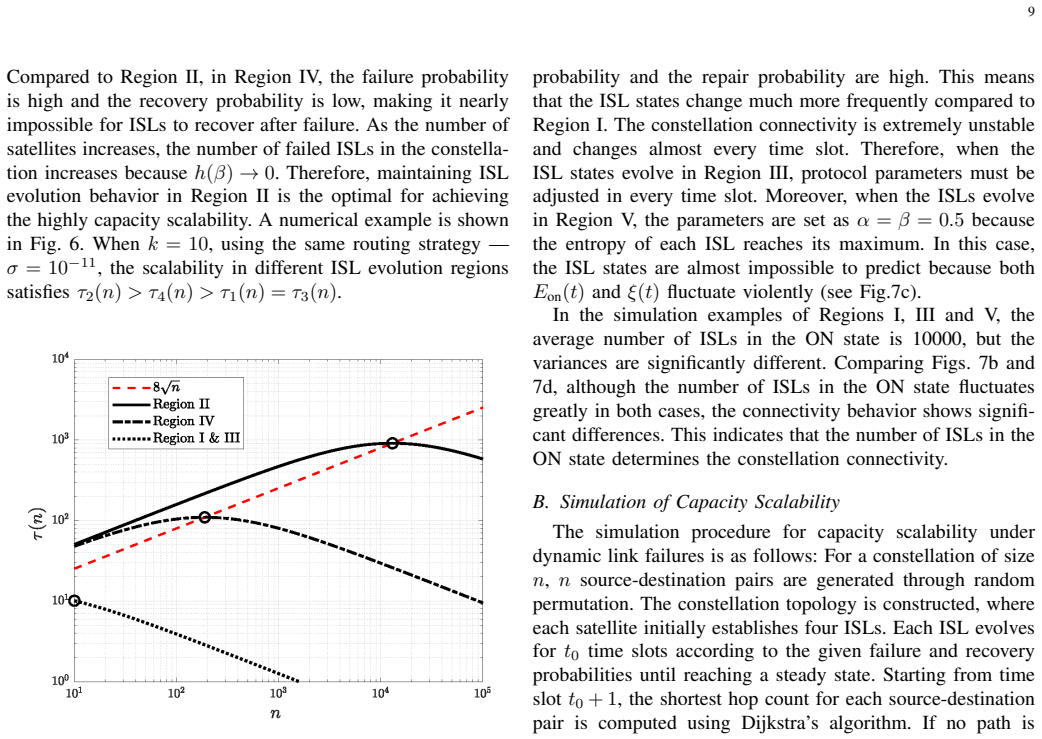
If ISL states follow a two-state discrete Markov chain and the maintenance period is k ≥ 1, the upper bound of capacity scalability under the uniform traffic pattern is O(1/n), where n is the number of satellites. With perfect information about the constellation topology, the upper bound can be achieved via shortest-path routing. For any given protocol, there exists an optimal constellation deployment scale in terms of capacity scalability. When the constellation size is below this optimum scale, capacity scalability increases with constellation size, thereby improving effective capacity. Increasing the maintenance period k can improve capacity scalability, but it does not change the fact of
What carries the argument
Capacity scalability, defined as the ratio of non-failure constellation capacity to protocol overhead incurred by link maintenance and routing.
If this is right
- Shortest-path routing attains the O(1/n) bound whenever full topology information is available.
- Capacity scalability rises with constellation size only up to a protocol-specific optimum; beyond that point it falls toward zero.
- Lengthening the maintenance interval k raises the scalability curve but leaves the eventual decay to zero unchanged.
- The existence of an optimum scale implies that simply adding more satellites eventually reduces the fraction of capacity available for user traffic.
Where Pith is reading between the lines
- Constellation operators could use the derived optimum as a design target rather than always pursuing the largest possible number of satellites.
- If link failures turn out to be spatially or temporally correlated, the scaling bound may become either tighter or looser than the independent-Markov prediction.
- Routing schemes that exploit partial topology information might achieve a scaling better than shortest-path under imperfect knowledge.
- The same Markov maintenance model could be applied to other overhead-dominated networks, such as large-scale mesh or ad-hoc systems, to locate analogous optimal sizes.
Load-bearing premise
Inter-satellite link states can be modeled as independent two-state Markov chains with a fixed maintenance period k.
What would settle it
Simulate or measure the effective-to-overhead capacity ratio while increasing satellite count n under the stated Markov link model and check whether the ratio follows the predicted O(1/n) decay past the claimed optimum.
Figures




read the original abstract
Dynamic link failures disrupt the connectivity and geometric symmetry of the constellation structure, thereby increasing protocol overhead and degrading the effective capacity for traffic transport. The fundamental relationship between constellation size and effective capacity under protocol overhead constraints remains unclear. To this end, we define capacity scalability as the ratio of constellation capacity under non-failure conditions to protocol overhead. Specifically, if ISL states follow a two-state discrete Markov chain and the maintenance period is $k \geq 1$, the upper bound of capacity scalability under the uniform traffic pattern is $O(1/n)$, where $n$ is the number of satellites. With perfect information about the constellation topology, the upper bound can be achieved via shortest-path routing. For any given protocol, there exists an optimal constellation deployment scale in terms of capacity scalability. When the constellation size is below this optimum scale, capacity scalability increases with constellation size, thereby improving effective capacity. Increasing the maintenance period $k$ can improve capacity scalability, but it does not change the fact that the capacity scalability converges to zero when the constellation size exceeds the optimal scale.
Editorial analysis
A structured set of objections, weighed in public.
Referee Report
Summary. The paper models inter-satellite link (ISL) failures in LEO constellations as a two-state discrete Markov chain with fixed maintenance period k ≥ 1. It defines capacity scalability as the ratio of non-failure constellation capacity to protocol overhead, proves that this quantity is upper-bounded by O(1/n) under uniform traffic (n = number of satellites), shows the bound is achieved by shortest-path routing with perfect topology knowledge, and establishes that an optimal finite scale exists beyond which scalability converges to zero even as k increases.
Significance. If the Markov-chain derivation and overhead accounting are rigorous, the result supplies a concrete, model-based limit on effective capacity growth in large LEO systems and identifies an optimal deployment size together with the limited benefit of longer maintenance intervals. This would be useful for constellation sizing once the model parameters are calibrated to measured failure statistics.
major comments (2)
- [Main theorem / capacity-scalability derivation] The central O(1/n) upper bound is asserted to follow directly from the steady-state failure probability of the two-state Markov chain and the per-link maintenance cost; the manuscript must exhibit the explicit algebraic steps (including how overhead scales with n and how non-failure capacity is normalized) that produce this order, because the scaling appears to be a direct modeling consequence rather than an independent geometric or topological property.
- [Achievability argument] The achievability claim relies on shortest-path routing under perfect topology information; the paper should quantify the additional overhead (or its absence) incurred by acquiring and disseminating that perfect information, as any realistic dissemination cost would alter the claimed tightness of the bound.
minor comments (2)
- [Abstract / Definitions] Define a compact symbol (e.g., S(n,k)) for capacity scalability at the outset and use it consistently in all statements of the bound and optimality result.
- [Traffic model] Clarify whether the uniform traffic pattern is chosen as the worst case, the average case, or for analytic tractability, and state any assumptions on traffic matrix symmetry.
Simulated Author's Rebuttal
We thank the referee for the constructive comments. We agree that the derivation of the O(1/n) bound requires more explicit algebraic steps and that the perfect-topology assumption needs clarification. We will revise the manuscript accordingly, as detailed in the point-by-point responses below.
read point-by-point responses
-
Referee: [Main theorem / capacity-scalability derivation] The central O(1/n) upper bound is asserted to follow directly from the steady-state failure probability of the two-state Markov chain and the per-link maintenance cost; the manuscript must exhibit the explicit algebraic steps (including how overhead scales with n and how non-failure capacity is normalized) that produce this order, because the scaling appears to be a direct modeling consequence rather than an independent geometric or topological property.
Authors: We agree that the algebraic steps should be exhibited explicitly. The steady-state failure probability of each ISL is π_f = 1/(k+1). Non-failure capacity is normalized as C_nf = (1 - π_f) C_full, where C_full denotes the capacity of the fully connected constellation under uniform traffic. Protocol overhead is incurred by per-link maintenance and scales as Θ(n) because the number of ISLs grows linearly with n in a LEO mesh. Capacity scalability is therefore S = C_nf / overhead = O(1/n). In the revised manuscript we will add a dedicated subsection that walks through these steps, including the normalization of C_nf and the linear scaling of overhead with n, to make the origin of the bound transparent. revision: yes
-
Referee: [Achievability argument] The achievability claim relies on shortest-path routing under perfect topology information; the paper should quantify the additional overhead (or its absence) incurred by acquiring and disseminating that perfect information, as any realistic dissemination cost would alter the claimed tightness of the bound.
Authors: The achievability result is stated under the ideal assumption of perfect, instantaneous topology knowledge, which yields an upper bound on routing performance. Under this assumption, shortest-path routing incurs no extra overhead beyond data-plane transmission. We acknowledge that realistic acquisition and dissemination of topology information would require control messages whose cost could scale with n and would therefore loosen the bound. Our analysis deliberately isolates data-plane scalability under the failure model; we will revise the text to state this idealization explicitly and note that a joint data-plus-control model lies beyond the present scope. This clarification will be added without changing the mathematical claims under the stated assumptions. revision: partial
Circularity Check
No significant circularity
full rationale
The paper explicitly defines capacity scalability as the ratio of non-failure constellation capacity to protocol overhead. It then assumes ISL states obey a two-state discrete Markov chain with fixed maintenance period k ≥ 1 and derives that the resulting overhead growth forces an O(1/n) upper bound under uniform traffic. This is a direct mathematical consequence of the modeling assumptions rather than a self-definitional loop, a fitted parameter renamed as a prediction, or a load-bearing self-citation. No equations or steps in the abstract reduce the claimed bound to its own inputs by construction; the result remains conditional on the external Markov model and is therefore self-contained.
Axiom & Free-Parameter Ledger
axioms (1)
- domain assumption Inter-satellite link states follow a two-state discrete Markov chain
Lean theorems connected to this paper
-
IndisputableMonolith/Cost/FunctionalEquation.leanwashburn_uniqueness_aczel unclear?
unclearRelation between the paper passage and the cited Recognition theorem.
if ISL states follow a two-state discrete Markov chain and the maintenance period is k ≥ 1, the upper bound of capacity scalability under the uniform traffic pattern is O(1/n)
-
IndisputableMonolith/Foundation/RealityFromDistinction.leanreality_from_one_distinction unclear?
unclearRelation between the paper passage and the cited Recognition theorem.
ω ≥ H̄_k(α, β) = [h(π₁) + (k−1)(π₁ h(α) + π₀ h(β))]/k
What do these tags mean?
- matches
- The paper's claim is directly supported by a theorem in the formal canon.
- supports
- The theorem supports part of the paper's argument, but the paper may add assumptions or extra steps.
- extends
- The paper goes beyond the formal theorem; the theorem is a base layer rather than the whole result.
- uses
- The paper appears to rely on the theorem as machinery.
- contradicts
- The paper's claim conflicts with a theorem or certificate in the canon.
- unclear
- Pith found a possible connection, but the passage is too broad, indirect, or ambiguous to say the theorem truly supports the claim.
Reference graph
Works this paper leans on
-
[1]
Extending the ecob space debris index with fragmentation risk estimation,
F. Letizia, C. Colombo, H. Lewis, and H. Krag, “Extending the ecob space debris index with fragmentation risk estimation,” 2017
work page 2017
-
[2]
Assess- ing and minimizing collisions in satellite mega-constellations,
N. Reiland, A. J. Rosengren, R. Malhotra, and C. Bombardelli, “Assess- ing and minimizing collisions in satellite mega-constellations,”Advances in Space Research, vol. 67, no. 11, pp. 3755–3774, 2021
work page 2021
-
[3]
Large constellations assessment and optimization in leo space debris environment,
L. Olivieri and A. Francesconi, “Large constellations assessment and optimization in leo space debris environment,”Advances in Space Research, vol. 65, no. 1, pp. 351–363, 2020
work page 2020
-
[4]
M. Sheng, D. Zhou, S. Ji, W. Bai, Y . Zhu, J. Liu, and J. Li, “Effects of space environment on satellite mega-constellations: From nodes and links to network performance,”Engineering, 2025
work page 2025
-
[5]
Weathering a solar superstorm: Starlink performance during the may 2024 storm,
A. Ramanathan and S. A. Jyothi, “Weathering a solar superstorm: Starlink performance during the may 2024 storm,” inProceedings of the 2nd International Workshop on LEO Networking and Communication, 2024, pp. 31–36
work page 2024
-
[6]
V . W. S. Chan, “Free space optical communication and network ar- chitecture - fundamentals, history and looking forward,”IEEE J. Sel. Top. Quantum Electron., vol. 32, no. 1: Advances in Free Space Laser Communications, pp. 1–20, 2026
work page 2026
-
[7]
M. Sheng, D. Zhou, W. Bai, J. Liu, H. Li, Y . Shi, and J. Li, “Coverage enhancement for 6g satellite-terrestrial integrated networks: performance metrics, constellation configuration and resource allocation,”Science China Information Sciences, vol. 66, no. 3, p. 130303, 2023
work page 2023
-
[8]
Lattice networks: capacity limits, optimal routing, and queueing behavior,
G. Barrenetxea, B. Berefull-Lozano, and M. Vetterli, “Lattice networks: capacity limits, optimal routing, and queueing behavior,”IEEE/ACM Trans. Netw., vol. 14, no. 3, pp. 492–505, 2006
work page 2006
-
[9]
Capacity provisioning and failure recovery for low earth orbit satellite constellation,
J. Sun and E. Modiano, “Capacity provisioning and failure recovery for low earth orbit satellite constellation,”International journal of satellite communications and networking, vol. 21, no. 3, pp. 259–284, 2003
work page 2003
-
[10]
Scalability analysis of grid-based multi-hop wireless networks,
R. Urgaonkar, V . Manfredi, and R. Ramanathan, “Scalability analysis of grid-based multi-hop wireless networks,” in2013 Fifth International Conference on Communication Systems and Networks (COMSNETS), 2013, pp. 1–10
work page 2013
-
[11]
Symptotics: a framework for estimating the scalability of real-world wireless networks,
R. Ramanathan, E. Ciftcioglu, A. Samanta, R. Urgaonkar, and T. La Porta, “Symptotics: a framework for estimating the scalability of real-world wireless networks,”Wireless Networks, vol. 23, no. 4, pp. 1063–1083, 2017
work page 2017
-
[12]
Modeling and analysis of cascading failures in leo satellite networks,
L. Zhang, Y . Du, and Z. Sun, “Modeling and analysis of cascading failures in leo satellite networks,”IEEE Trans. Netw. Sci. Eng., vol. 11, no. 1, pp. 807–822, 2024
work page 2024
-
[13]
A dynamic cascading failure model for leo satellite networks,
L. Zhang and Y . Du, “A dynamic cascading failure model for leo satellite networks,”IEEE Trans. Netw. Serv. Manag., vol. 21, no. 2, pp. 1672– 1689, 2024
work page 2024
-
[14]
Failure resilience in proliferated low earth orbit satellite network topologies,
T. Shake, J. Sun, T. Royster, and A. Narula-Tam, “Failure resilience in proliferated low earth orbit satellite network topologies,” inMILCOM 2022, 2022, pp. 828–834
work page 2022
-
[15]
Capacity analysis and robust topology design of leo satellite constellation with node/link failure,
L. Guo, J. Liu, M. Sheng, Y . Li, and J. Li, “Capacity analysis and robust topology design of leo satellite constellation with node/link failure,” IEEE Trans. Commun., vol. 74, pp. 7420–7433, 2026
work page 2026
-
[16]
L. Guo, M. Sheng, J. Liu, and J. Li, “Exploring the throughput capacity limits of leo satellite constellation networks: Mathematical models and analysis,” in2024 16th International Conference on Wireless Communications and Signal Processing (WCSP), 2024, pp. 1019–1024
work page 2024
-
[17]
Inter-satellite link planning for high capacity in leo mega-constellations,
T. Lan, D. Zhou, M. Sheng, and J. Li, “Inter-satellite link planning for high capacity in leo mega-constellations,” inICC 2024, 2024, pp. 4451–4456
work page 2024
-
[18]
Minimum-hop constellation design for low earth orbit satellite networks,
C. Rao and E. Modiano, “Minimum-hop constellation design for low earth orbit satellite networks,” inIEEE INFOCOM 2025, 2025, pp. 1– 10
work page 2025
-
[19]
Centralized versus distributed routing for large-scale satellite networks,
R. V . Ramakanth and E. Modiano, “Centralized versus distributed routing for large-scale satellite networks,” 2025. [Online]. Available: https://arxiv.org/abs/2501.13744
-
[20]
Prabr: Integrating primary and backup routing in pleo satellite networks,
C. Brady, J. Sun, M. Yuksel, and T. Shake, “Prabr: Integrating primary and backup routing in pleo satellite networks,” in2025 IEEE Aerospace Conference, 2025, pp. 1–10
work page 2025
-
[21]
J. Sun, T. Shake, A. Narula-Tam, and T. Royster, “Multicast communi- cations with uplink broadcast in a proliferated low earth orbit satellite network,” in2025 IEEE Aerospace Conference, 2025, pp. 1–8
work page 2025
-
[22]
Low-overhead gps- free geometric routing for leo satellite networks,
M. Yuksel, C. Brady, J. Sun, and T. Shake, “Low-overhead gps- free geometric routing for leo satellite networks,” in2025 IEEE 26th International Symposium on a World of Wireless, Mobile and Multimedia Networks (WoWMoM), 2025, pp. 21–30
work page 2025
-
[23]
Hybrid geometric/shortest-path routing in proliferated low- earth-orbit satellite networks,
T. Shake, “Hybrid geometric/shortest-path routing in proliferated low- earth-orbit satellite networks,” inMILCOM 2023, 2023, pp. 357–364
work page 2023
-
[24]
S. Li, C. Zhang, C. Zhao, and C. Xia, “Analyzing the robustness of leo satellite networks based on two different attacks and load distribution methods,”Chaos: An Interdisciplinary Journal of Nonlinear Science, vol. 34, no. 3, 2024
work page 2024
-
[25]
Robustness of leo satellite hypernetworks under different network topologies and attack strategies,
——, “Robustness of leo satellite hypernetworks under different network topologies and attack strategies,”Physics Letters A, vol. 526, p. 129952, 2024
work page 2024
-
[26]
L. Bai, H. Ma, Y . Jiang, Z. Yin, H. Wan, and H. Wang, “Grl-rr: A graph reinforcement learning-based resilient routing framework for software-defined leo mega-constellations,”Computer Networks, vol. 259, p. 111089, 2025
work page 2025
-
[27]
Optimal oblivious load-balancing for sparse traffic in large-scale satellite networks,
R. V . Ramakanth and E. Modiano, “Optimal oblivious load-balancing for sparse traffic in large-scale satellite networks,”arXiv preprint arXiv:2601.02537, 2026
work page internal anchor Pith review arXiv 2026
-
[28]
A network- level 3-layer single event upset risk assessment model for satellite mega constellations,
Y . Nie, D. Zhou, M. Sheng, J. Liu, W. Bai, and J. Li, “A network- level 3-layer single event upset risk assessment model for satellite mega constellations,” in2025 IEEE/CIC International Conference on Communications in China (ICCC), 2025, pp. 1–6
work page 2025
-
[29]
Impact analysis of solar background noise on leo mega-constellations,
X. Liu, W. Bai, M. Sheng, D. Zhou, J. Liu, S. Ji, and Y . Zhu, “Impact analysis of solar background noise on leo mega-constellations,” inICC 2025, 2025, pp. 6916–6921
work page 2025
-
[30]
Channel probing in op- portunistic communication systems,
M. Johnston, I. Keslassy, and E. Modiano, “Channel probing in op- portunistic communication systems,”IEEE Trans. Inf. Theory, vol. 63, no. 11, pp. 7535–7552, 2017
work page 2017
discussion (0)
Sign in with ORCID, Apple, or X to comment. Anyone can read and Pith papers without signing in.