Recognition: 2 theorem links
· Lean TheoremAttacks and Mitigations for Distributed Governance of Agentic AI under Byzantine Adversaries
Pith reviewed 2026-05-13 03:57 UTC · model grok-4.3
The pith
A compromised central Provider in agentic AI governance allows attacks that steal private data, undermine agent identity, and bypass access rules.
A machine-rendered reading of the paper's core claim, the machinery that carries it, and where it could break.
Core claim
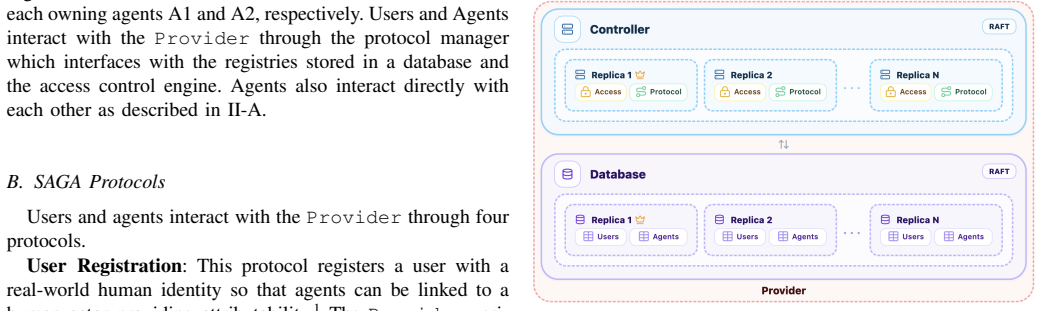
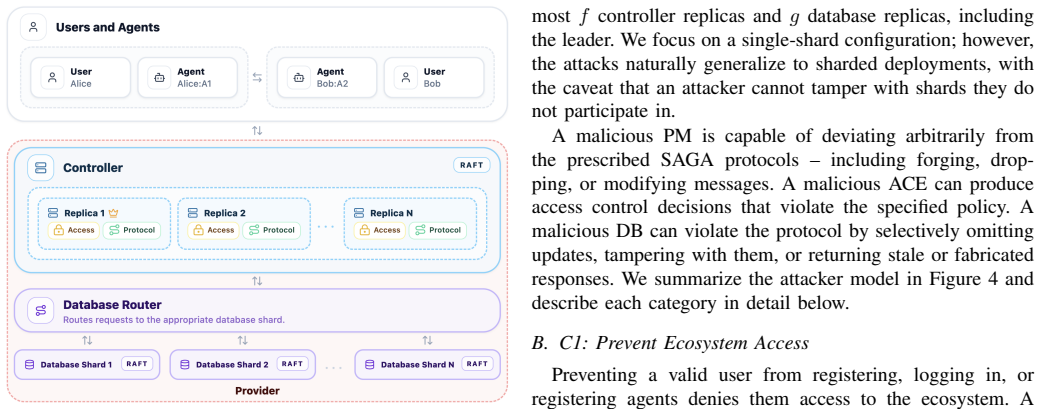
The SAGA architecture assumes a logically centralized Provider that stores user and agent data and enforces communication policies; when this Provider deviates from the protocol, it can mount attacks that remove attributability of agents to owners, extract private data stored at the Provider, or allow unauthorized agents to interact despite policy restrictions. The work demonstrates these attacks in practice and then defines SAGA-BFT as a fully Byzantine-fault-tolerant replacement, SAGA-MON as a lightweight monitoring layer on the Provider, SAGA-AUD as client-side auditing, and SAGA-HYB as a hybrid that mixes resilience with monitoring, each evaluated for the security guarantees and overhead
What carries the argument
The SAGA Provider, the single point that holds identity records and actively enforces owner policies; when it is Byzantine, the mitigations are SAGA-BFT (full Byzantine replication), SAGA-MON (server-side checks), SAGA-AUD (client audits), and SAGA-HYB (combined).
If this is right
- SAGA-BFT blocks all listed attacks but imposes high latency and throughput costs from Byzantine protocols.
- SAGA-MON and SAGA-AUD stop most attack classes while adding only small runtime overhead.
- SAGA-HYB lets operators choose the security level that matches their performance budget.
- Evaluations on the four architectures versus baseline SAGA quantify exactly where each design sits on the security-performance curve.
Where Pith is reading between the lines
- Operators running large numbers of agents on public clouds will likely prefer the lighter monitoring or hybrid options to preserve scalability.
- The same attack surface may appear in any governance system that places policy enforcement and identity storage in one administrative domain.
- Client-side auditing could be combined with existing logging tools already present in cloud deployments.
Load-bearing premise
That the monitoring, auditing, and hybrid solutions can be added without creating new attack surfaces that a compromised Provider or insiders could exploit.
What would settle it
A working implementation of SAGA-MON in which a Provider still succeeds in extracting private data or bypassing access control without triggering the monitors.
Figures





read the original abstract
Agentic AI governance is a critical component of agentic AI infrastructure ensuring that agents follow their owner's communication and interaction policies, and providing protection against attacks from malicious agents. The state-of-the-art solution, SAGA, assumes a logically centralized point of trust, the Provider, which serves as a repository for user and agent information and actively enforces policies. While SAGA provides protection against malicious agents, it remains vulnerable to a malicious Provider that deviates from the protocol, undermining the security of the identity and access control infrastructure. Deployment on both private and public clouds, each susceptible to insider threats, further increases the risk of Provider compromise. In this work, we analyze the attacks that can be mounted from a compromised Provider, taking into account the different system components and realistic deployments. We identify and execute several concrete attacks with devastating effects: undermining agent attributability, extracting private data, or bypassing access control. We then present three types of solutions for securing the Provider that offer different trade-offs between security and performance. We first present SAGA-BFT, a fully byzantine-resilient architecture that provides the strongest protection, but incurs significant performance degradation, due to the high-cost of byzantine resilient protocols. We then propose SAGA-MON and SAGA-AUD, two novel solutions that leverage lightweight server-side monitoring or client-side auditing to provide protection against most classes of attacks with minimal overhead. Finally, we propose SAGA-HYB, a hybrid architecture that combines byzantine-resilience with monitoring and auditing to trade-off security for performance. We evaluate all the architectures and compare them with SAGA. We discuss which solution is best and under what conditions.
Editorial analysis
A structured set of objections, weighed in public.
Referee Report
Summary. The manuscript analyzes attacks on the SAGA system for agentic AI governance from a compromised Provider in cloud deployments. It identifies and executes concrete attacks that undermine agent attributability, extract private data, or bypass access control. It proposes three types of mitigations: SAGA-BFT for full Byzantine fault tolerance (with performance costs), SAGA-MON and SAGA-AUD leveraging lightweight server-side monitoring or client-side auditing for most attacks with minimal overhead, and SAGA-HYB as a hybrid. The architectures are evaluated and compared to the original SAGA, discussing best choices under different conditions.
Significance. If the concrete attacks hold and the proposed mitigations are shown to be effective without introducing new vulnerabilities, this would contribute meaningfully to the security of agentic AI systems by addressing Provider compromise risks. The work is credited for its identification of specific attack vectors and the exploration of security-performance trade-offs in the proposed solutions.
major comments (1)
- Description of SAGA-MON and SAGA-AUD: The central claim that these solutions provide protection against most classes of attacks with minimal overhead depends on the monitoring and auditing components resisting circumvention by the Byzantine adversary. No formal model or adversarial analysis is described that rules out evasion tactics such as selective logging, forged attestations, or timing attacks on the monitor, leaving the mitigation effectiveness unproven.
minor comments (1)
- Abstract: The abstract mentions evaluation of all architectures but does not include any specific performance or security metrics, which would help readers quickly gauge the trade-offs.
Simulated Author's Rebuttal
We thank the referee for their constructive feedback and recognition of the paper's contributions in identifying concrete attacks on SAGA and exploring security-performance trade-offs in the proposed mitigations. We address the single major comment point by point below.
read point-by-point responses
-
Referee: Description of SAGA-MON and SAGA-AUD: The central claim that these solutions provide protection against most classes of attacks with minimal overhead depends on the monitoring and auditing components resisting circumvention by the Byzantine adversary. No formal model or adversarial analysis is described that rules out evasion tactics such as selective logging, forged attestations, or timing attacks on the monitor, leaving the mitigation effectiveness unproven.
Authors: We thank the referee for this observation. The manuscript presents SAGA-MON and SAGA-AUD through detailed architectural descriptions, concrete attack scenarios that the mechanisms are designed to address, and empirical performance comparisons showing low overhead relative to SAGA-BFT. Informal arguments are provided for why the tamper-evident logging in SAGA-MON and cryptographic auditing in SAGA-AUD raise the bar for circumvention. However, we agree that the absence of an explicit adversarial model analyzing evasion strategies (selective logging, forged attestations, timing attacks) leaves the claims less rigorously supported than they could be. In the revised version we will add a dedicated subsection that formally models the Byzantine Provider's capabilities against these components and analyzes each listed evasion tactic, demonstrating detection or prevention where applicable. This will directly bolster the central claim without changing the proposed architectures or evaluation results. revision: yes
Circularity Check
No significant circularity in derivation chain
full rationale
The paper begins from the publicly described SAGA system (state-of-the-art governance with a trusted Provider), applies the standard Byzantine adversary model to enumerate concrete attacks on attributability, data extraction, and access control, then introduces new architectures (SAGA-BFT, SAGA-MON, SAGA-AUD, SAGA-HYB) whose security/performance trade-offs are evaluated directly. No equations, fitted parameters, or self-definitions appear; claims do not reduce to prior self-citations by construction. The analysis remains self-contained against external BFT benchmarks and does not rely on load-bearing unverified self-citations for its core results.
Axiom & Free-Parameter Ledger
axioms (1)
- domain assumption The Provider component can be compromised by Byzantine adversaries in realistic private and public cloud deployments
Lean theorems connected to this paper
-
IndisputableMonolith/Foundation/RealityFromDistinction.leanreality_from_one_distinction unclear?
unclearRelation between the paper passage and the cited Recognition theorem.
We first present SAGA-BFT, a fully byzantine-resilient architecture... SAGA-MON and SAGA-AUD... SAGA-HYB, a hybrid architecture that combines byzantine-resilience with monitoring and auditing
-
IndisputableMonolith/Cost/FunctionalEquation.leanwashburn_uniqueness_aczel unclear?
unclearRelation between the paper passage and the cited Recognition theorem.
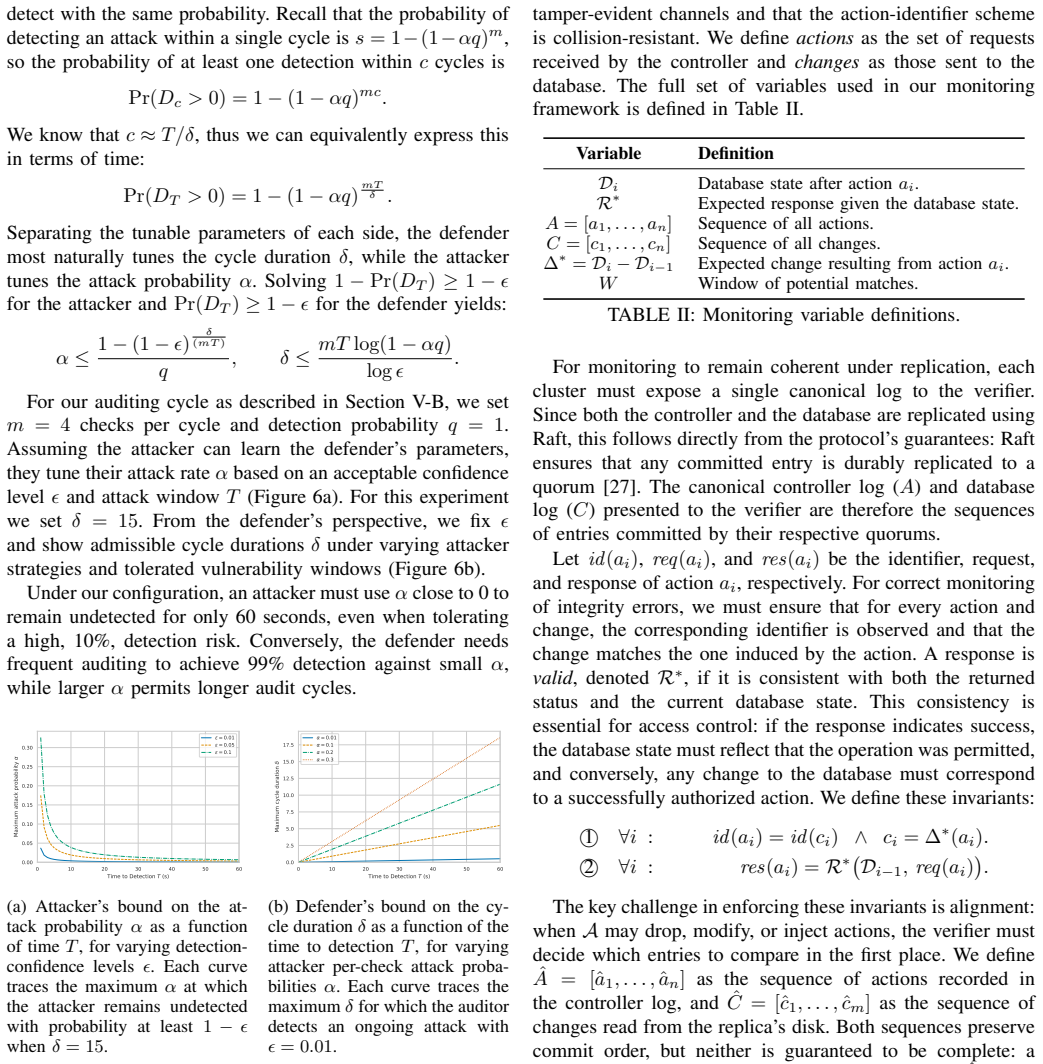
We derive system invariants and use monitoring to analyze database logs and network communication to check if the request and response observed match, as they are specified by the protocol.
What do these tags mean?
- matches
- The paper's claim is directly supported by a theorem in the formal canon.
- supports
- The theorem supports part of the paper's argument, but the paper may add assumptions or extra steps.
- extends
- The paper goes beyond the formal theorem; the theorem is a base layer rather than the whole result.
- uses
- The paper appears to rely on the theorem as machinery.
- contradicts
- The paper's claim conflicts with a theorem or certificate in the canon.
- unclear
- Pith found a possible connection, but the passage is too broad, indirect, or ambiguous to say the theorem truly supports the claim.
Reference graph
Works this paper leans on
-
[1]
Systemic risks associated with agentic ai: A policy brief,
A. Bellog ´ın, P. Giudici, S. Larsson, J. Pang, G. Schimpf, B. Sengupta, and G. Solmaz, “Systemic risks associated with agentic ai: A policy brief,”ACM Europe TPC-Autonomous Systems Subcommittee, 2025
work page 2025
-
[2]
AutoGen: Enabling Next-Gen LLM Applications via Multi-Agent Conversation
Q. Wu, G. Bansal, J. Zhang, Y . Wu, B. Li, E. Zhu, L. Jiang, X. Zhang, S. Zhang, J. Liu, A. H. Awadallah, R. W. White, D. Burger, and C. Wang, “Autogen: Enabling next-gen llm applications via multi-agent conversation,” 2023. [Online]. Available: https: //arxiv.org/abs/2308.08155
work page internal anchor Pith review Pith/arXiv arXiv 2023
-
[3]
MetaGPT: Meta programming for a multi-agent collaborative framework,
S. Hong, M. Zhuge, J. Chen, X. Zheng, Y . Cheng, J. Wang, C. Zhang, Z. Wang, S. K. S. Yau, Z. Lin, L. Zhou, C. Ran, L. Xiao, C. Wu, and J. Schmidhuber, “MetaGPT: Meta programming for a multi-agent collaborative framework,” inThe Twelfth International Conference on Learning Representations, 2024. [Online]. Available: https://openreview.net/forum?id=VtmBAGCN7o
work page 2024
-
[4]
Announcing the Agent2Agent (A2A) protocol,
R. Surapaneni, M. Jha, M. Vakoc, and T. Segal, “Announcing the Agent2Agent (A2A) protocol,” Google Developers Blog, April 9 2025. [Online]. Available: https://developers.googleblog.com/en/ a2a-a-new-era-of-agent-interoperability/
work page 2025
-
[5]
Introducing the Model Context Protocol,
Anthropic, “Introducing the Model Context Protocol,” Anthropic News, November 25 2024. [Online]. Available: https://www.anthropic.com/ news/model-context-protocol
work page 2024
-
[6]
CVE-2025-32711: AI command injection in Microsoft 365 Copilot (EchoLeak),
MITRE, “CVE-2025-32711: AI command injection in Microsoft 365 Copilot (EchoLeak),” https://nvd.nist.gov/vuln/detail/CVE-2025-32711, 2025, accessed: 2026-05-01
work page 2025
-
[7]
AI-powered coding tool wiped out a software company’s database in ‘catastrophic failure’,
J. Kahn, “AI-powered coding tool wiped out a software company’s database in ‘catastrophic failure’,”Fortune, Jul. 2025, accessed 2026-05-01. [Online]. Available: https://fortune.com/2025/07/23/ ai-coding-tool-replit-wiped-database-called-it-a-catastrophic-failure/
work page 2025
-
[8]
Disrupting the first reported AI-orchestrated cyber espionage campaign,
Anthropic, “Disrupting the first reported AI-orchestrated cyber espionage campaign,” https://www.anthropic.com/ news/disrupting-AI-espionage, Nov. 2025, full report: https://assets.anthropic.com/m/ec212e6566a0d47/original/ Disrupting-the-first-reported-AI-orchestrated-cyber-espionage-campaign. pdf. Accessed 2026-05-01
work page 2025
-
[9]
Practices for governing agentic ai systems,
Y . Shavit, S. Agarwal, M. Brundage, S. Adler, C. O’Keefe, R. Campbell, T. Lee, P. Mishkin, T. Eloundou, A. Hickeyet al., “Practices for governing agentic ai systems,”Research Paper, OpenAI, 2023
work page 2023
-
[10]
A. Chan, N. Kolt, P. Wills, U. Anwar, C. S. de Witt, N. Rajkumar, L. Hammond, D. Krueger, L. Heim, and M. Anderljung, “IDs for AI systems,”arXiv preprint arXiv:2406.12137, 2024
-
[11]
The agntcy agent directory service: Architecture and implementation,
L. Muscariello, V . Pandey, and R. Polic, “The agntcy agent di- rectory service: Architecture and implementation,”arXiv preprint arXiv:2509.18787, 2025
-
[12]
A. Chan, K. Wei, S. Huang, N. Rajkumar, E. Perrier, S. Lazar, G. K. Hadfield, and M. Anderljung, “Infrastructure for AI agents,”arXiv preprint arXiv:2501.10114, 2025
-
[13]
Authenticated Delegation and Authorized AI Agents,
T. South, S. Marro, T. Hardjono, R. Mahari, C. D. Whitney, D. Green- wood, A. Chan, and A. Pentland, “Authenticated delegation and autho- rized AI agents,”arXiv preprint arXiv:2501.09674, 2025
-
[14]
Upgrade or switch: Do we need a next-gen trusted architecture for the internet of AI agents?
R. Raskar, P. Chari, J. J. Grogan, M. Lambe, R. Lincourt, R. Bala, A. Joshi, A. Singh, A. Chopra, R. Ranjan, S. Gupta, D. Stripelis, M. Gorskikh, and S. Wang, “Upgrade or switch: Do we need a next-gen trusted architecture for the internet of AI agents?” 2025. [Online]. Available: https://arxiv.org/abs/2506.12003
-
[15]
Fortifying the agentic web: A unified zero-trust architecture against logic-layer threats,
K. Huang, Y . Mehmood, H. Atta, J. Huang, M. Z. Baig, and S. B. Balija, “Fortifying the agentic web: A unified zero-trust architecture against logic-layer threats,”arXiv preprint arXiv:2508.12259, 2025
-
[16]
Trustagent: Towards safe and trustworthy llm-based agents through agent constitution,
W. Hua, X. Yang, M. Jin, Z. Li, W. Cheng, R. Tang, and Y . Zhang, “Trustagent: Towards safe and trustworthy llm-based agents through agent constitution,” inTrustworthy Multi-modal Foundation Models and AI Agents (TiFA), 2024
work page 2024
-
[17]
Contextual agent security: A policy for every purpose,
L. Tsai and E. Bagdasarian, “Contextual agent security: A policy for every purpose,” inProceedings of the 2025 Workshop on Hot Topics in Operating Systems, 2025, pp. 8–17
work page 2025
-
[18]
Y . Louck, A. Stulman, and A. Dvir, “Improving google a2a protocol: Protecting sensitive data and mitigating unintended harms in multi-agent systems,”arXiv preprint arXiv:2505.12490, 2025
-
[19]
Building a secure agentic ai application leveraging a2a protocol,
I. Habler, K. Huang, V . S. Narajala, and P. Kulkarni, “Building a secure agentic ai application leveraging a2a protocol,”arXiv preprint arXiv:2504.16902, 2025
-
[20]
Smcp: Secure model context protocol,
X. Hou, S. Wang, Y . Zhang, Z. Xue, Y . Zhao, C. Fu, and H. Wang, “Smcp: Secure model context protocol,”arXiv preprint arXiv:2602.01129, 2026
-
[21]
SAGA: A security architecture for governing ai agentic systems,
G. Syros, A. Suri, J. Ginesin, C. Nita-Rotaru, and A. Oprea, “SAGA: A security architecture for governing ai agentic systems,” inProceedings of the Network and Distributed System Security Symposium, ser. NDSS, 2026
work page 2026
- [22]
-
[23]
Hey, you, get off of my cloud: exploring information leakage in third-party compute clouds,
T. Ristenpart, E. Tromer, H. Shacham, and S. Savage, “Hey, you, get off of my cloud: exploring information leakage in third-party compute clouds,” inProceedings of the 16th ACM conference on Computer and communications security, 2009, pp. 199–212
work page 2009
-
[24]
A container security survey: Exploits, attacks, and defenses,
O. Jarkas, R. Ko, N. Dong, and R. Mahmud, “A container security survey: Exploits, attacks, and defenses,”ACM Computing Surveys, vol. 57, no. 7, pp. 1–36, 2025
work page 2025
-
[25]
Practical byzantine fault tolerance,
M. Castro, B. Liskovet al., “Practical byzantine fault tolerance,” in OsDI, vol. 99, no. 1999, 1999, pp. 173–186
work page 1999
-
[26]
Openid connect core 1.0 incorporating errata set 1,
N. Sakimura, J. Bradley, M. Jones, B. De Medeiros, and C. Mortimore, “Openid connect core 1.0 incorporating errata set 1,”The OpenID Foundation, specification, vol. 335, 2014
work page 2014
-
[27]
In search of an understandable consensus algorithm,
D. Ongaro and J. Ousterhout, “In search of an understandable consensus algorithm,” inProceedings of the 2014 USENIX Conference on USENIX Annual Technical Conference, ser. USENIX ATC’14. USA: USENIX Association, 2014, p. 305–320
work page 2014
-
[28]
Bigtable: A distributed storage system for structured data,
F. Chang, J. Dean, S. Ghemawat, W. C. Hsieh, D. A. Wallach, M. Bur- rows, T. Chandra, A. Fikes, and R. E. Gruber, “Bigtable: A distributed storage system for structured data,”ACM Transactions on Computer Systems (TOCS), vol. 26, no. 2, pp. 1–26, 2008
work page 2008
-
[29]
Spanner: Google’s globally distributed database,
J. C. Corbett, J. Dean, M. Epstein, A. Fikes, C. Frost, J. J. Furman, S. Ghemawat, A. Gubarev, C. Heiser, P. Hochschildet al., “Spanner: Google’s globally distributed database,”ACM Transactions on Computer Systems (TOCS), vol. 31, no. 3, pp. 1–22, 2013
work page 2013
-
[30]
Megastore: Providing scalable, highly available storage for interactive services
J. Baker, C. Bond, J. C. Corbett, J. Furman, A. Khorlin, J. Larson, J.- M. Leon, Y . Li, A. Lloyd, and V . Yushprakh, “Megastore: Providing scalable, highly available storage for interactive services.” inCIDR, vol. 11, 2011, pp. 223–234
work page 2011
-
[31]
H. F. Korth and A. S. S. Sudarshan, “Database system concepts,” 2020
work page 2020
-
[32]
Sharding distributed databases: A critical review,
S. Solat, “Sharding distributed databases: A critical review,”arXiv preprint arXiv:2404.04384, 2024
-
[33]
From prompt injections to protocol exploits: Threats in llm-powered ai agents workflows,
M. A. Ferrag, N. Tihanyi, D. Hamouda, L. Maglaras, A. Lakas, and M. Debbah, “From prompt injections to protocol exploits: Threats in llm-powered ai agents workflows,”ICT Express, 2025
work page 2025
-
[34]
J.-t. Huang, J. Zhou, T. Jin, X. Zhou, Z. Chen, W. Wang, Y . Yuan, M. R. Lyu, and M. Sap, “On the resilience of llm-based multi-agent collaboration with faulty agents,”arXiv preprint arXiv:2408.00989, 2024
- [35]
-
[36]
Ai agents under threat: A survey of key security challenges and future pathways,
Z. Deng, Y . Guo, C. Han, W. Ma, J. Xiong, S. Wen, and Y . Xiang, “Ai agents under threat: A survey of key security challenges and future pathways,”ACM Computing Surveys, vol. 57, no. 7, pp. 1–36, 2025
work page 2025
-
[37]
Demonstrations of integrity attacks in multi-agent systems
C. Zheng, Y . Cao, X. Dong, and T. He, “Demonstrations of integrity attacks in multi-agent systems,”arXiv preprint arXiv:2506.04572, 2025
-
[38]
The latest gossip on bft consensus,
E. Buchman, J. Kwon, and Z. Milosevic, “The latest gossip on bft consensus,”arXiv preprint arXiv:1807.04938, 2018
-
[39]
Bigchaindb: A scalable blockchain database (draft),
T. McConaghy, R. Marques, A. M ¨uller, D. De Jonghe, T. Mc- Conaghy, G. McMullen, R. Henderson, S. Bellemare, and A. Granzotto, “Bigchaindb: A scalable blockchain database (draft),”BigchainDB (2016), pp. 1–65, 2016
work page 2016
-
[40]
Blockchaindb: A shared database on blockchains,
M. El-Hindi, C. Binnig, A. Arasu, D. Kossmann, and R. Ramamurthy, “Blockchaindb: A shared database on blockchains,”Proceedings of the VLDB Endowment, vol. 12, no. 11, pp. 1597–1609, 2019
work page 2019
-
[41]
Hybrid blockchain database systems: design and performance,
Z. Ge, D. Loghin, B. C. Ooi, P. Ruan, and T. Wang, “Hybrid blockchain database systems: design and performance,”Proceedings of the VLDB Endowment, vol. 15, no. 5, pp. 1092–1104, 2022
work page 2022
-
[42]
A. Singh, T. Das, P. Maniatis, P. Druschel, and T. Roscoe, “Bft protocols under fire.” inNSDI, vol. 8, 2008, pp. 189–204
work page 2008
-
[43]
Beyond the whitepaper: Where bft consensus protocols meet reality,
D. Wong, D. Kolegov, and I. Mikushin, “Beyond the whitepaper: Where bft consensus protocols meet reality,”Cryptology ePrint Archive, 2024
work page 2024
-
[44]
Randomized testing of byzantine fault tolerant algorithms,
L. N. Winter, F. Buse, D. De Graaf, K. V on Gleissenthall, and B. Kulahcioglu Ozkan, “Randomized testing of byzantine fault tolerant algorithms,”Proceedings of the ACM on Programming Languages, vol. 7, no. OOPSLA1, pp. 757–788, 2023. 14
work page 2023
-
[45]
Empirically derived analytic models of wide-area tcp connections,
V . Paxson, “Empirically derived analytic models of wide-area tcp connections,”IEEE/ACM transactions on Networking, vol. 2, no. 4, pp. 316–336, 2002
work page 2002
-
[46]
Rethinkdb-rethinking database storage,
L. Walsh, V . Akhmechet, and M. Glukhovsky, “Rethinkdb-rethinking database storage,”Hexagram 49, Inc, p. 85, 2009
work page 2009
-
[47]
arXiv preprint arXiv:2410.11905 , year =
S. Marro, E. La Malfa, J. Wright, G. Li, N. Shadbolt, M. Wooldridge, and P. Torr, “A scalable communication protocol for networks of large language models,”arXiv preprint arXiv:2410.11905, 2024
-
[48]
Agent network protocol technical white paper,
G. Chang, E. Lin, C. Yuan, R. Cai, B. Chen, X. Xie, and Y . Zhang, “Agent network protocol technical white paper,”arXiv preprint arXiv:2508.00007, 2025
-
[49]
Z. Anbiaee, M. Rabbani, M. Mirani, G. Piya, I. Opushnyev, A. Ghorbani, and S. Dadkhah, “Security threat modeling for emerging ai-agent protocols: A comparative analysis of mcp, a2a, agora, and anp,”arXiv preprint arXiv:2602.11327, 2026
work page internal anchor Pith review Pith/arXiv arXiv 2026
-
[50]
Tamas: Benchmarking adversarial risks in multi-agent llm systems,
I. Kavathekar, H. Jain, A. Rathod, P. Kumaraguru, and T. Ganu, “Tamas: Benchmarking adversarial risks in multi-agent llm systems,”arXiv preprint arXiv:2511.05269, 2025. APPENDIX A. Additional Details for Auditing and Monitoring In this appendix, we first provide a detailed step-by-step description of the monitoring verification process. We then present th...
discussion (0)
Sign in with ORCID, Apple, or X to comment. Anyone can read and Pith papers without signing in.