Recognition: no theorem link
QAP-Router: Tackling Qubit Routing as Dynamic Quadratic Assignment with Reinforcement Learning
Pith reviewed 2026-05-13 04:41 UTC · model grok-4.3
The pith
Framing qubit routing as a dynamic quadratic assignment problem lets a reinforcement learning policy with lookahead and transformer attention cut added CNOT gates by 12 to 30 percent.
A machine-rendered reading of the paper's core claim, the machinery that carries it, and where it could break.
Core claim
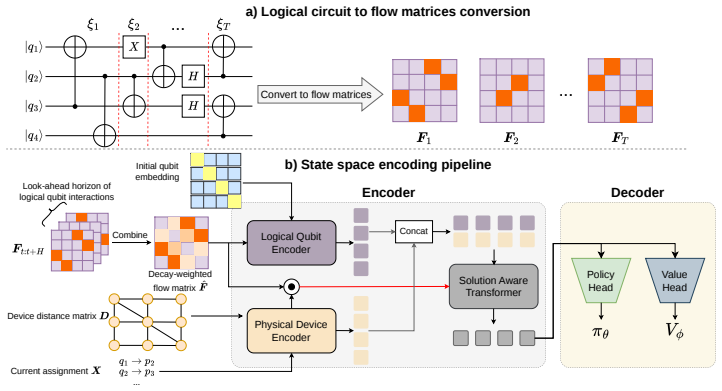
The central claim is that qubit routing is best solved by maintaining a dynamic quadratic assignment objective whose reward equals the sum over logical gate flows times physical distances; this objective is optimized by a reinforcement-learning policy whose transformer backbone injects the flow-distance product into attention and whose lookahead mechanism evaluates candidate assignments several steps ahead. The formulation therefore unifies local gate placement with global topology cost inside a single learned policy rather than relying on hand-crafted heuristics or generic sequential decision models.
What carries the argument
The dynamic quadratic assignment objective that treats logical gate interactions as a flow matrix and hardware connectivity as a distance matrix, used both to define the reinforcement-learning reward and to shape the attention inside a solution-aware transformer policy equipped with lookahead.
If this is right
- Local routing decisions become globally consistent because each step optimizes the same flow-distance product rather than a myopic heuristic.
- The transformer attention layers directly exploit the QAP structure, allowing the policy to weigh future gate interactions against current hardware distances.
- Lookahead integration reduces error accumulation that arises when early swaps lock the circuit into costly later configurations.
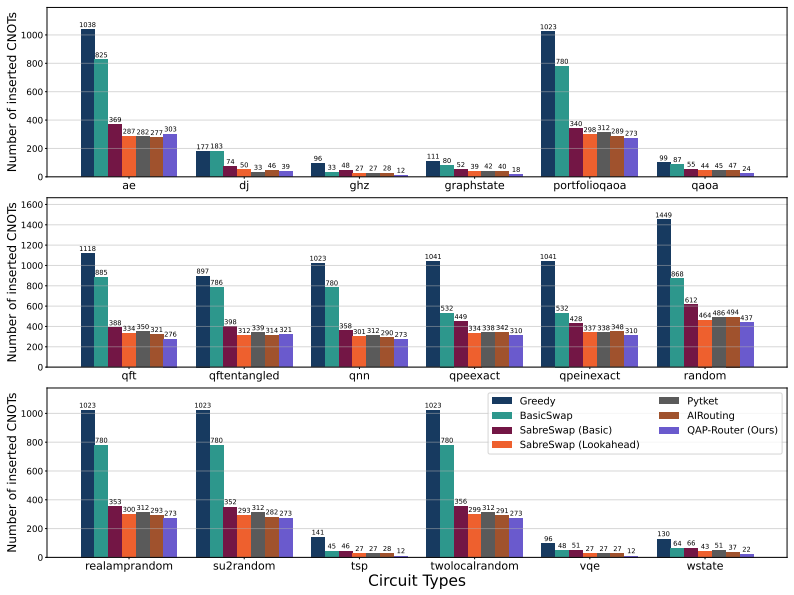
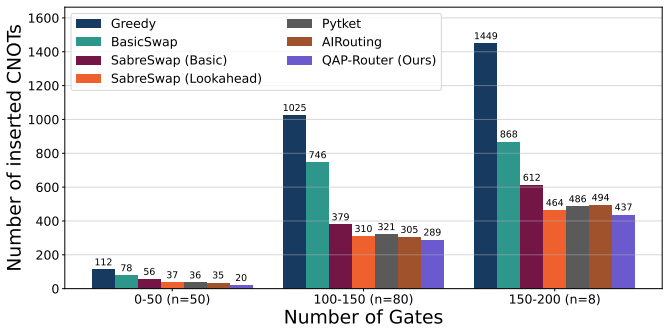
- The measured CNOT reductions hold across real-world circuits from multiple independent suites, suggesting the method is not tuned to a single benchmark family.
Where Pith is reading between the lines
- The same flow-distance framing could be reused for other compilation subtasks such as initial placement or gate scheduling by redefining the flow matrix accordingly.
- On larger devices the learned policy might serve as a fast heuristic inside hybrid classical-quantum compilers that alternate between exact solvers and the RL router.
- Because the reward is explicitly a matrix product, the approach could be extended to weighted costs that incorporate measured gate error rates or decoherence times without changing the policy architecture.
Load-bearing premise
The dynamic QAP objective together with the solution-aware transformer policy and lookahead will continue to yield globally efficient routings on circuits and hardware topologies outside the three benchmark suites tested.
What would settle it
A head-to-head run on a fresh collection of circuits drawn from an application domain or device size not represented in MQTBench, AgentQ, or QUEKO, in which the method produces no reduction in CNOT count relative to the same industry baselines, would falsify the generality of the performance claim.
Figures






read the original abstract
Qubit routing is a fundamental problem in quantum compilation, known to be NP-hard. Its dynamic nature makes local routing decisions propagate and compound over time, making global efficient solutions challenging. Existing heuristic methods rely on local rules with limited lookahead, while recent learning-based approaches often treat routing as a generic sequential decision problem without fully exploiting its underlying structure. In this paper, we introduce QAP-Router, framing qubit routing based on a dynamic Quadratic Assignment Problem (QAP) formulation. By modeling logical interactions, or quantum gates, as flow matrices and hardware topology as a distance matrix, our approach captures the interaction-distance coupling in a unified objective, which defines the reward in the reinforcement learning environment. To further exploit this structure, the policy network employs a solution-aware Transformer backbone that encodes the interaction between the flow matrix and the distance matrix into the attention mechanism. We also integrate a lookahead mechanism that blends naturally into the QAP framework, preventing myopic decisions. Extensive experiments on 1,831 real-world quantum circuits from the MQTBench, AgentQ and QUEKO datasets show that our method substantially reduces the CNOT gate count of routed circuits by 15.7%, 30.4% and 12.1%, respectively, relative to existing industry compilers.
Editorial analysis
A structured set of objections, weighed in public.
Referee Report
Summary. The paper introduces QAP-Router, framing qubit routing as a dynamic Quadratic Assignment Problem (QAP) solved via reinforcement learning. Logical gate interactions are modeled as flow matrices and hardware topology as a distance matrix to define the RL reward; the policy uses a solution-aware Transformer that incorporates flow-distance interactions into attention, augmented by a lookahead mechanism. Experiments on 1,831 circuits from MQTBench, AgentQ, and QUEKO report CNOT-count reductions of 15.7%, 30.4%, and 12.1% relative to existing industry compilers.
Significance. If the empirical margins hold under rigorous controls, the work is significant because it supplies a structured, globally-aware objective for an NP-hard dynamic routing task that existing local heuristics and generic RL pipelines do not fully exploit. Credit is due for the explicit QAP reward construction and the integration of the flow-distance coupling directly into the Transformer attention and lookahead, which are falsifiable design choices that can be tested on new topologies.
major comments (2)
- [Abstract] Abstract: the headline performance claims (15.7%, 30.4%, 12.1% CNOT reduction) are presented without naming the exact baseline compilers, their versions or optimization flags, the number of independent runs, or any measure of variance or statistical significance; these omissions are load-bearing for the central empirical assertion.
- [Experiments] Experiments section: no cross-dataset hold-out, no scaling curves with qubit count or depth, and no topology-agnostic test set are described, so it is impossible to determine whether the reported gains arise from the dynamic-QAP formulation or from statistical similarity between the training and test circuit ensembles.
minor comments (1)
- [Method] The notation for the dynamic flow matrix update rule should be stated explicitly with an equation number so that the lookahead integration can be verified without ambiguity.
Simulated Author's Rebuttal
We thank the referee for the constructive and detailed feedback. The comments highlight important aspects of clarity and experimental rigor that we will address. We respond point-by-point to the major comments below and indicate the revisions planned for the manuscript.
read point-by-point responses
-
Referee: [Abstract] Abstract: the headline performance claims (15.7%, 30.4%, 12.1% CNOT reduction) are presented without naming the exact baseline compilers, their versions or optimization flags, the number of independent runs, or any measure of variance or statistical significance; these omissions are load-bearing for the central empirical assertion.
Authors: We agree that the abstract would be strengthened by greater specificity on the empirical claims. In the revised manuscript, we will update the abstract to name the primary baseline compilers (Qiskit and t|ket>) and their optimization settings, while noting that full details—including 10 independent runs per circuit, standard deviations, and statistical significance—are reported in Section 4. This change preserves abstract length while making the central results more transparent and verifiable. revision: yes
-
Referee: [Experiments] Experiments section: no cross-dataset hold-out, no scaling curves with qubit count or depth, and no topology-agnostic test set are described, so it is impossible to determine whether the reported gains arise from the dynamic-QAP formulation or from statistical similarity between the training and test circuit ensembles.
Authors: This is a fair observation on experimental controls. The original evaluation uses three distinct datasets (MQTBench, AgentQ, QUEKO) and multiple hardware topologies, but does not include explicit cross-dataset hold-out, scaling curves, or a dedicated topology-agnostic test set. We will revise the Experiments section to add: (i) scaling curves for qubit count (up to 50) and depth, (ii) a held-out cross-dataset evaluation protocol, and (iii) a topology-agnostic test set. These additions will clarify generalization and isolate the contribution of the dynamic QAP formulation. revision: yes
Circularity Check
No circularity; empirical RL method validated externally
full rationale
The paper formulates qubit routing as a dynamic QAP with flow/distance matrices defining the RL reward, then trains a solution-aware Transformer policy with lookahead. All reported CNOT reductions (15.7-30.4%) are measured against independent industry compilers on external benchmark suites (MQTBench, AgentQ, QUEKO), not derived from or forced by any internal parameter fit, self-citation, or definitional equivalence. The QAP objective is an input modeling choice whose outputs are tested rather than presupposed.
Axiom & Free-Parameter Ledger
free parameters (1)
- RL training hyperparameters
axioms (2)
- domain assumption Qubit routing is NP-hard and local decisions compound globally
- domain assumption The QAP objective (flow-distance product) is an appropriate proxy for total swap cost
Reference graph
Works this paper leans on
-
[1]
Challenges and opportunities in quantum optimization.Nature Reviews Physics, pages 1–18, 2024
Amira Abbas, Andris Ambainis, Brandon Augustino, Andreas Bärtschi, Harry Buhrman, Carleton Coffrin, Giorgio Cortiana, Vedran Dunjko, Daniel J Egger, Bruce G Elmegreen, et al. Challenges and opportunities in quantum optimization.Nature Reviews Physics, pages 1–18, 2024
work page 2024
-
[2]
Deep Learning using Rectified Linear Units (ReLU)
Abien Fred Agarap. Deep learning using rectified linear units (relu).arXiv preprint arXiv:1803.08375, 2018
work page internal anchor Pith review Pith/arXiv arXiv 2018
-
[3]
Jimmy Lei Ba, Jamie Ryan Kiros, and Geoffrey E Hinton. Layer normalization.arXiv preprint arXiv:1607.06450, 2016
work page internal anchor Pith review Pith/arXiv arXiv 2016
-
[4]
Bao Bach, Ilya Safro, and Ed Younis. Efficient compilation for shuttling trapped-ion machines via the position graph architectural abstraction.arXiv preprint arXiv:2501.12470, 2025
-
[5]
Puneet S Bagga and Arthur Delarue. Solving the quadratic assignment problem using deep reinforcement learning.arXiv preprint arXiv:2310.01604, 2023
-
[6]
Marcello Benedetti, Erika Lloyd, Stefan Sack, and Mattia Fiorentini. Parameterized quantum circuits as machine learning models.Quantum Science and Technology, 4(4):043001, 2019
work page 2019
-
[7]
Machine learning for combinatorial optimization: a methodological tour d’horizon, 2020
Yoshua Bengio, Andrea Lodi, and Antoine Prouvost. Machine learning for combinatorial optimization: a methodological tour d’horizon, 2020
work page 2020
-
[8]
Quantum machine learning.Nature, 549(7671):195, 2017
Jacob Biamonte, Peter Wittek, Nicola Pancotti, Patrick Rebentrost, Nathan Wiebe, and Seth Lloyd. Quantum machine learning.Nature, 549(7671):195, 2017
work page 2017
-
[9]
Quantum amplitude amplification and estimation
Gilles Brassard, Peter Høyer, Michele Mosca, and Alain Tapp. Quantum amplitude amplification and estimation. InQuantum Computation and Information, volume 305 ofContemporary Mathematics, pages 53–74. American Mathematical Society, 2002
work page 2002
-
[10]
Greg Brockman, Vicki Cheung, Ludwig Pettersson, Jonas Schneider, John Schulman, Jie Tang, and Wojciech Zaremba. Openai gym, 2016
work page 2016
-
[11]
Marco Cerezo, Guillaume Verdon, Hsin-Yuan Huang, Lukasz Cincio, and Patrick J Coles. Challenges and opportunities in quantum machine learning.Nature computational science, 2(9):567–576, 2022
work page 2022
-
[12]
Quantum algorithms revisited.Proceedings of the Royal Society of London
Richard Cleve, Artur Ekert, Chiara Macchiavello, and Michele Mosca. Quantum algorithms revisited.Proceedings of the Royal Society of London. Series A: Mathematical, Physical and Engineering Sciences, 454(1969):339–354, 1998
work page 1969
-
[13]
On the qubit routing problem.arXiv preprint arXiv:1902.08091, 2019
Alexander Cowtan, Silas Dilkes, Ross Duncan, Alexandre Krajenbrink, Will Simmons, and Seyon Sivarajah. On the qubit routing problem.arXiv preprint arXiv:1902.08091, 2019
-
[14]
Rapid solution of problems by quantum computation
David Deutsch and Richard Jozsa. Rapid solution of problems by quantum computation. Proceedings of the Royal Society of London. Series A: Mathematical and Physical Sciences, 439(1907):553–558, 1992
work page 1907
-
[15]
Wolfgang Dür, Guifré Vidal, and J. Ignacio Cirac. Three qubits can be entangled in two inequivalent ways.Physical Review A, 62(6):062314, 2000
work page 2000
-
[16]
A Quantum Approximate Optimization Algorithm
Edward Farhi, Jeffrey Goldstone, and Sam Gutmann. A quantum approximate optimization algorithm.arXiv preprint arXiv:1411.4028, 2014
work page internal anchor Pith review Pith/arXiv arXiv 2014
-
[17]
A quantum approximate optimization algorithm
Edward Farhi, Jeffrey Goldstone, and Sam Gutmann. A quantum approximate optimization algorithm. 2014
work page 2014
-
[18]
Daniel M. Greenberger, Michael A. Horne, and Anton Zeilinger. Going beyond Bell’s theorem. In Menas Kafatos, editor,Bell’s Theorem, Quantum Theory and Conceptions of the Universe, pages 69–72. Kluwer Academic Publishers, Dordrecht, 1989. 10
work page 1989
-
[19]
Marc Hein, Wolfgang Dür, Jens Eisert, Robert Raussendorf, Maarten Van den Nest, and Hans J. Briegel. Entanglement in graph states and its applications. In Giulio Casati, Dima L. Shepelyansky, Peter Zoller, and Giuliano Benenti, editors,Quantum Computers, Algorithms and Chaos, volume 162 ofProceedings of the International School of Physics “Enrico Fermi”, ...
work page 2006
-
[20]
Steven Herbert and Akash Sengupta. Using reinforcement learning to find efficient qubit routing policies for deployment in near-term quantum computers.arXiv preprint arXiv:1812.11619, 2018
-
[21]
Quantum computing for finance.Nature Reviews Physics, 5(8):450–465, 2023
Dylan Herman, Cody Googin, Xiaoyuan Liu, Yue Sun, Alexey Galda, Ilya Safro, Marco Pistoia, and Yuri Alexeev. Quantum computing for finance.Nature Reviews Physics, 5(8):450–465, 2023
work page 2023
-
[22]
Generic topology mapping strategies for large-scale parallel architectures
Torsten Hoefler and Marc Snir. Generic topology mapping strategies for large-scale parallel architectures. InProceedings of the international conference on Supercomputing, pages 75–84, 2011
work page 2011
-
[23]
Reinforcement learning and dear framework for solving the qubit mapping problem
Ching-Yao Huang, Chi-Hsiang Lien, and Wai-Kei Mak. Reinforcement learning and dear framework for solving the qubit mapping problem. InProceedings of the 41st IEEE/ACM international conference on computer-aided design, pages 1–9, 2022
work page 2022
-
[24]
BasicSwap: Qiskit transpiler pass documentation
IBM Quantum. BasicSwap: Qiskit transpiler pass documentation. https://quantum.cloud. ibm.com/docs/api/qiskit/qiskit.transpiler.passes.BasicSwap, 2026. Accessed: 2026-05-05
work page 2026
-
[25]
EfficientSU2: Qiskit circuit library documentation
IBM Quantum. EfficientSU2: Qiskit circuit library documentation. https://quantum.cloud. ibm.com/docs/api/qiskit/qiskit.circuit.library.EfficientSU2, 2026. Ac- cessed: 2026-05-05
work page 2026
-
[26]
RealAmplitudes: Qiskit circuit library documentation
IBM Quantum. RealAmplitudes: Qiskit circuit library documentation. https://quantum. cloud.ibm.com/docs/api/qiskit/qiskit.circuit.library.RealAmplitudes,
-
[27]
Accessed: 2026-05-05
work page 2026
-
[28]
TwoLocal: Qiskit circuit library documentation
IBM Quantum. TwoLocal: Qiskit circuit library documentation. https://quantum. cloud.ibm.com/docs/api/qiskit/qiskit.circuit.library.TwoLocal, 2026. Ac- cessed: 2026-05-05
work page 2026
-
[29]
Algorithmic theory of qubit routing
Takehiro Ito, Naonori Kakimura, Naoyuki Kamiyama, Yusuke Kobayashi, and Yoshio Okamoto. Algorithmic theory of qubit routing. InAlgorithms and Data Structures Symposium, pages 533–546. Springer, 2023
work page 2023
-
[30]
Ali Javadi-Abhari, Matthew Treinish, Kevin Krsulich, Christopher J Wood, Jake Lishman, Julien Gacon, Simon Martiel, Paul D Nation, Lev S Bishop, Andrew W Cross, et al. Quantum computing with qiskit.arXiv preprint arXiv:2405.08810, 2024
work page internal anchor Pith review Pith/arXiv arXiv 2024
-
[31]
Agent-q: fine-tuning large language models for quantum circuit generation and optimization
Linus Jern, Valter Uotila, Cong Yu, and Bo Zhao. Agent-q: fine-tuning large language models for quantum circuit generation and optimization. In2025 IEEE International Conference on Quantum Computing and Engineering (QCE), volume 1, pages 1621–1632. IEEE, 2025
work page 2025
-
[32]
A comprehensive review of quantum circuit optimization: Current trends and future directions
Krishnageetha Karuppasamy, Varun Puram, Stevens Johnson, and Johnson P Thomas. A comprehensive review of quantum circuit optimization: Current trends and future directions. Quantum Reports, 7(1):2, 2025
work page 2025
-
[33]
Evidence for the utility of quantum computing before fault tolerance.Nature, 618(7965):500–505, 2023
Youngseok Kim, Andrew Eddins, Sajant Anand, Ken Xuan Wei, Ewout Van Den Berg, Sami Rosenblatt, Hasan Nayfeh, Yantao Wu, Michael Zaletel, Kristan Temme, et al. Evidence for the utility of quantum computing before fault tolerance.Nature, 618(7965):500–505, 2023
work page 2023
-
[34]
Practical and efficient quantum circuit synthesis and transpiling with reinforcement learning
David Kremer, Victor Villar, Hanhee Paik, Ivan Duran, Ismael Faro, and Juan Cruz-Benito. Practical and efficient quantum circuit synthesis and transpiling with reinforcement learning. arXiv preprint arXiv:2405.13196, 2024
-
[35]
The quadratic assignment problem.Management science, 9(4):586–599, 1963
Eugene L Lawler. The quadratic assignment problem.Management science, 9(4):586–599, 1963. 11
work page 1963
-
[36]
The generalized quadratic assignment problem.Research Rep., Dept., Mechanical Industrial Eng., Univ
Chi-Guhn Lee and Zhong Ma. The generalized quadratic assignment problem.Research Rep., Dept., Mechanical Industrial Eng., Univ. Toronto, Canada, page M5S, 2004
work page 2004
-
[37]
Tackling the qubit mapping problem for nisq-era quantum devices
Gushu Li, Yufei Ding, and Yuan Xie. Tackling the qubit mapping problem for nisq-era quantum devices. InProceedings of the twenty-fourth international conference on architectural support for programming languages and operating systems, pages 1001–1014, 2019
work page 2019
-
[38]
Post-quantum security: Opportunities and challenges.Sensors, 23(21):8744, 2023
Silong Li, Yuxiang Chen, Lin Chen, Jing Liao, Chanchan Kuang, Kuanching Li, Wei Liang, and Naixue Xiong. Post-quantum security: Opportunities and challenges.Sensors, 23(21):8744, 2023
work page 2023
-
[39]
Fujitsu and riken develop world-leading 256-qubit superconducting quan- tum computer, 2025
Fujitsu Limited. Fujitsu and riken develop world-leading 256-qubit superconducting quan- tum computer, 2025. Date accessed: May 03, 2026. https://info.archives.global. fujitsu/global/about/resources/news/press-releases/2025/0422-01.html
work page 2025
-
[40]
Chang Liu, Zetian Jiang, Runzhong Wang, Junchi Yan, Lingxiao Huang, and Pinyan Lu. Revocable deep reinforcement learning with affinity regularization for outlier-robust graph matching.arXiv preprint arXiv:2012.08950, 2020
-
[41]
Xiaoyuan Liu, Hayato Ushijima-Mwesigwa, Avradip Mandal, Sarvagya Upadhyay, Ilya Safro, and Arnab Roy. Leveraging special-purpose hardware for local search heuristics.Computational Optimization and Applications, 82(1):1–29, 2022
work page 2022
-
[42]
Ising formulations of many np problems.Frontiers in physics, 2:74887, 2014
Andrew Lucas. Ising formulations of many np problems.Frontiers in physics, 2:74887, 2014
work page 2014
-
[43]
Marco Maronese, Lorenzo Moro, Lorenzo Rocutto, and Enrico Prati. Quantum compiling. In Quantum Computing Environments, pages 39–74. Springer, 2022
work page 2022
-
[44]
K. Mitarai, M. Negoro, M. Kitagawa, and K. Fujii. Quantum circuit learning.Phys. Rev. A, 98(3):032309, 2018
work page 2018
-
[45]
Abtin Molavi, Amanda Xu, Ethan Cecchetti, Swamit Tannu, and Aws Albarghouthi. Generating compilers for qubit mapping and routing.Proceedings of the ACM on Programming Languages, 10(POPL):2265–2294, 2026
work page 2026
-
[46]
Qubit mapping and routing via maxsat
Abtin Molavi, Amanda Xu, Martin Diges, Lauren Pick, Swamit Tannu, and Aws Albarghouthi. Qubit mapping and routing via maxsat. In2022 55th IEEE/ACM international symposium on Microarchitecture (MICRO), pages 1078–1091. IEEE, 2022
work page 2022
-
[47]
Noise-adaptive compiler mappings for noisy intermediate-scale quantum com- puters
Prakash Murali, Jonathan M Baker, Ali Javadi-Abhari, Frederic T Chong, and Margaret Martonosi. Noise-adaptive compiler mappings for noisy intermediate-scale quantum com- puters. InProceedings of the twenty-fourth international conference on architectural support for programming languages and operating systems, pages 1015–1029, 2019
work page 2019
-
[48]
Siyuan Niu, Adrien Suau, Gabriel Staffelbach, and Aida Todri-Sanial. A hardware-aware heuristic for the qubit mapping problem in the nisq era.IEEE Transactions on Quantum Engineering, 1:1–14, 2020
work page 2020
-
[49]
Revised note on learning quadratic assignment with graph neural networks
Alex Nowak, Soledad Villar, Afonso S Bandeira, and Joan Bruna. Revised note on learning quadratic assignment with graph neural networks. In2018 IEEE Data Science Workshop (DSW), pages 1–5. IEEE, 2018
work page 2018
-
[50]
Adam Paszke, Sam Gross, Francisco Massa, Adam Lerer, James Bradbury, Gregory Chanan, Trevor Killeen, Zeming Lin, Natalia Gimelshein, Luca Antiga, et al. Pytorch: An imperative style, high-performance deep learning library.Advances in neural information processing systems, 32, 2019
work page 2019
-
[51]
A variational eigenvalue solver on a photonic quantum processor.Nature communications, 5:4213, 2014
Alberto Peruzzo, Jarrod McClean, Peter Shadbolt, Man-Hong Yung, Xiao-Qi Zhou, Peter J Love, Alán Aspuru-Guzik, and Jeremy L O’brien. A variational eigenvalue solver on a photonic quantum processor.Nature communications, 5:4213, 2014
work page 2014
-
[52]
Security in quantum cryptography.Reviews of Modern Physics, 94(2):025008, 2022
Christopher Portmann and Renato Renner. Security in quantum cryptography.Reviews of Modern Physics, 94(2):025008, 2022. 12
work page 2022
-
[53]
Matteo G Pozzi, Steven J Herbert, Akash Sengupta, and Robert D Mullins. Using reinforcement learning to perform qubit routing in quantum compilers.ACM Transactions on Quantum Computing, 3(2):1–25, 2022
work page 2022
-
[54]
MQT Bench: Benchmarking software and design automation tools for quantum computing.Quantum, 2023
Nils Quetschlich, Lukas Burgholzer, and Robert Wille. MQT Bench: Benchmarking software and design automation tools for quantum computing.Quantum, 2023. MQT Bench is available athttps://www.cda.cit.tum.de/mqtbench/
work page 2023
-
[55]
Antonin Raffin, Ashley Hill, Adam Gleave, Anssi Kanervisto, Maximilian Ernestus, and Noah Dormann. Stable-baselines3: Reliable reinforcement learning implementations.Journal of machine learning research, 22(268):1–8, 2021
work page 2021
-
[56]
Robert Raussendorf and Hans J. Briegel. A one-way quantum computer.Physical Review Letters, 86(22):5188–5191, 2001
work page 2001
-
[57]
Proximal Policy Optimization Algorithms
John Schulman, Filip Wolski, Prafulla Dhariwal, Alec Radford, and Oleg Klimov. Proximal policy optimization algorithms.arXiv preprint arXiv:1707.06347, 2017
work page internal anchor Pith review Pith/arXiv arXiv 2017
-
[58]
Better process mapping and sparse quadradic assignment, 2017
Christian Schulz and Jesper Larsson Träff. Better process mapping and sparse quadradic assignment, 2017
work page 2017
-
[59]
Ruslan Shaydulin, Hayato Ushijima-Mwesigwa, Ilya Safro, Susan Mniszewski, and Yuri Alexeev. Network community detection on small quantum computers.Advanced Quantum Technologies, 2(9):1900029, 2019
work page 2019
-
[60]
Qubit routing using graph neural network aided monte carlo tree search
Animesh Sinha, Utkarsh Azad, and Harjinder Singh. Qubit routing using graph neural network aided monte carlo tree search. InProceedings of the AAAI conference on artificial intelligence, volume 36, pages 9935–9943, 2022
work page 2022
-
[61]
Marcos Siraichi, Vinicius Fernandes Dos Santos, Sylv ain Collange, and Fernando Magno Quin- tão Pereira. Qubit allocation. InCGO 2018-IEEE/ACM International Symposium on Code Generation and Op timization, pages 1–12, 2018
work page 2018
-
[62]
t| ket>: a retargetable compiler for nisq devices.Quantum Science & Technology, 6(1):014003, 2021
Seyon Sivarajah, Silas Dilkes, Alexander Cowtan, Will Simmons, Alec Edgington, and Ross Duncan. t| ket>: a retargetable compiler for nisq devices.Quantum Science & Technology, 6(1):014003, 2021
work page 2021
-
[63]
Robert S Smith, Eric C Peterson, Mark G Skilbeck, and Erik J Davis. An open-source, industrial-strength optimizing compiler for quantum programs.Quantum Science & Technology, 5(4):044001, 2020
work page 2020
-
[64]
Optimization of the hop-byte metric for effective topol- ogy aware mapping
C Devi Sudheer and Ashok Srinivasan. Optimization of the hop-byte metric for effective topol- ogy aware mapping. In2012 19th International Conference on High Performance Computing, pages 1–9. IEEE, 2012
work page 2012
-
[65]
Bochen Tan and Jason Cong. Optimality study of existing quantum computing layout synthesis tools.IEEE Transactions on Computers, 70(9):1363–1373, 2020
work page 2020
-
[66]
Zhentao Tan and Yadong Mu. Learning solution-aware transformers for efficiently solving quadratic assignment problem.arXiv preprint arXiv:2406.09899, 2024
-
[67]
Alpharouter: Quantum circuit routing with reinforcement learning and tree search
Wei Tang, Yiheng Duan, Yaroslav Kharkov, Rasool Fakoor, Eric Kessler, and Yunong Shi. Alpharouter: Quantum circuit routing with reinforcement learning and tree search. In2024 IEEE International Conference on Quantum Computing and Engineering (QCE), volume 1, pages 930–940. IEEE, 2024
work page 2024
-
[68]
An ising-based model for qubit mapping
Hayato Ushijima Mwesigwa and Xiaoyuan Liu. An ising-based model for qubit mapping. In Proceedings of the SC’23 Workshops of the International Conference on High Performance Computing, Network, Storage, and Analysis, pages 1492–1498, 2023
work page 2023
-
[69]
Ashish Vaswani, Noam Shazeer, Niki Parmar, Jakob Uszkoreit, Llion Jones, Aidan N Gomez, Łukasz Kaiser, and Illia Polosukhin. Attention is all you need. InAdvances in neural information processing systems, pages 5998–6008, 2017. 13
work page 2017
-
[70]
Runzhong Wang, Junchi Yan, and Xiaokang Yang. Neural graph matching network: Learn- ing lawler’s quadratic assignment problem with extension to hypergraph and multiple-graph matching.IEEE Transactions on Pattern Analysis and Machine Intelligence, 44(9):5261–5279, 2021
work page 2021
-
[71]
Implementation of the quantum fourier transform.Physical review letters, 86(9):1889, 2001
Yaakov S Weinstein, MA Pravia, EM Fortunato, Seth Lloyd, and David G Cory. Implementation of the quantum fourier transform.Physical review letters, 86(9):1889, 2001
work page 2001
-
[72]
Ge Yan, Wenjie Wu, Yuheng Chen, Kaisen Pan, Xudong Lu, Zixiang Zhou, Yuhan Wang, Ruocheng Wang, and Junchi Yan. Quantum circuit synthesis and compilation optimization: Overview and prospects.arXiv preprint arXiv:2407.00736, 2024
-
[73]
Learning local search heuristics for boolean satisfiability
Emre Yolcu and Barnabás Póczos. Learning local search heuristics for boolean satisfiability. Advances in Neural Information Processing Systems, 32, 2019
work page 2019
-
[74]
Quantum machine learning: A review and case studies.Entropy, 25(2):287, 2023
Amine Zeguendry, Zahi Jarir, and Mohamed Quafafou. Quantum machine learning: A review and case studies.Entropy, 25(2):287, 2023
work page 2023
-
[75]
Exponential quantum advantage in processing massive classical data
Haimeng Zhao, Alexander Zlokapa, Hartmut Neven, Ryan Babbush, John Preskill, Jarrod R McClean, and Hsin-Yuan Huang. Exponential quantum advantage in processing massive classical data.arXiv preprint arXiv:2604.07639, 2026
work page internal anchor Pith review Pith/arXiv arXiv 2026
-
[76]
Lightsabre: A lightweight and enhanced sabre algorithm.arXiv preprint arXiv:2409.08368, 2024
Henry Zou, Matthew Treinish, Kevin Hartman, Alexander Ivrii, and Jake Lishman. Lightsabre: A lightweight and enhanced sabre algorithm.arXiv preprint arXiv:2409.08368, 2024
-
[77]
Alwin Zulehner, Alexandru Paler, and Robert Wille. An efficient methodology for mapping quantum circuits to the ibm qx architectures.IEEE Transactions on Computer-Aided Design of Integrated Circuits and Systems, 2018. A Related Work Qubit mapping and routing are of central importance in quantum compilation. These problems are often defined in terms of boo...
work page 2018
-
[78]
Finally, a third forward pass routes the original circuit again using the layout information obtained from the backward passX ′′ 0. This bidirectional procedure allows the router to account for both early and late two-qubit interactions. Compared with applying a single forward pass, the forward–backward–forward refinement can reduce unnecessary SWAP inser...
work page 2000
discussion (0)
Sign in with ORCID, Apple, or X to comment. Anyone can read and Pith papers without signing in.