Recognition: no theorem link
Novel implementation of the extended sampling method for inverse biharmonic scattering
Pith reviewed 2026-05-13 03:41 UTC · model grok-4.3
The pith
The extended sampling method derived from factorization analysis recovers the location, size, and possibly shape of clamped obstacles in biharmonic scattering from far-field data of one or few incident waves.
A machine-rendered reading of the paper's core claim, the machinery that carries it, and where it could break.
Core claim
By adapting the factorization method's analysis to the biharmonic equation, the new ESM indicator function identifies sampling points inside or intersecting the unknown clamped obstacle, enabling reconstruction of its location as well as approximate size from far-field patterns generated by a single or few incident waves.
What carries the argument
The extended sampling method indicator function based on the range test from the factorization of the far-field operator for the biharmonic equation with clamped boundary conditions.
If this is right
- The method can determine obstacle size in addition to location using limited data.
- Sound-hard sampling disks provide a new way to identify intersections not previously explored.
- Reconstructions are stable under noise in the data.
- The choice of reference disk radius impacts the accuracy of size recovery.
Where Pith is reading between the lines
- This technique could be tested on real experimental data from flexural wave experiments.
- It may extend to three-dimensional problems or other types of obstacles.
- Combining with machine learning could enhance shape recovery beyond size estimation.
- The approach might reduce the need for multiple incident directions in practical nondestructive testing.
Load-bearing premise
The factorization method analysis for the biharmonic equation applies directly to constructing the ESM indicator without further justification for the boundary condition or disk choices.
What would settle it
If numerical tests show that the indicator function does not correctly detect intersections for known clamped obstacles or produces inconsistent size estimates with varying noise levels, the claim would be falsified.
Figures
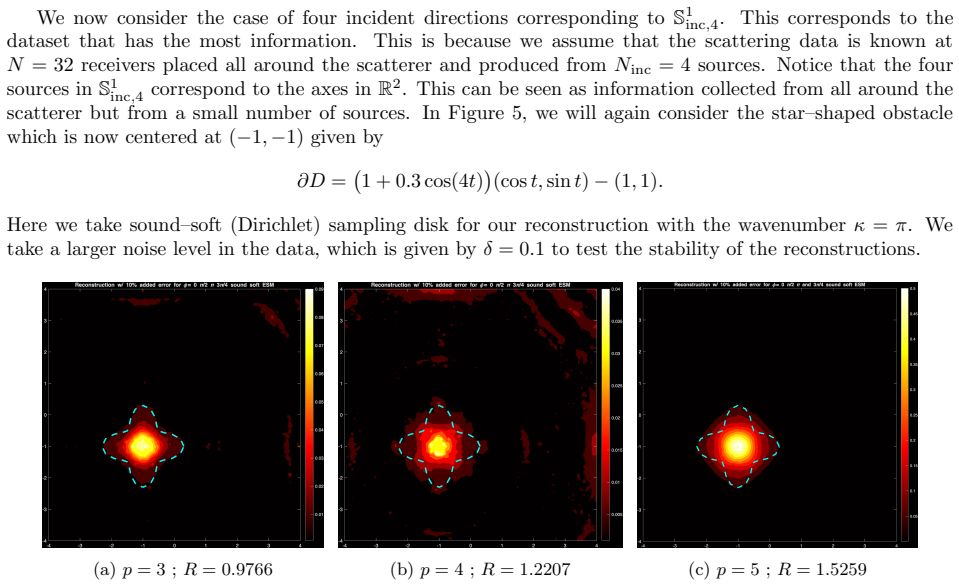
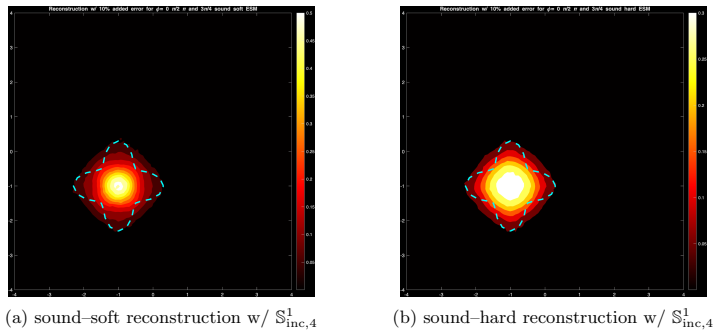
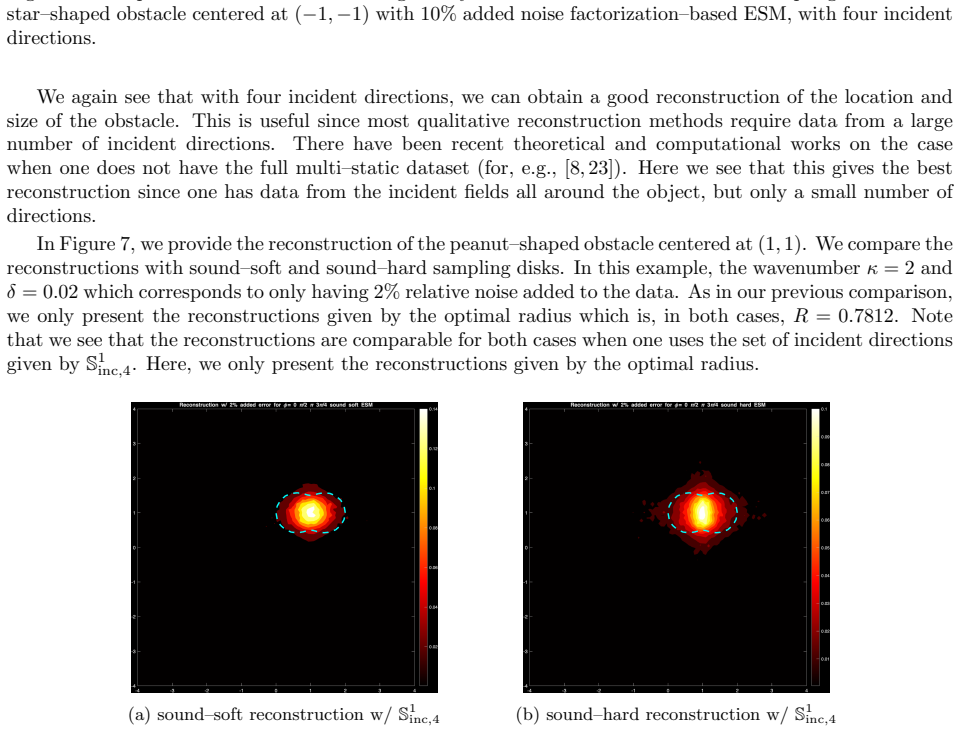
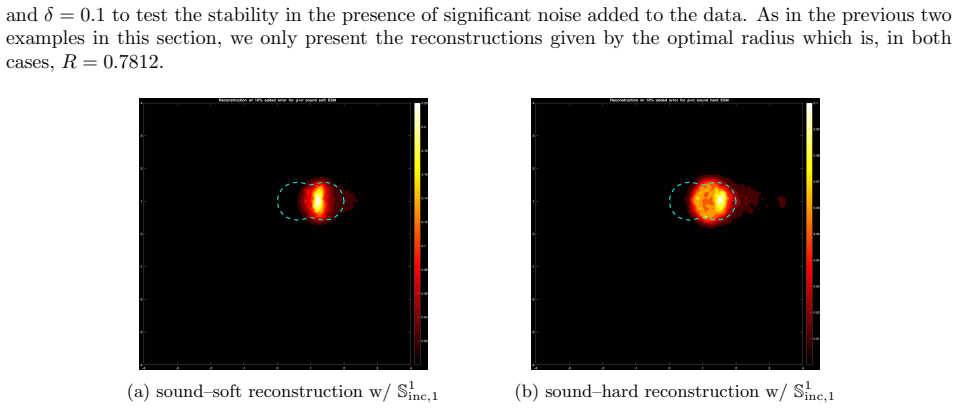
read the original abstract
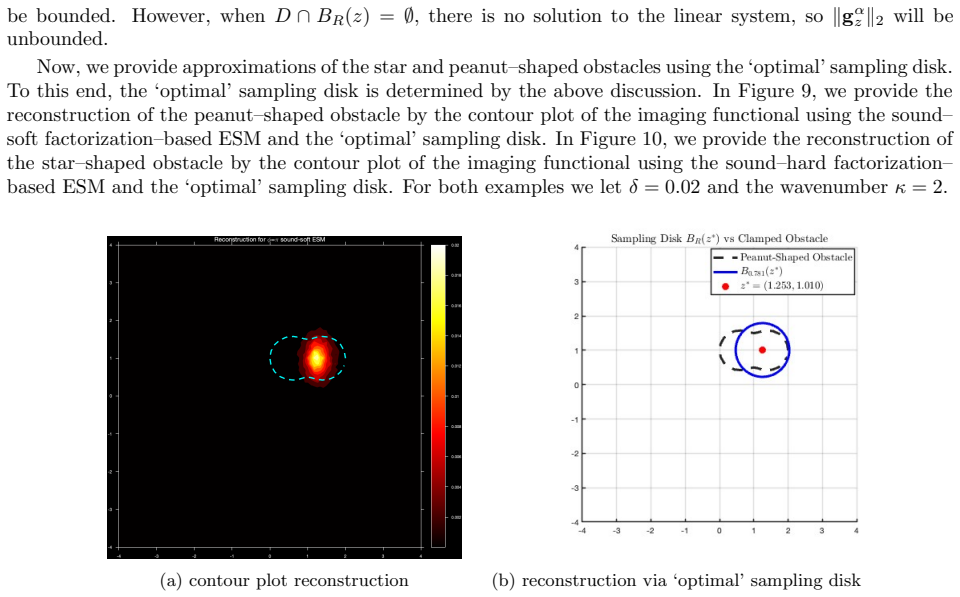
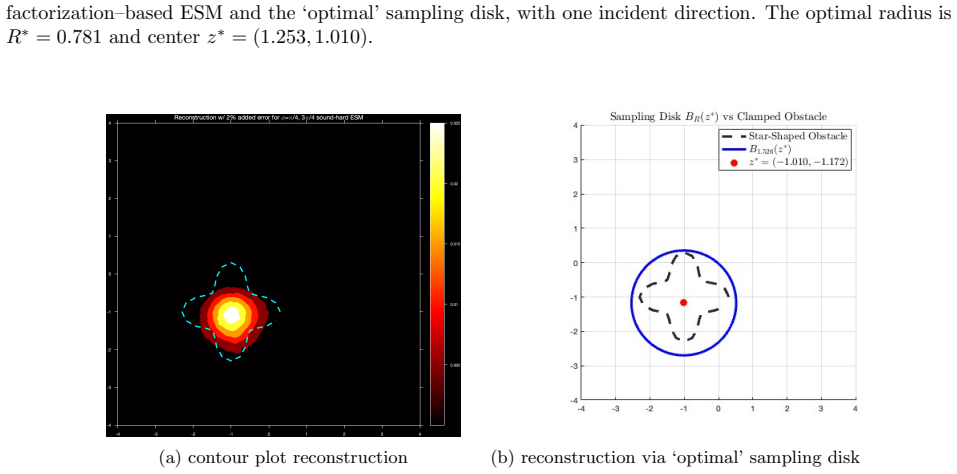
This paper considers an inverse shape problem for recovering an unknown clamped obstacle in two dimensions from far--field measurements generated by a single incident wave or just a few incident waves for the biharmonic (flexural) wave equation. Here we will develop a new extended sampling method (ESM) that is derived using the analysis of the well--known factorization method. We will also consider an ESM using both sound--soft and sound--hard sampling disks to identify sampling points where the reference disk intersects the unknown cavity. The use of a sound--hard sampling disk has not been studied in the literature whereas the sound--soft sampling disk has been used in most recent works. Traditionally the ESM seeks to find the location of the scatterer from limited incident directional data. Here, our method acts more like the factorization method to obtain the location as well as the size (and possibly the shape) of the obstacle. We present numerical experiments with synthetic data that demonstrate how effective this new implementation is with respect to noisy data and illustrate the influence of the reference disk radius on the reconstruction.
Editorial analysis
A structured set of objections, weighed in public.
Referee Report
Summary. The paper develops a novel extended sampling method (ESM) for the inverse shape problem of recovering a clamped obstacle in 2D biharmonic scattering from far-field data generated by one or a few incident waves. The method is derived from the analysis of the factorization method and employs both sound-soft and sound-hard reference sampling disks to detect intersections with the unknown obstacle, thereby recovering its location, size, and possibly shape. Numerical experiments with synthetic noisy data are presented to illustrate effectiveness and the influence of the reference disk radius.
Significance. If the central derivation holds, the work provides a practical extension of sampling methods to the biharmonic equation with clamped boundary conditions, enabling reconstruction from limited incident data. The introduction of sound-hard sampling disks is a novel contribution not previously studied in the ESM literature. The numerical results demonstrate robustness to noise, which strengthens potential applicability in flexural wave inverse problems.
major comments (3)
- [§3] §3 (derivation of the ESM indicator function): The claim that the new ESM is 'derived using the analysis of the well-known factorization method' requires explicit verification that the range identity and factorization of the far-field operator for the biharmonic equation adapt directly to the clamped boundary condition (w = ∂w/∂n = 0) and the biharmonic Green's function without additional error terms or modified orthogonality relations. The provided construction does not include the necessary steps confirming this transfer.
- [§3.2] §3.2 (sound-hard sampling disks): The indicator function behavior for sound-hard reference disks at boundary intersections is asserted to reliably detect the obstacle, but no explicit analysis or orthogonality property is given to justify why the factorization-based indicator remains valid for this previously unstudied case, unlike the standard sound-soft disks.
- [§4] §4 (numerical experiments): The reported reconstructions with noisy data and varying disk radii rely on post-hoc choice of radius and threshold for the indicator I(z); without a quantitative error analysis or stability estimate linking the indicator to the factorization range identity, it is unclear whether the observed effectiveness supports the theoretical claim of recovering size and shape.
minor comments (2)
- The notation for the far-field operator and the explicit form of the indicator function I(z) should be stated clearly in a single location with all dependencies (e.g., on the sampling disk radius) made explicit.
- [§4] Figure captions in §4 should include the specific noise level (e.g., percentage) and the exact number of incident waves used for each reconstruction to allow direct comparison with the abstract claims.
Simulated Author's Rebuttal
We thank the referee for the careful reading, positive assessment of significance, and constructive major comments. We address each point below, indicating planned revisions to clarify the theoretical foundations and strengthen the numerical discussion.
read point-by-point responses
-
Referee: [§3] §3 (derivation of the ESM indicator function): The claim that the new ESM is 'derived using the analysis of the well-known factorization method' requires explicit verification that the range identity and factorization of the far-field operator for the biharmonic equation adapt directly to the clamped boundary condition (w = ∂w/∂n = 0) and the biharmonic Green's function without additional error terms or modified orthogonality relations. The provided construction does not include the necessary steps confirming this transfer.
Authors: We agree that the adaptation steps merit more explicit detail. Section 3 constructs the ESM indicator by factoring the far-field operator via the biharmonic single-layer potential and Green's function, with the range identity following from the completeness of Herglotz wave functions and the clamped conditions (w = ∂w/∂n = 0) ensuring the required orthogonality without extra error terms. We will revise §3 to insert the intermediate steps verifying the direct transfer of the factorization identity to the clamped biharmonic setting. revision: yes
-
Referee: [§3.2] §3.2 (sound-hard sampling disks): The indicator function behavior for sound-hard reference disks at boundary intersections is asserted to reliably detect the obstacle, but no explicit analysis or orthogonality property is given to justify why the factorization-based indicator remains valid for this previously unstudied case, unlike the standard sound-soft disks.
Authors: The sound-hard reference disks are a novel element. The indicator is defined via the same factorization range test, where the far-field pattern of the sound-hard disk serves as the probing function; the intersection detection follows because non-intersection preserves the range membership through reciprocity of the biharmonic Green's function. We will add a concise justification paragraph in §3.2 outlining this property for the sound-hard case. revision: yes
-
Referee: [§4] §4 (numerical experiments): The reported reconstructions with noisy data and varying disk radii rely on post-hoc choice of radius and threshold for the indicator I(z); without a quantitative error analysis or stability estimate linking the indicator to the factorization range identity, it is unclear whether the observed effectiveness supports the theoretical claim of recovering size and shape.
Authors: The experiments demonstrate practical performance with limited data and noise, with radius and threshold choices guided by the theoretical decay properties of the indicator outside the obstacle. We acknowledge that a full quantitative stability estimate is absent. In revision we will expand §4 with explicit discussion of parameter selection criteria and additional tests; however, deriving a rigorous error bound from the range identity lies beyond the present scope. revision: partial
- A complete quantitative stability estimate rigorously linking the indicator function values to the factorization range identity.
Circularity Check
No significant circularity: ESM derived from external factorization analysis
full rationale
The paper states its ESM is 'derived using the analysis of the well-known factorization method' and introduces sound-hard sampling disks as a novel element. The factorization method is treated as an independent, established technique rather than a self-citation or fitted input. No equations or steps in the provided text reduce the indicator function I(z) or the claimed recovery of location/size/shape to a tautological fit, self-definition, or unverified author-specific uniqueness theorem. The derivation chain remains grounded in external analysis with the paper's contribution being the adaptation and numerical demonstration.
Axiom & Free-Parameter Ledger
Reference graph
Works this paper leans on
- [1]
- [2]
-
[3]
L. Bourgeois and C. Hazard, On well-posedness of scattering problems in a Kirchhoff–Love infinite plate, SIAM Journal on Applied Mathematics,80, 1546–1566 (2020)
work page 2020
-
[4]
L. Bourgeois and A. Recoquillay, The linear sampling method for Kirchhoff–Love infinite plates,Inverse Problems and Imaging,14, 363–384 (2020)
work page 2020
-
[5]
D. Colton and R. Kress,Inverse Acoustic and Electromagnetic Scattering Theory, 4th edition, Springer, 2019
work page 2019
-
[6]
H. Dong and P. Li, A novel boundary integral formulation for the biharmonic wave scattering problem, Journal of Scientific Computing,98, 42:1–29 (2024)
work page 2024
-
[7]
H. Dong and P. Li, Uniqueness of an inverse cavity scattering problem for the biharmonic wave equation, Inverse Problems,40, 065011 (2024). 18
work page 2024
-
[8]
F. Dou, X. Liu, S. Meng and B. Zhang, Data completion algorithms and their applications in inverse acoustic scattering with limited-aperture backscattering data,Journal of Computational Mathematics, 469, 111550 (2022)
work page 2022
-
[9]
P. Gao, A. Climente, J. S´ anchez-Dehesa, and L. Wu, Theoretical study of Platonic crystals with period- ically structured N-beam resonators,Journal of Applied Physics,123, 091707 (2018)
work page 2018
-
[10]
J. Guo, Y. Long, Q. Wu, and J. L. Jin, On direct and inverse obstacle scattering problems for biharmonic waves,Inverse Problems,40, 125032 (2024)
work page 2024
-
[11]
I. Harris and A. Kleefeld, Factorization method for a simply supported obstacle from point source mea- surements via far–field transformation. (arXiv:2603.27647)
- [12]
- [13]
- [14]
- [15]
- [16]
- [17]
-
[18]
A. Kirsch, Characterization of the shape of a scattering obstacle using the spectral data of the far field operator,Inverse Problems,14, 1489–1512 (1998)
work page 1998
-
[19]
A. Kirsch and N. Grinberg,The Factorization Method for Inverse Problems, Oxford University Press, Oxford (2008)
work page 2008
-
[20]
Z. Li, Z. Deng, and J. Sun, Extended-sampling-Bayesian method for limited aperture inverse scattering problems,SIAM Journal on Imaging Sciences,13, 422–444 (2020)
work page 2020
-
[21]
Z. Li, J. Sun, and L. Xu, An extended sampling–ensemble Kalman filter approach for partial data inverse elastic problems,Inverse Problems in Science and Engineering,29, 1–17 (2020)
work page 2020
- [22]
- [23]
-
[24]
J. Liu, F. Yang, X. Yan, and J. Sun, Extended sampling method for inverse electromagnetic scattering problems using a single incident wave,Inverse Problems,42, 015010 (2026)
work page 2026
-
[25]
V. Memmolo, E. Monaco, N. D. Boffa, L. Maio, and F. Ricci, Guided wave propagation and scattering for structural health monitoring of stiffened composites,Composite Structures,184, 568–580 (2018)
work page 2018
-
[26]
S. Meng, A sampling type method in an electromagnetic waveguide,Inverse Problems and Imaging, 15(4), 745-762 (2021)
work page 2021
- [27]
discussion (0)
Sign in with ORCID, Apple, or X to comment. Anyone can read and Pith papers without signing in.