Recognition: no theorem link
Enabling AI-Native Mobility in 6G: A Real-World Dataset for Handover, Beam Management, and Timing Advance
Pith reviewed 2026-05-13 03:09 UTC · model grok-4.3
The pith
A real-world dataset from a commercial 5G network captures handover, beam, and timing advance data across multiple mobility modes and speeds.
A machine-rendered reading of the paper's core claim, the machinery that carries it, and where it could break.
Core claim
The paper presents a dataset gathered from a commercially deployed network that records user equipment mobility across pedestrian to high-speed train scenarios, with particular attention to handover procedures and the inclusion of timing advance measurements at key signaling events that previous datasets have omitted.
What carries the argument
The dataset of real-time UE mobility measurements including timing advance at RACH trigger, MAC CE, and PDCCH grant events.
If this is right
- AI/ML models trained on this data can predict timing advance to reduce handover interruption time.
- Beam management procedures can be optimized using observed real-world patterns instead of simulations.
- Continuous throughput can be maintained during and after handovers in high-speed scenarios.
- Multiple use cases for understanding AI/ML model inference in mobility management become feasible.
Where Pith is reading between the lines
- Future work could combine this dataset with simulated 6G scenarios to test model robustness.
- Similar data collection efforts in other networks would allow cross-validation of the trained models.
- Extending the dataset to include more 6G-specific parameters like higher frequency bands could accelerate AI-native mobility research.
Load-bearing premise
Measurements taken from a single commercial network deployment will be representative enough of general user mobility and network conditions to train AI models that perform well in other real-world settings.
What would settle it
An AI model trained solely on this dataset shows no reduction in handover interruption time when evaluated on mobility data collected from a different commercial network or deployment.
Figures






read the original abstract
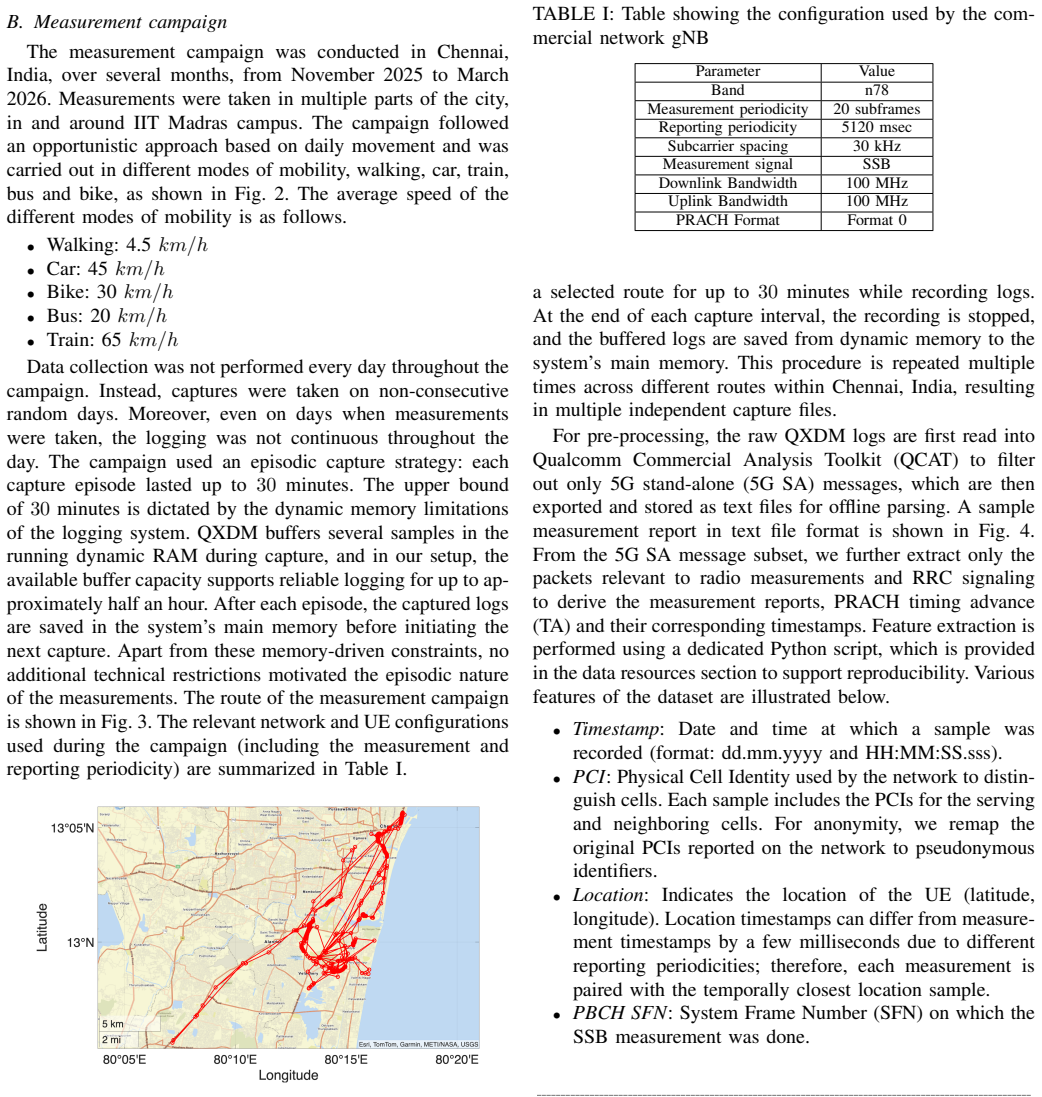
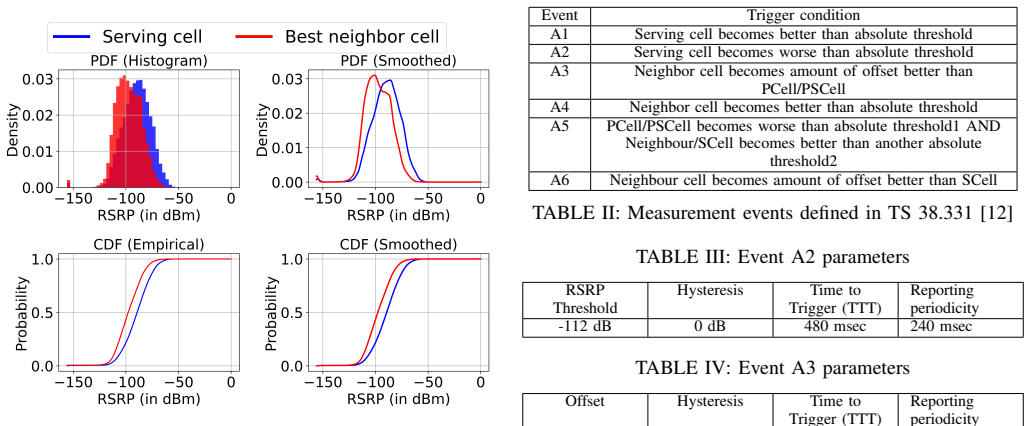
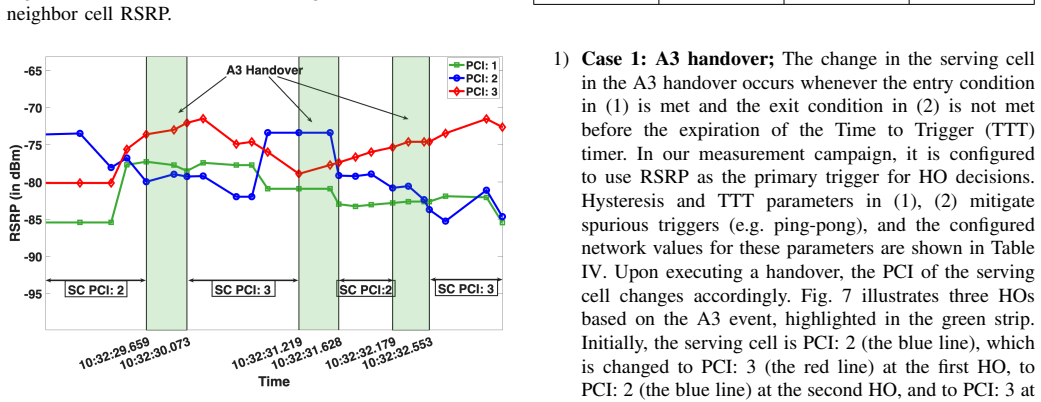
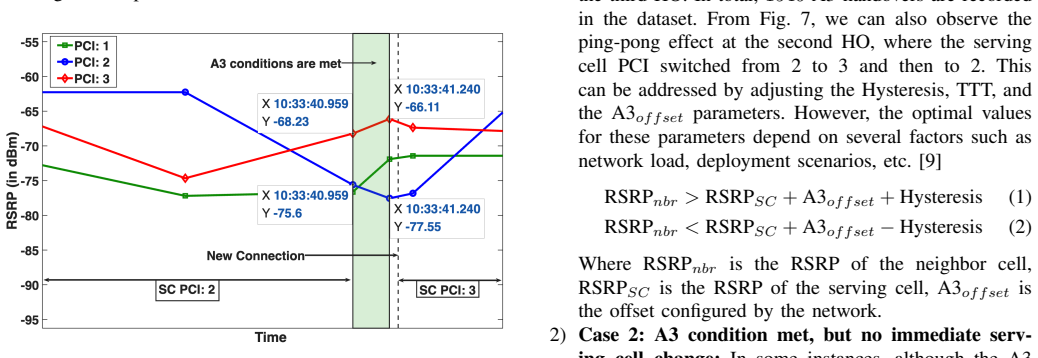
To address the issues of high interruption time and measurement report overhead under user equipment (UE) mobility especially in high speed 5G use cases the use of AI/ML techniques (AI/ML beam management and mobility procedures) have been proposed. These techniques rely heavily on data that are most often simulated for various scenarios and do not accurately reflect real deployment behavior or user traffic patterns. Therefore, there is an utmost need for realistic datasets under various conditions. This work presents a dataset collected from a commercially deployed network across various modes of mobility (pedestrian, bike, car, bus, and train) and at multiple speeds to depict real time UE mobility. When collecting the dataset, we focused primarily on handover (HO) scenarios, with the aim of reducing the HO interruption time and maintaining continuous throughput during and immediately after HO execution. To support this research, the dataset includes timing advance (TA) measurements at various signaling events such as RACH trigger, MAC CE, and PDCCH grant which are typically missing in existing works. We cover a detailed description of the creation of the dataset; experimental setup, data acquisition, and extraction. We also cover an exploratory analysis of the data, with a primary focus on mobility, beam management, and TA. We discuss multiple use cases in which the proposed dataset can facilitate understanding of the inference of the AI/ML model. One such use case is to train and evaluate various AI/ML models for TA prediction.
Editorial analysis
A structured set of objections, weighed in public.
Referee Report
Summary. The paper claims to present a real-world dataset collected from a commercially deployed network under various mobility modes (pedestrian, bike, car, bus, train) at multiple speeds, focusing on handover scenarios to support AI/ML for reducing HO interruption time. It includes detailed description of dataset creation, exploratory analysis on mobility, beam management, and TA, and discusses use cases like TA prediction, highlighting TA measurements at RACH, MAC CE, and PDCCH events missing in prior works.
Significance. If the dataset is made available with sufficient documentation and validation, it holds significant potential to advance AI-native mobility research in 6G by providing authentic commercial traces that can lead to more realistic model training and better performance in high-mobility scenarios compared to simulation-based datasets.
major comments (3)
- [Abstract] Abstract and introduction: The abstract outlines the collection focus and intended uses but supplies no quantitative details on dataset size, number of traces, total duration, validation, or statistical properties of the HO/TA/beam data, leaving the support for the central claim of utility for AI training difficult to evaluate.
- [Experimental Setup] Experimental setup and data acquisition sections: All traces come from a single operator deployment; the manuscript does not provide cross-validation against other networks, specific radio configurations, cell density, or frequency bands, so the claim that the data accurately reflects general real-world UE mobility behavior for training generalizable AI/ML models is not supported.
- [Exploratory Analysis] Exploratory analysis section: The analysis of HO/TA/beam statistics treats observed values as representative without error characterization or comparison to other deployments, which is load-bearing for the use-case claims such as training TA prediction models.
minor comments (2)
- [References] The manuscript would benefit from additional citations to existing 5G mobility datasets to better highlight the novelty of the included TA signaling events.
- [Figures] Ensure figures in the exploratory analysis have consistent axis labels and legends when presenting TA and beam data distributions.
Simulated Author's Rebuttal
We thank the referee for the constructive and detailed feedback on our manuscript. We have addressed each major comment point by point below and will incorporate revisions to strengthen the paper.
read point-by-point responses
-
Referee: [Abstract] Abstract and introduction: The abstract outlines the collection focus and intended uses but supplies no quantitative details on dataset size, number of traces, total duration, validation, or statistical properties of the HO/TA/beam data, leaving the support for the central claim of utility for AI training difficult to evaluate.
Authors: We agree that quantitative details are important for evaluating the dataset's utility. In the revised manuscript, we will expand the abstract and introduction to include specific metrics such as the total number of mobility traces collected, overall duration of the dataset, number of handover events, and key statistical properties (e.g., distributions of timing advance values and beam indices). We will also briefly note the validation steps used during data acquisition. These additions will directly support the claims regarding suitability for AI/ML training. revision: yes
-
Referee: [Experimental Setup] Experimental setup and data acquisition sections: All traces come from a single operator deployment; the manuscript does not provide cross-validation against other networks, specific radio configurations, cell density, or frequency bands, so the claim that the data accurately reflects general real-world UE mobility behavior for training generalizable AI/ML models is not supported.
Authors: We acknowledge that the dataset originates from a single commercial operator's 5G deployment, which inherently limits cross-network validation. In the revision, we will provide additional details on the specific radio configurations, cell densities, and frequency bands employed during collection. We will also revise the language around generalizability to emphasize that the traces capture authentic real-world UE mobility and signaling behavior from a live network (including the unique TA measurement points at RACH, MAC CE, and PDCCH), while explicitly noting the single-operator scope as a limitation. This positions the dataset as a valuable complement to simulation-based works rather than a fully generalizable benchmark. revision: partial
-
Referee: [Exploratory Analysis] Exploratory analysis section: The analysis of HO/TA/beam statistics treats observed values as representative without error characterization or comparison to other deployments, which is load-bearing for the use-case claims such as training TA prediction models.
Authors: We will update the exploratory analysis section to include error characterization, such as standard deviations, interquartile ranges, or confidence intervals for the reported handover, beam management, and timing advance statistics. This will better convey the variability in the observed data. Direct comparisons to other deployments are not feasible without access to additional proprietary traces, so we will add a limitations paragraph clarifying the scope of the analysis and how the use-case examples (e.g., TA prediction) are intended as illustrative demonstrations rather than validated general models. revision: partial
Circularity Check
No significant circularity in dataset description paper
full rationale
This is a dataset collection and description paper with no mathematical derivations, parameter fittings, predictions of derived quantities, or load-bearing self-citations. The central contribution is the raw traces and exploratory statistics from one commercial deployment; use-case discussions (e.g., future TA prediction) are forward-looking suggestions rather than executed inferences that reduce to the paper's own inputs. All content is self-contained descriptive reporting.
Axiom & Free-Parameter Ledger
axioms (1)
- domain assumption Data collected from a commercial 5G network accurately depicts real-time UE mobility behavior and traffic patterns
Reference graph
Works this paper leans on
-
[1]
A data-driven framework for inter-frequency handover failure prediction and mitigation,
M. Manalastas, M. U. B. Farooq, S. M. A. Zaidi, A. Abu-Dayya, and A. Imran, “A data-driven framework for inter-frequency handover failure prediction and mitigation,”IEEE Transactions on V ehicular Technology, vol. 71, no. 6, pp. 6158–6172, 2022
work page 2022
-
[2]
Y . Zheng, J. Wang, X. Li, J. Li, and S. Liu, “Cell-level rsrp estimation with the image-to-image wireless propagation model based on measured data,”IEEE Transactions on Cognitive Communications and Network- ing, vol. 9, no. 6, pp. 1412–1423, 2023
work page 2023
-
[3]
Study on Artificial Intelli- gence (AI)/Machine Learning (ML) for NR air interface (Release 18),
3rd Generation Partnership Project (3GPP), “Study on Artificial Intelli- gence (AI)/Machine Learning (ML) for NR air interface (Release 18),” 3rd Generation Partnership Project (3GPP), Technical Report TR 38.843, 2023, version 18.0.0, December
work page 2023
-
[4]
Deep learning-based handover prediction for 5g and beyond networks,
J. P. S. H. Lima, A. A. M. de Medeiros, E. P. de Aguiar, E. F. Silva, V . A. de Sousa, M. L. Nunes, and A. L. Reis, “Deep learning-based handover prediction for 5g and beyond networks,” inICC 2023 - IEEE International Conference on Communications, 2023, pp. 3468–3473
work page 2023
-
[5]
A machine learning based intelligent propagation model for rsrp prediction,
S. Wu, B. Ma, T. Ye, J. Zhang, W. Shao, and W. Zheng, “A machine learning based intelligent propagation model for rsrp prediction,” in 2022 International Seminar on Computer Science and Engineering Technology (SCSET), 2022, pp. 1–5
work page 2022
-
[6]
5g handover using rein- forcement learning,
V . Yajnanarayana, H. Ryd ´en, and L. H ´evizi, “5g handover using rein- forcement learning,” in2020 IEEE 3rd 5G World F orum (5GWF), 2020, pp. 349–354
work page 2020
-
[7]
Novel algorithm to reduce handover failure rate in 5g networks,
V . Mishra, D. Das, and N. N. Singh, “Novel algorithm to reduce handover failure rate in 5g networks,” in2020 IEEE 3rd 5G World F orum (5GWF), 2020, pp. 524–529
work page 2020
-
[8]
S.-G. Park, J.-S. Kim, K.-S. Kim, and Y .-J. Ko, “Seeing the future (phase i): Ai-based measurement prediction for reliable high-capacity vehicular connectivity in road-embedded mobile networks,” in2025 16th Inter- national Conference on Information and Communication Technology Convergence (ICTC), 2025, pp. 718–719
work page 2025
-
[9]
Handover configurations in operational 5g networks: Diversity, evolution, and impact on performance,
M. Ghoshal, I. Khan, P. Dinh, Z. J. Kong, O. Basit, S. Wang, Y . Feng, Y . C. Hu, and D. Koutsonikolas, “Handover configurations in operational 5g networks: Diversity, evolution, and impact on performance,”arXiv preprint arXiv:2511.03116, 2025
-
[10]
A large-scale dataset of 4g, nb-iot, and 5g non-standalone network measurements,
K. Kousias, M. Rajiullah, G. Caso, U. Ali, O. Alay, A. Brunstrom, L. De Nardis, M. Neri, and M.-G. Di Benedetto, “A large-scale dataset of 4g, nb-iot, and 5g non-standalone network measurements,”IEEE Communications Magazine, vol. 62, no. 5, pp. 44–49, 2024
work page 2024
-
[11]
Ai-augmented l1/l2 triggered mobility: Enabling 6g-native predictive mobility,
M. Dai, C. Zhang, Y . Zhang, C. Zhang, Y . Cao, Y . Wang, H. Wang, and Y . Xu, “Ai-augmented l1/l2 triggered mobility: Enabling 6g-native predictive mobility,”IEEE Communications Standards Magazine, 2026
work page 2026
-
[12]
Radio Resource Con- trol (RRC); Protocol specification,
3rd Generation Partnership Project (3GPP), “Radio Resource Con- trol (RRC); Protocol specification,” 3rd Generation Partnership Project (3GPP), Technical Specification (TS) TS 38.331, 2026, version 19.1.0
work page 2026
-
[13]
“IIT Madras 5G Testbed,” https://5gtestbed.in, Accessed: 2026-12-05
work page 2026
-
[14]
On l1/l2- triggered mobility in 3gpp release 18 and beyond,
B. Khodapanah, S. Goyal, M. Gursu, J. Stanczak, A. Kakkavas, R. Temelli, A. Badalioglu, P. Spapis, and C. Majumdar, “On l1/l2- triggered mobility in 3gpp release 18 and beyond,”IEEE Access, vol. 12, pp. 171 790–171 806, 2024
work page 2024
discussion (0)
Sign in with ORCID, Apple, or X to comment. Anyone can read and Pith papers without signing in.