Recognition: 2 theorem links
· Lean TheoremThe Payment Heterogeneity Index: An Integrated Unsupervised Framework for High-Volume Procurement Oversight and Decision Support
Pith reviewed 2026-05-14 21:50 UTC · model grok-4.3
The pith
The Payment Heterogeneity Index flags suppliers with atypical payment structures using only unlabeled data.
A machine-rendered reading of the paper's core claim, the machinery that carries it, and where it could break.
Core claim
The paper establishes that the Payment Heterogeneity Index, formed as the product of a tail-behaviour component and a structural-dispersion component obtained from Gaussian Mixture Model estimation of payment regimes, isolates suppliers whose one-dimensional payment samples exhibit statistically significant structural differences from the overall population and interact with recurring payment anchors.
What carries the argument
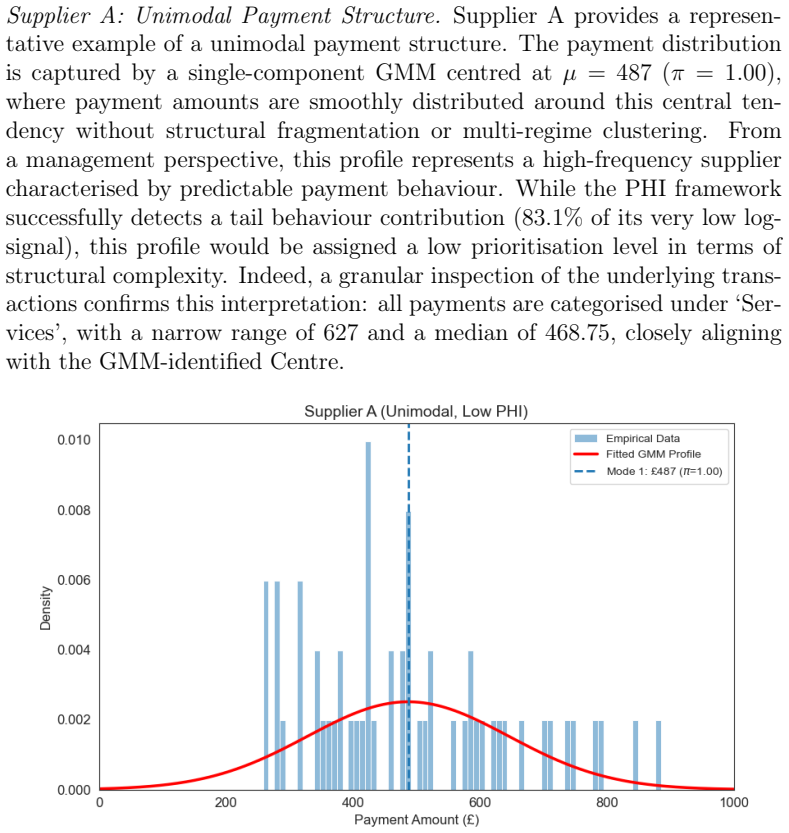
The Payment Heterogeneity Index (PHI), a multiplicative composite of tail-behaviour sensitivity to outliers and clustering together with structural dispersion that summarises regime variability, prevalence, and separation from the dominant mode via Gaussian Mixture Models.
Load-bearing premise
That the structural signatures captured by the Gaussian Mixture Model components and tail-behaviour measure correspond to financially meaningful deviations such as errors or fraud rather than benign differences in legitimate payment practices.
What would settle it
An independent audit of the high-PHI suppliers that finds no elevated rate of irregularities compared with low-PHI suppliers would undermine the claim that the index isolates cases worth prioritising for oversight.
Figures






read the original abstract
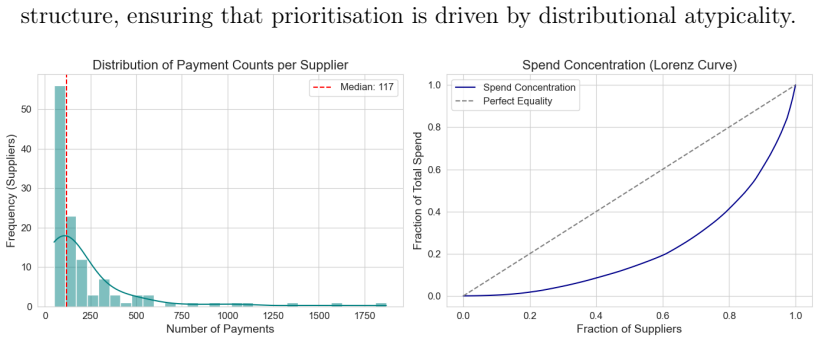
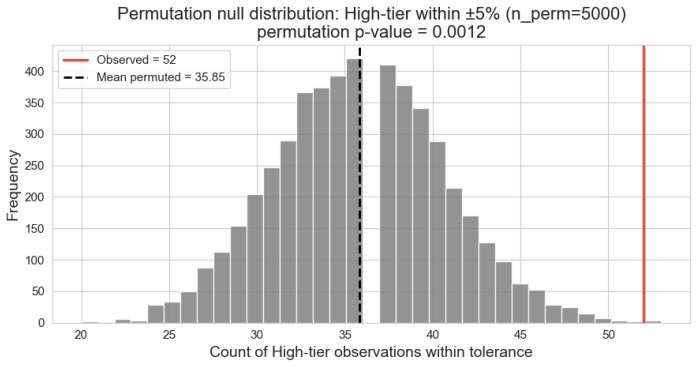
Public procurement is vulnerable to error, fraud and corruption, yet high transaction volumes overwhelm oversight. While research often focuses on tender-stage anomalies, post-award payments remain underexplored. Since labelled datasets are rare and existing methods such as Benford's Law face restrictive assumptions, there is a need for additional interpretable, unsupervised frameworks that augment oversight and simplify management. This paper introduces the Structural Heterogeneity Index (SHI), a composite statistic for one-dimensional samples defined by four components: modality, asymmetry, tail behaviour, and structural dispersion. The Payment Heterogeneity Index (PHI) is its multiplicative instance for post-award payments. PHI combines a tail-behaviour component, sensitive to outliers and point clustering, with a structural-dispersion component summarising payment regime architecture. Structural dispersion is computed via Gaussian Mixture Model (GMM) estimation, integrating within-regime variability, prevalence, and separation from the dominant mode. Applied to UK municipal procurement data, PHI isolates a financially significant cohort (10.1% of high-volume suppliers) whose structural signatures deviate from the population and interact with recurring payment anchors. Permutation and Kolmogorov-Smirnov tests confirm that high-PHI suppliers exhibit statistically significant structural differences. A forensic review by a Certified Fraud Examiner supports the plausibility of the prioritised cases. Comparison shows PHI uniquely identifies regime separation obscured by metrics like the Coefficient of Variation (\r{ho}=0.310). PHI functions as an effective discovery tool where no confirmed labels exist, offering a transparent, lightweight screening mechanism for post-award oversight.
Editorial analysis
A structured set of objections, weighed in public.
Referee Report
Summary. The manuscript introduces the Payment Heterogeneity Index (PHI) as the multiplicative application of the Structural Heterogeneity Index (SHI), an unsupervised composite statistic for one-dimensional samples defined by four components: modality, asymmetry, tail behaviour, and structural dispersion. Structural dispersion is obtained via Gaussian Mixture Model (GMM) estimation that integrates within-regime variability, prevalence, and separation from the dominant mode. Applied to UK municipal procurement data, PHI flags 10.1% of high-volume suppliers whose payment patterns deviate structurally from the population. Permutation and Kolmogorov-Smirnov tests are reported to confirm statistically significant differences, and a Certified Fraud Examiner review supports the plausibility of the flagged cases. PHI is shown to capture regime separation not detected by the coefficient of variation (ρ=0.310) and is positioned as a transparent screening tool for post-award oversight where labelled data are unavailable.
Significance. If the central claim holds, the work supplies a lightweight, interpretable unsupervised framework that fills a documented gap in post-award payment oversight. Credit is due for the explicit construction of PHI from four defined components, the external statistical validation via permutation and KS tests, the comparison against the coefficient of variation, and the inclusion of a forensic plausibility check. These elements make the index a practical discovery tool rather than a confirmatory detector, which is appropriate given the absence of labels.
major comments (2)
- Abstract and methods description: the GMM procedure for the structural-dispersion component is described only at a high level; the manuscript does not specify how the number of mixture components is selected, convergence criteria, or how error in the fitted parameters is quantified. Because this component directly determines the PHI value and the subsequent identification of the 10.1% cohort, the omission is load-bearing for reproducibility of the reported statistical tests.
- Abstract: the claim that high-PHI suppliers form a 'financially significant cohort' whose signatures 'interact with recurring payment anchors' rests on the assumption that GMM-derived regime separation corresponds to deviations of oversight interest rather than benign heterogeneity in legitimate payment practices. The forensic review provides qualitative support, but quantitative bounds on false-positive rates or data-exclusion rules are not reported, weakening the link between statistical difference and actionable oversight value.
minor comments (2)
- Abstract: the reported correlation appears as 'Coefficient of Variation (r{ho}=0.310)'; this is evidently a typesetting error for ρ=0.310 and should be corrected for clarity.
- Title versus abstract: the title names the Payment Heterogeneity Index, while the abstract first defines the Structural Heterogeneity Index (SHI) and then states that PHI is its multiplicative instance for payments. A brief clarifying sentence on the relationship between SHI and PHI would remove potential reader confusion.
Simulated Author's Rebuttal
We thank the referee for the constructive and detailed feedback. We address each major comment below and outline the revisions we will make to strengthen the manuscript.
read point-by-point responses
-
Referee: Abstract and methods description: the GMM procedure for the structural-dispersion component is described only at a high level; the manuscript does not specify how the number of mixture components is selected, convergence criteria, or how error in the fitted parameters is quantified. Because this component directly determines the PHI value and the subsequent identification of the 10.1% cohort, the omission is load-bearing for reproducibility of the reported statistical tests.
Authors: We agree that the current description of the GMM procedure is insufficient for full reproducibility. In the revised manuscript we will add a dedicated subsection specifying that the number of mixture components is selected by minimising the Bayesian Information Criterion (BIC), that the EM algorithm is run with a log-likelihood convergence tolerance of 1e-6 and a maximum of 1000 iterations, and that parameter uncertainty is quantified via 500 bootstrap resamples of each supplier's payment vector. These details will be placed in the methods section immediately following the definition of structural dispersion. revision: yes
-
Referee: Abstract: the claim that high-PHI suppliers form a 'financially significant cohort' whose signatures 'interact with recurring payment anchors' rests on the assumption that GMM-derived regime separation corresponds to deviations of oversight interest rather than benign heterogeneity in legitimate payment practices. The forensic review provides qualitative support, but quantitative bounds on false-positive rates or data-exclusion rules are not reported, weakening the link between statistical difference and actionable oversight value.
Authors: The manuscript already frames PHI as an unsupervised discovery and screening tool rather than a confirmatory detector, precisely because labelled data are unavailable. The phrase 'financially significant cohort' refers to the 10.1 % of suppliers accounting for a disproportionate share of transaction volume; the observed interaction with recurring payment anchors is an empirical pattern in the data. We will add an explicit limitations paragraph stating that quantitative false-positive rates cannot be computed without ground-truth labels and will report sensitivity results across alternative GMM specifications (BIC versus AIC and 2–5 components). The Certified Fraud Examiner review is presented only as qualitative plausibility support, consistent with the unsupervised setting. revision: partial
- Quantitative bounds on false-positive rates cannot be supplied without labelled data, which are unavailable in this unsupervised framework.
Circularity Check
No significant circularity in derivation chain
full rationale
The PHI is defined explicitly as a multiplicative composite of four components (modality, asymmetry, tail behaviour, structural dispersion) with GMM serving only as a standard estimation procedure for the dispersion term; no equation reduces the final index value to a fitted parameter or self-referential input by construction. External validation steps (KS tests, permutation tests, CFE review) operate on the computed PHI values rather than presupposing them. The framework remains self-contained as an unsupervised screening statistic without load-bearing self-citations or imported uniqueness claims.
Axiom & Free-Parameter Ledger
free parameters (1)
- GMM mixture count
axioms (1)
- domain assumption Payment amounts to a supplier can be usefully represented as a finite mixture of Gaussian distributions
invented entities (1)
-
Payment Heterogeneity Index (PHI)
no independent evidence
Lean theorems connected to this paper
-
IndisputableMonolith/Cost/FunctionalEquation.leanwashburn_uniqueness_aczel unclear?
unclearRelation between the paper passage and the cited Recognition theorem.
PHI = M × A × T × D where M = k (GMM components), T = 1 + |ln((Q95−Q05)/(Q75−Q25))|, D = 1 + π* s* + Σ πi ln(1 + |μi − μ*|)
-
IndisputableMonolith/Foundation/RealityFromDistinction.leanreality_from_one_distinction unclear?
unclearRelation between the paper passage and the cited Recognition theorem.
Gaussian Mixture Models for PHI Operationalisation... kmax = min(4, floor(n/25))
What do these tags mean?
- matches
- The paper's claim is directly supported by a theorem in the formal canon.
- supports
- The theorem supports part of the paper's argument, but the paper may add assumptions or extra steps.
- extends
- The paper goes beyond the formal theorem; the theorem is a base layer rather than the whole result.
- uses
- The paper appears to rely on the theorem as machinery.
- contradicts
- The paper's claim conflicts with a theorem or certificate in the canon.
- unclear
- Pith found a possible connection, but the passage is too broad, indirect, or ambiguous to say the theorem truly supports the claim.
Reference graph
Works this paper leans on
- [1]
-
[2]
Fazekas, Mihály and Kocsis, Gábor , year =. Uncovering High-Level Corruption: Cross-National Objective Corruption Risk Indicators Using Public Procurement Data , journal =
-
[3]
Anomaly Detection: A Survey , journal =
Chandola, Varun and Banerjee, Arindam and Kumar, Vipin , year =. Anomaly Detection: A Survey , journal =
-
[4]
Detecting Fraud in Public Procurement: A
Tyska Carvalho, Jônata and Castro, Márcio and Machado dos Santos, Matheus and Ferrão, Lívia and Schmitz, Fernando Augusto , year =. Detecting Fraud in Public Procurement: A. Anais do XXXIX Simpósio Brasileiro de Banco de Dados (SBBD 2024) , pages =
work page 2024
-
[5]
Nai, Roberto and Sulis, Emilio and Meo, Rosa , year =. Public Procurement Fraud Detection and Artificial Intelligence Techniques: A Literature Review , booktitle =
-
[6]
Prediction of Public Procurement Corruption Indices Using Machine Learning Methods , booktitle =
Rabuzin, Kornelije and Modrušan, Nikola , year =. Prediction of Public Procurement Corruption Indices Using Machine Learning Methods , booktitle =
- [7]
- [8]
-
[9]
Dempster, A. P. and Laird, N. M. and Rubin, D. B. , title =. Journal of the Royal Statistical Society: Series B (Methodological) , volume =. 1977 , doi =
work page 1977
-
[10]
McLachlan, Geoffrey J. and Peel, David , title =. 2000 , doi =
work page 2000
-
[11]
The Annals of Statistics , volume =
Schwarz, Gideon , title =. The Annals of Statistics , volume =. 1978 , doi =
work page 1978
-
[12]
American Economic Journal: Economic Policy , volume =
Palguta, Ján and Pertold, Filip , title =. American Economic Journal: Economic Policy , volume =. 2017 , doi =
work page 2017
-
[13]
American Economic Review , volume =
Bandiera, Oriana and Prat, Andrea and Valletti, Tommaso , title =. American Economic Review , volume =. 2009 , doi =
work page 2009
-
[14]
Information Systems Management , volume =
Janssen, Marijn and Charalabidis, Yannis and Zuiderwijk, Anneke , title =. Information Systems Management , volume =. 2012 , doi =
work page 2012
-
[15]
Computers & Security , volume =
West, Jarrod and Bhattacharya, Maumita , title =. Computers & Security , volume =. 2016 , doi =
work page 2016
-
[16]
Ngai, E. W. T. and Hu, Yong and Wong, Y. H. and Chen, Yijun and Sun, Xin , title =. Decision Support Systems , volume =. 2011 , doi =
work page 2011
-
[17]
Bertot, John C. and Jaeger, Paul T. and Grimes, Justin M. , title =. Government Information Quarterly , volume =. 2010 , doi =
work page 2010
-
[18]
The Law and Economics of Public Procurement Reform , editor =
Spagnolo, Giancarlo , title =. The Law and Economics of Public Procurement Reform , editor =
-
[19]
Hodge, Victoria J. and Austin, Jim , title =. Artificial Intelligence Review , volume =. 2004 , doi =
work page 2004
-
[20]
Coviello, Decio and Guglielmo, Andrea and Spagnolo, Giancarlo , title =. Management Science , volume =. 2018 , doi =
work page 2018
-
[21]
Pedregosa, F. and Varoquaux, G. and Gramfort, A. and Michel, V. and Thirion, B. and Grisel, O. and Blondel, M. and Prettenhofer, P. and Weiss, R. and Dubourg, V. and Vanderplas, J. and Passos, A. and Cournapeau, D. and Brucher, M. and Perrot, M. and Duchesnay, E. , title =. Journal of Machine Learning Research , volume =. 2011 , url =
work page 2011
-
[22]
and Iossa, Elisabetta and Mollisi, Vincenzo and Spagnolo, Giancarlo , title =
Decarolis, Francesco and Giuffrida, Leonardo M. and Iossa, Elisabetta and Mollisi, Vincenzo and Spagnolo, Giancarlo , title =. The Journal of Law, Economics, and Organization , volume =. 2020 , doi =
work page 2020
-
[23]
Journal of the European Economic Association , volume =
Szucs, Ferenc , title =. Journal of the European Economic Association , volume =. 2024 , doi =
work page 2024
-
[24]
Journal of Political Economy , volume =
Carril, Rodrigo , title =. Journal of Political Economy , volume =. 2021 , doi =
work page 2021
-
[25]
Bandiera, Oriana and Bosio, Erika and Spagnolo, Giancarlo , title =. 2021 , number =
work page 2021
-
[26]
Data Science and Management , year =
Chen, Yisong and Zhao, Chuqing and Xu, Yixin and Nie, Chuanhao and Zhang, Yixin , title =. Data Science and Management , year =. doi:10.1016/j.dsm.2025.08.002 , note =
-
[27]
Journal of Economic Behavior & Organization , year =
Caglayan, Mustafa and Talavera, Oleksandr and Zhang, Wei , title =. Journal of Economic Behavior & Organization , year =
-
[28]
Harvard Journal of Law & Technology , volume=
Counterfactual explanations without opening the black box: Automated decisions and the GDPR , author=. Harvard Journal of Law & Technology , volume=
-
[29]
Journal of Business Research , volume=
Factors influencing big data decision-making quality , author=. Journal of Business Research , volume=. 2017 , publisher=
work page 2017
-
[30]
International Journal of Project Management , volume=
Corruption in public projects and megaprojects: There is an elephant in the room! , author=. International Journal of Project Management , volume=. 2017 , publisher=
work page 2017
-
[31]
Human-in-the-Loop Anomaly Detection and Explanation , author=. International Conference on Information Processing and Management of Uncertainty in Knowledge-Based Systems , pages=. 2022 , publisher=
work page 2022
-
[32]
2017 IEEE International Conference on Big Data (Big Data) , pages=
Human-in-the-loop learning-oriented anomaly detection , author=. 2017 IEEE International Conference on Big Data (Big Data) , pages=. 2017 , publisher=
work page 2017
discussion (0)
Sign in with ORCID, Apple, or X to comment. Anyone can read and Pith papers without signing in.