Recognition: unknown
Formation of stable exoplanetary systems around pulsars by capture: An exercise in computational classical mechanics
Pith reviewed 2026-05-14 20:58 UTC · model grok-4.3
The pith
Chaotic post-capture encounters can drive a captured planet into a stable low-eccentricity orbit around a pulsar.
A machine-rendered reading of the paper's core claim, the machinery that carries it, and where it could break.
Core claim
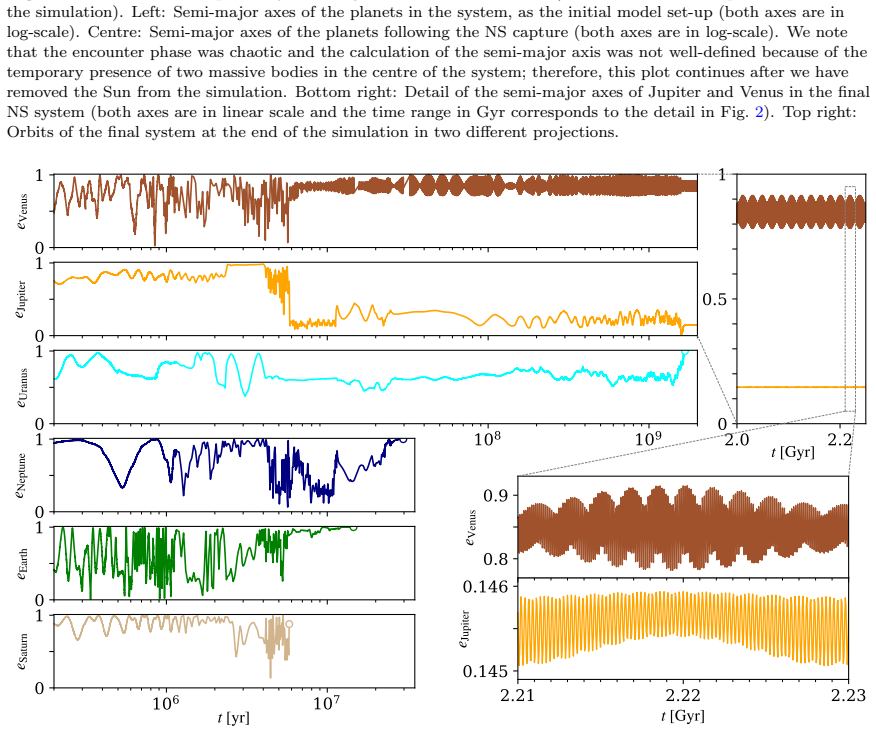
In a specific high-precision N-body integration, a Jupiter-mass planet captured by a compact stellar remnant undergoes repeated planet-planet scatterings and the ejection of companion planets, after which the remaining planet settles into an orbit with eccentricity approximately 0.146 that persists without disruption for gigayears. This outcome demonstrates that chaotic post-capture evolution need not preclude long-term stability and therefore renders the dynamical capture route viable for producing the low-eccentricity systems observed around pulsars.
What carries the argument
High-precision N-body integration of gravitational capture followed by chaotic multi-body scattering and ejection, tracking orbital elements over gigayear timescales.
If this is right
- The capture formation channel must be retained as a viable explanation for low-eccentricity pulsar planets.
- Post-capture chaos followed by ejection can act as a natural eccentricity-damping mechanism.
- Long-term stability is reachable even when initial capture leaves the system dynamically excited.
- Similar capture-and-scattering sequences may operate around other compact objects such as black holes or white dwarfs.
Where Pith is reading between the lines
- Statistical sampling over many encounter geometries would be needed to estimate the fraction of captures that reach stable low-eccentricity states.
- The same mechanism could be tested by searching for residual ejected planets or debris signatures around known pulsar systems.
- Because the simulation uses only Newtonian gravity and standard initial conditions, the result supplies a concrete benchmark for analytic theories of chaotic planetary scattering.
Load-bearing premise
That the results of one particular choice of initial conditions and a single illustrative run are representative of the statistical outcomes of realistic capture encounters rather than an uncommon lucky case.
What would settle it
A large ensemble of capture simulations with varied impact parameters and mass ratios that yields zero or extremely few stable low-eccentricity survivors after several gigayears would falsify the claim.
Figures

read the original abstract
The study of our Solar System -- its formation, evolution, and long-term stability -- has been ongoing for centuries and is now a standard part of scientific education. While the formation of other Solar-like exoplanetary systems is generally explained using the same mechanisms that describe our own, the discovery of exoplanets around pulsars in 1990s has raised new questions about their origin. Several scenarios were proposed, including formation by capture during a close encounter of a compact stellar-mass remnant and a pre-existing planetary system. It was, however, also conjectured that captured planets should exhibit high eccentricities and -- if more planets are captured -- their evolution would lead to chaos We revisit classical mechanics as applied to planetary systems. As an example and follow-up to previous works, we use an open-source high-precision $N$-body code to investigate dynamical interactions between planetary systems and stellar remnants, the orbital properties of captured planets, and their long-term stability over gigayears. We corroborate that the captured planets often exhibit high eccentricities (unlike some observed pulsar planetary systems), but we also present a student's simulation where a Jupiter-like planet undergoes a series of planet-planet encounters and planetary ejections, eventually stabilising at a low eccentricity of ~0.146. This shows that a chaotic post-capture evolution may eventually lead to long-term stability, making the dynamical formation channel viable for producing low-eccentricity systems. These results warrant more detailed investigation in future work. Beyond their astrophysical significance, they also illustrate general principles of non-linear dynamics and computation, where aspects of the analysis can even be carried out at the high-school or undergraduate level, making this type of research accessible to students at an early stage.
Editorial analysis
A structured set of objections, weighed in public.
Referee Report
Summary. The paper claims that a high-precision N-body integration of a capture encounter between a stellar remnant and a multi-planet system shows that a Jupiter-like planet can be captured, undergo chaotic planet-planet scattering and ejections, and eventually stabilize at low eccentricity (e ≈ 0.146) over gigayear timescales. This is presented as evidence that the dynamical capture channel can produce the low-eccentricity pulsar planets that have been observed, contrary to earlier conjectures that captured planets would retain high eccentricities or evolve chaotically.
Significance. If the reported trajectory is representative, the work supplies a concrete dynamical pathway by which capture followed by scattering can yield stable, low-eccentricity orbits, thereby keeping the capture scenario viable for explaining at least some pulsar planets. The use of an open-source high-precision N-body integrator and the explicit framing as a student-accessible exercise are positive features that demonstrate reproducibility and pedagogical value.
major comments (2)
- [Results section describing the N-body integration] The viability conclusion rests on a single illustrative integration (the “student’s simulation” described in the results section). No ensemble statistics, no systematic variation of impact parameter, relative velocity, or planet masses, and no estimate of the fraction of encounters that reach e < 0.2 are provided; therefore the reported low-eccentricity outcome cannot be shown to be typical rather than a rare measure-zero case in the high-dimensional encounter parameter space.
- [Long-term stability discussion] The final eccentricity is quoted as ~0.146 with no accompanying uncertainty, convergence test, or energy-error diagnostic. Given the chaotic nature of the scattering phase, small changes in initial conditions or integrator settings could alter the outcome; without such checks the robustness of the claimed stable state is not established.
minor comments (2)
- [Abstract and Methods] The abstract and methods should list the exact initial orbital elements, impact parameter, and integrator settings (timestep, softening, etc.) so that the single run can be reproduced by others.
- [Figures] Figure captions and axis labels for the orbital-element time series should explicitly state the integration duration in years and the number of planets remaining at late times.
Simulated Author's Rebuttal
We thank the referee for the constructive comments. We agree that the manuscript presents only a single illustrative integration and lacks ensemble statistics or explicit robustness diagnostics. We will revise the text to clarify that the example demonstrates dynamical possibility rather than typicality, and we will add energy-error and convergence checks.
read point-by-point responses
-
Referee: [Results section describing the N-body integration] The viability conclusion rests on a single illustrative integration (the “student’s simulation” described in the results section). No ensemble statistics, no systematic variation of impact parameter, relative velocity, or planet masses, and no estimate of the fraction of encounters that reach e < 0.2 are provided; therefore the reported low-eccentricity outcome cannot be shown to be typical rather than a rare measure-zero case in the high-dimensional encounter parameter space.
Authors: We acknowledge that the demonstration is based on a single integration. The manuscript frames this as an illustrative student's simulation to show that low-eccentricity stabilization is dynamically possible after capture and scattering, not that it is the typical outcome. We will revise the results and discussion sections to emphasize this scope explicitly and to state that a full statistical exploration of parameter space is beyond the present pedagogical exercise and is left for future work. revision: partial
-
Referee: [Long-term stability discussion] The final eccentricity is quoted as ~0.146 with no accompanying uncertainty, convergence test, or energy-error diagnostic. Given the chaotic nature of the scattering phase, small changes in initial conditions or integrator settings could alter the outcome; without such checks the robustness of the claimed stable state is not established.
Authors: We agree that additional checks are warranted. In the revised manuscript we will report the maximum relative energy error over the full integration, repeat the run with a halved timestep to verify that the final semi-major axis and eccentricity remain qualitatively unchanged, and note that the precise value 0.146 is not expected to be reproducible to high precision because of chaos, while the attainment of a stable low-eccentricity orbit is. revision: yes
Circularity Check
No circularity: results follow from direct numerical integration of Newtonian equations
full rationale
The paper's central result is the output of a single forward integration of the standard N-body equations of motion using an open-source high-precision code. The reported final eccentricity of ~0.146 is the direct numerical outcome of that integration starting from chosen initial conditions; it is not obtained by fitting a parameter to the target quantity, nor is any step defined in terms of the result itself. No self-citations are used to justify uniqueness theorems, ansatzes, or load-bearing premises. The derivation chain consists solely of the classical gravitational force law integrated in time, which is independent of the specific stability claim and externally verifiable by any N-body integrator.
Axiom & Free-Parameter Ledger
free parameters (2)
- initial orbital elements and impact parameter
- planet masses (Jupiter-like)
axioms (1)
- standard math Newtonian gravity and point-mass interactions govern the dynamics over gigayear timescales
Reference graph
Works this paper leans on
-
[1]
REBOUND: an open-source multi-purpose N-body code for collisional dynamics. , keywords =. doi:10.1051/0004-6361/201118085 , adsurl =
-
[2]
A new paradigm for reproducing and analyzing N-body simulations of planetary systems. , keywords =. doi:10.1093/mnras/stx232 , adsurl =
-
[3]
REBOUNDx: a library for adding conservative and dissipative forces to otherwise symplectic N-body integrations. , keywords =. doi:10.1093/mnras/stz2870 , archivePrefix =. 1908.05634 , primaryClass =
-
[4]
Symplectic maps for the N-body problem. , keywords =. doi:10.1086/115978 , adsurl =
-
[5]
WHFAST: a fast and unbiased implementation of a symplectic Wisdom-Holman integrator for long-term gravitational simulations. , keywords =. doi:10.1093/mnras/stv1257 , archivePrefix =. 1506.01084 , primaryClass =
work page internal anchor Pith review Pith/arXiv arXiv doi:10.1093/mnras/stv1257
-
[6]
IAU Colloquium 83: Dynamics of Comets: Their Origin and Evolution , year = 1985, editor =
An efficient integrator that uses Gauss-Radau spacings. IAU Colloquium 83: Dynamics of Comets: Their Origin and Evolution , year = 1985, editor =. doi:10.1007/978-94-009-5400-7_17 , adsurl =
-
[7]
IAS15: a fast, adaptive, high-order integrator for gravitational dynamics, accurate to machine precision over a billion orbits. , keywords =. doi:10.1093/mnras/stu2164 , archivePrefix =. 1409.4779 , primaryClass =
work page internal anchor Pith review Pith/arXiv arXiv doi:10.1093/mnras/stu2164
-
[8]
Armitage and Shirley Ho and David N
Daniel Tamayo and Miles Cranmer and Samuel Hadden and Hanno Rein and Peter Battaglia and Alysa Obertas and Philip J. Armitage and Shirley Ho and David N. Spergel and Christian Gilbertson and Naireen Hussain and Ari Silburt and Daniel Jontof-Hutter and Kristen Menou , title =. Proceedings of the National Academy of Sciences , volume =. 2020 , doi =. https:...
-
[9]
Diversity of Exoplanets. arXiv e-prints , keywords =. doi:10.48550/arXiv.2505.09754 , eprint =
-
[10]
Dynamics of exoplanetary systems, links to their habitability
Dynamics of exoplanetary systems, links to their habitability. SF2A-2014: Proceedings of the Annual meeting of the French Society of Astronomy and Astrophysics , year = 2014, editor =. doi:10.48550/arXiv.1412.0284 , archivePrefix =. 1412.0284 , primaryClass =
work page internal anchor Pith review Pith/arXiv arXiv doi:10.48550/arxiv.1412.0284 2014
-
[11]
Charles R. Harris and K. Jarrod Millman and St. Array programming with. 2020 , month = sep, journal =. doi:10.1038/s41586-020-2649-2 , publisher =
-
[12]
Hunter, J. D. , Title =. Computing in Science & Engineering , Volume =
-
[13]
Close encounters with the Death Star: Interactions between collapsed bodies and the Solar System. , keywords =. doi:10.1051/0004-6361/202140454 , adsurl =
-
[14]
How a fake Kepler portrait became iconic. Physics Today , keywords =. doi:10.1063/PT.3.4825 , archivePrefix =. 2108.02213 , primaryClass =
-
[15]
extended version on arXiv e-prints , year = 2021, month = sep, eprint =
How a fake Kepler portrait became iconic. extended version on arXiv e-prints , year = 2021, month = sep, eprint =
2021
-
[16]
Dynamics of star associations in an SMBH IMBH system: The case of IRS13 in the Galactic centre. , keywords =. doi:10.1051/0004-6361/202452050 , archivePrefix =. 2410.14541 , primaryClass =
-
[17]
Intrinsic Stochasticity in Plasmas , year = 1979, editor =
Lyapunov characteristic exponents and stochasticity. Intrinsic Stochasticity in Plasmas , year = 1979, editor =
1979
-
[18]
Journal of Physics A , year = 2013, month = jun, volume =
Lyapunov analysis: from dynamical systems theory to applications. Journal of Physics A , year = 2013, month = jun, volume =. doi:10.1088/1751-8113/46/25/250301 , adsurl =
-
[19]
Simple tools to study global dynamics in non-axisymmetric galactic potentials - I. , keywords =. doi:10.1051/aas:2000108 , adsurl =
-
[20]
Lecture Notes in Physics , year = 2010, editor =
The Lyapunov Characteristic Exponents and Their Computation. Lecture Notes in Physics , year = 2010, editor =. doi:10.1007/978-3-642-04458-8_2 , adsurl =
-
[21]
Timescales of Chaos in the Inner Solar System: Lyapunov Spectrum and Quasi-integrals of Motion , author =. Phys. Rev. X , volume =. 2023 , month =. doi:10.1103/PhysRevX.13.021018 , url =
-
[22]
Hussain, Naireen and Tamayo, Daniel , title =. 2019 , month =. doi:10.1093/mnras/stz3402 , url =
-
[23]
arXiv e-prints , keywords =
Detecting Irregular Orbits in Gravitational N-body Simulations. arXiv e-prints , keywords =. 0607343 , doi =
-
[24]
Chaos in multiplanetary extrasolar systems. , keywords =. doi:10.1093/mnras/stac3200 , archivePrefix =. 2211.01721 , primaryClass =
-
[25]
Chaos in the N-Body Problem of Stellar Dynamics
Heggie, Douglas C. Chaos in the N-Body Problem of Stellar Dynamics. Predictability, Stability, and Chaos in N-Body Dynamical Systems. 1991. doi:10.1007/978-1-4684-5997-5_4
-
[26]
Binary evolution in stellar dynamics. , keywords =. doi:10.1093/mnras/173.3.729 , adsurl =
-
[27]
Encounters between binary and single stars and their effect on the dynamical evolution of stellar systems. , keywords =. doi:10.1086/111815 , adsurl =
-
[28]
Stochastic problems in physics and astronomy,
Stochastic Problems in Physics and Astronomy. Reviews of Modern Physics , year = 1943, month = jan, volume =. doi:10.1103/RevModPhys.15.1 , adsurl =
-
[29]
Archive for History of Exact Sciences , year =
Fraser, Craig and Nakane, Michiyo , title =. Archive for History of Exact Sciences , year =. doi:10.1007/s00407-022-00303-9 , url =
-
[30]
A planetary system around the millisecond pulsar PSR1257 + 12. , keywords =. doi:10.1038/355145a0 , adsurl =
-
[31]
Confirmation of Earth-Mass Planets Orbiting the Millisecond Pulsar PSR B1257+12. Science , keywords =. doi:10.1126/science.264.5158.538 , adsurl =
-
[32]
Long-Term Stability and Dynamical Environment of the PSR 1257+12 Planetary System. , keywords =. doi:10.1086/426775 , adsurl =
-
[33]
The Evolution of Protoplanetary Disks around Millisecond Pulsars: The PSR 1257+12 System. , keywords =. doi:10.1086/520327 , adsurl =
-
[34]
Time-dependent models of accretion discs with nuclear burning following the tidal disruption of a white dwarf by a neutron star. , keywords =. doi:10.1093/mnras/stw1410 , adsurl =
-
[35]
A planet orbiting the neutron star PSR1829-10. , keywords =. doi:10.1038/352311a0 , adsurl =
-
[36]
, year = 1993, month = oct, volume =
A second companion of the millisecond pulsar 1620 - 26. , year = 1993, month = oct, volume =. doi:10.1038/365817a0 , adsurl =
-
[37]
Orbital Parameters of the PSR B1620-26 Triple System
Orbital Parameters of the PSR B1620-26 Triple System. ASPC , volume =. doi:10.48550/arXiv.astro-ph/9605141 , adsurl =
work page internal anchor Pith review Pith/arXiv arXiv doi:10.48550/arxiv.astro-ph/9605141
-
[38]
The Triple Pulsar System PSR B1620-26 in M4. , keywords =. doi:10.1086/307771 , adsurl =
-
[39]
Formation of a planet orbiting pulsar 1829-10 from the debris of a supernova explosion. , keywords =. doi:10.1038/353827a0 , adsurl =
-
[40]
ASPC , volume =
The pulsar planet production process. ASPC , volume =
-
[41]
The origin of the planet orbiting PSR1829 - 10. , keywords =. doi:10.1038/352783a0 , adsurl =
-
[42]
A debris disk around an isolated young neutron star. , keywords =. doi:10.1038/nature04669 , adsurl =
-
[43]
ASPC , volume =
The Formation of Planet Pulsars. ASPC , volume =
-
[44]
Long-term stability of captured planetary systems
-
[45]
Detailed study of the stability of planetary systems captured by a massive stellar remnant. Proceedings of ``MODEST-24: Exploring Dense Stellar Systems Across Cosmic Time'' , year = 2024, month = aug, eid =. doi:10.5281/zenodo.13325829 , adsurl =
-
[46]
Gravity: Newtonian, Post-Newtonian, Relativistic
-
[47]
The Eccentric Kozai Mechanism for a Test Particle. , keywords =. doi:10.1088/0004-637X/742/2/94 , adsurl =
-
[48]
, year = 1962, month = nov, volume =
Secular perturbations of asteroids with high inclination and eccentricity. , year = 1962, month = nov, volume =. doi:10.1086/108790 , adsurl =
-
[49]
, year = 1962, month = oct, volume =
The evolution of orbits of artificial satellites of planets under the action of gravitational perturbations of external bodies. , year = 1962, month = oct, volume =. doi:10.1016/0032-0633(62)90129-0 , adsurl =
-
[50]
Theoretical Implications of the PSR B1620-26 Triple System and Its Planet. , keywords =. doi:10.1086/308167 , adsurl =
-
[51]
2008 , publisher=
Galactic Dynamics: 2nd Ed , author=. 2008 , publisher=
2008
-
[52]
2023 , publisher=
Dynamics of Planetary Systems , author=. 2023 , publisher=
2023
-
[53]
2021 , publisher=
Classical Electrodynamics , author=. 2021 , publisher=
2021
-
[54]
2002 , publisher=
Classical Mechanics , author=. 2002 , publisher=
2002
-
[55]
Macrocosmos/microcosmos: celestial mechanics and old quantum theory , journal =
Steven N Shore , keywords =. Macrocosmos/microcosmos: celestial mechanics and old quantum theory , journal =. 2003 , issn =. doi:https://doi.org/10.1016/S0315-0860(02)00028-9 , url =
-
[56]
Mathematical methods of classical mechanics
-
[57]
doi:10.3931/e-rara-421 , publisher = "
Les m \'e thodes nouvelles de la m \'e canique c \'e leste. doi:10.3931/e-rara-421 , publisher = "
-
[58]
Revista Mexicana de Astronomia y Astrofisica Conference Series , year = 2024, volume =
Fostering Innovation, Inclusion, and Diversity in Astronomy Education: The Czech Astronomy Olympiad Experience. Revista Mexicana de Astronomia y Astrofisica Conference Series , year = 2024, volume =. doi:10.22201/ia.14052059p.2024.57.05 , archivePrefix =. 2401.12376 , primaryClass =
-
[59]
Simulating observable comets. III. Real stellar perturbers of the Oort cloud and their output. , year = 2006, month = apr, volume =. doi:10.1051/0004-6361:20054284 , adsurl =
-
[60]
Close approach parameters recalculated based on the first Gaia data release
Gliese 710 will pass the Sun even closer. Close approach parameters recalculated based on the first Gaia data release. , keywords =. doi:10.1051/0004-6361/201629835 , adsurl =
-
[61]
, year = 2017, month = dec, volume =
A brief visit from a red and extremely elongated interstellar asteroid. , year = 2017, month = dec, volume =. doi:10.1038/nature25020 , adsurl =
-
[62]
Interstellar Visitors: A Physical Characterization of Comet C/2019 Q4 (Borisov) with OSIRIS at the 10.4 \, m GTC. RNAAS. doi:10.3847/2515-5172/ab449c , adsurl =
-
[63]
Z., Micheli, M., Farnocchia, D., et al
Discovery and Preliminary Characterization of a Third Interstellar Object: 3I/ATLAS. , keywords =. doi:10.3847/2041-8213/adf49a , archivePrefix =. 2507.02757 , primaryClass =
-
[64]
The dynamics of elliptical rings. , keywords =. doi:10.1086/113446 , adsurl =
-
[65]
1923 , publisher=
Atomic structure and spectral lines , author=. 1923 , publisher=
1923
-
[66]
Sternberg, Shlomo , title = "
-
[67]
A. N. Kolmogorov , title =. Doklady Akademii Nauk SSSR , volume =. 1954 , note =
1954
-
[68]
V. I. Arnold , title =. Russian Mathematical Surveys , volume =
-
[69]
Stable and Random Motions in Dynamical Systems , publisher =
J. Stable and Random Motions in Dynamical Systems , publisher =. 1973 , address =
1973
-
[70]
Nicholas Minorsky , title =
discussion (0)
Sign in with ORCID, Apple, or X to comment. Anyone can read and Pith papers without signing in.