Recognition: 2 theorem links
· Lean TheoremDo Fair Models Reason Fairly? Counterfactual Explanation Consistency for Procedural Fairness in Credit Decisions
Pith reviewed 2026-05-14 20:46 UTC · model grok-4.3
The pith
Outcome-fair credit models can still apply different reasoning to similar individuals, a hidden procedural bias missed by standard metrics.
A machine-rendered reading of the paper's core claim, the machinery that carries it, and where it could break.
Core claim
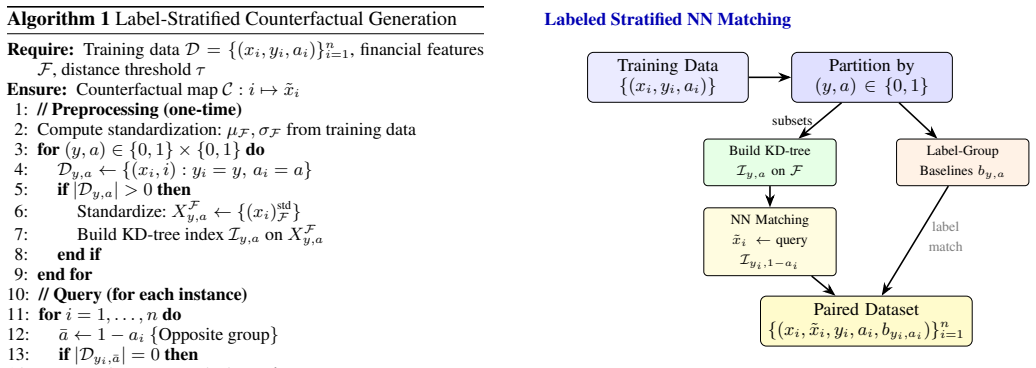
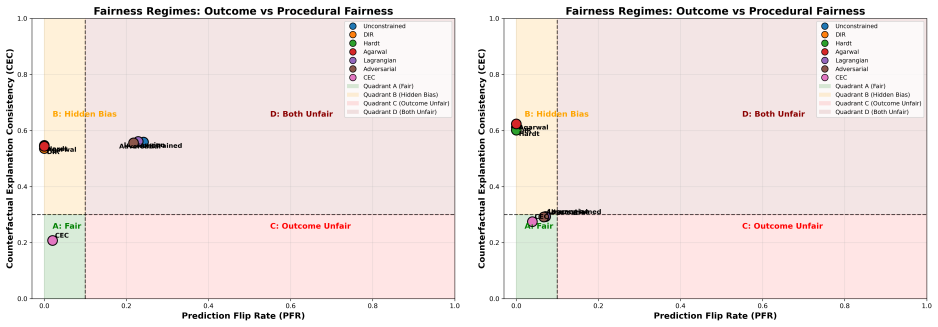
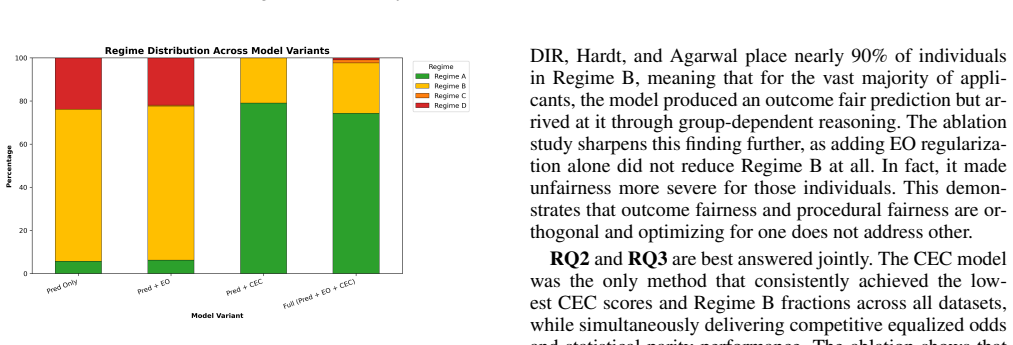
Existing outcome-fair models frequently exhibit Regime B, producing the same decision for an individual and its counterfactual yet with misaligned feature attributions; the CEC framework detects this bias through nearest-neighbor counterfactual generation and aligned integrated-gradient comparisons, then mitigates it via an individual-level procedural fairness metric and a corresponding training loss.
What carries the argument
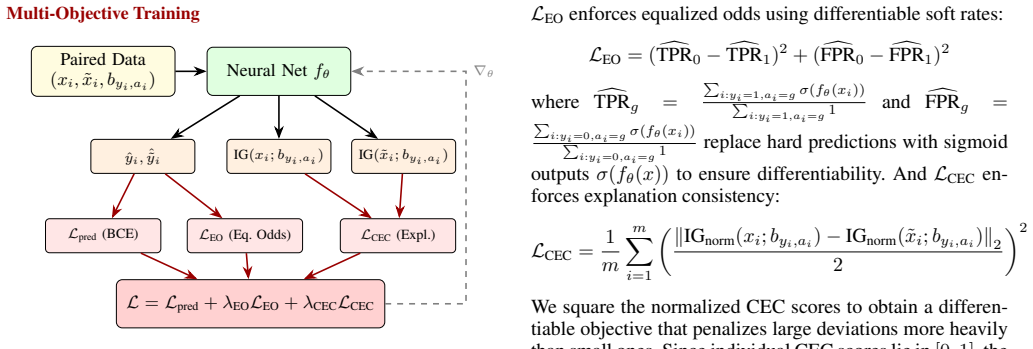
Counterfactual Explanation Consistency (CEC) that aligns integrated-gradient attributions between each instance and its nearest-neighbor counterfactual to enforce procedural fairness.
If this is right
- Standard outcome-based fairness metrics and training algorithms leave substantial procedural inconsistencies undetected.
- Adding the CEC loss during training reduces hidden procedural bias on credit datasets.
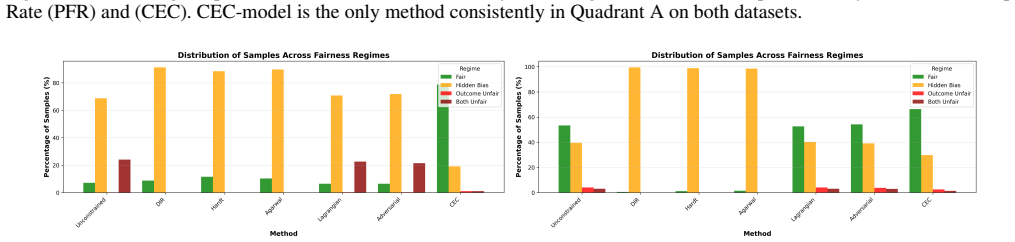
- Regime B bias appears consistently in popular outcome-fair baselines across synthetic and real credit data.
- Procedural bias reduction occurs with only modest degradation in predictive utility.
Where Pith is reading between the lines
- The same consistency requirement could be applied to other high-stakes domains such as hiring or medical triage.
- Hybrid counterfactual generators might further stabilize the metric when data density varies.
- Enforcing explanation consistency may indirectly improve model robustness to small input changes.
Load-bearing premise
Nearest-neighbor counterfactuals together with integrated-gradient attributions reliably capture the model's true reasoning without artifacts introduced by the generation method itself.
What would settle it
A model retrained with the CEC loss that still shows large attribution differences when the same instances are explained with a different counterfactual generator or a different attribution technique.
Figures


read the original abstract
Machine learning algorithms in socially sensitive domains (e.g., credit decisions) often focus on equalizing predictive outcomes. However, satisfying these metrics does not guarantee that models use the same reasoning for different groups. We show that existing outcome-fair models can still apply fundamentally different reasoning to individuals, a ``hidden procedural bias'' missed by standard fairness metrics and algorithms. We propose Counterfactual Explanation Consistency (CEC), a framework that detects and mitigates this bias by aligning feature attributions between individuals and their counterfactual counterparts. Key contributions include a nearest-neighbor counterfactual generation method, a modified baseline for integrated gradient comparisons, an individual-level procedural fairness metric, and a corresponding training loss. We introduce a taxonomy identifying ``Regime B'' (same outcome, different reasoning) as a critical blind spot. Experiments on synthetic data, German Credit, Adult Income, and HMDA mortgage data demonstrate that outcome-fair baselines exhibit substantial hidden bias, while CEC substantially reduces it with modest utility cost.
Editorial analysis
A structured set of objections, weighed in public.
Referee Report
Summary. The paper claims that outcome-fair ML models for credit decisions can still exhibit hidden procedural bias by applying fundamentally different reasoning to individuals (Regime B), which standard fairness metrics miss. It introduces the Counterfactual Explanation Consistency (CEC) framework, including nearest-neighbor counterfactual generation, a modified integrated-gradients baseline, an individual-level procedural fairness metric, and a corresponding training loss to detect and mitigate this bias. Experiments on synthetic data, German Credit, Adult Income, and HMDA mortgage datasets are reported to show that outcome-fair baselines have substantial hidden bias while CEC reduces it at modest utility cost.
Significance. If the central claim holds, the work identifies a meaningful gap between outcome fairness and procedural fairness in high-stakes tabular domains and supplies a practical detection/mitigation method. The multi-dataset evaluation is a strength. However, the absence of reported statistical significance, exact metric values, and controls for generation artifacts limits immediate impact and verifiability.
major comments (2)
- Abstract: the claim that outcome-fair baselines exhibit 'substantial hidden bias' and that CEC 'substantially reduces it' is load-bearing for the central contribution, yet no exact metric values, statistical significance tests, effect sizes, or controls for nearest-neighbor artifacts are provided, preventing assessment of whether the reported improvement is robust or artifact-driven.
- Nearest-neighbor counterfactual generation method: the framework assumes NN search in feature space plus modified IG attribution alignment reliably isolates reasoning differences rather than distance-metric or scaling artifacts; in high-dimensional datasets (HMDA, Adult), this is a load-bearing assumption with no reported sensitivity analysis to k, feature normalization, or alternative counterfactual generators.
minor comments (1)
- Abstract: the taxonomy of regimes (especially Regime B) is introduced but not defined with sufficient precision to allow readers to map it onto existing fairness literature without ambiguity.
Simulated Author's Rebuttal
We thank the referee for the constructive feedback. We agree that additional quantitative details and robustness checks will strengthen the paper and address the concerns about verifiability. We respond to each major comment below and will incorporate the suggested additions in the revision.
read point-by-point responses
-
Referee: Abstract: the claim that outcome-fair baselines exhibit 'substantial hidden bias' and that CEC 'substantially reduces it' is load-bearing for the central contribution, yet no exact metric values, statistical significance tests, effect sizes, or controls for nearest-neighbor artifacts are provided, preventing assessment of whether the reported improvement is robust or artifact-driven.
Authors: We agree that exact numerical values, significance tests, and artifact controls are needed for full assessment. While the figures show clear trends, the revised manuscript will add a results table reporting precise mean CEC scores (with standard deviations) for all methods and datasets, p-values from paired statistical tests (e.g., Wilcoxon signed-rank), and effect sizes (Cohen's d). We will also include a control experiment using randomly generated counterfactuals (instead of NN) to demonstrate that the observed consistency gains are not driven by generation artifacts. revision: yes
-
Referee: Nearest-neighbor counterfactual generation method: the framework assumes NN search in feature space plus modified IG attribution alignment reliably isolates reasoning differences rather than distance-metric or scaling artifacts; in high-dimensional datasets (HMDA, Adult), this is a load-bearing assumption with no reported sensitivity analysis to k, feature normalization, or alternative counterfactual generators.
Authors: We acknowledge the importance of validating this assumption, particularly for high-dimensional data. In the revision we will add a dedicated sensitivity analysis section (and appendix) that varies k (values 1, 5, 10, 20), tests alternative normalizations (min-max, z-score, robust scaling), and compares NN counterfactuals against two alternative generators (optimization-based and generative-model-based). These experiments will be run on HMDA and Adult to confirm that CEC improvements remain stable. revision: yes
Circularity Check
No significant circularity; CEC definitions and loss are independent of fitted outputs
full rationale
The paper defines Counterfactual Explanation Consistency (CEC) via nearest-neighbor counterfactual generation in feature space, a modified integrated-gradients baseline, an individual-level procedural fairness metric, and a corresponding training loss. These elements are introduced as new constructs that operate on model attributions and counterfactual pairs; the metric and loss are not algebraically reduced to the same fitted parameters they evaluate, nor do they rely on self-citation chains or uniqueness theorems imported from the authors' prior work. The derivation chain for identifying Regime B (same outcome, different reasoning) therefore remains self-contained against external benchmarks and does not collapse by construction to its inputs.
Axiom & Free-Parameter Ledger
Lean theorems connected to this paper
-
IndisputableMonolith/Foundation/AlexanderDuality.lean (D=3 forcing)alexander_duality_circle_linking unclear?
unclearRelation between the paper passage and the cited Recognition theorem.
Regime B (same outcome, different reasoning) ... taxonomy of four fairness regimes
What do these tags mean?
- matches
- The paper's claim is directly supported by a theorem in the formal canon.
- supports
- The theorem supports part of the paper's argument, but the paper may add assumptions or extra steps.
- extends
- The paper goes beyond the formal theorem; the theorem is a base layer rather than the whole result.
- uses
- The paper appears to rely on the theorem as machinery.
- contradicts
- The paper's claim conflicts with a theorem or certificate in the canon.
- unclear
- Pith found a possible connection, but the passage is too broad, indirect, or ambiguous to say the theorem truly supports the claim.
Reference graph
Works this paper leans on
-
[1]
Women in the American Political System: An Encyclopedia of Women as Voters, Candidates, and Office Holders , volume=
Equal credit opportunity act , author=. Women in the American Political System: An Encyclopedia of Women as Voters, Candidates, and Office Holders , volume=
-
[2]
Home Mortgage Disclosure Act, and Community , year=
Fair Housing Act , author=. Home Mortgage Disclosure Act, and Community , year=
-
[3]
2009 , publisher=
Causality , author=. 2009 , publisher=
2009
-
[4]
International Journal of Management , volume=
Machine learning algorithms for credit risk assessment: an economic and financial analysis , author=. International Journal of Management , volume=
-
[5]
Applied Soft Computing , volume=
Statistical and machine learning models in credit scoring: A systematic literature survey , author=. Applied Soft Computing , volume=. 2020 , publisher=
2020
-
[6]
IEEE Transactions on Evolutionary Computation , volume=
A fast and elitist multiobjective genetic algorithm: NSGA-II , author=. IEEE Transactions on Evolutionary Computation , volume=. 2002 , publisher=
2002
-
[7]
Journal of Healthcare Engineering , volume=
Involvement of machine learning tools in healthcare decision making , author=. Journal of Healthcare Engineering , volume=. 2021 , publisher=
2021
-
[8]
Applied Sciences , volume=
Bias in machine learning: A literature review , author=. Applied Sciences , volume=. 2024 , publisher=
2024
-
[9]
Advances in Neural Information Processing Systems , volume=
Optimized pre-processing for discrimination prevention , author=. Advances in Neural Information Processing Systems , volume=
-
[10]
Advances in Neural Information Processing Systems , volume=
Fairness aware counterfactuals for subgroups , author=. Advances in Neural Information Processing Systems , volume=
-
[11]
Advances in Neural Information Processing Systems , volume=
Achieving equalized odds by resampling sensitive attributes , author=. Advances in Neural Information Processing Systems , volume=
-
[12]
Proceedings of the ACM Conference on Fairness, Accountability, and Transparency , pages=
Marrying fairness and explainability in supervised learning , author=. Proceedings of the ACM Conference on Fairness, Accountability, and Transparency , pages=
-
[13]
Proceedings of the ACM conference on fairness, accountability, and transparency , pages=
The road to explainability is paved with bias: Measuring the fairness of explanations , author=. Proceedings of the ACM conference on fairness, accountability, and transparency , pages=
-
[14]
1994 , howpublished =
Hofmann, Hans , title =. 1994 , howpublished =
1994
-
[15]
2009 , howpublished =
Yeh, I-Cheng , title =. 2009 , howpublished =
2009
-
[16]
International Conference on Machine Learning , pages=
Preventing fairness gerrymandering: Auditing and learning for subgroup fairness , author=. International Conference on Machine Learning , pages=. 2018 , organization=
2018
-
[17]
29th IEEE International Requirements Engineering Conference (RE) , pages=
Exploring explainability: a definition, a model, and a knowledge catalog , author=. 29th IEEE International Requirements Engineering Conference (RE) , pages=. 2021 , organization=
2021
-
[18]
Proceedings of the AAAI/ACM Conference on AI, Ethics, and Society , pages=
Fairness via explanation quality: Evaluating disparities in the quality of post hoc explanations , author=. Proceedings of the AAAI/ACM Conference on AI, Ethics, and Society , pages=
-
[19]
2005 , publisher=
Multicriteria optimization , author=. 2005 , publisher=
2005
-
[20]
ACM Computing Surveys (CSUR) , volume=
A review on fairness in machine learning , author=. ACM Computing Surveys (CSUR) , volume=. 2022 , publisher=
2022
-
[21]
arXiv preprint arXiv:2309.17347 , year=
Demographic parity: Mitigating biases in real-world data , author=. arXiv preprint arXiv:2309.17347 , year=
-
[22]
California Law Review , volume=
Big data's disparate impact , author=. California Law Review , volume=. 2016 , publisher=
2016
-
[23]
Proceedings of the 3rd Innovations in Theoretical Computer Science Conference , pages=
Fairness through awareness , author=. Proceedings of the 3rd Innovations in Theoretical Computer Science Conference , pages=
-
[24]
Advances in Neural Information Processing Systems , volume=
Counterfactual fairness , author=. Advances in Neural Information Processing Systems , volume=
-
[25]
Big Data , volume=
Fair prediction with disparate impact: A study of bias in recidivism prediction instruments , author=. Big Data , volume=. 2017 , publisher=
2017
-
[26]
Advances in Neural Information Processing Systems , volume=
Equality of opportunity in supervised learning , author=. Advances in Neural Information Processing Systems , volume=
-
[27]
Proceedings of the 23rd ACM SIGKDD International Conference on Knowledge Discovery and Data Mining , pages=
Algorithmic decision making and the cost of fairness , author=. Proceedings of the 23rd ACM SIGKDD International Conference on Knowledge Discovery and Data Mining , pages=
-
[28]
On the Robustness of Interpretability Methods
On the robustness of interpretability methods , author=. arXiv preprint arXiv:1806.08049 , year=
work page internal anchor Pith review Pith/arXiv arXiv
-
[29]
Advances in Neural Information Processing Systems , volume=
Explanations can be manipulated and geometry is to blame , author=. Advances in Neural Information Processing Systems , volume=
-
[30]
Advances in Neural Information Processing Systems , volume=
Training for Stable Explanation for Free , author=. Advances in Neural Information Processing Systems , volume=
-
[31]
European Conference on Artificial Intelligence , pages=
You shouldn’t trust me: Learning models which conceal unfairness from multiple explanation methods , author=. European Conference on Artificial Intelligence , pages=. 2020 , publisher=
2020
-
[32]
Pattern Recognition , volume=
Towards robust explanations for deep neural networks , author=. Pattern Recognition , volume=. 2022 , publisher=
2022
-
[33]
Why should I trust you?
" Why should I trust you?" Explaining the predictions of any classifier , author=. Proceedings of the 22nd ACM SIGKDD International Conference on Knowledge Discovery and Data Mining , pages=
-
[34]
, author=
The mythos of model interpretability: In machine learning, the concept of interpretability is both important and slippery. , author=. Queue , volume=. 2018 , publisher=
2018
-
[35]
arXiv preprint arXiv:2010.07389 , year=
Explainability for fair machine learning , author=. arXiv preprint arXiv:2010.07389 , year=
-
[36]
Proceedings of the AAAI Conference on Artificial Intelligence , volume=
Fairness in decision-making—the causal explanation formula , author=. Proceedings of the AAAI Conference on Artificial Intelligence , volume=
-
[37]
Advances in Neural Information Processing Systems , volume=
Towards robust interpretability with self-explaining neural networks , author=. Advances in Neural Information Processing Systems , volume=
-
[38]
Electronics , volume=
Evaluating the quality of machine learning explanations: A survey on methods and metrics , author=. Electronics , volume=. 2021 , publisher=
2021
-
[39]
Advances in Neural Information Processing Systems , volume=
On the (in) fidelity and sensitivity of explanations , author=. Advances in Neural Information Processing Systems , volume=
-
[40]
Proceedings of the Twenty-Ninth International Joint Conference on Artificial Intelligence , pages=
Evaluating and Aggregating Feature-based Model Explanations , author=. Proceedings of the Twenty-Ninth International Joint Conference on Artificial Intelligence , pages=
-
[41]
Digital Signal Processing , volume=
Methods for interpreting and understanding deep neural networks , author=. Digital Signal Processing , volume=. 2018 , publisher=
2018
-
[42]
arXiv preprint arXiv:2211.05667 , year=
What makes a good explanation?: A harmonized view of properties of explanations , author=. arXiv preprint arXiv:2211.05667 , year=
-
[43]
arXiv preprint arXiv:2007.07584 , year=
On quantitative aspects of model interpretability , author=. arXiv preprint arXiv:2007.07584 , year=
-
[44]
Proceedings of the 43rd International ACM SIGIR Conference on Research and Development in Information Retrieval , pages=
Measuring recommendation explanation quality: The conflicting goals of explanations , author=. Proceedings of the 43rd International ACM SIGIR Conference on Research and Development in Information Retrieval , pages=
-
[45]
ACM Transactions on Software Engineering and Methodology , volume=
Fairness testing: A comprehensive survey and analysis of trends , author=. ACM Transactions on Software Engineering and Methodology , volume=. 2024 , publisher=
2024
-
[46]
Proceedings of the Genetic and Evolutionary Computation Conference Companion , pages=
Fair feature subset selection using multiobjective genetic algorithm , author=. Proceedings of the Genetic and Evolutionary Computation Conference Companion , pages=
-
[47]
Proceedings of the AAAI Conference on Artificial Intelligence , volume=
Generating diagnostic and actionable explanations for fair graph neural networks , author=. Proceedings of the AAAI Conference on Artificial Intelligence , volume=
-
[48]
Pattern Recognition , volume=
The level of strength of an explanation: A quantitative evaluation technique for post-hoc XAI methods , author=. Pattern Recognition , volume=. 2025 , publisher=
2025
-
[49]
ACM Computing Surveys , volume=
A survey on bias and fairness in machine learning , author=. ACM Computing Surveys , volume=. 2021 , publisher=
2021
-
[50]
The Annals of Mathematical Statistics , pages=
On a test of whether one of two random variables is stochastically larger than the other , author=. The Annals of Mathematical Statistics , pages=. 1947 , publisher=
1947
-
[51]
Artificial Intelligence and Machine Learning for Multi-domain Operations Applications , volume=
Developing the sensitivity of LIME for better machine learning explanation , author=. Artificial Intelligence and Machine Learning for Multi-domain Operations Applications , volume=. 2019 , organization=
2019
-
[52]
Advances in Neural Information Processing Systems , volume=
Reliable post hoc explanations: Modeling uncertainty in explainability , author=. Advances in Neural Information Processing Systems , volume=
-
[53]
Advances in Neural Information Processing Systems , volume=
Openxai: Towards a transparent evaluation of model explanations , author=. Advances in Neural Information Processing Systems , volume=
-
[54]
International Conference on Machine Learning , pages=
Fair regression: Quantitative definitions and reduction-based algorithms , author=. International Conference on Machine Learning , pages=. 2019 , organization=
2019
-
[55]
arXiv preprint arXiv:2108.00783 , year=
Carla: a python library to benchmark algorithmic recourse and counterfactual explanation algorithms , author=. arXiv preprint arXiv:2108.00783 , year=
-
[56]
2008 , journal=
Using data mining to predict secondary school student performance , author=. 2008 , journal=
2008
-
[57]
Journal of Ethnicity in Criminal Justice , volume=
The effect of race/ethnicity on sentencing: Examining sentence type, jail length, and prison length , author=. Journal of Ethnicity in Criminal Justice , volume=. 2015 , publisher=
2015
-
[58]
Proceedings of the AAAI/ACM Conference on AI, Ethics, and Society , pages=
Mitigating unwanted biases with adversarial learning , author=. Proceedings of the AAAI/ACM Conference on AI, Ethics, and Society , pages=
-
[59]
Knowledge and Information Systems , volume=
Data preprocessing techniques for classification without discrimination , author=. Knowledge and Information Systems , volume=. 2012 , publisher=
2012
-
[60]
2007 , publisher=
UCI machine learning repository , author=. 2007 , publisher=
2007
-
[61]
Uncertainty in Artificial Intelligence , pages=
Fairness-aware class imbalanced learning on multiple subgroups , author=. Uncertainty in Artificial Intelligence , pages=. 2023 , organization=
2023
-
[62]
Computers & Chemical Engineering , volume=
Stakeholder-oriented multi-objective process optimization based on an improved genetic algorithm , author=. Computers & Chemical Engineering , volume=. 2020 , publisher=
2020
-
[63]
arXiv preprint arXiv:2004.01840 , year=
Abstracting fairness: Oracles, metrics, and interpretability , author=. arXiv preprint arXiv:2004.01840 , year=
-
[64]
1993 , publisher=
Decisions with multiple objectives: preferences and value trade-offs , author=. 1993 , publisher=
1993
-
[65]
Machine Learning , volume=
Fair and green hyperparameter optimization via multi-objective and multiple information source Bayesian optimization , author=. Machine Learning , volume=. 2024 , publisher=
2024
-
[66]
arXiv preprint arXiv:2503.07066 , year=
You Only Debias Once: Towards Flexible Accuracy-Fairness Trade-offs at Inference Time , author=. arXiv preprint arXiv:2503.07066 , year=
-
[67]
IEEE Transactions on Evolutionary Computation , volume=
An evolutionary many-objective optimization algorithm using reference-point-based nondominated sorting approach, part I: solving problems with box constraints , author=. IEEE Transactions on Evolutionary Computation , volume=. 2013 , publisher=
2013
-
[68]
An Evolutionary Many-Objective Optimization Algorithm Using Reference-Point Based Nondominated Sorting Approach,
Jain, Himanshu and Deb, Kalyanmoy , journal=. An Evolutionary Many-Objective Optimization Algorithm Using Reference-Point Based Nondominated Sorting Approach,. 2014 , volume=
2014
-
[69]
IEEE Transactions on Evolutionary Computation , volume=
Mitigating unfairness via evolutionary multiobjective ensemble learning , author=. IEEE Transactions on Evolutionary Computation , volume=. 2022 , publisher=
2022
-
[70]
Complex & Intelligent Systems , volume=
Fairness optimisation with multi-objective swarms for explainable classifiers on data streams , author=. Complex & Intelligent Systems , volume=. 2024 , publisher=
2024
-
[71]
2017 , publisher=
Multi-objective decision making , author=. 2017 , publisher=
2017
-
[72]
Complex & Intelligent Systems , volume=
Towards fairness-aware multi-objective optimization , author=. Complex & Intelligent Systems , volume=. 2025 , publisher=
2025
-
[73]
Proceedings of the AAAI/ACM Conference on AI, Ethics, and Society , volume=
A Human-in-the-Loop Fairness-Aware Model Selection Framework for Complex Fairness Objective Landscapes , author=. Proceedings of the AAAI/ACM Conference on AI, Ethics, and Society , volume=
-
[74]
Proceedings of the ACM Conference on Fairness, Accountability, and Transparency , pages=
A critical survey on fairness benefits of explainable AI , author=. Proceedings of the ACM Conference on Fairness, Accountability, and Transparency , pages=
-
[75]
Ethics and Information Technology , volume=
Fairness, explainability and in-between: Understanding the impact of different explanation methods on non-expert users’ perceptions of fairness toward an algorithmic system , author=. Ethics and Information Technology , volume=. 2022 , publisher=
2022
-
[76]
Advances in Neural Information Processing Systems , volume=
Fairness with overlapping groups; a probabilistic perspective , author=. Advances in Neural Information Processing Systems , volume=
-
[77]
arXiv preprint arXiv:2411.02569 , year=
The Intersectionality Problem for Algorithmic Fairness , author=. arXiv preprint arXiv:2411.02569 , year=
-
[78]
arXiv preprint arXiv:2106.13346 , year=
What will it take to generate fairness-preserving explanations? , author=. arXiv preprint arXiv:2106.13346 , year=
-
[79]
Proceedings of the AAAI/ACM Conference on AI, Ethics, and Society , pages=
Fooling lime and shap: Adversarial attacks on post hoc explanation methods , author=. Proceedings of the AAAI/ACM Conference on AI, Ethics, and Society , pages=
-
[80]
Proceedings of the AAAI Conference on Artificial Intelligence , volume=
Accurate fairness: Improving individual fairness without trading accuracy , author=. Proceedings of the AAAI Conference on Artificial Intelligence , volume=
discussion (0)
Sign in with ORCID, Apple, or X to comment. Anyone can read and Pith papers without signing in.