Recognition: unknown
Grid-Orch: An LLM-Powered Orchestrator for Distribution Grid Simulation and Analytics
Pith reviewed 2026-05-14 19:56 UTC · model grok-4.3
The pith
Grid-Orch connects large language models to OpenDSS so engineers can run complex grid analyses through natural language.
A machine-rendered reading of the paper's core claim, the machinery that carries it, and where it could break.
Core claim
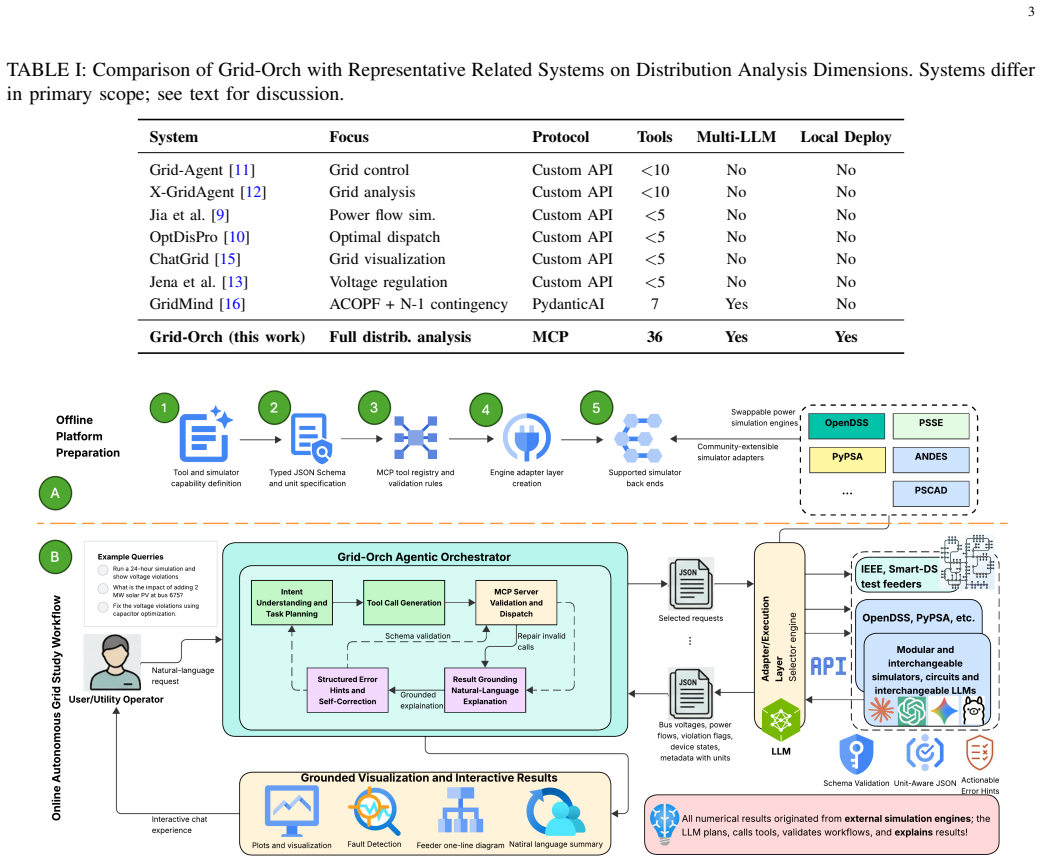
Grid-Orch supplies an LLM with thirty-six domain-specific tools across eleven categories for OpenDSS, including power flow, voltage analysis, quasi-static time series simulation, and three multi-step optimization skills. This setup allows users to orchestrate complete engineering workflows through natural language, with results that match direct scripting while reducing completion time from hours to under two minutes.
What carries the argument
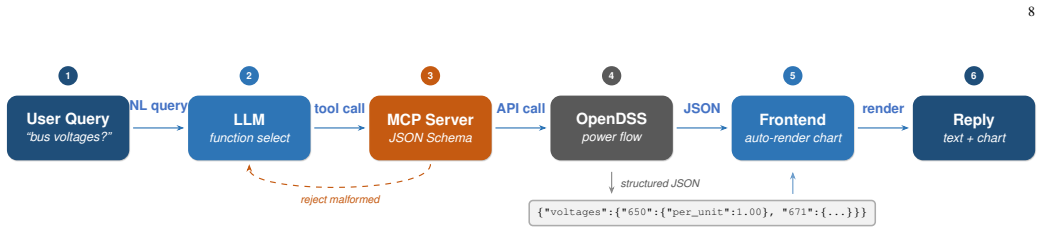
The Model Context Protocol layer that exposes thirty-six OpenDSS tools to the LLM so the model can select, sequence, and execute simulation and optimization steps without the user writing code.
If this is right
- Complex tasks such as capacitor placement and voltage violation analysis become available as conversational workflows.
- Results from natural language requests match those produced by traditional direct OpenDSS scripting.
- Both cloud-hosted and locally deployed LLMs can drive the same tool set, including in air-gapped utility environments.
- A single chat session can handle full multi-step sequences instead of separate manual commands.
Where Pith is reading between the lines
- Routine grid studies could be delegated to team members who lack deep scripting experience.
- The same tool pattern could be applied to other distribution simulators beyond OpenDSS.
- Faster iteration on mitigation options might shorten the time needed to evaluate new DER connections.
- Visualization and dashboard features could support real-time review of simulation outputs during the conversation.
Load-bearing premise
The LLM will reliably pick the correct tools and follow the right sequence for multi-step tasks without selecting the wrong action or introducing errors.
What would settle it
Have an engineer run the same DER interconnection screening workflow once through the natural language chat and once with direct OpenDSS scripting, then check whether the numerical outputs are identical and whether the chat version finishes in under two minutes.
Figures





read the original abstract
The power distribution engineering workforce faces a projected shortage of up to 1.5 million engineers by 2030, creating urgent demand for more accessible analysis tools. This paper introduces Grid-Orch, a framework that bridges Large Language Models (LLMs) and power system simulation through the Model Context Protocol (MCP), enabling engineers to perform complex distribution analyses via natural language. Using OpenDSS as the reference implementation, Grid-Orch provides 36 domain-specific tools across eleven categories, covering power flow, voltage analysis, quasi-static time series (QSTS) simulation, and automated optimization. A provider-agnostic LLM layer supports both cloud-hosted (Gemini, Claude) and locally deployed (Ollama, llama-cpp) models, enabling air-gapped operation for security-sensitive utility environments. Three optimization skills, capacitor placement, voltage violation analysis, and overvoltage mitigation, extend the platform beyond single-tool queries to multi-step engineering workflows. Grid-Orch is delivered as an interactive web platform with chat-based interaction, a QSTS dashboard, and feeder topology visualization, and renders simulation results inline. Workflow demonstrations show that distribution analyses formerly requiring hours of scripting, such as distributed energy resource (DER) interconnection screening, complete in under two minutes through natural language, producing numerically identical results to direct OpenDSS scripting.
Editorial analysis
A structured set of objections, weighed in public.
Referee Report
Summary. The paper introduces Grid-Orch, a framework that integrates large language models with OpenDSS via the Model Context Protocol to enable natural-language orchestration of distribution grid simulations. It supplies 36 domain-specific tools across eleven categories (power flow, voltage analysis, QSTS, optimization) and supports both cloud and local LLMs. Three multi-step optimization skills are demonstrated, with workflow examples such as DER interconnection screening reported to finish in under two minutes and yield numerically identical results to direct OpenDSS scripting.
Significance. If the orchestration reliability can be established, the work would meaningfully lower the barrier to complex distribution analyses, directly addressing the projected engineer shortage by allowing engineers to perform formerly script-intensive tasks through natural language while supporting air-gapped deployment.
major comments (2)
- [Abstract] Abstract: the central claim that workflow demonstrations produce numerically identical results to direct OpenDSS scripting is presented without any quantitative metrics on LLM tool-selection success rate, sequencing error frequency, or failure modes across repeated trials and multiple feeders; this directly undercuts the reliability assertion that the framework can be depended upon for production analyses.
- [Workflow demonstrations] Workflow demonstrations section: the multi-step skills (capacitor placement, voltage violation analysis, overvoltage mitigation) are illustrated with single successful runs but contain no description of how the LLM is prompted to recover from incorrect tool calls or how consistency is measured, leaving the multi-step workflow claim load-bearing yet unsupported by systematic evidence.
minor comments (2)
- The description of the 36 tools would be clearer if each tool were listed with its exact input/output signature and an example natural-language invocation.
- Figure captions for the QSTS dashboard and feeder visualization should explicitly state which simulation parameters were used and whether the displayed results match the numerical values reported in the text.
Simulated Author's Rebuttal
We thank the referee for these targeted comments on reliability quantification. We agree that the current demonstrations would be strengthened by systematic metrics on tool-selection accuracy, error recovery, and consistency across repeated trials. The revised manuscript will incorporate a new evaluation subsection reporting these statistics, along with updates to the abstract and workflow section.
read point-by-point responses
-
Referee: [Abstract] Abstract: the central claim that workflow demonstrations produce numerically identical results to direct OpenDSS scripting is presented without any quantitative metrics on LLM tool-selection success rate, sequencing error frequency, or failure modes across repeated trials and multiple feeders; this directly undercuts the reliability assertion that the framework can be depended upon for production analyses.
Authors: We agree that aggregate quantitative metrics are needed to support the reliability claim. In revision we will add to the abstract and a new 'Evaluation of Orchestration Reliability' subsection: results from 50 repeated trials per workflow across three feeders, reporting (i) tool-selection success rate, (ii) sequencing error frequency, (iii) failure-mode breakdown, and (iv) recovery success after self-correction. These numbers will replace the single-run narrative and will be referenced in the abstract. revision: yes
-
Referee: [Workflow demonstrations] Workflow demonstrations section: the multi-step skills (capacitor placement, voltage violation analysis, overvoltage mitigation) are illustrated with single successful runs but contain no description of how the LLM is prompted to recover from incorrect tool calls or how consistency is measured, leaving the multi-step workflow claim load-bearing yet unsupported by systematic evidence.
Authors: We accept that the current text relies on single successful traces. The revision will expand the Workflow Demonstrations section with: (1) the exact prompting template used for error recovery (iterative feedback loop that re-invokes the LLM with the failed tool output and a correction instruction); (2) consistency metrics (success rate, average steps, and variance) measured over 20 independent executions of each skill on multiple feeders; and (3) one concrete example of an incorrect tool call followed by successful recovery. These additions directly address the lack of systematic evidence. revision: yes
Circularity Check
No significant circularity in software framework description
full rationale
This is a software engineering paper presenting an LLM-orchestrated framework (Grid-Orch) with 36 tools for OpenDSS-based distribution analysis. No mathematical derivations, equations, fitted parameters, or predictive models are defined or claimed. The central claims rest on implementation details, tool categories, and workflow demonstrations rather than any self-referential reduction, self-citation chain, or ansatz that collapses to its own inputs. The absence of any load-bearing derivation steps means the paper is self-contained against external benchmarks such as direct OpenDSS scripting.
Axiom & Free-Parameter Ledger
axioms (1)
- domain assumption LLMs can reliably translate natural language queries into correct sequences of power system tool calls without hallucinations or sequencing errors
Reference graph
Works this paper leans on
-
[1]
The future of the energy workforce,
IEEE Power & Energy Society and Kearney, “The future of the energy workforce,” https://resourcecenter.ieee-pes.org/industry-reports/ pes ir 01 081925, IEEE PES/Kearney, Tech. Rep., 2025
work page 2025
-
[2]
U.S. energy and employment report 2024,
U.S. Department of Energy, “U.S. energy and employment report 2024,” https://www.energy.gov/sites/default/files/2024-06/2024-USEER-0.pdf, DOE, Tech. Rep., 2024
work page 2024
-
[3]
Grid modernization strategy 2024,
——, “Grid modernization strategy 2024,” https://www.energy.gov/sites/ default/files/2024-12/Grid%20Modernization%20Strategy%202024.pdf, DOE, Tech. Rep., 2024
work page 2024
-
[4]
International Energy Agency, “World energy employment 2025,” https:// www.iea.org/reports/world-energy-employment-2025, IEA, Tech. Rep., 2025, 60% of energy companies report labor shortages
work page 2025
-
[5]
OpenDSS: Open distribution system simulator,
Electric Power Research Institute, “OpenDSS: Open distribution system simulator,” https://www.epri.com/pages/sa/opendss, 2023, version 9.x
work page 2023
-
[6]
Function calling with large language models,
OpenAI, “Function calling with large language models,” https://platform. openai.com/docs/guides/function-calling, 2023, accessed: 2026-01-05
work page 2023
-
[7]
ReAct: Synergizing reasoning and acting in language models,
S. Yao, J. Zhao, D. Yu, N. Du, I. Shafran, K. Narasimhan, and Y . Cao, “ReAct: Synergizing reasoning and acting in language models,” in International Conference on Learning Representations (ICLR), 2023
work page 2023
-
[8]
A survey on large language model based autonomous agents,
L. Wang, C. Ma, X. Feng, Z. Zhang, H. Yang, J. Zhang, Z. Chen, J. Tang, X. Chen, Y . Linet al., “A survey on large language model based autonomous agents,”Frontiers of Computer Science, vol. 18, no. 6, p. 186345, 2024
work page 2024
-
[9]
Enhancing LLMs for power system simu- lations: A feedback-driven multi-agent framework,
M. Jia, Z. Cui, and G. Hug, “Enhancing LLMs for power system simu- lations: A feedback-driven multi-agent framework,”IEEE Transactions on Smart Grid, vol. 16, no. 6, pp. 5556–5559, 2025
work page 2025
-
[10]
OptDis- Pro: LLM-based multi-agent framework for flexibly adapting heuristic optimal DisFlow,
Z. Li, H. Yang, Y . Liu, Y . Xiang, H. Gao, J. Liu, and J. Liu, “OptDis- Pro: LLM-based multi-agent framework for flexibly adapting heuristic optimal DisFlow,”IEEE Transactions on Smart Grid, vol. 17, no. 1, pp. 794–796, 2026
work page 2026
-
[11]
Grid-Agent: An LLM-powered multi-agent system for power grid control,
Y . Zhang, A. M. Saber, A. Youssef, and D. Kundur, “Grid-Agent: An LLM-powered multi-agent system for power grid control,” arXiv preprint arXiv:2508.05702, 2025
-
[12]
X-GridAgent: An LLM-powered agentic AI sys- tem for assisting power grid analysis,
Y . Wen and X. Chen, “X-GridAgent: An LLM-powered agentic AI sys- tem for assisting power grid analysis,” arXiv preprint arXiv:2512.20789, 2025
-
[13]
A. Jena, F. Ding, J. Wang, Y . Yao, and L. Xie, “LLM-based adaptive distribution voltage regulation under frequent topology changes: An in- context MPC framework,”IEEE Transactions on Smart Grid, vol. 16, no. 5, pp. 4297–4299, 2025
work page 2025
-
[14]
Model context protocol specification,
Anthropic, “Model context protocol specification,” https: //spec.modelcontextprotocol.io/, 2024, version 1.0, Released November 2024
work page 2024
-
[15]
ChatGrid: Power grid visualization empow- ered by a large language model,
S. Jin and S. Abhyankar, “ChatGrid: Power grid visualization empow- ered by a large language model,” in2024 IEEE Workshop on Energy Data Visualization (EnergyVis). IEEE, 2024, pp. 12–16
work page 2024
-
[16]
GridMind: LLMs-powered agents for power system analysis and operations,
H. Jin, K. Kim, and J. Kwon, “GridMind: LLMs-powered agents for power system analysis and operations,” arXiv preprint arXiv:2509.02494, 2025
-
[17]
Large language models for power system applications: A comprehensive literature survey,
M. Sarwar, M. Rizwan, M. Aziz, and A. R. Sudais, “Large language models for power system applications: A comprehensive literature survey,” arXiv preprint arXiv:2512.13004, 2025
-
[18]
Y . Chen and A. Anderson, “Connecting minds: AI use cases to bridge power systems and large language models for practical applications,” Pa- cific Northwest National Laboratory, Richland, W A, Tech. Rep. PNNL- 38003, May 2025, prepared for the U.S. Department of Energy under Contract DE-AC05-76RL01830
work page 2025
-
[19]
PowerGraph-LLM: Novel power grid graph embedding and optimization with large language models,
F. Bernier, J. Cao, M. Cordy, and S. Ghamizi, “PowerGraph-LLM: Novel power grid graph embedding and optimization with large language models,”IEEE Transactions on Power Systems, vol. 40, pp. 5483–5486, 2025
work page 2025
-
[20]
eGridGPT: Trustworthy AI in the control room,
S. L. Choi, R. Jain, P. Emami, K. Wadsack, F. Ding, H. Sun, K. Gruchalla, J. Hong, H. Zhang, X. Zhu, and B. Kroposki, “eGridGPT: Trustworthy AI in the control room,” National Renewable Energy Laboratory, Golden, CO, Tech. Rep. NREL/TP-5D00-87440, May 2024. [Online]. Available: https://www.nrel.gov/docs/fy24osti/87440.pdf
work page 2024
-
[21]
IoT-MCP: Bridging LLMs and IoT systems through model context protocol,
N. Yang, G. Lyu, M. Ma, Y . Lu, Y . Li, Z. Gao, H. Ye, J. Zhang, T. Chen, and Y . Chen, “IoT-MCP: Bridging LLMs and IoT systems through model context protocol,” inProceedings of the 19th ACM Workshop on Wireless Network Testbeds, Experimental evaluation & Characterization (WiNTECH ’25). Washington, DC: ACM, 2025
work page 2025
-
[22]
Model Context Protocol (MCP): Landscape, Security Threats, and Future Research Directions
X. Hou, Y . Zhao, S. Wang, and H. Wang, “Model context protocol (MCP): Landscape, security threats, and future research directions,” arXiv preprint arXiv:2503.23278, 2025
work page internal anchor Pith review Pith/arXiv arXiv 2025
-
[23]
LangChain: Building applications with LLMs through composability,
H. Chase, “LangChain: Building applications with LLMs through composability,” https://github.com/langchain-ai/langchain, 2023, v0.1+; open-source LLM application framework
work page 2023
-
[24]
Q. Zhang and L. Xie, “PowerAgent: A road map toward agentic intel- ligence in power systems: Foundation model, model context protocol, and workflow,”IEEE Power and Energy Magazine, 2025
work page 2025
-
[25]
OpenDSSDirect.py: Python interface for OpenDSS,
NREL and Contributors, “OpenDSSDirect.py: Python interface for OpenDSS,” https://github.com/dss-extensions/OpenDSSDirect.py, 2023, version 0.9.x
work page 2023
-
[26]
Tool learning with foundation models,
Y . Qin, S. Liang, Y . Ye, K. Zhu, L. Yan, Y . Lu, Y . Lin, X. Cong, X. Tang, B. Qianet al., “Tool learning with foundation models,”ACM Computing Surveys, 2024
work page 2024
-
[27]
Cip-007-6 cyber security – system security management,
North American Electric Reliability Corporation (NERC), “Cip-007-6 cyber security – system security management,” https://www.nerc.com/ standards/reliability-standards/cip/cip-007-6, 2016, reliability Standard
work page 2016
-
[28]
Reference guide: The open distribu- tion system simulator (OpenDSS),
R. C. Dugan and D. Montenegro, “Reference guide: The open distribu- tion system simulator (OpenDSS),” Electric Power Research Institute, Tech. Rep., 2019, includes QSTS methodology and time-series simula- tion procedures
work page 2019
-
[29]
Toolformer: Language models can teach themselves to use tools,
T. Schick, J. Dwivedi-Yu, R. Dess `ı, R. Raileanu, M. Lomeli, E. Hambro, L. Zettlemoyer, N. Cancedda, and T. Scialom, “Toolformer: Language models can teach themselves to use tools,”Advances in Neural Infor- mation Processing Systems, vol. 36, 2023
work page 2023
-
[30]
Equipping agents for the real world with agent skills,
B. Zhang, K. Lazuka, and M. Murag, “Equipping agents for the real world with agent skills,” https://www.anthropic.com/engineering/ equipping-agents-for-the-real-world-with-agent-skills, 2025, anthropic Engineering Blog, October 2025
work page 2025
-
[31]
J. Kennedy and R. Eberhart, “Particle swarm optimization,” inProceed- ings of ICNN’95 - International Conference on Neural Networks, vol. 4. IEEE, 1995, pp. 1942–1948
work page 1995
-
[32]
Review of challenges and research opportunities for voltage control in smart grids,
H. Sun, Q. Guo, J. Qi, V . Ajjarapu, R. Bravo, J. Chow, Z. Li, R. Moghe, E. Nasr-Azadani, U. Tamrakaret al., “Review of challenges and research opportunities for voltage control in smart grids,”IEEE Transactions on Power Systems, vol. 34, no. 4, pp. 2790–2801, 2019
work page 2019
-
[33]
Next.js: The react framework for production,
Vercel, “Next.js: The react framework for production,” https://nextjs.org/, 2024, accessed: 2026-04-13
work page 2024
-
[34]
Fastapi: A modern, fast (high-performance) web frame- work for building apis with python,
S. Ram ´ırez, “Fastapi: A modern, fast (high-performance) web frame- work for building apis with python,” https://fastapi.tiangolo.com/, 2018, accessed: 2026-04-13
work page 2018
-
[35]
Sqlalchemy: The python sql toolkit and object relational mapper,
M. Bayer, “Sqlalchemy: The python sql toolkit and object relational mapper,” https://www.sqlalchemy.org/, 2026, version 2.0 Documenta- tion, Accessed: 2026-04-13
work page 2026
-
[36]
Mapping objects to relational databases: O/r mapping in detail,
S. W. Ambler, “Mapping objects to relational databases: O/r mapping in detail,”IBM DeveloperWorks, 2003
work page 2003
-
[37]
Postgresql: The world’s most advanced open source relational database,
P. G. D. Group, “Postgresql: The world’s most advanced open source relational database,” https://www.postgresql.org/, 2024, accessed: 2026- 04-13
work page 2024
-
[38]
End-use load profiles for the U.S. building stock,
National Renewable Energy Laboratory, “End-use load profiles for the U.S. building stock,” https://www.nrel.gov/buildings/ end-use-load-profiles.html, 2022
work page 2022
-
[39]
Analytic considerations and design basis for the IEEE distribution test feeders,
K. P. Schneider, B. A. Mather, B. C. Palet al., “Analytic considerations and design basis for the IEEE distribution test feeders,”IEEE Transac- tions on Power Systems, vol. 33, no. 3, pp. 3181–3188, 2017
work page 2017
-
[40]
Smart-ds synthetic electrical network data opendss models for sfo, gso, and aus,
B. Palmintier, C. Mateo Domingo, F. E. Postigo Marcos, T. Gomez San Roman, F. de Cuadra, N. Gensollen, T. Elgindy, and P. Duenas, “Smart-ds synthetic electrical network data opendss models for sfo, gso, and aus,” Open Energy Data Initiative (OEDI), National Renewable Energy Laboratory (NREL), 2020, accessed: 2026-04-08. [Online]. Available: https://data.o...
work page 2020
-
[41]
Quasi-static time-series simulation using OpenDSS,
D. Montenegro and R. C. Dugan, “Quasi-static time-series simulation using OpenDSS,” Electric Power Research Institute, Tech. Rep., 2016
work page 2016
-
[42]
IEEE Standards Association,IEEE Standard for Interconnection and In- teroperability of Distributed Energy Resources with Associated Electric Power Systems Interfaces, IEEE Std. 1547-2018, 2018
work page 2018
-
[43]
Hybrid symbolic-numeric framework for power system modeling and analysis,
H. Cui, F. Li, and K. Tomsovic, “Hybrid symbolic-numeric framework for power system modeling and analysis,”IEEE Transactions on Power Systems, vol. 36, no. 2, pp. 1373–1384, 2020
work page 2020
discussion (0)
Sign in with ORCID, Apple, or X to comment. Anyone can read and Pith papers without signing in.