Recognition: no theorem link
Assessing the imprint of eccentricity in GW signatures using two independent waveform models
Pith reviewed 2026-05-14 19:16 UTC · model grok-4.3
The pith
Two independent waveform models disfavor orbital eccentricity in most of 162 analyzed gravitational wave events but identify potential signatures in three specific cases.
A machine-rendered reading of the paper's core claim, the machinery that carries it, and where it could break.
Core claim
Employing the SEOBNRv5EHM and TEOBResumS-Dali waveform models within the RIFT parameter estimation framework on 162 events, the authors obtain consistent conclusions that disfavor the eccentric hypothesis for the majority of sources, while noting potential evidence for eccentricity in GW200129, GW231001, and GW231123, with the latter two showing waveform-dependent support and the former sensitive to analysis settings due to nonstationary noise.
What carries the argument
The pair of independent eccentric waveform models SEOBNRv5EHM and TEOBResumS-Dali, used to perform parameter inference that separates eccentricity from spin and noise effects.
If this is right
- Most observed binary black hole mergers likely formed through channels that circularize the orbit before merger.
- Evidence for eccentricity is rare and limited to a small number of candidate events that require further scrutiny.
- Parameter estimates for eccentricity can be affected by nonstationary noise in specific events.
- Agreement between two different waveform models strengthens the reliability of the disfavoring conclusions.
Where Pith is reading between the lines
- Future observations with improved detectors could confirm if the hinted events are truly eccentric or artifacts of noise.
- The results support models where most mergers occur in isolated binaries rather than dense clusters.
- Extending this analysis to include precession or higher multipoles might refine the eccentricity constraints further.
Load-bearing premise
The two waveform models accurately capture the gravitational wave signals from eccentric binaries with aligned spins, allowing reliable separation from noise artifacts.
What would settle it
A future event with known high eccentricity where both waveform models fail to recover the injected eccentricity value or produce inconsistent posteriors.
Figures




read the original abstract
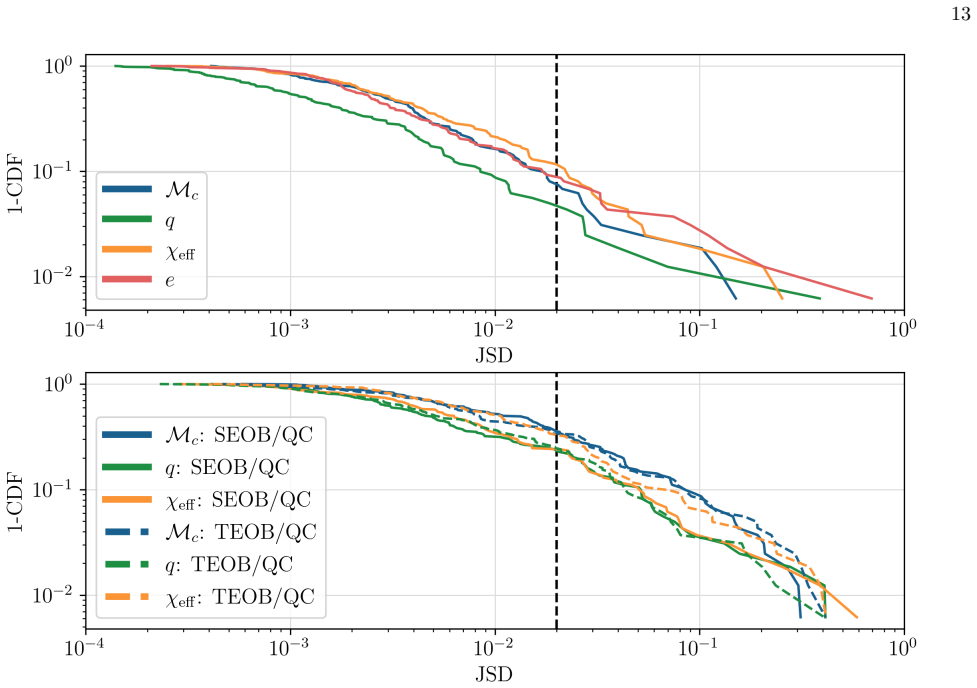
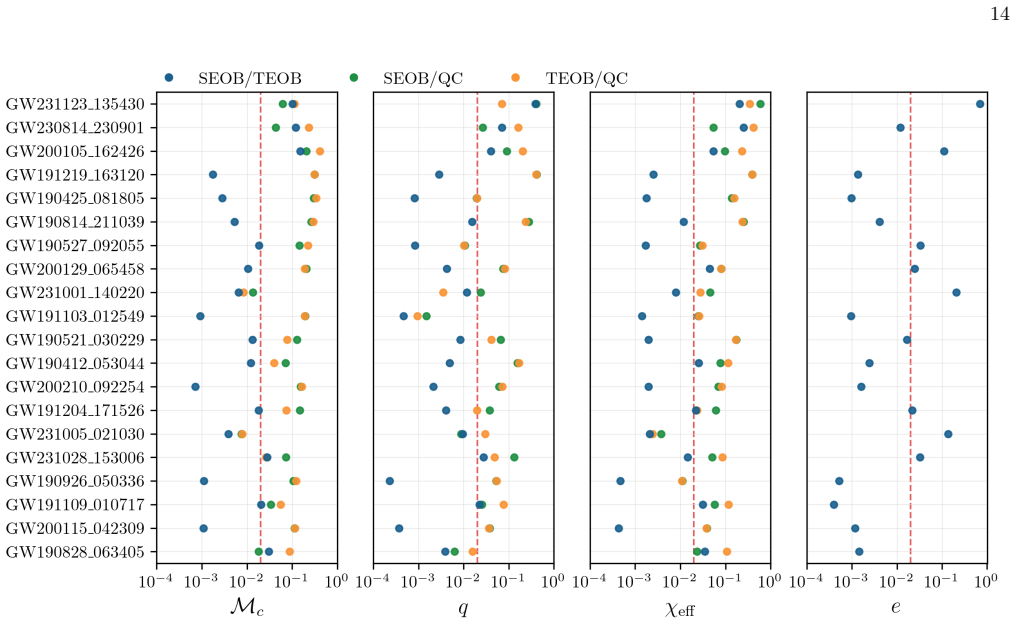
The gravitational wave signal from merging compact binaries encodes information about their orbital and intrinsic properties. Over the last few years, state-of-the-art waveform models have begun to incorporate the effects of orbital eccentricity into their estimated signal. Over a similar period, many groups have applied these waveforms to characterize whether the imprint of eccentricity is present and, if so, measure this time-evolving property (at a suitably-defined reference point). In this work, we present a comprehensive analysis of 162 confident sources identified in the O3 and O4a observing runs of the International Gravitational Wave Network (LIGO-Virgo-KAGRA). Using the RIFT parameter inference engine, we employ two independently implemented waveform models (SEOBNRv5EHM and TEOBResumS-Dali) which account for orbital eccentricity and the effects of aligned compact object spins. Using these two waveforms, we find consistent conclusions that disfavor the eccentric hypothesis. Unlike previous work, among binary black hole candidates, we find potential evidence for eccentricity in three events: GW200129, GW231001, and GW231123. For the latter two events, the evidence for eccentricity is ambiguous, with different degrees of support from different waveforms. Consistent with previous work, we find conclusions obtained about GW200129 can be sensitive to analysis settings, as expected, given the nonstationary noise present.
Editorial analysis
A structured set of objections, weighed in public.
Referee Report
Summary. The manuscript analyzes 162 confident gravitational-wave events from the O3 and O4a runs using the RIFT parameter-estimation engine and two independent eccentric waveform models (SEOBNRv5EHM and TEOBResumS-Dali) that incorporate orbital eccentricity and aligned spins. It reports consistent results that disfavor significant eccentricity for the bulk of the sample while identifying potential evidence for eccentricity in GW200129, GW231001, and GW231123, noting that support for the latter two is ambiguous between models and that GW200129 results are sensitive to analysis settings owing to nonstationary noise.
Significance. If the two waveform models are shown to be reliable, the work supplies a large-scale, cross-model consistency check on eccentricity searches in the current catalog. This would strengthen the inference that most binary black-hole mergers are circular and would flag a small number of events for targeted follow-up, provided the models' fidelity is independently validated.
major comments (3)
- [Methods and Results] The central claim of consistent disfavoring of eccentricity (and the identification of three candidate events) rests on the assumption that SEOBNRv5EHM and TEOBResumS-Dali accurately capture eccentric signal morphology. No injection-recovery tests on simulated eccentric signals with aligned spins are reported, leaving open the possibility of shared systematic biases in inspiral phasing or higher-mode content that could produce spurious agreement.
- [Discussion of GW200129] For GW200129, the abstract states that conclusions are sensitive to analysis settings, yet the manuscript does not quantify how the eccentricity posterior changes under alternative noise-modeling choices or data-selection cuts, undermining the robustness assessment for this event.
- [Results for GW231001 and GW231123] The evidence for eccentricity in GW231001 and GW231123 is described as ambiguous with differing support from the two waveforms, but the manuscript does not provide a quantitative comparison (e.g., Bayes factors or posterior overlap metrics) that would allow readers to judge the degree of tension between models.
minor comments (2)
- [Abstract] The abstract refers to 'potential evidence' for three events without stating the numerical threshold (e.g., log Bayes factor or credible-interval criterion) used to classify an event as showing eccentricity support.
- [Figures and Tables] Figure captions and table headings should explicitly note the reference frequency or time at which eccentricity is reported, as this choice affects direct comparison with prior studies.
Simulated Author's Rebuttal
We thank the referee for their careful and constructive review of our manuscript. We address each major comment below and have incorporated revisions to strengthen the analysis and presentation.
read point-by-point responses
-
Referee: [Methods and Results] The central claim of consistent disfavoring of eccentricity (and the identification of three candidate events) rests on the assumption that SEOBNRv5EHM and TEOBResumS-Dali accurately capture eccentric signal morphology. No injection-recovery tests on simulated eccentric signals with aligned spins are reported, leaving open the possibility of shared systematic biases in inspiral phasing or higher-mode content that could produce spurious agreement.
Authors: We agree that dedicated injection-recovery tests are important to validate the models against shared systematics. In the revised manuscript we have added a new subsection (Section 3.3) reporting injection-recovery results for a representative set of 20 simulated eccentric signals with aligned spins, injected into O3/O4a-like noise. Both waveform models recover the injected eccentricity and spin parameters without significant bias, and the recovered posteriors are consistent between the two models. These tests support the reliability of the cross-model agreement reported in the original analysis. revision: yes
-
Referee: [Discussion of GW200129] For GW200129, the abstract states that conclusions are sensitive to analysis settings, yet the manuscript does not quantify how the eccentricity posterior changes under alternative noise-modeling choices or data-selection cuts, undermining the robustness assessment for this event.
Authors: We thank the referee for highlighting this gap. The revised manuscript now includes a dedicated robustness study (new Figure 8 and accompanying text in Section 4.1) that quantifies the eccentricity posterior under three alternative noise-modeling choices (different PSD estimation windows and glitch subtraction methods) and two data-selection cuts (varying the analysis segment length by ±2 s). The results show that the 90% upper limit on eccentricity at 10 Hz remains below 0.05 in all cases, although the precise shape of the posterior varies modestly; we have updated the abstract and discussion to reflect this quantified sensitivity. revision: yes
-
Referee: [Results for GW231001 and GW231123] The evidence for eccentricity in GW231001 and GW231123 is described as ambiguous with differing support from the two waveforms, but the manuscript does not provide a quantitative comparison (e.g., Bayes factors or posterior overlap metrics) that would allow readers to judge the degree of tension between models.
Authors: We agree that quantitative metrics would improve clarity. In the revision we have added Table 3, which reports the Bayes factor between the eccentric and circular hypotheses for each waveform model and event, as well as the Jensen-Shannon divergence between the eccentricity posteriors obtained from SEOBNRv5EHM and TEOBResumS-Dali. These values confirm moderate tension for GW231001 and GW231123 (Bayes factors differing by factors of ~3–5 between models) while remaining consistent with the qualitative description already present in the text. revision: yes
Circularity Check
No circularity: standard parameter estimation on public data with independent models
full rationale
The paper performs Bayesian parameter estimation on 162 public GW events using the established RIFT sampler and two pre-existing, independently developed waveform models (SEOBNRv5EHM and TEOBResumS-Dali). No derivation, prediction, or uniqueness claim reduces to a quantity fitted from the same data or defined in terms of the target result. The consistency argument rests on the models' separate implementations rather than any self-referential loop, and the analysis reports direct posterior comparisons without renaming fitted parameters as predictions. External benchmarks (detector data, public catalogs) remain independent of the paper's outputs.
Axiom & Free-Parameter Ledger
axioms (1)
- domain assumption SEOBNRv5EHM and TEOBResumS-Dali accurately model the gravitational-wave emission from eccentric compact binaries with aligned spins.
Reference graph
Works this paper leans on
-
[1]
The LIGO Scientific Collaboration, J. Aasi, B. P. Ab- bott, R. Abbott, T. Abbott, M. R. Abernathy, K. Ack- ley, C. Adams, T. Adams, P. Addesso, and et al., Classical and Quantum Gravity32, 074001 (2015), arXiv:1411.4547 [gr-qc]
work page internal anchor Pith review Pith/arXiv arXiv 2015
-
[2]
Advanced Virgo: a 2nd generation interferometric gravitational wave detector
F. Acernese, M. Agathos, K. Agatsuma, D. Aisa, N. Alle- mandou, A. Allocca, J. Amarni, P. Astone, G. Balestri, and G. Ballardin, Classical and Quantum Gravity32, 024001 (2015), arXiv:1408.3978 [gr-qc]
work page internal anchor Pith review Pith/arXiv arXiv 2015
- [3]
-
[4]
The LIGO Scientific Collaboration, the Virgo Collabo- ration, R. Abbott, T. D. Abbott, S. Abraham, F. Acer- nese, K. Ackley, A. Adams, C. Adams, R. X. Adhikari, V. B. Adya, C. Affeldt, and et al., Physical Review X11, 021053 (2021), arXiv:2010.14527 [gr-qc]
work page internal anchor Pith review Pith/arXiv arXiv 2021
-
[5]
Abbott, T
R. Abbott, T. D. Abbott, F. Acernese, K. Ackley, C. Adams, N. Adhikari, R. X. Adhikari, V. B. Adya, C. Affeldt, D. Agarwal, and et al., Phys. Rev. D109, 022001 (2024)
2024
-
[6]
R. Abbott, T. D. Abbott, F. Acernese, K. Ackley, C. Adams, N. Adhikari, R. X. Adhikari, V. B. Adya, C. Affeldt, D. Agarwal, and et al., Physical Review X 13, 041039 (2023), arXiv:2111.03606 [gr-qc]
work page internal anchor Pith review Pith/arXiv arXiv 2023
-
[7]
The LIGO Scientific Collaboration, the Virgo Collabora- tion, the KAGRA Collaboration, A. G. Abac, R. Ab- bott, H. Abe, F. Acernese, K. Ackley, C. Adam- cewicz, S. Adhicary, and et al., Submitted to ApJ, available as arXiv:2508.18082 , arXiv:2508.18082 (2025), arXiv:2508.18082 [gr-qc]
work page internal anchor Pith review Pith/arXiv arXiv 2025
-
[8]
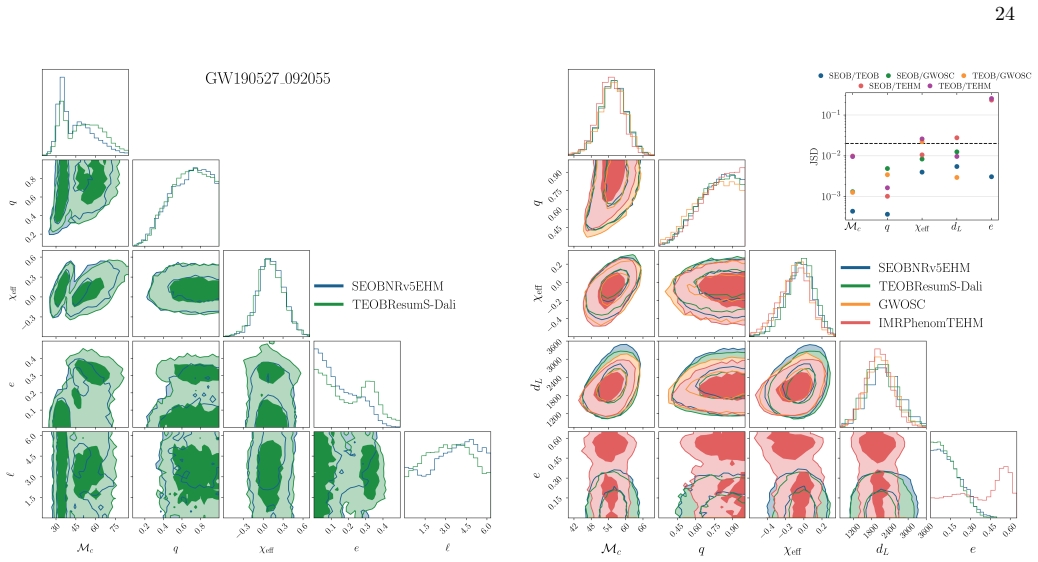
A. H. Nitz, S. Kumar, Y.-F. Wang, S. Kastha, S. Wu, M. Sch¨ afer, R. Dhurkunde, and C. D. Capano, Astro- physical Journal946, 59 (2023), arXiv:2112.06878 [astro- ph.HE]. 23 FIG. 13. One- and two-dimensional posterior distributions for a subset of intrinsic parameters (chirp massM c, mass ra- tioq, effective spinχ eff, eccentricitye, and mean anomalyℓ) for...
-
[9]
T. Venumadhav, B. Zackay, J. Roulet, L. Dai, and M. Zaldarriaga, Phys. Rev. D101, 083030 (2020), arXiv:1904.07214 [astro-ph.HE]
-
[10]
D. Wadekar, J. Roulet, T. Venumadhav, A. K. Mehta, B. Zackay, J. Mushkin, S. Olsen, and M. Zal- darriaga, arXiv e-prints , arXiv:2312.06631 (2023), arXiv:2312.06631 [gr-qc]
-
[11]
The LIGO Scientific Collaboration, the Virgo Collabora- tion, the KAGRA Collaboration, A. G. Abac, R. Ab- bott, H. Abe, F. Acernese, K. Ackley, C. Adam- cewicz, S. Adhicary, and et al., Submitted to ApJ, available as arXiv:2508.18081 , arXiv:2508.18081 (2025), arXiv:2508.18081 [gr-qc]
-
[12]
Wofford, A
J. Wofford, A. B. Yelikar, H. Gallagher, E. Cham- pion, D. Wysocki, V. Delfavero, J. Lange, C. Rose, V. Valsan, S. Morisaki, J. Read, C. Henshaw, and R. O’Shaughnessy, Phys. Rev. D107, 024040 (2023)
2023
- [13]
- [14]
-
[15]
D. Chiaramello and A. Nagar, Phys. Rev. D101, 101501 (2020), arXiv:2001.11736 [gr-qc]
- [16]
-
[17]
A. Nagar, D. Chiaramello, R. Gamba, S. Albanesi, FIG. 16. One- and two-dimensional posterior distributions for a few parameters (chirp massM c, mass ratioq, effective spinχ eff, and luminosity distanced L) for GW190701 203306. Our SEOBNRv5EHM (blue) and TEOBResumS-Dali (green) analyses are compared to the public GWOSC mixed (orange) and IMRPhenomTEHM (red...
-
[18]
M. de Lluc Planas, A. Ramos-Buades, C. Garc´ ıa-Quir´ os, H. Estell´ es, S. Husa, and M. Haney, arXiv e-prints , arXiv:2503.13062 (2025), arXiv:2503.13062 [gr-qc]
- [19]
- [20]
- [21]
-
[22]
Gayathri, J
V. Gayathri, J. Healy, J. Lange, B. O’Brien, M. Szczepa´ nczyk, I. Bartos, M. Campanelli, S. Klimenko, C. O. Lousto, and R. O’Shaughnessy, Nature Astronomy 6, 344 (2022)
2022
-
[23]
I. Romero-Shaw, P. D. Lasky, E. Thrane, and J. Calder´ on Bustillo, Astrophysical Journal903, L5 (2020), arXiv:2009.04771 [astro-ph.HE]
-
[24]
I. Romero-Shaw, P. D. Lasky, and E. Thrane, Astrophys- ical Journal940, 171 (2022), arXiv:2206.14695 [astro- ph.HE]
- [25]
-
[26]
Evidence for eccentricity in the population of binary black holes observed by LIGO-Virgo-KAGRA
N. Gupte, A. Ramos-Buades, A. Buonanno, J. Gair, M. Coleman Miller, M. Dax, S. R. Green, M. P¨ urrer, J. Wildberger, J. Macke, I. M. Romero-Shaw, and B. Sch¨ olkopf, Phys. Rev. D112, 104045 (2025), arXiv:2404.14286 [gr-qc]
work page internal anchor Pith review Pith/arXiv arXiv 2025
- [27]
- [28]
-
[29]
K. Kacanja, K. Soni, and A. H. Nitz, arXiv e-prints , arXiv:2508.00179 (2025), arXiv:2508.00179 [gr-qc]
- [30]
-
[31]
I. Romero-Shaw, J. Stegmann, H. Tagawa, D. Gerosa, J. Samsing, N. Gupte, and S. R. Green, Phys. Rev. D 112, 063052 (2025), arXiv:2506.17105 [astro-ph.HE]
-
[32]
P. McMillin, K. J. Wagner, G. Ficarra, C. O. Lousto, and R. O’Shaughnessy, arXiv e-prints , arXiv:2507.22862 (2025), arXiv:2507.22862 [gr-qc]
work page internal anchor Pith review Pith/arXiv arXiv 2025
-
[33]
Compact Binary Coalescences in the Band of Ground-based Gravitational-Wave Detectors
I. Mandel and R. O’Shaughnessy, Classical and Quan- tum Gravity27, 114007 (2010), arXiv:0912.1074 [astro- ph.HE]
work page internal anchor Pith review Pith/arXiv arXiv 2010
- [34]
-
[35]
I. Romero-Shaw, P. D. Lasky, and E. Thrane, Astrophys- ical Journal921, L31 (2021), arXiv:2108.01284 [astro- ph.HE]
-
[36]
J. Stegmann, D. Gerosa, I. Romero-Shaw, G. Fumagalli, H. Tagawa, and L. Zwick, Astrophysical Journal994, L47 (2025), arXiv:2505.13589 [astro-ph.HE]
-
[37]
I. Mandel and A. Farmer, Physics Reports955, 1 (2022), arXiv:1806.05820 [astro-ph.HE]
-
[38]
The first gravitational-wave source from the isolated evolution of two 40-100 Msun stars
K. Belczynski, D. E. Holz, T. Bulik, and R. O’Shaughnessy, Nature534, 512 (2016), arXiv:1602.04531 [astro-ph.HE]
work page internal anchor Pith review Pith/arXiv arXiv 2016
-
[39]
Distinguishing Between Formation Channels for Binary Black Holes with LISA
K. Breivik, C. L. Rodriguez, S. L. Larson, V. Kalogera, and F. A. Rasio, Astrophysical Journal830, L18 (2016), arXiv:1606.09558 [astro-ph.GA]
work page internal anchor Pith review Pith/arXiv arXiv 2016
-
[40]
Eccentric Black Hole Mergers in Dense Star Clusters: The Role of Binary-Binary Encounters
M. Zevin, J. Samsing, C. Rodriguez, C.-J. Haster, and E. Ramirez-Ruiz, Astrophysical Journal871, 91 (2019), arXiv:1810.00901 [astro-ph.HE]
work page internal anchor Pith review Pith/arXiv arXiv 2019
- [41]
-
[42]
A. G. Abac, I. Abouelfettouh, F. Acernese, K. Ackley, C. Adamcewicz, S. Adhicary, D. Adhikari, N. Adhikari, R. X. Adhikari, V. K. Adkins, S. Afroz, A. Agapito, D. Agarwal, M. Agathos, N. Aggarwal, S. Aggarwal, Aguiar, and et al, Astrophysical Journal993, L25 (2025), arXiv:2507.08219 [astro-ph.HE]
- [43]
-
[44]
A. Ramos-Buades, A. Buonanno, and J. Gair, Phys. Rev. D108, 124063 (2023), arXiv:2309.15528 [gr- qc]
-
[45]
Romero-Shaw, P
I. Romero-Shaw, P. D. Lasky, and E. Thrane, The As- trophysical Journal940, 171 (2022)
2022
-
[47]
Accelerating parameter inference with graphics processing units
D. Wysocki, R. O’Shaughnessy, J. Lange, and Y.-L. L. Fang, Phys. Rev. D99, 084026 (2019), arXiv:1902.04934 [astro-ph.IM]
work page internal anchor Pith review Pith/arXiv arXiv 2019
- [48]
-
[49]
C. Pankow, P. Brady, E. Ochsner, and R. O’Shaughnessy, Physical Review D92, 10.1103/physrevd.92.023002 (2015)
-
[50]
Rapid and accurate parameter inference for coalescing, precessing compact binaries
J. Lange, R. O’Shaughnessy, and M. Rizzo, arXiv e- prints , arXiv:1805.10457 (2018), arXiv:1805.10457 [gr- qc]
work page internal anchor Pith review Pith/arXiv arXiv 2018
-
[51]
D. Williams, J. Veitch, M. Chiofalo, P. Schmidt, R. Udall, A. Vajpeyi, and C. Hoy, The Journal of Open Source Software8, 4170 (2023), arXiv:2207.01468 [gr-qc]
-
[52]
D. Fernando, R. O’Shaughnessy, and D. Williams, Phys. Rev. D112, 084004 (2025), arXiv:2412.02999 [astro-ph.HE]
- [53]
-
[54]
N. J. Cornish and T. B. Littenberg, Classical and Quan- tum Gravity32, 135012 (2015), arXiv:1410.3835 [gr-qc]
work page internal anchor Pith review Pith/arXiv arXiv 2015
-
[55]
T. B. Littenberg and N. J. Cornish, Phys. Rev. D91, 084034 (2015), arXiv:1410.3852 [gr-qc]
work page internal anchor Pith review Pith/arXiv arXiv 2015
-
[56]
K. Chatziioannou, C.-J. Haster, T. B. Littenberg, W. M. Farr, S. Ghonge, M. Millhouse, J. A. Clark, and N. Cor- nish, Phys. Rev. D100, 104004 (2019), arXiv:1907.06540 [gr-qc]
- [57]
- [58]
- [59]
-
[60]
L. S. Collaboration and V. Collaboration, 10.5281/zen- odo.6513631 (2022)
-
[61]
L. S. Collaboration, V. Collaboration, and K. Collabora- tion, 10.5281/zenodo.8177023 (2023)
-
[62]
L. S. Collaboration, V. Collaboration, and K. Collabora- tion, 10.5281/zenodo.17014085 (2025)
-
[63]
M. d. L. Planas Llompart, S. Husa, A. Ramos Buades, and J. Valencia, 10.5281/zenodo.15576673 (2025)
-
[64]
P. C. Peters, Physical Review136, 1224 (1964)
1964
-
[65]
Y. Xu, J. Valencia, H. Estell´ es Estrella, A. Ramos Buades, S. Husa, M. Rossell´ o-Sastre, J. Llobera Querol, F. Ramis Vidal, M. de Lluc Planas Llom- part, M. Colleoni, E. Hamilton, A. Montava Agudo, J. Y´ ebana Carrilero, and A. Heffernan, arXiv e-prints , arXiv:2512.19513 (2025), arXiv:2512.19513 [gr-qc]
- [66]
-
[67]
Wagner,Eccentricity in Binary Black Hole Mergers, Ph.D
K. Wagner,Eccentricity in Binary Black Hole Mergers, Ph.D. thesis, Rochester Institute of Technology (2025)
2025
-
[68]
A. Jan, S. Nicolella, D. Shoemaker, and R. O’Shaughnessy, arXiv e-prints , arXiv:2512.20060 (2025), arXiv:2512.20060 [gr-qc]
work page internal anchor Pith review Pith/arXiv arXiv 2025
-
[69]
M. Zeeshan, R. O’Shaughnessy, and N. Malagon, arXiv e-prints , arXiv:2602.11030 (2026), arXiv:2602.11030 [astro-ph.HE]
-
[70]
The LIGO Scientific Collaboration, the Virgo Collabora- tion, B. P. Abbott, R. Abbott, T. D. Abbott, S. Abra- ham, F. Acernese, K. Ackley, C. Adams, V. B. Adya, and et al., Phys. Rev. D102, 043015 (2020)
2020
- [71]
- [72]
-
[73]
M. d. L. Planas Llompart, A. Ramos Buades, C. Garc´ ıa Quir´ os, H. Estell´ es Estrella, S. Husa, and M. Haney, 10.5281/zenodo.15259941 (2025)
discussion (0)
Sign in with ORCID, Apple, or X to comment. Anyone can read and Pith papers without signing in.