Recognition: 1 theorem link
· Lean TheoremEventual sign coherence
Pith reviewed 2026-05-14 18:50 UTC · model grok-4.3
The pith
For any skew-symmetric quiver, random infinite mutation sequences make c-vectors sign-coherent with probability 1.
A machine-rendered reading of the paper's core claim, the machinery that carries it, and where it could break.
Core claim
We prove that with probability 1, the sequence of c-vectors obtained by random mutation of an arbitrary quiver eventually becomes sign-coherent. This holds for skew-symmetric cluster algebras of arbitrary rank, and the conjecture is established in full generality for many families of quivers through the study of brog quivers.
What carries the argument
The c-vector mutation process on skew-symmetric quivers under random infinite sequences, where sign coherence is the property that all entries of each c-vector share the same sign.
Load-bearing premise
The mutation sequence is infinite and sufficiently generic, meaning every possible mutation direction is selected infinitely often with positive probability.
What would settle it
Construct a skew-symmetric quiver and an infinite mutation sequence where some c-vector coordinate keeps changing sign infinitely often, or compute the probability of non-coherence and show it exceeds zero.
Figures
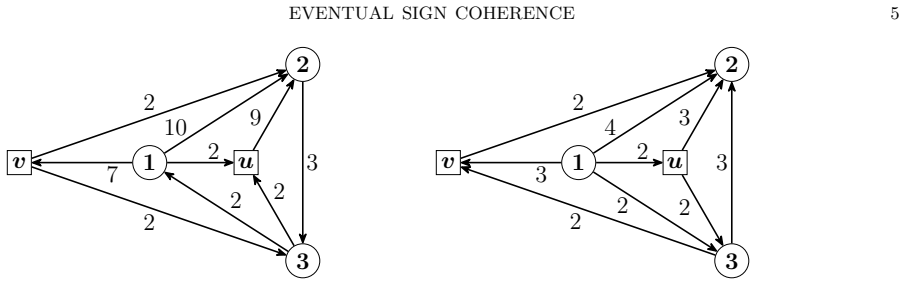

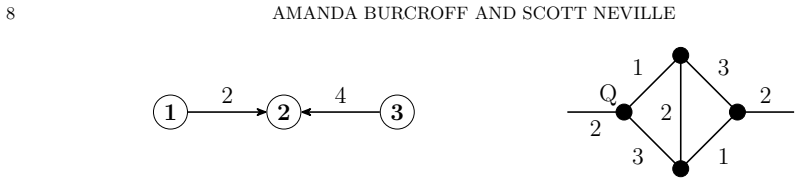
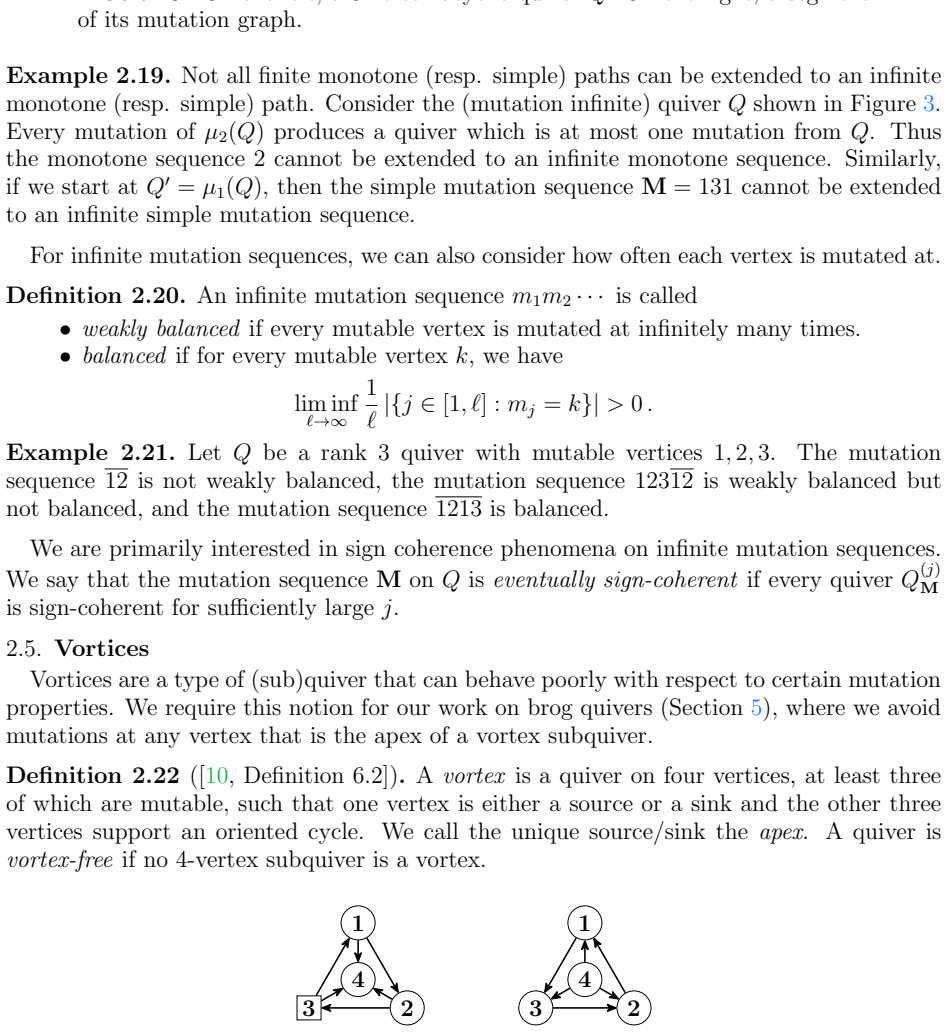
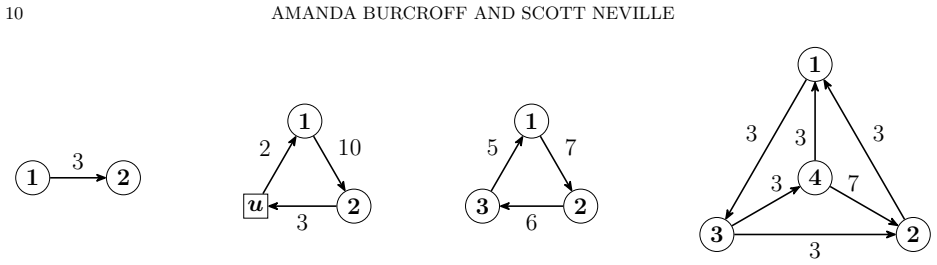


read the original abstract
The sign coherence of $c$-vectors is one of the fundamental theorems of cluster algebras with principal coefficients. In 2019, Gekhtman and Nakanishi posed the asymptotic sign coherence conjecture for arbitrary cluster algebras of geometric type, which says sign coherence should eventually hold in any sufficiently generic infinite mutation sequence. We prove that their conjecture holds almost always for skew-symmetric cluster algebras of arbitrary rank. That is, we prove that with probability $1$, the sequence of $c$-vectors obtained by random mutation of an arbitrary quiver eventually becomes sign-coherent. Our results also establish the conjecture in full generality for many families of quivers by studying a new class of brog quivers.
Editorial analysis
A structured set of objections, weighed in public.
Referee Report
Summary. The paper proves that with probability 1, the sequence of c-vectors obtained by random mutation of an arbitrary skew-symmetric quiver eventually becomes sign-coherent. This establishes the Gekhtman-Nakanishi asymptotic sign coherence conjecture almost surely for skew-symmetric cluster algebras of arbitrary rank. The argument reduces the problem to recurrence properties of a Markov chain on the finite set of sign patterns of c-vectors, shows that the set of sequences avoiding sign coherence has measure zero under the uniform random mutation measure, and introduces a new class of brog quivers for which the conjecture holds deterministically in full generality.
Significance. If the result holds, it supplies the first probabilistic resolution of an important open conjecture in cluster algebra theory, extending the classical sign-coherence theorem to asymptotic behavior under generic infinite mutation sequences. The reduction to an explicit invariant measure on the mutation graph and the use of finite sign-pattern state spaces constitute a clean Markov-chain technique that may extend to other asymptotic questions. The brog-quiver construction also provides a deterministic subclass with independent combinatorial interest.
major comments (2)
- [§4.1] §4.1, the recurrence argument: the claim that every component of the mutation graph on sign patterns is recurrent under the uniform measure relies on the existence of a positive invariant probability measure; however, the proof sketch does not explicitly construct this measure for an arbitrary initial quiver, leaving open whether the measure is supported on the reachable component containing the starting sign pattern.
- [Definition 5.3] Definition 5.3 of brog quivers: the combinatorial conditions are stated to be mutation-invariant, but the verification that a brog quiver remains brog after an arbitrary sequence of mutations is only indicated for a generating set of mutations; this invariance is load-bearing for the deterministic claim and requires a complete inductive argument.
minor comments (3)
- [§2.2] §2.2: the probability space of infinite mutation sequences is defined via the product measure, but the precise sigma-algebra and the meaning of 'sufficiently generic' in the conjecture statement should be cross-referenced explicitly to the measure-zero set constructed later.
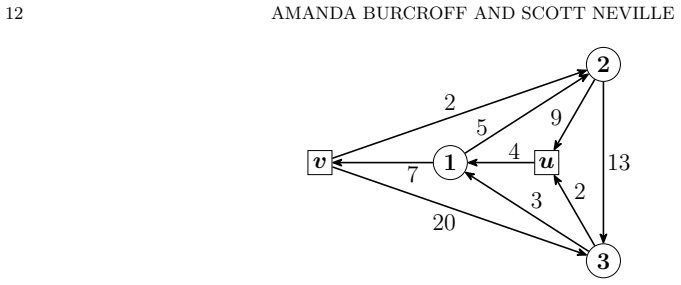
- [Figure 2] Figure 2: the caption does not indicate which edges correspond to which vertex mutations, reducing readability of the transition graph.
- [References] The reference list omits the arXiv number for the Gekhtman-Nakanishi 2019 paper; adding it would aid readers.
Simulated Author's Rebuttal
We thank the referee for the careful reading and for the positive evaluation of the manuscript. We address the two major comments below and will incorporate the requested clarifications into a revised version.
read point-by-point responses
-
Referee: [§4.1] §4.1, the recurrence argument: the claim that every component of the mutation graph on sign patterns is recurrent under the uniform measure relies on the existence of a positive invariant probability measure; however, the proof sketch does not explicitly construct this measure for an arbitrary initial quiver, leaving open whether the measure is supported on the reachable component containing the starting sign pattern.
Authors: We agree that the argument in §4.1 requires an explicit construction to confirm support on the reachable component. In the revision we will add a direct construction of the invariant probability measure on the finite set of sign patterns (via the uniform stationary distribution on the strongly connected components of the mutation graph) and prove that this measure is positive precisely on the component reachable from any given initial sign pattern. This will establish recurrence for the relevant component under the uniform random mutation measure. revision: yes
-
Referee: [Definition 5.3] Definition 5.3 of brog quivers: the combinatorial conditions are stated to be mutation-invariant, but the verification that a brog quiver remains brog after an arbitrary sequence of mutations is only indicated for a generating set of mutations; this invariance is load-bearing for the deterministic claim and requires a complete inductive argument.
Authors: We acknowledge that the mutation invariance of the brog conditions must be established by a complete induction rather than verification on a generating set alone. In the revised manuscript we will supply a full inductive proof: the base case is immediate from the definition, and the inductive step shows that if a quiver satisfies the brog conditions then any single mutation yields another quiver satisfying the same conditions, with the argument applying uniformly to all mutation directions. revision: yes
Circularity Check
No significant circularity detected
full rationale
The paper reduces the asymptotic sign coherence conjecture to recurrence properties of a Markov chain on the finite space of c-vector sign patterns under uniform random mutation. This argument relies on the explicit invariant measure and the fact that the set of non-coherent sequences has measure zero; it invokes no self-definitional loops, fitted inputs renamed as predictions, or load-bearing self-citations. The central claim follows directly from the definition of the mutation process and standard Markov chain theory without circular reduction to the conjecture itself.
Axiom & Free-Parameter Ledger
axioms (1)
- standard math Standard axioms and definitions of cluster algebras with geometric type and skew-symmetric exchange matrices
invented entities (1)
-
brog quivers
no independent evidence
Lean theorems connected to this paper
-
IndisputableMonolith/Foundation/RealityFromDistinction.leanreality_from_one_distinction unclear?
unclearRelation between the paper passage and the cited Recognition theorem.
We prove that with probability 1, the sequence of c-vectors obtained by random mutation of an arbitrary quiver eventually becomes sign-coherent (Theorem 4.8).
What do these tags mean?
- matches
- The paper's claim is directly supported by a theorem in the formal canon.
- supports
- The theorem supports part of the paper's argument, but the paper may add assumptions or extra steps.
- extends
- The paper goes beyond the formal theorem; the theorem is a base layer rather than the whole result.
- uses
- The paper appears to rely on the theorem as machinery.
- contradicts
- The paper's claim conflicts with a theorem or certificate in the canon.
- unclear
- Pith found a possible connection, but the passage is too broad, indirect, or ambiguous to say the theorem truly supports the claim.
Reference graph
Works this paper leans on
-
[1]
RealC-,G-structures and sign-coherence of cluster algebras
Ryota Akagi and Zhichao Chen. RealC-,G-structures and sign-coherence of cluster algebras. arXiv preprint 2509.06486, 2025
-
[2]
On maximal green sequences.Int
Thomas Br¨ ustle, Gr´ egoire Dupont, and Matthieu P´ erotin. On maximal green sequences.Int. Math. Res. Not. IMRN, 2014(16):4547–4586, 2014
2014
-
[3]
A conjecture onC-matrices of cluster algebras.Nagoya Math
Peigen Cao, Min Huang, and Fang Li. A conjecture onC-matrices of cluster algebras.Nagoya Math. J., 238:37–46, 2020
2020
-
[4]
Quivers with potentials and their representations II: applications to cluster algebras.J
Harm Derksen, Jerzy Weyman, and Andrei Zelevinsky. Quivers with potentials and their representations II: applications to cluster algebras.J. Amer. Math. Soc., 23(3):749–790, 2010
2010
- [5]
-
[6]
Ervin, Blake Jackson, Kyungyong Lee, and Son Dang Nguyen
Tucker J. Ervin, Blake Jackson, Kyungyong Lee, and Son Dang Nguyen. Geometry ofc-vectors and c-matrices for mutation-infinite quivers. arXiv preprint 2410.08510, 2024
-
[7]
Tucker J. Ervin and Scott Neville. Mutation cycles from reddening sequences. arXiv preprint 2504.06573, 2025
-
[8]
Skew-symmetric cluster algebras of finite muta- tion type.J
Anna Felikson, Michael Shapiro, and Pavel Tumarkin. Skew-symmetric cluster algebras of finite muta- tion type.J. Eur. Math. Soc. (JEMS), 14(4):1135–1180, 2012
2012
-
[9]
Cyclically ordered quivers.arXiv preprint arXiv:2406.03604, 2024
Sergey Fomin and Scott Neville. Cyclically ordered quivers. arXiv preprint 2406.03604, to appear in Adv. Math
-
[10]
Sergey Fomin and Scott Neville. Long mutation cycles. arXiv preprint 2304.11505, to appear inSelecta Math
-
[11]
Introduction to Cluster Algebras
Sergey Fomin, Lauren Williams, and Andrei Zelevinsky. Introduction to Cluster Algebras. Chapters 1–3. arXiv preprint 1608.05735, 2016
-
[12]
Cluster algebras IV: Coefficients.Compos
Sergey Fomin and Andrei Zelevinsky. Cluster algebras IV: Coefficients.Compos. Math., 143(1):112–164, 2007
2007
-
[13]
Fordy and Robert J
Allan P. Fordy and Robert J. Marsh. Cluster mutation-periodic quivers and associated Laurent se- quences.J. Algebraic Combin., 34(1):19–66, 2011
2011
-
[14]
Asymptotic sign coherence conjecture.Exp
Michael Gekhtman and Tomoki Nakanishi. Asymptotic sign coherence conjecture.Exp. Math., 31(2):497–505, 2022
2022
-
[15]
Topologizing infinite quivers and their mutations
Benjamin Grant. Topologizing infinite quivers and their mutations. arXiv preprint 2604.16660, 2026
work page internal anchor Pith review Pith/arXiv arXiv 2026
-
[16]
Canonical bases for cluster algebras.J
Mark Gross, Paul Hacking, Sean Keel, and Maxim Kontsevich. Canonical bases for cluster algebras.J. Amer. Math. Soc., 31(2):497–608, 2018
2018
-
[17]
Reconstruction of path algebras from their posets of tilting modules
Dieter Happel and Luise Unger. Reconstruction of path algebras from their posets of tilting modules. Trans. Amer. Math. Soc., 361(7):3633–3660, 2009
2009
-
[18]
Algebraic entropy of sign-stable mutation loops.Geom
Tsukasa Ishibashi and Shunsuke Kano. Algebraic entropy of sign-stable mutation loops.Geom. Dedicata, 214:79–118, 2021
2021
-
[19]
Entropy of cluster DT transformations and the finite-tame-wild trichotomy of acyclic quivers
Tsukasa Ishibashi and Shunsuke Kano. Entropy of cluster DT transformations and the finite-tame-wild trichotomy of acyclic quivers. arXiv preprint 2403.01396, 2024
-
[20]
A survey on maximal green sequences
Bernhard Keller and Laurent Demonet. A survey on maximal green sequences. InRepresentation theory and beyond, volume 758 ofContemp. Math., pages 267–286. Amer. Math. Soc., Providence, RI, 2020
2020
-
[21]
Discrete dynamical systems from real valued mutation.Exp
John Machacek and Nicholas Ovenhouse. Discrete dynamical systems from real valued mutation.Exp. Math., 33(2):261–275, 2024. EVENTUAL SIGN COHERENCE 29
2024
-
[22]
The existence of a maximal green sequence is not invariant under quiver mutation.Electron
Greg Muller. The existence of a maximal green sequence is not invariant under quiver mutation.Electron. J. Combin., 23(2):Paper 2.47, 23, 2016
2016
-
[23]
Donaldson-Thomas theory and cluster algebras.Duke Math
Kentaro Nagao. Donaldson-Thomas theory and cluster algebras.Duke Math. J., 162(7):1313–1367, 2013
2013
-
[24]
On tropical dualities in cluster algebras
Tomoki Nakanishi and Andrei Zelevinsky. On tropical dualities in cluster algebras. InAlgebraic groups and quantum groups, volume 565 ofContemp. Math., pages 217–226. Amer. Math. Soc., Providence, RI, 2012
2012
-
[25]
Cluster characters for cluster categories with infinite-dimensional morphism spaces.Adv
Pierre-Guy Plamondon. Cluster characters for cluster categories with infinite-dimensional morphism spaces.Adv. Math., 227(1):1–39, 2011
2011
-
[26]
Nathan Reading and David E. Speyer. Combinatorial frameworks for cluster algebras.Int. Math. Res. Not. IMRN, 1:109–173, 2016
2016
-
[27]
Exchange graphs via quiver mutation
Matthias Warkentin. Exchange graphs via quiver mutation. Ph.D. thesis, Technische Universit¨ at Chem- nitz, 2014. Department of Mathematics, MIT, Cambridge, MA 02139, USA Email address:amandabu@mit.edu Laboratoire d’Alg`ebre, de Combinatoire et d’informatique Math´ematique (LACIM), Uni- versit´e du Qu´ebec `a Montr´eal, Montr´eal, Qu´ebec, Canada Email ad...
2014
discussion (0)
Sign in with ORCID, Apple, or X to comment. Anyone can read and Pith papers without signing in.