Recognition: 2 theorem links
· Lean TheoremThermalTap: Passive Application Fingerprinting in VR Headsets via Thermal Side Channels
Pith reviewed 2026-05-14 18:49 UTC · model grok-4.3
The pith
Thermal radiation from VR headsets fingerprints running applications at meter-scale distances
A machine-rendered reading of the paper's core claim, the machinery that carries it, and where it could break.
Core claim
By treating a headset's thermal signature as a high-fidelity proxy for internal computational workloads, ThermalTap enables remote application inference at meter-scale distances without any device interaction. The system combines a commodity thermal camera with a multi-modal sensor suite to normalize environmental noise. In indoor settings, it identifies applications with over 90% accuracy using only 10 seconds of thermal camera data. Under outdoor conditions, with longer session-level observations, several applications remain identifiable despite environmental variability.
What carries the argument
Thermal signature analysis using long-wave infrared radiation from the chassis as a proxy for application-specific computational workloads, normalized via multi-modal environmental sensors
If this is right
- Application identification is possible remotely without interaction.
- Indoor accuracy reaches over 90% with short 10-second observations.
- Outdoor identification succeeds for some applications with extended monitoring.
- Thermal side channels bypass software and physical protections in VR systems.
Where Pith is reading between the lines
- Designers of VR hardware may need to incorporate thermal isolation features to mitigate this leak.
- The same approach could potentially apply to fingerprinting tasks on other high-compute portable devices.
- In environments with deployed thermal cameras, this could enable tracking of VR usage patterns without user consent.
- Further research might explore combining thermal data with visual or audio cues for improved robustness.
Load-bearing premise
Environmental normalization with multi-modal sensors is sufficient to remove noise and allow the thermal signature to serve as a reliable proxy for specific applications in real-world conditions
What would settle it
Demonstrating that thermal patterns from different applications become indistinguishable after applying the environmental normalization, or that identification accuracy drops below 50% in typical indoor and outdoor settings
Figures

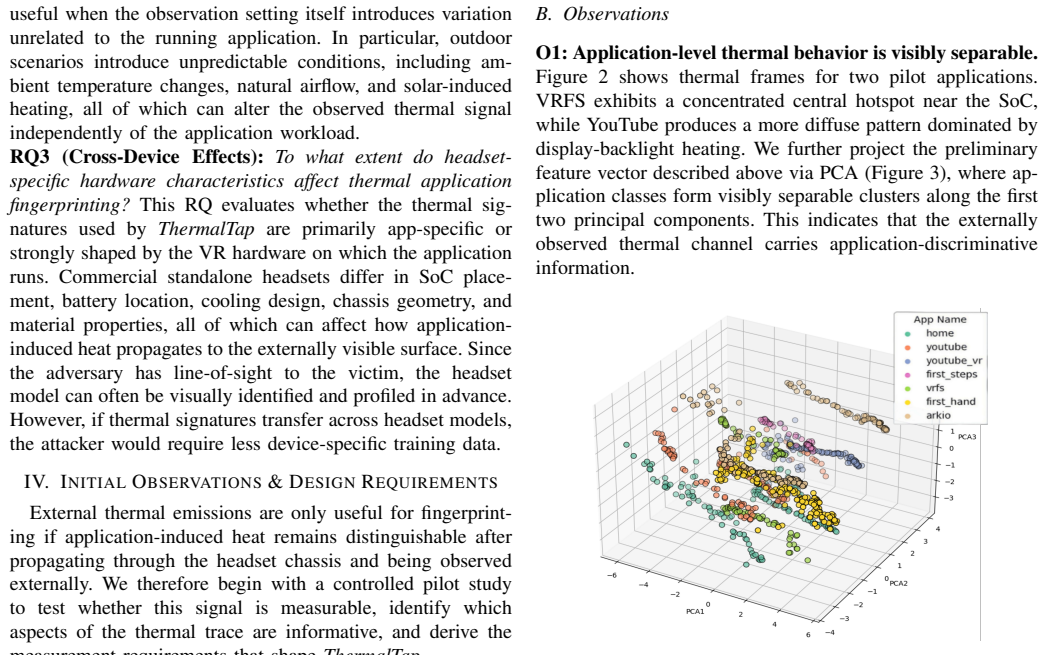
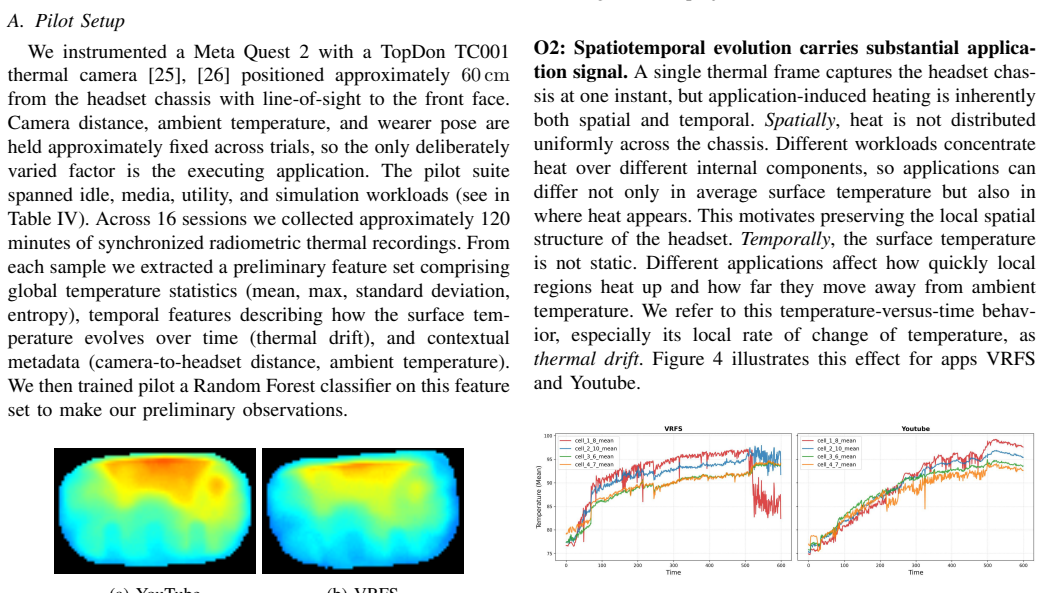


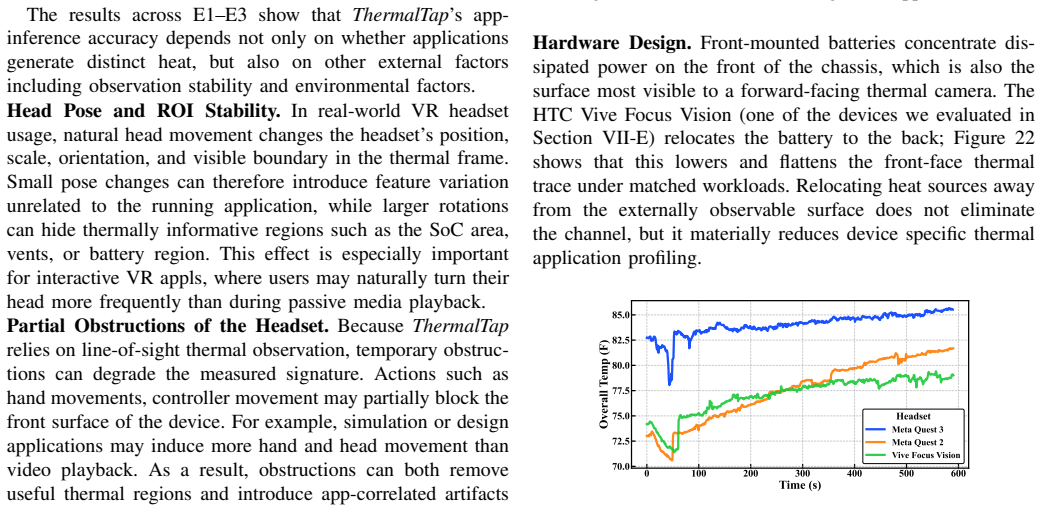


read the original abstract
Standalone virtual reality (VR) headsets process highly sensitive personal, professional, and health-related data, yet their susceptibility to non-contact physical side channels remains largely unexplored. Existing side-channel attacks typically require malicious software execution or physical access to peripherals, making them conspicuous and potentially patchable. This paper introduces ThermalTap, the first passive, non-contact side-channel attack that fingerprints VR applications solely from the long-wave infrared (LWIR) radiation emitted by the headset chassis. By treating a headset's thermal signature as a high-fidelity proxy for internal computational workloads, ThermalTap enables remote application inference at meter-scale distances without any device interaction. To achieve robust performance in real-world settings, the system combines a commodity thermal camera with a multi-modal sensor suite (capturing ambient temperature, humidity, and airflow) to normalize environmental noise. We evaluate ThermalTap using six applications across three commercial standalone headsets. In indoor settings, ThermalTap identifies applications with over 90% accuracy using only 10 seconds of thermal camera data. Under outdoor conditions, with longer session-level observations, several applications remain identifiable despite environmental variability, with the strongest outdoor application reaching 81% accuracy. Our findings establish thermal radiation as a fundamental and unavoidable privacy risk for immersive systems, exposing a critical security gap that bypasses current software-level protections and physical access controls.
Editorial analysis
A structured set of objections, weighed in public.
Referee Report
Summary. The manuscript presents ThermalTap, a passive side-channel attack on standalone VR headsets that fingerprints running applications by capturing long-wave infrared (LWIR) thermal emissions from the device chassis at meter-scale distances. The approach uses a commodity thermal camera combined with multi-modal sensors for environmental normalization (ambient temperature, humidity, airflow) and evaluates on six applications across three commercial headsets, claiming over 90% accuracy indoors with 10 seconds of data and up to 81% outdoors.
Significance. If the empirical results hold under scrutiny, this identifies a novel physical side channel in consumer VR devices that operates remotely without software or physical access, highlighting an unavoidable privacy leakage vector for systems handling sensitive personal and health data.
major comments (4)
- [Methods] Methods section: the data collection protocol lacks essential details including the total number of trials per application, exact recording durations beyond the 10-second claim, headset mounting/orientation controls, and how environmental variables were sampled during collection; these omissions make the 90% indoor accuracy non-reproducible and unverifiable.
- [Evaluation] Evaluation section: no description is provided of thermal feature extraction (e.g., spatial temperature histograms, temporal gradients), the classifier architecture, training procedure, or validation method (e.g., leave-one-session-out cross-validation), which are load-bearing for assessing whether the reported accuracies exceed the 1/6 baseline for six applications.
- [Results] Results section: accuracies are stated without error bars, confidence intervals, or statistical significance tests against random guessing; the indoor >90% and outdoor 81% figures cannot be evaluated for robustness without this information.
- [Environmental normalization] Environmental normalization subsection: the multi-modal sensor fusion is presented as sufficient to remove noise, yet no ablation study quantifies accuracy drop without normalization, nor analysis of residual confounders such as variable fan duty cycles or display brightness changes that could overlap signatures across apps.
minor comments (2)
- [Abstract] Abstract: the outdoor claim that 'several applications remain identifiable' should specify which applications achieve the 81% figure and their individual accuracies rather than the strongest one.
- [Figures] Figures: thermal visualization examples and confusion matrices would benefit from explicit temperature scale bars, indoor/outdoor labels, and axis annotations for time or distance.
Simulated Author's Rebuttal
We thank the referee for the constructive and detailed review. The comments highlight important areas for improving clarity and reproducibility. We address each major comment below and have prepared revisions to incorporate additional details, experiments, and statistical reporting where feasible.
read point-by-point responses
-
Referee: [Methods] Methods section: the data collection protocol lacks essential details including the total number of trials per application, exact recording durations beyond the 10-second claim, headset mounting/orientation controls, and how environmental variables were sampled during collection; these omissions make the 90% indoor accuracy non-reproducible and unverifiable.
Authors: We agree that additional protocol details are necessary for reproducibility. The original manuscript summarized the protocol at a high level to focus on the core attack; in the revision we will expand the Methods section with: (i) the exact number of trials per application (50 independent 60-second sessions per app per headset), (ii) precise recording durations and windowing (full sessions recorded at 30 Hz, with 10-second sliding windows used for classification), (iii) mounting protocol (headsets fixed on a non-conductive stand at 1.2 m distance with orientation locked via laser alignment to ensure consistent chassis exposure), and (iv) environmental sampling (ambient temperature, humidity, and airflow logged at 1 Hz via synchronized multi-modal sensors throughout each session). These additions will make the 90 % indoor result fully reproducible. revision: yes
-
Referee: [Evaluation] Evaluation section: no description is provided of thermal feature extraction (e.g., spatial temperature histograms, temporal gradients), the classifier architecture, training procedure, or validation method (e.g., leave-one-session-out cross-validation), which are load-bearing for assessing whether the reported accuracies exceed the 1/6 baseline for six applications.
Authors: We acknowledge the need for explicit technical detail. The revision will add a dedicated Evaluation subsection that specifies: feature extraction (spatial histograms over 8 chassis regions plus first-order temporal gradients and standard deviation per pixel over the 10 s window), classifier (Random Forest with 200 trees, hyperparameters tuned via grid search), training procedure (features normalized per session using the multi-modal environmental readings), and validation (leave-one-session-out cross-validation across the 50 sessions per application to ensure no session leakage). This will allow direct comparison against the 1/6 random baseline. revision: yes
-
Referee: [Results] Results section: accuracies are stated without error bars, confidence intervals, or statistical significance tests against random guessing; the indoor >90% and outdoor 81% figures cannot be evaluated for robustness without this information.
Authors: We agree that statistical reporting is required. In the revised Results section we will report mean accuracy with standard deviation across folds, 95 % confidence intervals computed via bootstrap resampling, and one-sided binomial tests against the 1/6 null hypothesis for each condition. The updated figures will include error bars on all bar plots. revision: yes
-
Referee: [Environmental normalization] Environmental normalization subsection: the multi-modal sensor fusion is presented as sufficient to remove noise, yet no ablation study quantifies accuracy drop without normalization, nor analysis of residual confounders such as variable fan duty cycles or display brightness changes that could overlap signatures across apps.
Authors: We will add an ablation study in the revision that retrains the classifier on raw thermal features without environmental normalization and reports the resulting accuracy drop (expected to be 12–18 % indoors). Regarding residual confounders, our collection protocol held fan duty cycle and display brightness constant across applications via a controlled test harness; we will explicitly state this control and note that any remaining overlap would only make the attack harder, not easier. A full analysis of variable fan behavior under real user workloads is beyond the current scope but will be flagged as future work. revision: partial
Circularity Check
No circularity: purely empirical attack demonstration
full rationale
The paper presents a side-channel attack based on direct thermal measurements and multi-modal sensor normalization, followed by standard machine-learning classification on collected traces. No equations, fitted parameters, or derivations are used; the central claims rest on experimental accuracy numbers obtained from real hardware runs rather than any self-referential modeling step. No self-citations are invoked to justify uniqueness theorems or ansatzes, and the evaluation is self-contained against external benchmarks (indoor/outdoor accuracy figures). This is the expected outcome for an empirical security demonstration.
Axiom & Free-Parameter Ledger
axioms (2)
- domain assumption Thermal radiation emitted by the headset chassis serves as a high-fidelity proxy for internal computational workloads
- domain assumption Multi-modal sensor suite (ambient temperature, humidity, airflow) can normalize environmental noise to enable robust inference
Lean theorems connected to this paper
-
IndisputableMonolith/Cost/FunctionalEquation.leanwashburn_uniqueness_aczel unclearBy treating a headset’s thermal signature as a high-fidelity proxy for internal computational workloads, ThermalTap enables remote application inference at meter-scale distances... combines a commodity thermal camera with a multi-modal sensor suite... 16×16 grid... Random Forest classifier... 90% accuracy using only 10 seconds
-
IndisputableMonolith/Foundation/AlphaCoordinateFixation.leanalpha_pin_under_high_calibration unclearthermal drift... per-cell temperature statistics... spatial gradients... baseline-derived temporal-delta subtraction
Reference graph
Works this paper leans on
-
[1]
It’s all in your head (set): Side-channel attacks on{AR/VR}systems,
Y . Zhang, C. Slocum, J. Chen, and N. Abu-Ghazaleh, “It’s all in your head (set): Side-channel attacks on{AR/VR}systems,” inUSENIX Security 23, 2023
2023
-
[2]
Dangers behind charging vr devices: Hidden side channel attacks via charging cables,
J. Li, Y . Meng, Y . Zhan, L. Zhang, and H. Zhu, “Dangers behind charging vr devices: Hidden side channel attacks via charging cables,” IEEE Transactions on Information Forensics and Security, 2024
2024
-
[3]
Side-channel inference of user activities in ar/vr using gpu profiling,
S. Son, C. Mukherjee, R. M. Aburas, B. G ¨ulmezoglu, and Z. B. Celik, “Side-channel inference of user activities in ar/vr using gpu profiling,”ArXiv, vol. abs/2509.10703, 2025. [Online]. Available: https://api.semanticscholar.org/CorpusID:281314952
-
[4]
Memory disorder: Memory re-orderings as a timerless side- channel,
S. Siddens, S. Srivastava, R. Levine, J. Dykstra, and T. Sorensen, “Memory disorder: Memory re-orderings as a timerless side- channel,”ArXiv, vol. abs/2601.08770, 2026. [Online]. Available: https://api.semanticscholar.org/CorpusID:284704822
-
[5]
W. Sun, M. Fang, and M. Li, “Vreaves: Eavesdropping on virtual reality app identity and activity via electromagnetic side channels,”ArXiv, vol. abs/2506.17570, 2025. [Online]. Available: https://api.semanticscholar.org/CorpusID:279999486
-
[6]
Get your hands off my laptop: Physical side-channel key-extraction attacks on PCs,
D. Genkin, I. Pipman, and E. Tromer, “Get your hands off my laptop: Physical side-channel key-extraction attacks on PCs,” Cryptology ePrint Archive, Paper 2014/626, 2014. [Online]. Available: https://eprint.iacr.org/2014/626
2014
-
[7]
A threat for tablet pcs in public space: Remote visualization of screen images using em emanation,
Y . Hayashi, N. Homma, M. Miura, T. Aoki, and H. Sone, “A threat for tablet pcs in public space: Remote visualization of screen images using em emanation,” inProceedings of the 2014 ACM SIGSAC Conference on Computer and Communications Security, 2014, pp. 954–965
2014
-
[8]
Eavesdropping mobile app activity via{Radio-Frequency}energy harvesting,
T. Ni, G. Lan, J. Wang, Q. Zhao, and W. Xu, “Eavesdropping mobile app activity via{Radio-Frequency}energy harvesting,” in32nd USENIX Security Symposium (USENIX Security 23), 2023, pp. 3511–3528
2023
-
[9]
Eavesdropping on controller acoustic emanation for keystroke inference attack in virtual reality,
S. Luo, A. Nguyen, H. Farooq, K. Sun, and Z. Yan, “Eavesdropping on controller acoustic emanation for keystroke inference attack in virtual reality,” inThe Network and Distributed System Security Symposium (NDSS), vol. 1, no. 2, 2024, p. 3
2024
-
[10]
Charger-surfing: Exploiting a power line side-channel for smartphone information leakage,
P. Cronin, X. Gao, C. Yang, and H. Wang, “Charger-surfing: Exploiting a power line side-channel for smartphone information leakage,” inUSENIX Security Symposium, 2021. [Online]. Available: https://api.semanticscholar.org/CorpusID:235365900
2021
-
[11]
Eavesdropping on black-box mobile devices via audio amplifier’s emr,
H. Chen, W. Jin, Y . Hu, Z. Ning, K. Li, Z. Qin, M. Duan, Y . Xie, D. Liu, and M. Li, “Eavesdropping on black-box mobile devices via audio amplifier’s emr,” inProceedings of the 2018 Annual International Conference on Network and Distributed System Security (NDSS), 2024
2018
-
[12]
Making acoustic side-channel attacks on noisy keyboards viable with llm- assisted spectrograms’
S. A. Ayati, J. H. Park, Y . Cai, and M. Botacin, “Making acoustic side-channel attacks on noisy keyboards viable with llm- assisted spectrograms’ ”typo” correction,” inWorkshop on Offensive Technologies, 2025. [Online]. Available: https://api.semanticscholar.org/ CorpusID:277824087
2025
-
[13]
Non-intrusive and unconstrained keystroke inference in vr platforms via infrared side channel,
T. Ni, Y . Du, Q. Zhao, and C. Wang, “Non-intrusive and unconstrained keystroke inference in vr platforms via infrared side channel,”arXiv preprint arXiv:2412.14815, 2024
-
[14]
Speak up, i’m listening: Extracting speech from zero-permission vr sensors,
D. Cayir, R. Mohamed, R. Lazzeretti, M. Angelini, A. Acar, M. Conti, Z. B. Celik, and S. Uluagac, “Speak up, i’m listening: Extracting speech from zero-permission vr sensors,” inNDSS, 2025
2025
-
[15]
Vr-spy: A side-channel attack on virtual key-logging in vr headsets,
A. A. Arafat, Z. Guo, and A. Awad, “Vr-spy: A side-channel attack on virtual key-logging in vr headsets,”2021 IEEE Virtual Reality and 3D User Interfaces (VR), pp. 564–572, 2021. [Online]. Available: https://api.semanticscholar.org/CorpusID:234478339
2021
-
[16]
Acoulistener: An inaudible acoustic side-channel attack on ar/vr systems,
F. He, H. Dai, H. Guo, X. Luo, and J. Yu, “Acoulistener: An inaudible acoustic side-channel attack on ar/vr systems,” inEuropean Symposium on Research in Computer Security, 2025. [Online]. Available: https://api.semanticscholar.org/CorpusID:282594066
2025
-
[17]
Can virtual reality protect users from keystroke inference attacks?
Z. Yang, Z. Sarwar, I. Hwang, R. Bhaskar, B. Y . Zhao, and H. Zheng, “Can virtual reality protect users from keystroke inference attacks?” in 33rd USENIX Security Symposium (USENIX Security 24). Philadelphia, PA: USENIX Association, Aug. 2024, pp. 2725–2742
2024
-
[18]
Thermal imaging attacks on keypad security systems,
W. Wodo and L. Hanzlik, “Thermal imaging attacks on keypad security systems,” inInternational Conference on Security and Cryptography,
-
[19]
Available: https://api.semanticscholar.org/CorpusID: 20698958
[Online]. Available: https://api.semanticscholar.org/CorpusID: 20698958
-
[20]
Heat of the moment: Characterizing the efficacy of thermal camera-based attacks,
K. Mowery, S. Meiklejohn, and S. Savage, “Heat of the moment: Characterizing the efficacy of thermal camera-based attacks,” in Workshop on Offensive Technologies, 2011. [Online]. Available: https://api.semanticscholar.org/CorpusID:6549699
2011
-
[21]
Are thermal attacks ubiquitous?: When non-expert attackers use off the shelf thermal cameras,
Y . Abdrabou, Y . Abdelrahman, A. Ayman, A. Elmougy, and M. Khamis, “Are thermal attacks ubiquitous?: When non-expert attackers use off the shelf thermal cameras,”Proceedings of the 2020 International Conference on Advanced Visual Interfaces, 2020. [Online]. Available: https://api.semanticscholar.org/CorpusID:222111495
2020
-
[22]
Conducting and mitigating portable thermal imaging attacks on user authentication using ai-driven methods,
S. A. Macdonald, N. Alotaibi, M. Islam, and M. Khamis, “Conducting and mitigating portable thermal imaging attacks on user authentication using ai-driven methods,”Proceedings of the Augmented Humans International Conference 2023, 2023. [Online]. Available: https: //api.semanticscholar.org/CorpusID:257497581
2023
-
[23]
Thermosecure: Investigating the effectiveness of ai-driven thermal attacks on commonly used computer keyboards,
N. Alotaibi, J. Williamson, and M. Khamis, “Thermosecure: Investigating the effectiveness of ai-driven thermal attacks on commonly used computer keyboards,”ACM Transactions on Privacy and Security, vol. 26, pp. 1 – 24, 2022. [Online]. Available: https://api.semanticscholar.org/CorpusID:252222915
2022
-
[24]
Stay cool! understanding thermal attacks on mobile-based user authentication,
Y . Abdelrahman, M. Khamis, S. Schneegass, and F. Alt, “Stay cool! understanding thermal attacks on mobile-based user authentication,”Proceedings of the 2017 CHI Conference on Human Factors in Computing Systems, 2017. [Online]. Available: https://api.semanticscholar.org/CorpusID:1419311
2017
-
[25]
Thermalbleed: A practical thermal side-channel attack,
T. Kim and Y . Shin, “Thermalbleed: A practical thermal side-channel attack,”IEEE Access, vol. 10, pp. 25 718–25 731, 2022
2022
-
[26]
[Online]
Meta Platforms, Inc.,Meta Quest 2, Meta, 2020. [Online]. Available: https://www.meta.com/quest/products/quest-2/
2020
-
[27]
[Online]
TOPDON Technology Co., Ltd.,TOPDON TC001 Thermal Camera, TOPDON, 2022. [Online]. Available: https://www.topdon.us/products/ tc001
2022
-
[28]
Sra-seg: Synthetic to real alignment for semi-supervised medical image segmentation,
O. R. R. Aranya and K. Desai, “Sra-seg: Synthetic to real alignment for semi-supervised medical image segmentation,” 2026. [Online]. Available: https://arxiv.org/abs/2602.02944
-
[29]
[Online]
Meta Platforms, Inc.,Meta Quest 3, Meta, 2023. [Online]. Available: https://www.meta.com/quest/quest-3/
2023
-
[30]
[Online]
HTC Corporation,VIVE Focus Vision, HTC, 2024. [Online]. Available: https://www.vive.com/us/product/vive-focus-vision/overview/
2024
-
[31]
Youtube,
Google LLC, “Youtube,” https://www.youtube.com/, n.d., video stream- ing platform
-
[32]
Zoom web client,
Zoom Video Communications, Inc., “Zoom web client,” https://zoom. us/, n.d., web-based video conferencing platform
-
[33]
Arkio, “Arkio,” https://www.arkio.is/, n.d., collaborative spatial design application for VR and AR
-
[34]
Meta Platforms, Inc., “Firsthand,” https://www.meta.com/experiences/ first-hand/5030224183773255/, n.d., virtual reality experience
- [35]
-
[36]
[Online]
Xinfrared (InfiRay Technologies Co., Ltd.),InfiRay P2 Pro Thermal Camera, Xinfrared, n.d. [Online]. Available: https://www.xinfrared. com/products/infiray p2 pro thermal camera 14
-
[37]
An experimental comparison of three methods for constructing ensembles of decision trees: Bagging, boosting, and ran- domization,
T. G. Dietterich, “An experimental comparison of three methods for constructing ensembles of decision trees: Bagging, boosting, and ran- domization,”Machine learning, 2000
2000
-
[38]
Random forests,
L. Breiman, “Random forests,”Machine learning, vol. 45, no. 1, pp. 5–32, 2001. APPENDIXA PILOTSTUDY The application suite in out pilot study covered a set of representative set of apps including idle, media, utility, and simulation workloads, as summarized in Table IV. TABLE IV: Application test suite used in pilot study. Application Category Load Level H...
2001
discussion (0)
Sign in with ORCID, Apple, or X to comment. Anyone can read and Pith papers without signing in.