Recognition: no theorem link
A Multi-Agent Orchestration Framework for Venture Capital Due Diligence
Pith reviewed 2026-05-14 01:59 UTC · model grok-4.3
The pith
A multi-agent framework automates venture capital due diligence by synthesizing data from LLMs and official registries.
A machine-rendered reading of the paper's core claim, the machinery that carries it, and where it could break.
Core claim
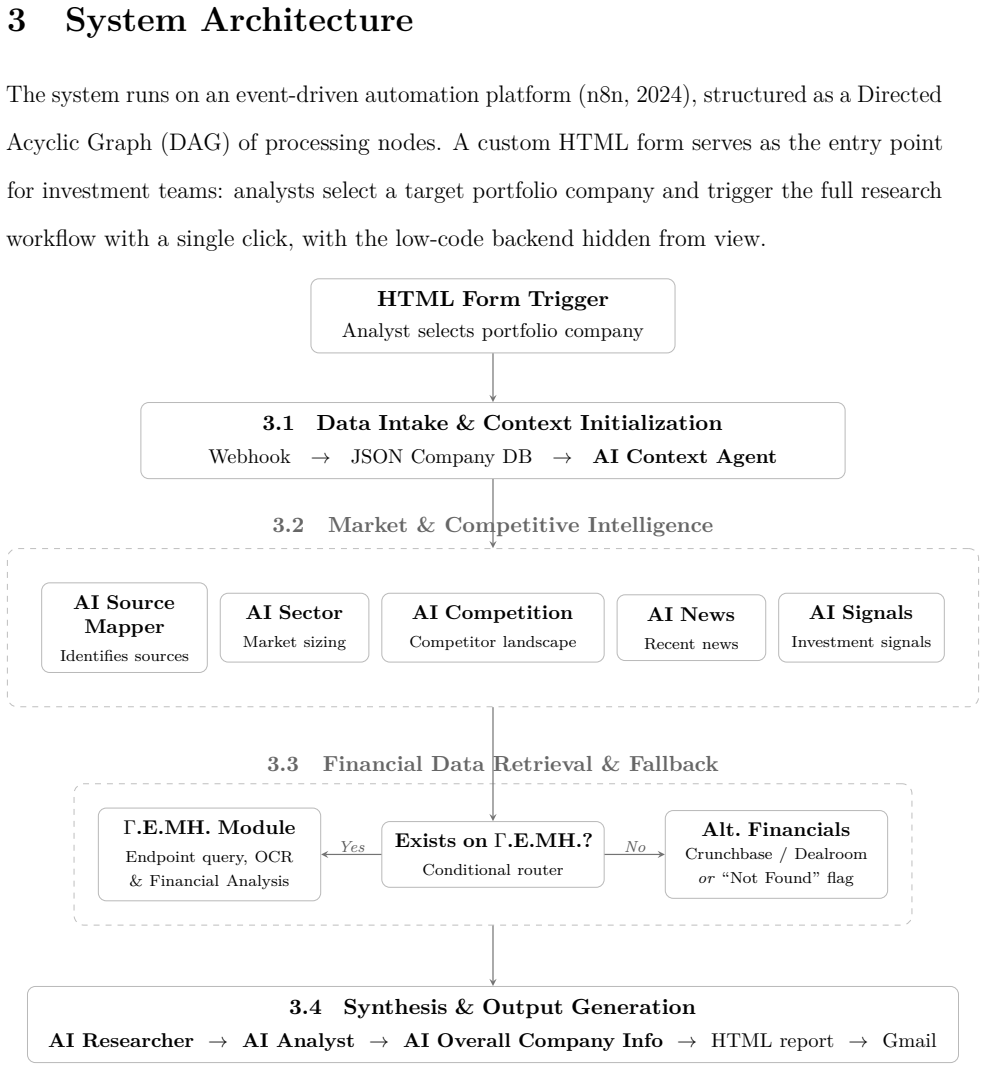
The authors present an event-driven multi-agent orchestration architecture that combines LLMs with real-time web retrieval for VC due diligence. A core technical element is the reverse-engineering of the Greek Business Registry's communication to fetch official filings, parsed via layout-aware OCR, with structural fallbacks to prevent hallucinations by explicitly marking data absence.
What carries the argument
The programmatic extraction pipeline that reverse-engineers the Greek Business Registry's frontend-to-backend communication to query dynamic endpoints for financial filings, combined with layout-aware OCR and a structural fallback mechanism to flag data absence.
If this is right
- Due diligence can be performed without manual data gathering from multiple sources.
- Structured intelligence is generated automatically for investment decisions.
- Risk of hallucinations in financial data is reduced through explicit absence flagging.
- Replicability is supported by public release of all workflow artifacts.
Where Pith is reading between the lines
- This framework could be extended to registries in other countries for wider VC applications.
- Integration with additional data sources might improve the depth of market analysis.
- Adoption could lead to faster screening of potential investments in venture capital.
Load-bearing premise
The combination of LLMs and the layout-aware OCR will accurately produce structured data from unstructured sources without errors or hallucinations, and the reverse-engineered access to the registry will continue functioning despite site changes.
What would settle it
Running the system on a set of known companies and comparing the extracted financial figures against verified official records, or observing if it fails after a registry website update.
Figures
read the original abstract
We present a fully automated multi-agent framework for corporate due diligence and market analysis in venture capital. The system runs on an event-driven orchestration architecture, combining Large Language Models (LLMs) with real-time web retrieval to synthesize unstructured data into structured investment intelligence. A central technical contribution is a programmatic extraction pipeline that reverse-engineers the frontend-to-backend communication of the Greek Business Registry ($\Gamma$.E.MH.), querying dynamic endpoints to retrieve official financial filings that are then parsed using a layout-aware OCR extractor. A structural fallback mechanism explicitly flags data absence rather than generating unverified figures, directly targeting hallucination in financial contexts. All workflow artifacts are publicly available to support replication.
Editorial analysis
A structured set of objections, weighed in public.
Referee Report
Summary. The paper presents a fully automated multi-agent framework for corporate due diligence and market analysis in venture capital. It uses an event-driven orchestration architecture combining Large Language Models with real-time web retrieval to synthesize unstructured data into structured investment intelligence. A key contribution is a programmatic extraction pipeline that reverse-engineers the Greek Business Registry (Γ.E.MH.) to query dynamic endpoints for official financial filings, parsed with a layout-aware OCR extractor, and includes a structural fallback to flag missing data instead of hallucinating. All workflow artifacts are publicly available.
Significance. If the framework reliably extracts and synthesizes accurate structured intelligence from unstructured sources without introducing hallucinations or errors, it could meaningfully advance automation in VC due diligence by reducing manual analysis of filings and market data. The public release of artifacts is a clear strength for reproducibility in multi-agent systems research. However, the lack of any empirical validation means the practical significance cannot yet be assessed beyond the level of a system description.
major comments (2)
- [Abstract and Evaluation] The central claim that the system produces reliable structured investment intelligence is unsupported by evidence. The abstract and system description detail the architecture, reverse-engineered GEMH pipeline, layout-aware OCR, and anti-hallucination fallback, but no quantitative evaluation is provided: no precision/recall on extracted financial fields, no success rates on dynamic endpoint queries, no comparison to ground-truth filings, and no end-to-end accuracy metrics on due-diligence tasks.
- [Extraction Pipeline] The weakest assumption—that the combination of the reverse-engineered registry pipeline, layout-aware OCR, and LLM synthesis will produce accurate results without errors or hallucinations—is load-bearing for the contribution but remains untested. The fallback mechanism is described as explicitly flagging data absence, yet no experiments demonstrate its effectiveness or the pipeline's robustness as sites change.
minor comments (1)
- [Architecture] Clarify the exact event-driven orchestration details and agent roles in the multi-agent architecture for readers unfamiliar with the specific implementation.
Simulated Author's Rebuttal
We thank the referee for the constructive and detailed review. We address the major comments point by point below, clarifying that the manuscript is presented as a system description of a novel multi-agent framework and programmatic pipeline, with all artifacts released publicly to support future evaluation and replication.
read point-by-point responses
-
Referee: [Abstract and Evaluation] The central claim that the system produces reliable structured investment intelligence is unsupported by evidence. The abstract and system description detail the architecture, reverse-engineered GEMH pipeline, layout-aware OCR, and anti-hallucination fallback, but no quantitative evaluation is provided: no precision/recall on extracted financial fields, no success rates on dynamic endpoint queries, no comparison to ground-truth filings, and no end-to-end accuracy metrics on due-diligence tasks.
Authors: We acknowledge that the manuscript contains no quantitative evaluation metrics such as precision/recall, query success rates, or ground-truth comparisons. The work focuses on the event-driven orchestration architecture, the reverse-engineering of the Greek Business Registry endpoints, the layout-aware OCR parser, and the structural fallback to flag missing data. These elements constitute the primary technical contribution, as no prior public system has automated access to these official dynamic filings in this manner. The public release of all workflow artifacts is intended to enable independent empirical validation by the community rather than to serve as a fully benchmarked application paper. revision: no
-
Referee: [Extraction Pipeline] The weakest assumption—that the combination of the reverse-engineered registry pipeline, layout-aware OCR, and LLM synthesis will produce accurate results without errors or hallucinations—is load-bearing for the contribution but remains untested. The fallback mechanism is described as explicitly flagging data absence, yet no experiments demonstrate its effectiveness or the pipeline's robustness as sites change.
Authors: The referee correctly notes that no experiments were performed to measure extraction accuracy, hallucination rates, or robustness to site changes. The fallback is implemented as an explicit structural check that surfaces data gaps instead of synthesizing figures, but its performance is not quantified. We view this as a limitation of the current manuscript, which prioritizes the novel implementation of the registry pipeline and orchestration over empirical testing. The open-source artifacts allow others to conduct such tests as the system evolves. revision: no
- Quantitative empirical validation of extraction accuracy, hallucination rates, and pipeline robustness, as no such experiments or ground-truth comparisons were conducted in the original manuscript.
Circularity Check
No circularity: system description paper with no derivations or fitted predictions
full rationale
The manuscript presents an engineering architecture for a multi-agent VC due-diligence system that combines LLMs, web retrieval, and a reverse-engineered GEMH registry pipeline with layout-aware OCR and an explicit fallback flag for missing data. No equations, parameter-fitting steps, uniqueness theorems, or self-citation chains appear in the provided text. All load-bearing claims are design choices whose correctness is left to empirical validation outside the paper; none reduce to their own inputs by construction. This is the normal, non-circular outcome for a system-description paper.
Axiom & Free-Parameter Ledger
axioms (2)
- domain assumption LLMs combined with real-time retrieval can synthesize unstructured data into reliable structured intelligence
- domain assumption The reverse-engineered frontend-to-backend communication of the Greek Business Registry remains stable enough for programmatic querying
Reference graph
Works this paper leans on
-
[1]
Advances in Neural Information Processing Systems (NeurIPS) , volume =
Retrieval-augmented generation for knowledge-intensive NLP tasks , author =. Advances in Neural Information Processing Systems (NeurIPS) , volume =
-
[2]
The Rise and Potential of Large Language Model Based Agents: A Survey
The rise and potential of large language model based agents: A survey , author =. arXiv preprint arXiv:2309.07864 , year =
work page internal anchor Pith review Pith/arXiv arXiv
-
[3]
ACM Computing Surveys , volume =
Survey of hallucination in natural language generation , author =. ACM Computing Surveys , volume =. 2023 , publisher =
work page 2023
-
[4]
Yang, Hongyang and Liu, Xiao-Yang and Wang, Christina Dan , journal =
-
[5]
On the Opportunities and Risks of Foundation Models
On the opportunities and risks of foundation models , author =. arXiv preprint arXiv:2108.07258 , year =. 2108.07258 , archiveprefix =
work page internal anchor Pith review Pith/arXiv arXiv
-
[6]
AutoGen: Enabling Next-Gen LLM Applications via Multi-Agent Conversation
Autogen: Enabling next-gen llm applications via multi-agent conversation , author =. arXiv preprint arXiv:2308.08155 , year =
work page internal anchor Pith review Pith/arXiv arXiv
-
[7]
Retrieval-Augmented Generation for Large Language Models: A Survey
Retrieval-augmented generation for large language models: A survey , author =. arXiv preprint arXiv:2312.10997 , year =. 2312.10997 , archiveprefix =
work page internal anchor Pith review Pith/arXiv arXiv
-
[8]
BloombergGPT: A Large Language Model for Finance
BloombergGPT: A Large Language Model for Finance , author =. arXiv preprint arXiv:2303.17564 , year =
work page internal anchor Pith review Pith/arXiv arXiv
- [9]
-
[10]
Journal of Financial Economics , volume =
What do private equity firms say they do? , author =. Journal of Financial Economics , volume =. 2016 , publisher =
work page 2016
- [11]
-
[12]
n8n: Workflow Automation Platform , year =
- [13]
-
[14]
GitHub repository , howpublished =
Paruchuri, Vik , title =. GitHub repository , howpublished =. 2025 , publisher =
work page 2025
- [15]
-
[16]
International Journal of Intelligent Engineering and Systems , volume =
MARAG-Fin: An Intelligent Multi-agent RAG-LLM Architecture Integrating Financial News Sentiment and Time Series Data for Data-driven Trading Decision-making , author =. International Journal of Intelligent Engineering and Systems , volume =. 2026 , doi =
work page 2026
-
[17]
Findings of the Association for Computational Linguistics: EMNLP 2025 , pages =
QuantAgents: Towards Multi-agent Financial System via Simulated Trading , author =. Findings of the Association for Computational Linguistics: EMNLP 2025 , pages =. 2025 , publisher =
work page 2025
-
[18]
Hong, Sirui and Zhuge, Mingchen and Chen, Jonathan and Zheng, Xiawu and Cheng, Yuheng and Zhang, Ceyao and Wang, Jinlin and Wang, Zili and Yau, Steven Ka Shing and Lin, Zijuan and others , booktitle =. 2024 , url =
work page 2024
-
[19]
Zhang, Wentao and Zhao, Lingxuan and Xia, Haochong and Sun, Shuo and Sun, Jiaze and Zhao, Molei and Li, Xinyi and Zhao, Yuqing and Shu, Yilei and Du, Fangyi and others , journal =
-
[20]
Companies House Public Data API , year =
discussion (0)
Sign in with ORCID, Apple, or X to comment. Anyone can read and Pith papers without signing in.