Recognition: no theorem link
IndicMedDialog: A Parallel Multi-Turn Medical Dialogue Dataset for Accessible Healthcare in Indic Languages
Pith reviewed 2026-05-14 19:00 UTC · model grok-4.3
The pith
IndicMedDialog supplies parallel multi-turn medical dialogues in English and nine Indic languages to support personalized symptom-elicitation models.
A machine-rendered reading of the paper's core claim, the machinery that carries it, and where it could break.
Core claim
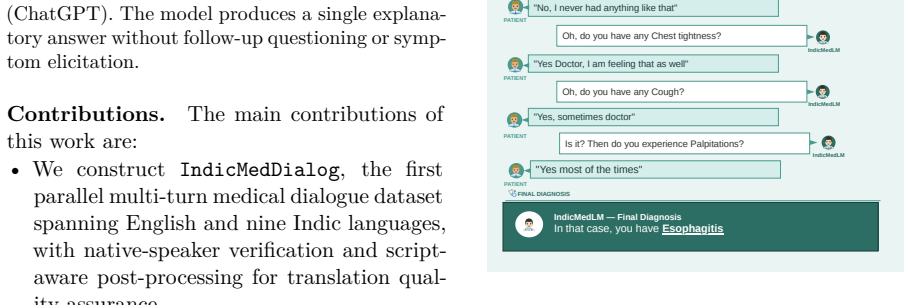
IndicMedDialog is a parallel multi-turn medical dialogue dataset covering English and nine Indic languages; it is built from LLM-generated synthetic consultations translated with TranslateGemma, verified by native speakers, and post-processed for script accuracy, then used to fine-tune IndicMedLM via parameter-efficient adaptation so the model can conduct personalized, multi-turn symptom elicitation.
What carries the argument
IndicMedDialog dataset — a parallel corpus of multi-turn medical dialogues that supplies both training data and evaluation material across ten languages.
If this is right
- A fine-tuned IndicMedLM can maintain coherent multi-turn symptom questioning while incorporating optional patient pre-context.
- The same dataset enables direct comparison of model performance across English and nine Indic languages under identical medical scenarios.
- Native-speaker verification plus script-aware post-processing reduces phonetic, lexical, and spacing errors that otherwise break dialogue flow.
- Error analysis across ten languages reveals language-specific failure modes that future training runs can target.
Where Pith is reading between the lines
- The dataset could serve as a testbed for measuring how well small quantized models retain medical reasoning after cross-lingual transfer.
- If the synthetic dialogues prove robust, similar pipelines might accelerate creation of domain-specific conversation data in other low-resource languages.
- Real-world deployment would still require ongoing clinical oversight because the current expert review covers only a sample of outputs.
Load-bearing premise
LLM-generated synthetic consultations, once translated and checked by native speakers, produce clinically plausible dialogues that match real patient-provider exchanges without systematic bias or factual mistakes.
What would settle it
Medical experts reviewing a random sample of the generated dialogues flag repeated factual errors, missing clinical steps, or culturally inappropriate advice at a rate above 15 percent.
Figures



read the original abstract
Most existing medical dialogue systems operate in a single-turn question--answering paradigm or rely on template-based datasets, limiting conversational realism and multilingual applicability. We introduce IndicMedDialog, a parallel multi-turn medical dialogue dataset spanning English and nine Indic languages: Assamese, Bengali, Gujarati, Hindi, Marathi, Punjabi, Tamil, Telugu, and Urdu. The dataset extends MDDial with LLM-generated synthetic consultations, translated using TranslateGemma, verified by native speakers, and refined through a script-aware post-processing pipeline to correct phonetic, lexical, and character-spacing errors. Building on this dataset, we fine-tune IndicMedLM via parameter-efficient adaptation of a quantized small language model, incorporating optional patient pre-context to personalise multi-turn symptom elicitation. We evaluate against zero-shot multilingual baselines, conduct systematic error analysis across ten languages, and validate clinical plausibility through medical expert evaluation.
Editorial analysis
A structured set of objections, weighed in public.
Referee Report
Summary. The paper introduces IndicMedDialog, a parallel multi-turn medical dialogue dataset covering English and nine Indic languages (Assamese, Bengali, Gujarati, Hindi, Marathi, Punjabi, Tamil, Telugu, Urdu). It is constructed by extending MDDial via LLM-generated synthetic consultations, TranslateGemma translation, native-speaker verification, and script-aware post-processing. The authors then fine-tune IndicMedLM via parameter-efficient adaptation of a quantized small language model (with optional patient pre-context), evaluate against zero-shot multilingual baselines, perform error analysis across ten languages, and validate clinical plausibility via medical expert evaluation.
Significance. If the dataset construction pipeline produces clinically plausible dialogues without systematic factual errors or biases, and if the fine-tuned model shows meaningful gains over baselines, the work would provide a valuable resource for multilingual medical dialogue systems in low-resource Indic languages, addressing a clear gap in accessible healthcare AI.
major comments (2)
- [Abstract / Evaluation section] Abstract and evaluation description: the manuscript states that clinical plausibility is validated through medical expert evaluation and that systematic error analysis is conducted, yet supplies no quantitative results (e.g., inter-rater agreement, error rates, or comparison against real consultations). This information is load-bearing for the central claim that the synthetic data faithfully represents patient-provider interactions.
- [Abstract / Dataset construction] Dataset creation pipeline (described in abstract): the reliance on native-speaker verification to catch LLM hallucinations and factual errors in medical content is not supported by reported metrics or protocols showing that non-expert verifiers reliably detect clinical inaccuracies; this assumption underpins the entire dataset's utility for downstream fine-tuning.
minor comments (2)
- [Abstract] Clarify the base small language model used for IndicMedLM (name, size, quantization details) and the exact parameter-efficient adaptation method (e.g., LoRA rank, target modules).
- [Abstract] The post-processing pipeline for phonetic, lexical, and character-spacing errors should include concrete examples of corrections applied per language.
Simulated Author's Rebuttal
We thank the referee for their constructive feedback, which highlights important areas for strengthening the manuscript's claims about dataset quality and validation. We address each major comment below and will incorporate revisions to provide the requested quantitative details and protocol transparency.
read point-by-point responses
-
Referee: [Abstract / Evaluation section] Abstract and evaluation description: the manuscript states that clinical plausibility is validated through medical expert evaluation and that systematic error analysis is conducted, yet supplies no quantitative results (e.g., inter-rater agreement, error rates, or comparison against real consultations). This information is load-bearing for the central claim that the synthetic data faithfully represents patient-provider interactions.
Authors: We agree that quantitative results are necessary to substantiate the claims. In the revised manuscript, we will expand the Evaluation section with specific metrics from the medical expert evaluation, including inter-rater agreement (e.g., Cohen's kappa), categorized error rates (factual inaccuracies, hallucinations, clinical implausibility), and comparisons of dialogue statistics such as average turns, symptom coverage, and lexical diversity against publicly available real medical dialogue corpora. We will also detail the expert evaluation protocol, including the number of experts, their qualifications, and scoring rubrics. revision: yes
-
Referee: [Abstract / Dataset construction] Dataset creation pipeline (described in abstract): the reliance on native-speaker verification to catch LLM hallucinations and factual errors in medical content is not supported by reported metrics or protocols showing that non-expert verifiers reliably detect clinical inaccuracies; this assumption underpins the entire dataset's utility for downstream fine-tuning.
Authors: We acknowledge the importance of documenting the verification process rigorously. The revised version will include a new subsection on native-speaker verification that reports the full protocol: number of verifiers per language, their selection (native speakers, with preference for those having medical familiarity), provided guidelines for identifying hallucinations and errors, and quantitative outcomes such as inter-verifier agreement rates and the percentage of dialogues flagged for correction. We will also explain how this step is complemented by the medical expert review to address potential limitations of non-expert detection. revision: yes
Circularity Check
No circularity: dataset construction and fine-tuning rely on external verification steps
full rationale
The paper describes creation of IndicMedDialog by extending MDDial via LLM-generated consultations, TranslateGemma translation, native-speaker verification, and script post-processing, followed by parameter-efficient fine-tuning of IndicMedLM and evaluation against baselines plus expert plausibility checks. No equations, fitted parameters, or self-referential derivations appear; claims do not reduce to inputs by construction. External human verification and expert evaluation provide independent grounding, making the work self-contained without circular steps.
Axiom & Free-Parameter Ledger
axioms (2)
- domain assumption LLM-generated synthetic consultations can be refined into clinically plausible multi-turn medical dialogues via translation and native-speaker verification
- domain assumption TranslateGemma produces translations that preserve medical accuracy and conversational naturalness for the target Indic languages
Reference graph
Works this paper leans on
-
[1]
Findings of the Association for Computational Linguistics: EMNLP 2024 , pages=
Bimedix: Bilingual medical mixture of experts llm , author=. Findings of the Association for Computational Linguistics: EMNLP 2024 , pages=
2024
-
[2]
arXiv preprint arXiv:2308.08147 , year=
Mddial: A multi-turn differential diagnosis dialogue dataset with reliability evaluation , author=. arXiv preprint arXiv:2308.08147 , year=
-
[3]
Real-World Doctor Agent with Proactive Consultation through Multi-Agent Reinforcement Learning
Doctoragent-rl: A multi-agent collaborative reinforcement learning system for multi-turn clinical dialogue , author=. arXiv preprint arXiv:2505.19630 , year=
work page internal anchor Pith review Pith/arXiv arXiv
-
[4]
Proceedings of the 2020 conference on empirical methods in natural language processing (EMNLP) , pages=
MedDialog: Large-scale medical dialogue datasets , author=. Proceedings of the 2020 conference on empirical methods in natural language processing (EMNLP) , pages=
2020
-
[5]
CCF International Conference on Natural Language Processing and Chinese Computing , pages=
Meddg: an entity-centric medical consultation dataset for entity-aware medical dialogue generation , author=. CCF International Conference on Natural Language Processing and Chinese Computing , pages=. 2022 , organization=
2022
-
[6]
Proceedings of the AAAI conference on artificial intelligence , volume=
Zhongjing: Enhancing the chinese medical capabilities of large language model through expert feedback and real-world multi-turn dialogue , author=. Proceedings of the AAAI conference on artificial intelligence , volume=
-
[7]
Chatcounselor: A large language models for mental health support (2023) , author=
2023
-
[8]
Findings of the Association for Computational Linguistics: ACL 2024 , pages=
Notechat: a dataset of synthetic patient-physician conversations conditioned on clinical notes , author=. Findings of the Association for Computational Linguistics: ACL 2024 , pages=
2024
-
[9]
arXiv preprint arXiv:2310.15896 , year=
Bianque: Balancing the questioning and suggestion ability of health llms with multi-turn health conversations polished by chatgpt , author=. arXiv preprint arXiv:2310.15896 , year=
-
[10]
Proceedings of the 2024 Conference on Empirical Methods in Natural Language Processing , pages=
Meditod: An english dialogue dataset for medical history taking with comprehensive annotations , author=. Proceedings of the 2024 Conference on Empirical Methods in Natural Language Processing , pages=
2024
-
[11]
arXiv preprint arXiv:2401.05654 , year=
Towards conversational diagnostic AI , author=. arXiv preprint arXiv:2401.05654 , year=
-
[12]
Med-Chat: Tuning ChatGLM3-6B with Chinese Medical Dialogue , year=
Chu, Jiqing and Sun, Youqiang and Huang, He and Liu, Yuan , booktitle=. Med-Chat: Tuning ChatGLM3-6B with Chinese Medical Dialogue , year=
-
[13]
T-Agent: A Term-Aware Agent for Medical Dialogue Generation , year=
Hu, Zefa and Zhao, Haozhi and Zhao, Yuanyuan and Xu, Shuang and Xu, Bo , booktitle=. T-Agent: A Term-Aware Agent for Medical Dialogue Generation , year=
-
[14]
Cureus , volume=
Chatdoctor: A medical chat model fine-tuned on a large language model meta-ai (llama) using medical domain knowledge , author=. Cureus , volume=. 2023 , publisher=
2023
-
[15]
Proceedings of the Eighth International Joint Conference on Natural Language Processing (Volume 1: Long Papers) , pages=
Dailydialog: A manually labelled multi-turn dialogue dataset , author=. Proceedings of the Eighth International Joint Conference on Natural Language Processing (Volume 1: Long Papers) , pages=
-
[16]
arXiv preprint arXiv:2601.03023 , year=
MedDialogRubrics: A Comprehensive Benchmark and Evaluation Framework for Multi-turn Medical Consultations in Large Language Models , author=. arXiv preprint arXiv:2601.03023 , year=
-
[17]
arXiv preprint arXiv:2409.17610 , year=
ZALM3: Zero-Shot Enhancement of Vision-Language Alignment via In-Context Information in Multi-Turn Multimodal Medical Dialogue , author=. arXiv preprint arXiv:2409.17610 , year=
-
[18]
IEEE Transactions on Consumer Electronics , year=
Continuous Entity Reasoning for Multi-Turn Medical Dialogue Generation , author=. IEEE Transactions on Consumer Electronics , year=
-
[19]
Proceedings of the 2022 Conference on Empirical Methods in Natural Language Processing , pages=
Cdialog: A multi-turn covid-19 conversation dataset for entity-aware dialog generation , author=. Proceedings of the 2022 Conference on Empirical Methods in Natural Language Processing , pages=
2022
-
[20]
Proceedings of the AAAI Conference on Artificial Intelligence , volume=
Topic-aware multi-turn dialogue modeling , author=. Proceedings of the AAAI Conference on Artificial Intelligence , volume=
-
[21]
Proceedings of the 58th Annual Meeting of the Association for Computational Linguistics , pages=
MuTual: A dataset for multi-turn dialogue reasoning , author=. Proceedings of the 58th Annual Meeting of the Association for Computational Linguistics , pages=
-
[22]
Yi, Zihao and Ouyang, Jiarui and Xu, Zhe and Liu, Yuwen and Liao, Tianhao and Luo, Haohao and Shen, Ying , title =. ACM Comput. Surv. , month = dec, articleno =. 2025 , issue_date =. doi:10.1145/3771090 , abstract =
-
[23]
Proceedings of the 57th Annual Meeting of the Association for Computational Linguistics , pages=
Improving multi-turn dialogue modelling with utterance rewriter , author=. Proceedings of the 57th Annual Meeting of the Association for Computational Linguistics , pages=
-
[24]
arXiv preprint arXiv:2103.03125 , year=
Advances in multi-turn dialogue comprehension: A survey , author=. arXiv preprint arXiv:2103.03125 , year=
-
[25]
arXiv preprint arXiv:2402.17262 , year=
Speak out of turn: Safety vulnerability of large language models in multi-turn dialogue , author=. arXiv preprint arXiv:2402.17262 , year=
-
[26]
Weblinx: Real-world website navigation with multi-turn dialogue , author=. arXiv preprint arXiv:2402.05930 , year=
-
[27]
Proceedings of the 61st Annual Meeting of the Association for Computational Linguistics (Volume 1: Long Papers) , pages=
Mmdialog: A large-scale multi-turn dialogue dataset towards multi-modal open-domain conversation , author=. Proceedings of the 61st Annual Meeting of the Association for Computational Linguistics (Volume 1: Long Papers) , pages=
-
[28]
The llama 3 herd of models , author=. arXiv preprint arXiv:2407.21783 , year=
work page internal anchor Pith review Pith/arXiv arXiv
-
[29]
arXiv preprint arXiv:2601.09012 , year=
TranslateGemma Technical Report , author=. arXiv preprint arXiv:2601.09012 , year=
-
[30]
2026 , eprint=
Tiny Aya: Bridging Scale and Multilingual Depth , author=. 2026 , eprint=
2026
-
[31]
LLaMA: Open and Efficient Foundation Language Models
Llama: Open and efficient foundation language models , author=. arXiv preprint arXiv:2302.13971 , year=
work page internal anchor Pith review Pith/arXiv arXiv
-
[32]
6G non-terrestrial networks enabled low-altitude economy: Opportunities and challenges , author=. arXiv preprint arXiv:2311.09047 , year=
-
[33]
DeepSeek LLM: Scaling Open-Source Language Models with Longtermism
Deepseek llm: Scaling open-source language models with longtermism , author=. arXiv preprint arXiv:2401.02954 , year=
work page internal anchor Pith review Pith/arXiv arXiv
-
[34]
2025 , eprint=
DeepSeek-R1: Incentivizing Reasoning Capability in LLMs via Reinforcement Learning , author=. 2025 , eprint=
2025
-
[35]
2025 , eprint=
Qwen3 Technical Report , author=. 2025 , eprint=
2025
-
[36]
Qwen2.5-Coder Technical Report
Qwen2. 5-coder technical report , author=. arXiv preprint arXiv:2409.12186 , year=
work page internal anchor Pith review Pith/arXiv arXiv
-
[37]
Gemma: Open Models Based on Gemini Research and Technology
Gemma: Open models based on gemini research and technology , author=. arXiv preprint arXiv:2403.08295 , year=
work page internal anchor Pith review Pith/arXiv arXiv
-
[38]
, author=
Lora: Low-rank adaptation of large language models. , author=. Iclr , volume=
-
[39]
Decoupled Weight Decay Regularization
Decoupled weight decay regularization , author=. arXiv preprint arXiv:1711.05101 , year=
work page internal anchor Pith review Pith/arXiv arXiv
-
[40]
DeepSeekMath: Pushing the Limits of Mathematical Reasoning in Open Language Models
Deepseekmath: Pushing the limits of mathematical reasoning in open language models , author=. arXiv preprint arXiv:2402.03300 , year=
work page internal anchor Pith review Pith/arXiv arXiv
-
[41]
2011 , journal=
Computing Krippendorff's alpha-reliability , author=. 2011 , journal=
2011
-
[42]
Llama 3 Model Card , author=. , year=
-
[43]
International conference on machine learning , pages=
Calibrate before use: Improving few-shot performance of language models , author=. International conference on machine learning , pages=. 2021 , organization=
2021
-
[44]
arXiv preprint arXiv:2603.24132 , year=
MedAidDialog: A Multilingual Multi-Turn Medical Dialogue Dataset for Accessible Healthcare , author=. arXiv preprint arXiv:2603.24132 , year=
discussion (0)
Sign in with ORCID, Apple, or X to comment. Anyone can read and Pith papers without signing in.