Recognition: no theorem link
IdeaForge: A Knowledge Graph-Grounded Multi-Agent Framework for Cross-Methodology Innovation Analysis and Patent Claim Generation
Pith reviewed 2026-05-14 19:16 UTC · model grok-4.3
The pith
IdeaForge links innovation claims across methodologies in a knowledge graph to identify high-confidence patent candidates.
A machine-rendered reading of the paper's core claim, the machinery that carries it, and where it could break.
Core claim
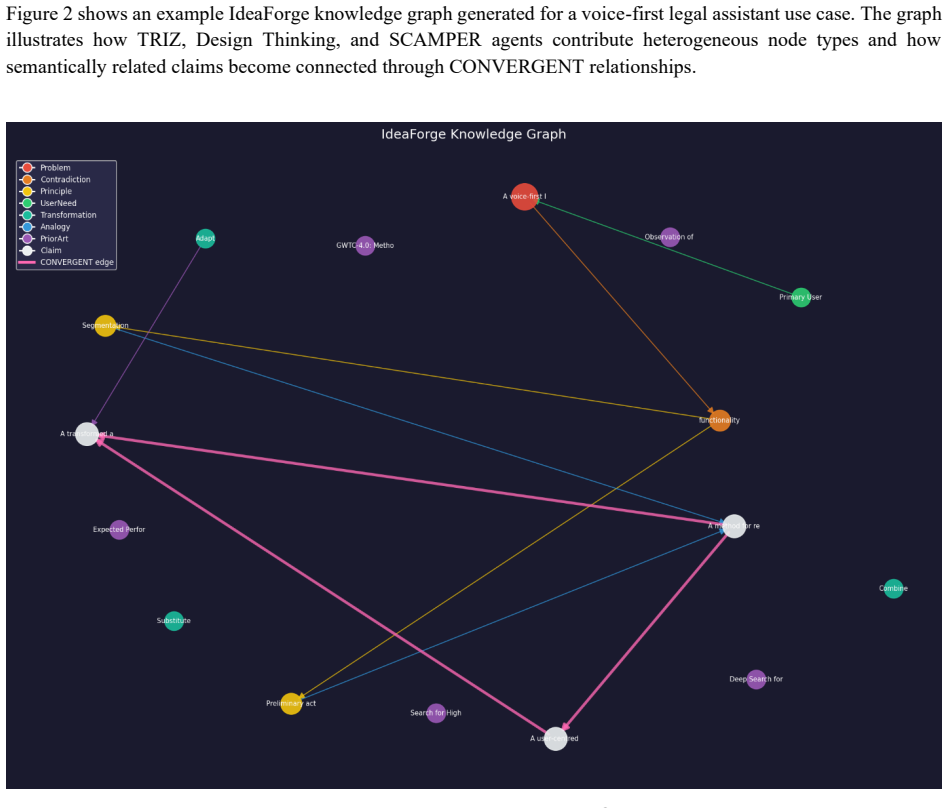
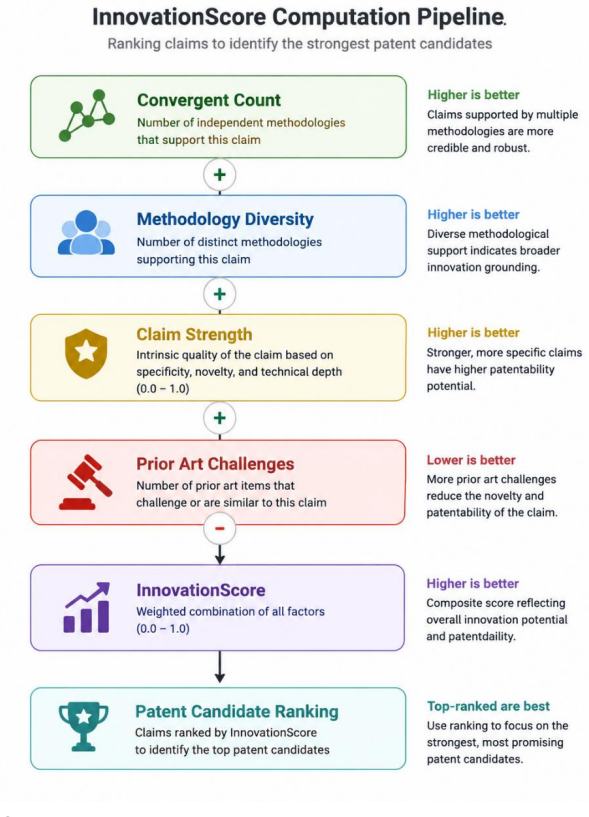
The central contribution is a cross-methodology convergence mechanism in which claims independently supported by TRIZ, Design Thinking, and SCAMPER are connected via CONVERGENT relationships in the knowledge graph. High-confidence innovation candidates are then identified by traversing these links, and an InnovationScore ranks them according to convergent support, methodology diversity, claim strength, and prior art challenges. A downstream patent drafting agent generates structured drafts grounded in the convergent claim subgraphs.
What carries the argument
The cross-methodology convergence mechanism that links claims across methodologies using CONVERGENT relationships in the knowledge graph to enable graph traversal for high-confidence candidates.
If this is right
- Graph traversal identifies high-confidence innovation candidates supported by multiple methodologies.
- Patent drafting reduces reliance on unconstrained language model generation by grounding in convergent subgraphs.
- Claims are ranked using an InnovationScore that incorporates convergent support and methodology diversity.
- Experiments demonstrate increased diversity and traceability compared to single-methodology baselines.
Where Pith is reading between the lines
- The approach could extend to suggesting novel combinations of ideas from different methods that no single agent proposed.
- Graph structure may make it easier to trace back which methodology supported each part of a patent claim.
- Connecting to patent databases in the same graph could automate prior art searches alongside claim generation.
Load-bearing premise
Specialist agents translate outputs from TRIZ, Design Thinking, and SCAMPER into consistent graph entities so that CONVERGENT links reflect genuine agreement rather than prompt noise.
What would settle it
A test where the same set of ideas is processed both with and without the convergence linking step, checking if the ranked claims and resulting patent drafts differ significantly in quality or novelty.
Figures

read the original abstract
Current AI-assisted innovation systems typically apply a single ideation methodology (such as TRIZ or Design Thinking) using sequential prompt-based workflows that do not preserve intermediate reasoning structure. As a result, insights generated across methodologies remain fragmented, limiting traceability, synthesis, and systematic evaluation of novelty. We present IdeaForge, a knowledge graph-grounded multi-agent framework for innovation analysis and patent claim generation. IdeaForge integrates multiple innovation methodologies (TRIZ, Design Thinking, and SCAMPER) through specialist agents operating over a persistent FalkorDB knowledge graph. Each agent contributes structured entities and relationships representing contradictions, inventive principles, user needs, transformations, analogies, and candidate claims. The central contribution of IdeaForge is a cross-methodology convergence mechanism implemented through graph-based claim linkage. Claims independently supported by multiple methodologies are connected using CONVERGENT relationships, enabling identification of high-confidence innovation candidates through graph traversal. A downstream patent drafting agent generates structured patent drafts grounded in convergent claim subgraphs, reducing reliance on unconstrained language model generation. An InnovationScore formula ranks claims by convergent support, methodology diversity, claim strength, and prior art challenge count. We describe the graph schema, agent architecture, convergence detection pipeline, and patent synthesis workflow. Experiments on a legal technology use case demonstrate that graph-grounded multi-methodology synthesis produces more diverse and traceable innovation candidates compared to single-methodology baselines. We discuss implications for computational creativity, explainable AI-assisted invention, and graph-native innovation systems.
Editorial analysis
A structured set of objections, weighed in public.
Referee Report
Summary. IdeaForge is a knowledge graph-grounded multi-agent framework integrating TRIZ, Design Thinking, and SCAMPER via specialist agents over a persistent FalkorDB graph. Structured entities and relationships capture contradictions, principles, needs, and claims; claims supported across methodologies are linked by CONVERGENT relationships to enable graph-traversal identification of high-confidence innovations. An InnovationScore ranks candidates by convergent support, methodology diversity, claim strength, and prior-art challenge count. A downstream patent-drafting agent generates structured drafts from convergent subgraphs. Experiments on a legal-technology use case are reported to yield more diverse and traceable candidates than single-methodology baselines.
Significance. If the convergence mechanism and agent fidelity are validated, the work would advance explainable, graph-native AI for invention by preserving intermediate reasoning structure across methodologies, enabling traceable synthesis and reducing reliance on unconstrained LLM generation for patent claims. It offers a concrete architecture for computational creativity and multi-methodology innovation analysis.
major comments (3)
- [Experiments] Experiments section: the legal-technology use case reports only that candidates are 'more diverse and traceable' with no quantitative metrics, baseline details, error analysis, or data-exclusion rules supplied. The central superiority claim therefore rests on an unelaborated qualitative comparison.
- [Agent architecture and convergence pipeline] Agent architecture and convergence pipeline: no inter-agent agreement metrics, human validation of sampled CONVERGENT links, or ablation on prompt sensitivity are reported. Without these, it remains unclear whether CONVERGENT relationships capture genuine cross-methodology agreement or agent-specific artifacts.
- [InnovationScore] InnovationScore definition: the score is computed from convergent support, methodology diversity, claim strength, and prior-art challenge count, all quantities derived from the same graph the system constructed. This raises a circularity risk that the ranking may reduce to internal graph properties rather than externally validated novelty.
minor comments (1)
- [Abstract and Methods] The abstract and methods description would benefit from an explicit statement of the graph schema (node/edge types and properties) to allow replication of the CONVERGENT linkage logic.
Simulated Author's Rebuttal
We thank the referee for their detailed and constructive feedback on our manuscript. We address each of the major comments below and outline the revisions we will make to strengthen the paper.
read point-by-point responses
-
Referee: [Experiments] Experiments section: the legal-technology use case reports only that candidates are 'more diverse and traceable' with no quantitative metrics, baseline details, error analysis, or data-exclusion rules supplied. The central superiority claim therefore rests on an unelaborated qualitative comparison.
Authors: We agree that the current experiments section relies on a qualitative assessment. In the revised version, we will expand this section to include quantitative metrics such as the number of candidate claims generated per methodology, a diversity index based on embedding similarity, traceability scores defined as the average number of supporting methodologies per claim, and explicit details on the single-methodology baselines used for comparison. We will also provide error analysis and the criteria for data exclusion in the legal-technology use case. revision: yes
-
Referee: [Agent architecture and convergence pipeline] Agent architecture and convergence pipeline: no inter-agent agreement metrics, human validation of sampled CONVERGENT links, or ablation on prompt sensitivity are reported. Without these, it remains unclear whether CONVERGENT relationships capture genuine cross-methodology agreement or agent-specific artifacts.
Authors: We acknowledge the need for additional validation of the convergence mechanism. We will add inter-agent agreement metrics, such as the proportion of CONVERGENT links that receive support from multiple agents. Additionally, we will include results from a human validation study on a random sample of CONVERGENT links, where domain experts assess whether the linkages represent genuine cross-methodology convergence. Finally, we will report an ablation study varying the agent prompts to assess sensitivity and output consistency. revision: yes
-
Referee: [InnovationScore] InnovationScore definition: the score is computed from convergent support, methodology diversity, claim strength, and prior-art challenge count, all quantities derived from the same graph the system constructed. This raises a circularity risk that the ranking may reduce to internal graph properties rather than externally validated novelty.
Authors: This is a valid concern regarding potential circularity in the InnovationScore. While the score is computed from graph-derived quantities, the prior-art challenge count is obtained through integration with external patent databases, providing an external anchor. Nevertheless, to address the referee's point, we will revise the manuscript to explicitly discuss the limitations of the score as an internal heuristic and propose future work on external validation against independent novelty assessments. We will also clarify the formula and its components in more detail. revision: partial
Circularity Check
InnovationScore reduces to direct counts from the self-constructed graph
specific steps
-
self definitional
[Abstract (InnovationScore formula)]
"An InnovationScore formula ranks claims by convergent support, methodology diversity, claim strength, and prior art challenge count."
The formula directly aggregates counts and properties of CONVERGENT relationships and other entities that the multi-agent system itself inserts into the FalkorDB graph during the convergence pipeline. No external validation data, disclosed weighting, or independent metric is introduced, so the ranking of 'high-confidence innovation candidates' is computed from the identical graph the framework constructed.
full rationale
The paper's central mechanism populates a knowledge graph with CONVERGENT links via specialist agents, then defines InnovationScore as a ranking over exactly those same graph quantities (convergent support, methodology diversity, claim strength, prior-art challenges). This makes the 'high-confidence' selection a direct function of the framework's own outputs rather than an independent derivation or external benchmark. No equations or weighting procedure are shown that would break the dependency. The architecture description and experiments remain self-contained against the graph they generate, producing moderate circularity without load-bearing self-citation or ansatz smuggling.
Axiom & Free-Parameter Ledger
free parameters (1)
- InnovationScore component weights
axioms (1)
- domain assumption Specialist agents can accurately apply TRIZ, Design Thinking, and SCAMPER to produce consistent structured entities and relationships
invented entities (1)
-
CONVERGENT relationship
no independent evidence
Reference graph
Works this paper leans on
-
[1]
and Chudziak, J.A
Szczepanik, K. and Chudziak, J.A. (2025). TRIZ Agents: A Multi -Agent LLM Approach for TRIZ -Based Innovation. Proceedings of the 17th International Conference on Agents and Artificial Intelligence (ICAART 2025), Volume 1, pp. 196-207
2025
-
[2]
and Zuo, H
Chen, L., Song, Y., Ding, S., Sun, L., Childs, P. and Zuo, H. (2024). TRIZ -GPT: An LLM-Augmented Method for Problem-Solving. International Design Engineering Technical Conferences (IDETC/CIE 2024)
2024
-
[3]
Guo, X., Tan, Y. and Chen, R. (2026). Leveraging Large Language Models and TRIZ: A Multi -agent Framework for Automated Patent Drafting and Innovation Generation. In: World Conference of AI-Powered Innovation and TRIZ Methodology. Springer Nature Switze rland. https://www.springerprofessional.de/world -conference-of-ai-powered- innovation-and-triz-methodo...
-
[4]
Altshuller, G.S. (1996). And Suddenly the Inventor Appeared: TRIZ, the Creative Problem Solving Approach. Technical Innovation Center
1996
-
[5]
Brown, T. (2008). Design Thinking. Harvard Business Review, 86(6), pp. 84 -92
2008
-
[6]
Eberle, B. (1996). Scamper: Games for Imagination Development. Prufrock Press
1996
-
[7]
and Gurevych, I
Reimers, N. and Gurevych, I. (2019). Sentence -BERT: Sentence Embeddings using Siamese BERT -Networks. Proceedings of EMNLP 2019
2019
-
[8]
Model Context Protocol: A Standard for Connecting AI Assistants to Data Sources
Anthropic (2024). Model Context Protocol: A Standard for Connecting AI Assistants to Data Sources. Technical Report
2024
-
[9]
Nigam, S.K. et al. (2025). NyayaAnumana and INLegalLlama: The Largest Indian Legal Judgment Prediction Dataset and Specialized Language Model. Proceedings of COLING 2025
2025
-
[10]
Malik, V. et al. (2021). ILDC for CJPE: Indian Legal Documents Corpus for Court Judgment Prediction and Explanation. Proceedings of ACL 2021
2021
-
[11]
Hogan, A., Blomqvist, E., Cochez, M., et al. (2021). Knowledge Graphs. ACM Computing Surveys, 54(4), 71:1 to 71:37. https://doi.org/10.1145/3447772
-
[12]
Edge, D., Trinh, H., Cheng, N., et al. (2024). From Local to Global: A GraphRAG Approach to Query -Focused Summarization. arXiv preprint arXiv:2404.16130
work page internal anchor Pith review Pith/arXiv arXiv 2024
-
[13]
Hong, S., Zheng, X., Chen, J., et al. (2024). MetaGPT: Meta Programming for A Multi -Agent Collaborative Framework. Proceedings of ICLR 2024
2024
-
[14]
Boden, M. A. (2004). The Creative Mind: Myths and Mechanisms (2nd ed.). Routledge
2004
-
[15]
FalkorDB: A Graph Database for AI Workloads
FalkorDB Team (2024). FalkorDB: A Graph Database for AI Workloads. https://docs.falkordb.com
2024
-
[16]
Lupu, M., Mayer, K., Tait, J. and Trippe, A. (Eds.) (2011). Current Challenges in Patent Information Retrieval. Springer. https://doi.org/10.1007/978-3-642-19231-9
discussion (0)
Sign in with ORCID, Apple, or X to comment. Anyone can read and Pith papers without signing in.