Recognition: no theorem link
ARE Method: Orbital Decompositions and Dihedral Cancellations for Determinants
Pith reviewed 2026-05-14 17:58 UTC · model grok-4.3
The pith
Cyclic group actions on the symmetric group reorganize the full Leibniz expansion of the determinant into (n-1)! orbits of size n that preserve every term and expose explicit sign laws and geometric patterns.
A machine-rendered reading of the paper's core claim, the machinery that carries it, and where it could break.
Core claim
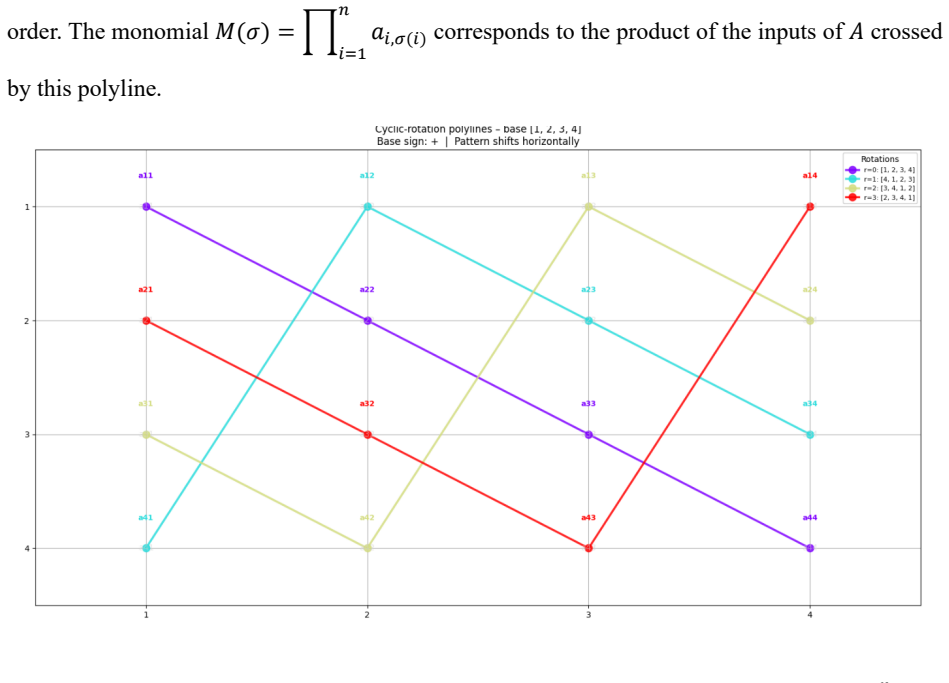
The symmetric group S_n admits a partition into (n-1)! orbits of size n under right composition with the cyclic group C_n; each orbit possesses a canonical representative and generates a family of determinant terms closed under cyclic rotation. A rectification theorem shows that a single block permutation converts the orbital polylines into parallel-line arrays whose collective sign is determined by explicit rotation laws. Dihedral symmetries further relate companion orbitals. The resulting decomposition reproduces the Leibniz sum exactly. In addition, no fixed-width direct extension of the Sarrus rule exists for n >= 4.
What carries the argument
Orbital decomposition of S_n under right action by C_n, together with the rectification block permutation that converts each orbital polyline into a parallel-line configuration.
If this is right
- The full set of n! Leibniz terms appears exactly once in the reorganized sum for every dimension.
- Sign changes under cyclic rotation within each orbit obey explicit, computable laws derived from the group action.
- Rectification converts every orbital configuration into a parallel-line array whose visual sum equals the determinant.
- Companion orbitals are paired by dihedral symmetries, giving a second layer of combinatorial structure.
- No fixed-width diagrammatic rule extending the Sarrus pattern can recover all terms once n reaches 4.
Where Pith is reading between the lines
- The same orbital technique might be applied to the permanent or other symmetric functions by replacing the sign character with the trivial character.
- The rectification step suggests a systematic way to generate higher-dimensional analogues of the Sarrus diagram that are no longer fixed-width.
- The impossibility result for fixed-width rules indicates that any diagrammatic method for n >= 4 must incorporate variable-width or non-local connections.
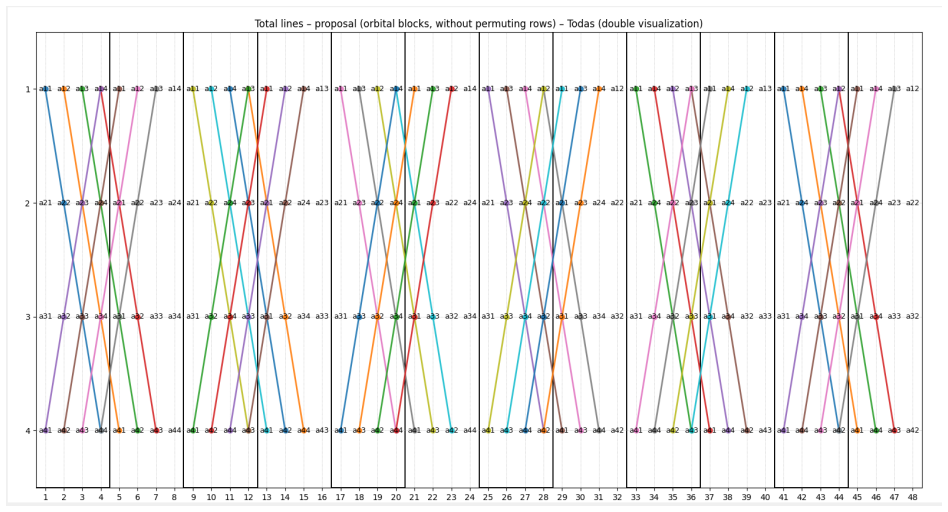
- The three visualizations (polylines, parallels, total lines) could be turned into deterministic generation algorithms for teaching or symbolic computation.
Load-bearing premise
The chosen right action of the cyclic group on S_n produces orbits whose sign behavior and term coverage exactly reproduce the Leibniz formula once the rectification permutation is applied.
What would settle it
For n=4, generate the 6 orbits explicitly and verify whether their 24 signed terms sum exactly to the determinant or whether any term is missing or duplicated.
Figures




read the original abstract
We develop the ARE method (Action-Rectification-Expansion), a structural framework for the organization of Leibniz terms in determinants through cyclic group actions and orbital decompositions. The symmetric group S_n is partitioned into (n-1)! disjoint orbits of size n under right composition by the cyclic group C_n. Each orbit admits a canonical representative and generates a family of determinant terms related by cyclic rotation. We prove explicit sign laws for orbital rotations, establish a rectification theorem transforming orbital polylines into parallel-line configurations through a single block permutation, and characterize companion orbitals through dihedral symmetries. The framework yields an exact reorganization of the Leibniz expansion preserving all n! terms while exposing hidden geometric and combinatorial structure. We further prove an impossibility theorem showing that no fixed-width direct extension of the classical Sarrus rule can capture all determinant terms for n >= 4. The method provides three equivalent visualizations: polylines, parallel rectified lines, and total-line representations. Deterministic orbital generation algorithms and computational verification against standard determinant methods are also presented. Although the approach does not reduce factorial complexity, it provides a systematic geometric and algebraic interpretation of determinant structure extending the conceptual spirit of Sarrus to arbitrary dimension.
Editorial analysis
A structured set of objections, weighed in public.
Circularity Check
No circularity: derivation proceeds from standard Leibniz formula via explicit group actions
full rationale
The paper begins with the classical Leibniz expansion over S_n and partitions it into orbits under the standard right action of the cyclic group C_n. Sign laws, the rectification theorem (mapping polylines to parallel lines via a single block permutation), and the impossibility result for Sarrus extensions are all derived directly from these group-theoretic constructions and explicit permutation sign calculations. No quantities are fitted to subsets of data and then re-labeled as predictions, no definitions are self-referential, and no central claim reduces to a self-citation chain. The preservation of all n! terms is asserted as a consequence of the orbit decomposition and rectification map, which are constructed from the input symmetric group without circular reindexing. This is a standard algebraic reorganization whose correctness can be checked externally against the Leibniz sum.
Axiom & Free-Parameter Ledger
axioms (2)
- standard math The Leibniz formula expresses the determinant as the signed sum over all permutations in S_n.
- standard math Right composition by the cyclic group C_n partitions S_n into orbits of size n.
Reference graph
Works this paper leans on
-
[1]
Verallgemeinerte Sarrussche Regel [Generalized Sarrus rule]
Arschon, S. “Verallgemeinerte Sarrussche Regel [Generalized Sarrus rule].” Mathematicheskii Sbornik (Recueil Mathématique) 42(1) (1935), 121–128
work page 1935
-
[2]
Artin, Michael. Algebra. Englewood Cliffs, NJ: Prentice Hall, 1991
work page 1991
-
[3]
Combinatorics of Permutations (2nd ed.)
Bóna, Miklós. Combinatorics of Permutations (2nd ed.). Chapman & Hall/CRC, 2012. 46
work page 2012
-
[4]
Eigenvalues and eigenvectors of symmetric centrosymmetric matrices
Cantoni, A.; Butler, P. "Eigenvalues and eigenvectors of symmetric centrosymmetric matrices." Linear Algebra and its Applications 13(3) (1976), 275–288
work page 1976
-
[5]
Dummit, David S.; Foote, Richard M. Abstract Algebra (3rd ed.). Hoboken, NJ: John Wiley & Sons, 2004
work page 2004
-
[6]
Golub, Gene H.; Van Loan, Charles F. Matrix Computations (4th ed.). Baltimore, MD: Johns Hopkins University Press, 2013
work page 2013
-
[7]
Harris, C.R.; Millman, K.J.; van der Walt, S.J.; et al. “Array programming with NumPy.” Nature 585 (2020), 357–362. DOI: 10.1038/s41586-020-2649-2
-
[8]
Accuracy and Stability of Numerical Algorithms (2nd ed.)
Higham, Nicholas J. Accuracy and Stability of Numerical Algorithms (2nd ed.). Philadelphia, PA: SIAM, 2002. DOI: 10.1137/1.9780898718027
-
[9]
Karim, Sharmila; Ibrahim, Haslinda; Omar, Zurni. “Some modifications of Sarrus’s rule method via permutation for finding determinant of 4×4 square matrix.” AIP Conference Proceedings 1782 (2016), 030008. DOI: 10.1063/1.4966065
-
[10]
Supplementum geometriae dimensoriae
Leibniz, G. W. “Supplementum geometriae dimensoriae.” Acta Eruditorum (Leipzig), September 1693, 385–392
-
[11]
Sarrus rules and dihedral groups
Lorenz, Dirk A.; Wirths, Karl -Joachim. “Sarrus rules and dihedral groups.” arXiv:1809.08948v2 [math.CO], 2018. Available at: https://arxiv.org/abs/1809.08948
work page internal anchor Pith review Pith/arXiv arXiv 2018
-
[12]
Sarrus Orbits: Visual –Combinatorial Determinant Methods , v2.1.0
Moya, R. Sarrus Orbits: Visual –Combinatorial Determinant Methods , v2.1.0. Zenodo,
-
[13]
DOI: 10.5281/zenodo.17423738
-
[14]
Vector Determinant in the ARE Framework: From Scalar to Vector -Valued, Version 1.0.0
Moya, R. Vector Determinant in the ARE Framework: From Scalar to Vector -Valued, Version 1.0.0. Zenodo, 2026. DOI: 10.5281/zenodo.19702486
-
[15]
The Theory of Determinants in the Historical Order of Development
Muir, Thomas. The Theory of Determinants in the Historical Order of Development. 4 vols. London: Macmillan, 1906–1923; unabridged reprint in 2 vols., New York: Dover, 1960
work page 1906
-
[16]
Enumerative Combinatorics, Volume 1 (2nd ed.)
Stanley, Richard P. Enumerative Combinatorics, Volume 1 (2nd ed.). Cambridge Studies in Advanced Mathematics 49. Cambridge: Cambridge University Press, 2012
work page 2012
-
[17]
Linear Algebra and Its Applications (4th ed.)
Strang, Gilbert. Linear Algebra and Its Applications (4th ed.). Belmont, CA: Thomson Brooks/Cole, 2006. 47
work page 2006
-
[18]
Trefethen, Lloyd N.; Bau, David III. Numerical Linear Algebra. Philadelphia, PA: SIAM,
-
[19]
DOI: 10.1137/1.9780898719574
-
[20]
The complexity of computing the permanent
Valiant, Leslie G. “The complexity of computing the permanent.” Theoretical Computer Science 8(2) (1979), 189–201. DOI: 10.1016/0304-3975(79)90044-6
-
[21]
Centrosymmetric (cross -symmetric) matrices, their basic properties, eigenvalues, and eigenvectors
Weaver, J. R. "Centrosymmetric (cross -symmetric) matrices, their basic properties, eigenvalues, and eigenvectors." American Mathematical Monthly 92(10) (1985), 711–717
work page 1985
discussion (0)
Sign in with ORCID, Apple, or X to comment. Anyone can read and Pith papers without signing in.