Recognition: unknown
Betti numbers for cochordal zero-divisor graphs of commutative rings
Pith reviewed 2026-05-14 17:49 UTC · model grok-4.3
The pith
The layered zero-divisor graph of finite chain rings is cochordal, yielding a refined Betti number formula for its edge ideal.
A machine-rendered reading of the paper's core claim, the machinery that carries it, and where it could break.
Core claim
The paper proves that the graph C(q,L) is cochordal. This property allows the determination of its type sequence and the correction of the Betti number formula for the edge ideal of the graph. When specialized to the rings Z_{2^m}[i] and Z_p[x]/(x^c), the computations show that the edge ideals have 2-linear resolutions and the rings are Cohen-Macaulay only in the degenerate or complete-graph cases.
What carries the argument
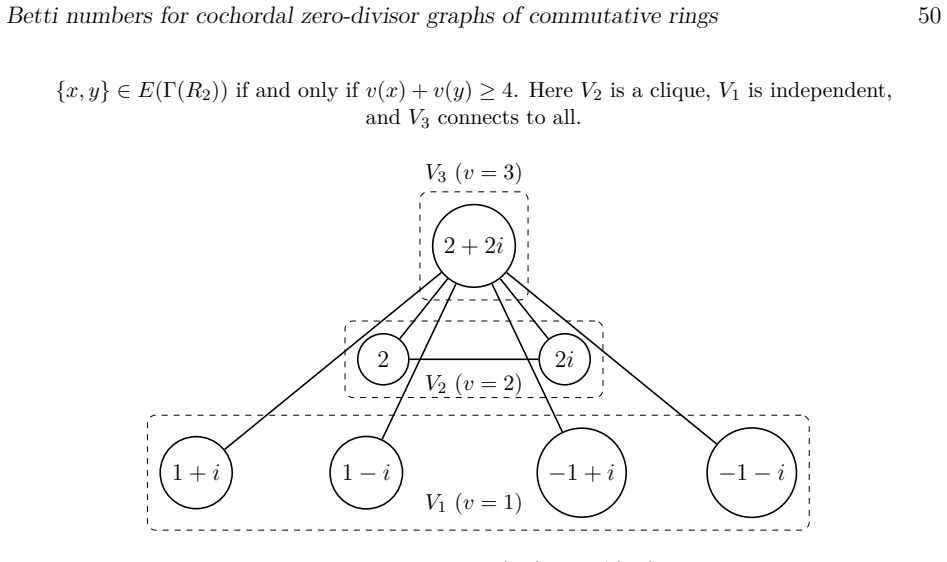
The layered graph C(q,L) defined by valuation layers with adjacency rule k + ℓ ≥ L, which is shown to be cochordal.
Load-bearing premise
The layered graph C(q,L) with the adjacency rule k + ℓ ≥ L accurately models the zero-divisor relations of the finite chain ring.
What would settle it
Direct computation of the minimal free resolution and Betti numbers for the edge ideal of a small ring such as Z_4[i] or Z_3[x]/(x^2) that differs from the formula derived from the cochordal type sequence.
Figures



read the original abstract
This paper studies the zero-divisor graphs attached to several finite chain-ring families and computes the homological invariants of their edge ideals by using cochordal constructible systems. We begin with a general layered graph $C(q,L)$, whose vertices are arranged according to valuation layers and whose adjacency is governed by the single rule $k+\ell\ge L$, form some integers $k$ and $\ell$. This graph models the zero-divisor structure of a finite chain ring with residue field of order $q$ and nilpotency index $L$. We prove that $C(q,L)$ is cochordal, determine its type sequence, then correct and refine the Betti formula of its edge ideal [Dung and Vu, Cochordal zero divisor graphs and Betti numbers of their edge ideals, Comm. Algebra 54(2) (2026) 736--744]. The results are then specialized to the Gaussian quotient rings $\mathbb Z_{2^m}[i]$ and to the truncated polynomial rings $\mathbb Z_p[x]/(x^c)$. We compute projective dimension, regularity, independence number, height, Hilbert series, and Cohen--Macaulay behavior. The computations show that these quotient rings have $2$-linear resolutions, while Cohen--Macaulayness occurs only in the expected degenerate or complete-graph cases.
Editorial analysis
A structured set of objections, weighed in public.
Referee Report
Summary. The paper introduces the layered graph C(q,L) whose vertices are partitioned into valuation layers and whose edges satisfy the adjacency rule k + ℓ ≥ L; this graph is shown to model the zero-divisor graph of a finite chain ring with residue field of cardinality q and nilpotency index L. The authors prove that C(q,L) is cochordal, compute its type sequence, correct and refine the Betti-number formula for the edge ideal given in Dung–Vu (Comm. Algebra 2026), and specialize the results to the rings ℤ_{2^m}[i] and ℤ_p[x]/(x^c). They obtain explicit formulas for the projective dimension, Castelnuovo–Mumford regularity, independence number, height, Hilbert series, and Cohen–Macaulay property, concluding that the edge ideals admit 2-linear resolutions and are Cohen–Macaulay only in the complete-graph or degenerate cases.
Significance. If the modeling and homological computations hold, the manuscript supplies the first explicit, parameter-free Betti-number formulas for an infinite family of zero-divisor graphs arising from commutative rings, together with a correction to an earlier formula. The explicit type-sequence description and the verification that the resolutions are 2-linear constitute concrete, reusable data for further work on monomial ideals and graph homological invariants.
minor comments (3)
- Abstract, line 3: the phrase “form some integers k and ℓ” is grammatically incomplete; replace with “for integers k, ℓ”.
- The specialization sections for ℤ_{2^m}[i] and ℤ_p[x]/(x^c) would benefit from a small table listing the Betti numbers for the first few values of m or c (e.g., m=2,3 and c=2,3) to allow immediate verification of the general formula.
- The statement that Cohen–Macaulayness holds “only in the expected degenerate or complete-graph cases” should be accompanied by a precise characterization of those cases in terms of the parameters q and L.
Simulated Author's Rebuttal
We thank the referee for the careful reading, positive assessment, and recommendation of minor revision. The report correctly identifies the main contributions: the layered graph model C(q,L), the proof that it is cochordal, the correction and refinement of the Betti-number formula from Dung–Vu, and the explicit homological invariants for the specialized chain rings. We will incorporate the minor revisions as recommended.
Circularity Check
No significant circularity detected
full rationale
The derivation begins with an explicit definition of the layered graph C(q,L) whose vertices are partitioned by additive valuation and whose edges are defined by the rule k + ℓ ≥ L; this rule is verified directly from the multiplication in the finite chain ring. Cochordality is established by constructing an explicit ordering, the type sequence is read off from the layers, and the refined Betti numbers are obtained by counting minimal generators and syzygies in each bidegree. The correction to the earlier formula of Dung and Vu is performed on the basis of this independent counting rather than by assuming the prior result. No equation reduces a claimed prediction to a fitted input or to a self-citation chain, and the central claims remain self-contained against the ring-theoretic model.
Axiom & Free-Parameter Ledger
axioms (1)
- domain assumption The graph C(q,L) with vertices arranged by valuation layers and edges when k + ℓ ≥ L models the zero-divisor structure of the finite chain ring.
Reference graph
Works this paper leans on
-
[1]
Akbari, H
S. Akbari, H. R. Maimani and S. Yassemi, When a zero-divisor graph is planar or a completer-partite graph,J. Algebra270(2003) 169–180,https://doi.org/10.1016/ S0021-8693(03)00370-3
2003
-
[2]
D. F. Anderson and A. Badawi, On the zero-divisor graph of a ring,Comm. Algebra36 (2008) 3073–3092,https://doi.org/10.1080/00927870802110888
-
[3]
D. F. Anderson and P. S. Livingston, The zero-divisor graph of a commutative ring,J. Algebra217(2) (1999) 434–447,https://doi.org/10.1006/jabr.1998.7840
-
[4]
G. Arunkumara, P. J. Cameron, T. Kavaskar and T. Tamizh Chelvam, Induced subgraphs of zero-divisor graphs,Discrete Math.346(7) (2023), Art. No. 113580, https://doi.org/10.1016/j.disc.2023.113580. Betti numbers for cochordal zero-divisor graphs of commutative rings64
-
[5]
Auslander and D
M. Auslander and D. A. Buchsbaum, Homological dimension in local rings, Trans. Amer. Math. Soc.85(1957) 390–405,https://doi.org/10.1090/ S0002-9947-1957-0086822-7
1957
-
[6]
Banerjee, The regularity of powers of edge ideals,J
A. Banerjee, The regularity of powers of edge ideals,J. Algebraic Combin.41(2) (2015) 303–321,https://doi.org/10.1007/s10801-014-0537-2
-
[7]
Beck, Coloring of commutative rings,J
I. Beck, Coloring of commutative rings,J. Algebra116(1) (1988) 208–226,https: //doi.org/10.1016/0021-8693(88)90202-5
-
[8]
Bruns and J
W. Bruns and J. Herzog,Cohen–Macaulay Rings, Cambridge Stud. Adv. Math. 39, Cambridge Univ. Press, Cambridge, 1993,https://doi.org/10.1017/ CBO9780511608681
1993
-
[9]
Algebra324(2010) 3591–3613, https://doi.org/10.1016/j.jalgebra.2010.09.013
R.Chen, Minimal free resolutions of linear edge ideals,J. Algebra324(2010) 3591–3613, https://doi.org/10.1016/j.jalgebra.2010.09.013
-
[10]
V. Chvátal and P. L. Hammer, Aggregation of inequalities in integer programming, Ann. Discrete Math.1(1977), 145–162.https://doi.org/10.1016/S0167-5060(08) 70731-3
-
[11]
A. Corso and U. Nagel, Specializations of Ferrers ideals,J. Algebraic Combin.28(3) (2008) 425–437,https://doi.org/10.1007/s10801-007-0111-2
-
[12]
Corso and U
A. Corso and U. Nagel, Monomial and toric ideals associated to Ferrers graphs, Trans. Amer. Math. Soc.361(3) (2009) 1371–1395,https://doi.org/10.1090/ S0002-9947-08-04636-9
2009
-
[13]
G. A. Dirac, On rigid circuit graphs,Abh. Math. Semin. Univ. Hambg.25(1961) 71–76, https://doi.org/10.1007/BF02992776
-
[14]
Dochtermann, Exposed circuits, linear quotients, and chordal clutters,J
A. Dochtermann, Exposed circuits, linear quotients, and chordal clutters,J. Combin. Theory Ser. A177(2021) 105327,https://doi.org/10.1016/j.jcta.2020.105327
-
[16]
Eisenbud,The Geometry of Syzygies, Grad
D. Eisenbud,The Geometry of Syzygies, Grad. Texts in Math. 229, Springer, New York, 2005,https://doi.org/10.1007/b137572
-
[17]
Fernandez-Ramos and P
O. Fernandez-Ramos and P. Gimenez, Regularity3in edge ideals associated to bi- partite graphs,J. Algebraic Combin.39(2014) 919–937,https://doi.org/10.1007/ s10801-013-0473-6
2014
-
[18]
C. A. Francisco, H. T. Hà and A. Van Tuyl, Splittings of monomial ideals, Proc. Amer. Math. Soc.137(10) (2009) 3271–3282,https://doi.org/10.1090/ S0002-9939-09-09929-8. Betti numbers for cochordal zero-divisor graphs of commutative rings65
2009
-
[19]
R. Fröberg, On Stanley–Reisner rings,Banach Center Publ.26(1990) 57–70,https: //doi.org/10.4064/-26-2-57-70
-
[20]
Fröberg, Betti numbers of fat forests and their Alexander dual,J
R. Fröberg, Betti numbers of fat forests and their Alexander dual,J. Algebraic Combin. 56(2022) 1023–1030,https://doi.org/10.1007/s10801-022-01143-0
-
[21]
Fröberg, Solution to a conjecture on edge rings with 2-linear resolutions,Comm
R. Fröberg, Solution to a conjecture on edge rings with 2-linear resolutions,Comm. Algebra51(2023) 1447–1450,https://doi.org/10.1080/00927872.2022.2137175
-
[22]
D. R. Grayson and M. E. Stillman, Macaulay2, a software system for research in alge- braic geometry, Available athttp://www.math.uiuc.edu/Macaulay2/
-
[23]
H. T. Hà and A. Van Tuyl, Monomial ideals, edge ideals of hypergraphs, and their graded Betti numbers,J. Algebraic Combin.27(2) (2008) 215–245,https://doi.org/ 10.1007/s10801-007-0079-y
-
[24]
J. Herzog and T. Hibi,Monomial Ideals, Grad. Texts in Math. 260, Springer, London, 2011,https://doi.org/10.1007/978-0-85729-106-6
-
[25]
J. Herzog, T. Hibi and X. Zheng, Dirac’s theorem on chordal graphs and Alexander duality,European J. Combin.25(7) (2004) 949–960,https://doi.org/10.1016/j. ejc.2003.12.008
work page doi:10.1016/j 2004
-
[26]
M. Hochster, Cohen–Macaulay rings, combinatorics, and simplicial complexes, inRing Theory II, Lecture Notes in Pure and Applied Mathematics, vol. 26, Marcel Dekker, New York, 1977, 171–223,https://doi.org/10.1007/978-94-010-1220-1_3
-
[27]
S. Jacques,Betti Numbers of Graph Ideals, PhD thesis, University of Sheffield, 2004. https://arxiv.org/abs/math/0410107
work page internal anchor Pith review Pith/arXiv arXiv 2004
-
[28]
D. Jaramillo and R. H. Villarreal, Thev-number of edge ideals,J. Combin. Theory Ser. A177(2021) 105310,https://doi.org/10.1016/j.jcta.2020.105310
-
[29]
N. V. R. Mahadev and U. N. Peled, Threshold graphs and related topics,Ann. Discrete Math.56(1995), 1–543.https://doi.org/10.1016/S0167-5060(13)71062-8
-
[30]
Matsumura,Commutative Ring Theory, Cambridge Stud
H. Matsumura,Commutative Ring Theory, Cambridge Stud. Adv. Math. 8, Cambridge Univ. Press, Cambridge, 1989,https://doi.org/10.1017/CBO9781139171762
-
[31]
F. Mohammadi and S. Moradi, Resolution of unmixed bipartite graphs,Bull. Korean Math. Soc.52(2015) 977–986,https://doi.org/10.4134/BKMS.2015.52.3.977
-
[32]
S. B. Mulay, Cycles and symmetries of zero-divisors,Comm. Algebra30(7) (2002) 3533– 3558,https://doi.org/10.1081/AGB-120004502
-
[33]
H. D. Nguyen and T. Vu, Linearity defect of edge ideals and Fröberg’s theorem,J. Alge- braic Combin.44(1)(2016)165–199,https://doi.org/10.1007/s10801-015-0662-6. Betti numbers for cochordal zero-divisor graphs of commutative rings66
-
[34]
S. Pirzada and S. A. Rather, On the linear strand of edge ideals of some zero divisor graphs,Comm. Algebra51(2) (2023) 620–632,https://doi.org/10.1080/00927872. 2022.2107211
-
[35]
B. A. Rather, Complex Zeros and Log-Concavity in Independent Domination Polyno- mials of Zero Divisor Graphs of Commutative Rings,Theor. Comput. Sci.1058(2025), Art. No. 115594,https://doi.org/10.1016/j.tcs.2025.115594
-
[36]
B. A. Rather, Independent domination polynomial of comaximal graphs of com- mutative rings,Algebra Colloq.33(2) (2026) 243–258,https://doi.org/10.1142/ S1005386726000222
2026
-
[37]
B. A. Rather, Complex zeros of independent domination polynomials of zero divisor graphs,Soft Comput.(2026),https://doi.org/10.1007/s00500-026-11308-9
-
[38]
B. A. Rather, Betti numbers of edge ideals of some graphs with application to graphs assigned to groups,Filomat38(2024) 2185–2204,https://doi.org/10.2298/ FIL2406185R
2024
-
[39]
B. A. Rather, Homological invariants of edge ideals of Wollastonite graphs,J. Comb. Optim.(2026),https://doi.org/10.1007/s10878-025-01389-x
-
[40]
B. A. Rather and J. Wang, Homological invariants of edge ideals of power graphs of finite groups,Filomat40(2) (2026) 739–750,https://doi.org/10.2298/FIL2602739R
-
[41]
B. A. Rather, M. Imran and A. Diene, The linear strand of edge ideals of comaximal graphs of commutative rings,Comm. Algebra52(2024) 1486–1500,https://doi.org/ 10.1080/00927872.2023.2263559
- [42]
-
[43]
P. Singh and R. Verma, Betti numbers of edge ideals of some split graphs,Comm. Algebra48(2020) 5026–5037,https://doi.org/10.1080/00927872.2020.1777559
-
[44]
S. Spiroff and C. Wickham, A zero divisor graph determined by equivalence classes of zero divisors,Comm. Algebra39(7) (2011) 2338–2348,https://doi.org/10.1080/ 00927872.2010.488675
-
[45]
R. P. Stanley,Combinatorics and Commutative Algebra, 2nd ed., Progress in Mathe- matics, vol. 41, Birkhäuser, 1996,https://doi.org/10.1007/b139094
-
[46]
R. H. Villarreal,Monomial Algebras, 2nd ed., Monographs and Research Notes in Math- ematics, CRC Press, Boca Raton, 2015,https://doi.org/10.1201/b18224
-
[47]
Wang, Zero-divisor graphs of finite commutative rings,J
H.-J. Wang, Zero-divisor graphs of finite commutative rings,J. Algebra296(2006) 47–58. Betti numbers for cochordal zero-divisor graphs of commutative rings67
2006
-
[48]
Woodroofe, Matchings, coverings, and Castelnuovo–Mumford regularity,J
R. Woodroofe, Matchings, coverings, and Castelnuovo–Mumford regularity,J. Commut. Algebra6(2) (2014) 287–304,https://doi.org/10.1216/JCA-2014-6-2-287
discussion (0)
Sign in with ORCID, Apple, or X to comment. Anyone can read and Pith papers without signing in.