Recognition: 2 theorem links
· Lean TheoremWhen Does the Dice Sum Become Prime?
Pith reviewed 2026-05-14 17:56 UTC · model grok-4.3
The pith
Dynamic programming computes the expected number of die rolls until the sum is prime to more than 1000 decimal places.
A machine-rendered reading of the paper's core claim, the machinery that carries it, and where it could break.
Core claim
Using a one-dimensional dynamic programming recursion together with truncation and rigorous error bounds, the expected number of rolls until the sum is prime is computed to more than 1000 decimal places, along with higher moments, improving substantially on the results of Conroy, Alon, and Malinovsky.
What carries the argument
One-dimensional dynamic programming recursion that follows the distribution of the current sum conditional on not having reached a prime yet, closed by truncation whose error is controlled by the exponential decay of the survival probability.
Load-bearing premise
The probability that the running sum has avoided all primes up to a large cutoff decays exponentially fast because primes have positive density.
What would settle it
Running a direct Monte Carlo simulation of millions of independent die sequences and obtaining an empirical mean lying outside the rigorous truncation interval claimed by the dynamic programming computation would show the error bounds are incorrect.
Figures

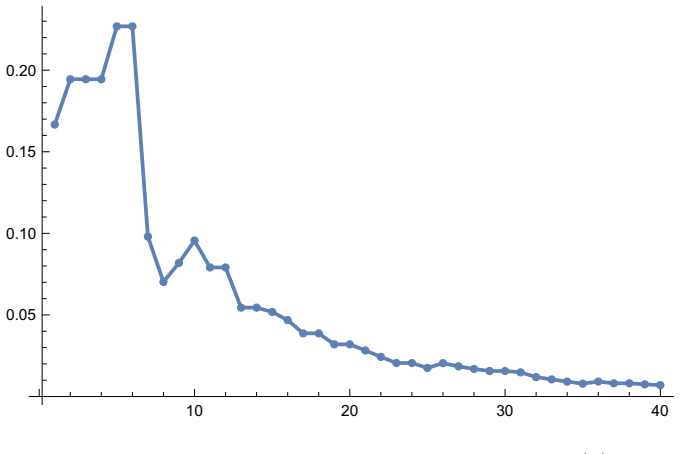

read the original abstract
Given a (possibly infinite) subset $A$ of the natural numbers, we ask how many times a fair six-sided die must be rolled until the rolled numbers add up to an element of $A$. Using a one-dimensional dynamic programming recursion together with truncation and rigorous error bounds, we compute the expected number of rolls efficiently and with very high accuracy. When $A$ is the set of prime numbers, the irregular distribution of primes makes it difficult to obtain explicit error estimates. Nevertheless, the density of primes implies that the associated survival probability decays exponentially fast, which enables highly accurate truncation estimates. As a result, our calculations yield significantly sharper estimates for this expectation and its higher moments than the original results of Conroy, Alon, and Malinovsky. In particular, we determine the expectation to more than $1000$ decimal places.
Editorial analysis
A structured set of objections, weighed in public.
Referee Report
Summary. The paper develops a one-dimensional dynamic programming recursion to compute the expected number of rolls of a fair six-sided die until the partial sum belongs to a given subset A of the naturals. For A equal to the primes, the authors combine the recursion with truncation at a large N and rigorous error bounds derived from the exponential decay of the probability that the sum has not yet hit a prime (using prime density). They report the expectation to more than 1000 decimal places together with higher moments, claiming these are substantially sharper than the earlier results of Conroy, Alon, and Malinovsky.
Significance. If the truncation error bounds are correctly derived and implemented, the work supplies the highest-precision numerical values currently available for this stopping-time expectation and its moments. The method is deterministic, forward-recursive, and free of fitted parameters, which makes the claimed 1000-decimal accuracy a concrete, falsifiable output that can be checked by independent recomputation at higher truncation thresholds.
major comments (2)
- [§4] §4 (truncation and error analysis): the manuscript asserts that prime density implies exponential decay of the survival probability, enabling truncation with rigorous bounds, yet no explicit formula is given for the constant C and rate r in the bound P(survival after k steps) ≤ C r^k, nor is the numerical value of r derived from a concrete prime-number-theorem estimate. Without this, the claimed 1000-decimal accuracy cannot be independently verified from the text alone.
- [§5] §5 (numerical results): the paper states that the expectation is obtained to more than 1000 decimal places, but supplies neither the explicit truncation threshold N used nor a table of successive approximations that would demonstrate convergence to the reported digits. A single high-precision output without accompanying convergence diagnostics leaves the error-bound claim untested within the manuscript.
minor comments (2)
- [§3] Notation for the state variable in the DP recursion should be introduced once and used consistently; the current text alternates between S_n and the partial-sum symbol without a single defining sentence.
- [Introduction] The comparison with Conroy–Alon–Malinovsky would be strengthened by quoting their reported precision (number of digits) alongside the new 1000-digit claim.
Simulated Author's Rebuttal
We thank the referee for the careful reading and positive recommendation. The comments on the truncation analysis and numerical presentation are well taken, and we will strengthen the manuscript accordingly to improve verifiability.
read point-by-point responses
-
Referee: §4 (truncation and error analysis): the manuscript asserts that prime density implies exponential decay of the survival probability, enabling truncation with rigorous bounds, yet no explicit formula is given for the constant C and rate r in the bound P(survival after k steps) ≤ C r^k, nor is the numerical value of r derived from a concrete prime-number-theorem estimate. Without this, the claimed 1000-decimal accuracy cannot be independently verified from the text alone.
Authors: We agree that an explicit formula for C and r would aid independent verification. The exponential decay follows from a lower bound on prime density via the prime number theorem: for sufficiently large x, π(x) > c x / log x with explicit c > 0 (e.g., c = 1/2 for x large enough). This yields a uniform upper bound on the probability of avoiding a prime at each step, leading to P(survival after k steps) ≤ C r^k with r = exp(−δ) for a concrete δ > 0 derived from the minimal density and C depending on the initial steps. In the revision we will insert the precise derivation, the numerical value of r employed, and the reference to the explicit PNT estimate used. revision: yes
-
Referee: §5 (numerical results): the paper states that the expectation is obtained to more than 1000 decimal places, but supplies neither the explicit truncation threshold N used nor a table of successive approximations that would demonstrate convergence to the reported digits. A single high-precision output without accompanying convergence diagnostics leaves the error-bound claim untested within the manuscript.
Authors: We accept that a convergence table and the explicit N would make the claimed precision more transparent. In the revised manuscript we will state the truncation threshold N used to obtain the 1000-decimal result and add a short table of successive approximations (for example at N = 10^5, 5×10^5, 10^6) showing stabilization of the leading digits to the reported precision. This will directly illustrate the practical effect of the error bounds. revision: yes
Circularity Check
No circularity: forward DP recursion with independent truncation bounds
full rationale
The derivation computes the target expectation (and moments) via a one-dimensional dynamic programming recursion initialized from base cases, combined with truncation whose error bounds are derived from the known exponential decay of survival probabilities (using prime density). This procedure is self-contained and does not fit any parameter to the target quantity, redefine the expectation in terms of itself, or rely on load-bearing self-citations whose content reduces to the present result. The improvement over Conroy et al. is achieved through higher-precision execution of the same independent recursion, not through circular reuse.
Axiom & Free-Parameter Ledger
axioms (1)
- domain assumption The density of primes implies that the survival probability decays exponentially fast
Lean theorems connected to this paper
-
IndisputableMonolith/Cost/FunctionalEquation.leanwashburn_uniqueness_aczel unclear?
unclearRelation between the paper passage and the cited Recognition theorem.
Using a one-dimensional dynamic programming recursion together with truncation and rigorous error bounds... E[τ] = E_N,0[τ] + B·P_N(0)
-
IndisputableMonolith/Foundation/RealityFromDistinction.leanreality_from_one_distinction unclear?
unclearRelation between the paper passage and the cited Recognition theorem.
the density of primes implies that the associated survival probability decays exponentially fast
What do these tags mean?
- matches
- The paper's claim is directly supported by a theorem in the formal canon.
- supports
- The theorem supports part of the paper's argument, but the paper may add assumptions or extra steps.
- extends
- The paper goes beyond the formal theorem; the theorem is a base layer rather than the whole result.
- uses
- The paper appears to rely on the theorem as machinery.
- contradicts
- The paper's claim conflicts with a theorem or certificate in the canon.
- unclear
- Pith found a possible connection, but the passage is too broad, indirect, or ambiguous to say the theorem truly supports the claim.
Reference graph
Works this paper leans on
-
[1]
Noga Alon and Yaakov Malinovsky,Hitting a prime in 2.43 dice rolls (on average), The American Statistician77(3), 301–303, 2023
2023
-
[2]
Noga Alon, Yaakov Malinovsky, Lucy Martinez, and Doron Zeilberger,Hitting k primes by dice rolls, Electronic Journal of Combinatorics32(4), 4.16, 2025
2025
-
[3]
A more recent version (2026) is available athttps://www.madandmoonly.com/ doctormatt/mathematics/dice1.pdf
Matthew Conroy,A Collection of Dice Problems, online note, 2018 version cited. A more recent version (2026) is available athttps://www.madandmoonly.com/ doctormatt/mathematics/dice1.pdf
2018
-
[4]
Lucy Martinez and Doron Zeilberger,How many Dice Rolls Would It Take to Reach Your Favorite Kind of Number?, Maple Transactions3(3), Autumn 2023
2023
-
[5]
Barkley Rosser and Lowell Schoenfeld,Approximate Formulas for some Functions of Prime Numbers, Illinois Journal of Mathematics6(1), 64–94, March 1962
1962
-
[6]
Anirban DasGupta,Student Puzzle Corner 17.IMS Bulletin46(2), 7, 2017
2017
-
[7]
Anirban DasGupta,Solution to Puzzle 17.IMS Bulletin46(5), 9, 2017
2017
-
[8]
Shane Chern,Hitting a prime by rolling a die with infinitely many faces, The Amer- ican Statistician78(3), 297–303, 2024
2024
-
[9]
Tipaluck Krityakierne and Thotsaporn Thanatipanonda,High-Precision Framework for Expected Hitting Times Analysis in the Dice-Sum Process, arXiv:2604.23133, 2026. 14
work page internal anchor Pith review Pith/arXiv arXiv 2026
discussion (0)
Sign in with ORCID, Apple, or X to comment. Anyone can read and Pith papers without signing in.