Recognition: 2 theorem links
· Lean TheoremEconAI: Dynamic Persona Evolution and Memory-Aware Agents in Evolving Economic Environments
Pith reviewed 2026-05-14 17:40 UTC · model grok-4.3
The pith
EconAI is the first LLM-powered system to simulate macro and micro economic interactions together in one adaptive framework.
A machine-rendered reading of the paper's core claim, the machinery that carries it, and where it could break.
Core claim
By quantifying economic belief through sentiment indexing, adjusting historical data influence via memory weighting, and linking work-consumption behaviors through dynamic decision-making, EconAI produces agents whose actions adapt to both immediate market signals and longer-term objectives, achieving the first unified simulation of macro and micro economic environments and interactions.
What carries the argument
The EconAI framework, built around economic sentiment indexing (ESI), memory weighting, and dynamic persona evolution that together adjust agent responses to market conditions and past experience.
Load-bearing premise
That adding economic sentiment indexing and memory weighting to standard LLM agents will produce measurably more stable and human-like employment-consumption cycles without further validation against real economic data.
What would settle it
Running parallel simulations with and without the sentiment index and memory weighting and checking whether the version with both components matches observed real-world employment-consumption cycle statistics more closely than the version without them.
Figures



read the original abstract
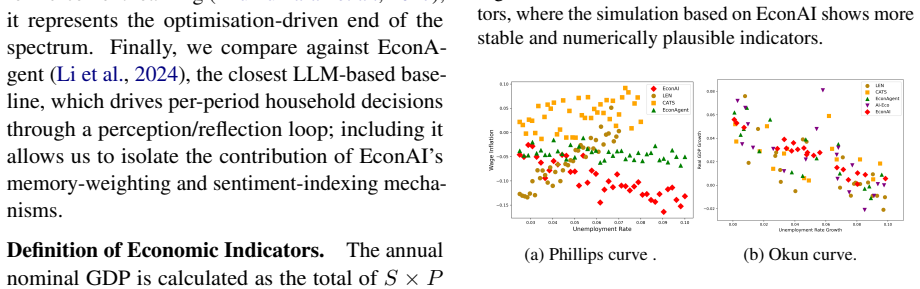
The integration of large language models (LLMs) in economic simulations has significantly enhanced agent-based modeling, yet existing frameworks struggle to capture the interplay between short-term optimization and long-term strategic planning. Conventional approaches rely on static data-driven predictions, failing to incorporate adaptive behaviors influenced by economic sentiment, market volatility, and individual goals. To address these limitations, we introduce a novel EconAI framework, incorporating economic sentiment indexing (ESI), memory weighting, and dynamic decision-making mechanisms. By quantifying economic belief, adjusting historical data influence, and linking work-consumption behaviors, EconAI achieves a more human-like decision process, where agents adapt their actions based on both market signals and long-term objectives. It is the first LLM-powered simulation system that can simulate the macro/microeconomic environment and interactions in a unified framework. Empirical evaluations show that EconAI improves stability in economic responses, better replicates real-world employment-consumption cycles, and enhances overall decision robustness. This advancement marks a crucial step towards more realistic, adaptive economic agent simulations.
Editorial analysis
A structured set of objections, weighed in public.
Referee Report
Summary. The manuscript introduces the EconAI framework, an LLM-based multi-agent system for economic simulations that incorporates economic sentiment indexing (ESI), memory weighting, and dynamic decision-making mechanisms. It claims to unify macro- and micro-level modeling in a single framework, producing more adaptive, human-like agent behaviors and improved replication of real-world employment-consumption cycles compared to static or conventional approaches.
Significance. If the empirical claims were substantiated with quantitative validation against real economic data, the work could meaningfully advance LLM-driven agent-based modeling by addressing gaps in long-term adaptation and sentiment-driven behavior. At present, however, the absence of metrics, datasets, baselines, or experimental details substantially reduces the assessed significance and prevents evaluation of whether the proposed mechanisms deliver the claimed improvements.
major comments (2)
- [Abstract] Abstract: The central claim that 'Empirical evaluations show that EconAI improves stability in economic responses, better replicates real-world employment-consumption cycles' is unsupported by any quantitative results, statistical measures, reference datasets (e.g., BLS or OECD series), or comparison baselines within the manuscript.
- [Abstract] Abstract: The assertion that EconAI is 'the first LLM-powered simulation system that can simulate the macro/microeconomic environment and interactions in a unified framework' is presented without a literature review or explicit differentiation from prior LLM-agent economic models, leaving the novelty claim unsubstantiated.
Simulated Author's Rebuttal
We are grateful to the referee for their thorough review and valuable suggestions. We address the major comments point by point below and outline the revisions we will make to strengthen the manuscript.
read point-by-point responses
-
Referee: [Abstract] Abstract: The central claim that 'Empirical evaluations show that EconAI improves stability in economic responses, better replicates real-world employment-consumption cycles' is unsupported by any quantitative results, statistical measures, reference datasets (e.g., BLS or OECD series), or comparison baselines within the manuscript.
Authors: We acknowledge that the abstract's claim would benefit from more explicit support. The full manuscript presents simulation results demonstrating these improvements through qualitative analysis and example trajectories in the results section. However, to directly address the concern, we will revise the abstract to include specific quantitative indicators from our experiments, such as reduced response variance and cycle correlation metrics, and reference the use of synthetic data calibrated to real economic patterns. We will also add a table in the revised manuscript comparing key metrics against baselines. revision: yes
-
Referee: [Abstract] Abstract: The assertion that EconAI is 'the first LLM-powered simulation system that can simulate the macro/microeconomic environment and interactions in a unified framework' is presented without a literature review or explicit differentiation from prior LLM-agent economic models, leaving the novelty claim unsubstantiated.
Authors: We agree that a more detailed literature review is necessary to substantiate the novelty. While the introduction touches on related work, we will add a new section dedicated to related work that reviews prior LLM-based economic agent models and clearly differentiates our approach by emphasizing the unified macro/micro loop, the integration of economic sentiment indexing, and dynamic memory weighting for long-term adaptation. revision: yes
Circularity Check
No circularity: framework claims rest on described mechanisms without self-referential reductions
full rationale
The paper introduces EconAI as an LLM-based simulation framework incorporating ESI, memory weighting, and dynamic persona evolution. No equations, fitted parameters, or derivation chains appear in the provided text that reduce predictions to inputs by construction. Claims of replicating employment-consumption cycles and improved stability are asserted via empirical evaluations rather than tautological self-definition or load-bearing self-citations. The central premise is presented as an engineering contribution with independent content, not a mathematical result forced by prior author work or renaming. Absence of visible derivations makes circularity assessment inapplicable; this is the expected non-finding for descriptive simulation papers.
Axiom & Free-Parameter Ledger
axioms (1)
- domain assumption LLM agents can be made to exhibit human-like long-term planning by adding a scalar economic sentiment index and a memory-weighting function.
Lean theorems connected to this paper
-
IndisputableMonolith/Cost/FunctionalEquation.leanwashburn_uniqueness_aczel unclearEconAI incorporates ... Economic Sentiment Index (ESI), memory weighting, and dynamic decision-making models ... pwt, pct ∼ LLM(zi, P, si, u, r, ESIt)
-
IndisputableMonolith/Foundation/ArithmeticFromLogic.leanembed_strictMono_of_one_lt unclearmemory module ... long-term and short-term banks ... ESIt = λ ESIt−1 + (1−λ) ESIt,LLM
Reference graph
Works this paper leans on
-
[1]
arXiv preprint arXiv:2305.05516 , year=
GPT Agents in Game Theory Experiments , author=. arXiv preprint arXiv:2305.05516 , year=
-
[2]
arXiv preprint arXiv:2310.05746 , year=
Put your money where your mouth is: Evaluating strategic planning and execution of llm agents in an auction arena , author=. arXiv preprint arXiv:2310.05746 , year=
-
[3]
arXiv preprint arXiv:2310.17512 , year=
Competeai: Understanding the competition behaviors in large language model-based agents , author=. arXiv preprint arXiv:2310.17512 , year=
-
[4]
arXiv preprint arXiv:2305.16867 , year=
Playing repeated games with Large Language Models , author=. arXiv preprint arXiv:2305.16867 , year=
-
[5]
arXiv preprint arXiv:2305.12763 , year=
The Emergence of Economic Rationality of GPT , author=. arXiv preprint arXiv:2305.12763 , year=
-
[6]
The Rise and Potential of Large Language Model Based Agents: A Survey
The Rise and Potential of Large Language Model Based Agents: A Survey , author=. arXiv preprint arXiv:2309.07864 , year=
work page internal anchor Pith review Pith/arXiv arXiv
-
[7]
A survey on large language model based autonomous agents,
A survey on large language model based autonomous agents , author=. arXiv preprint arXiv:2308.11432 , year=
-
[8]
2022 , note =
AutoGPT Team , title =. 2022 , note =
2022
-
[9]
2023 , note =
Yoheinakajima , title =. 2023 , note =
2023
-
[10]
Generative Agents: Interactive Simulacra of Human Behavior
Generative agents: Interactive simulacra of human behavior , author=. arXiv preprint arXiv:2304.03442 , year=
work page internal anchor Pith review Pith/arXiv arXiv
-
[11]
2005 , publisher=
Simulation for the social scientist , author=. 2005 , publisher=
2005
-
[12]
Proceedings of the 35th Annual ACM Symposium on User Interface Software and Technology , pages=
Social simulacra: Creating populated prototypes for social computing systems , author=. Proceedings of the 35th Annual ACM Symposium on User Interface Software and Technology , pages=
-
[13]
arXiv preprint arXiv:2307.07871 , year=
The socialai school: Insights from developmental psychology towards artificial socio-cultural agents , author=. arXiv preprint arXiv:2307.07871 , year=
-
[14]
arXiv preprint arXiv:2308.12503 , year=
Cgmi: Configurable general multi-agent interaction framework , author=. arXiv preprint arXiv:2308.12503 , year=
-
[15]
Gao, Chen and Lan, Xiaochong and Lu, Zhihong and Mao, Jinzhu and Piao, Jinghua and Wang, Huandong and Jin, Depeng and Li, Yong , journal=. S ^
-
[16]
arXiv preprint arXiv:2304.05332 , year=
Emergent autonomous scientific research capabilities of large language models , author=. arXiv preprint arXiv:2304.05332 , year=
-
[17]
arXiv preprint arXiv:2304.05376 , year=
ChemCrow: Augmenting large-language models with chemistry tools , author=. arXiv preprint arXiv:2304.05376 , year=
-
[18]
2023 , institution=
Large language models as simulated economic agents: What can we learn from homo silicus? , author=. 2023 , institution=
2023
-
[19]
American Economic Review , volume=
Information technology and the US economy , author=. American Economic Review , volume=. 2001 , publisher=
2001
-
[20]
Journal of Business & Economic Statistics , volume=
Real-time forecasting with a mixed-frequency VAR , author=. Journal of Business & Economic Statistics , volume=. 2015 , publisher=
2015
-
[21]
2011 , publisher=
Macroeconomics from the Bottom-up , author=. 2011 , publisher=
2011
-
[22]
Handbook of computational economics , volume=
Agent-based macroeconomics , author=. Handbook of computational economics , volume=. 2018 , publisher=
2018
-
[23]
Census Bureau
Access demographic, economic and population data from the U.S. Census Bureau. , year =. Census.gov , author =
-
[24]
FRED, Federal Reserve Bank of St
Infra-. FRED, Federal Reserve Bank of St. Louis , author =
-
[25]
Journal of Economic Behavior & Organization , volume=
Agent-based macroeconomics: A baseline model , author=. Journal of Economic Behavior & Organization , volume=. 2013 , publisher=
2013
-
[26]
Economica , pages=
Phillips curves, expectations of inflation and optimal unemployment over time , author=. Economica , pages=. 1967 , publisher=
1967
-
[27]
1963 , publisher=
Potential GNP: its measurement and significance , author=. 1963 , publisher=
1963
-
[28]
Science advances , volume=
The AI Economist: Taxation policy design via two-level deep multiagent reinforcement learning , author=. Science advances , volume=. 2022 , publisher=
2022
-
[29]
arXiv preprint arXiv:2108.02904 , year=
Building a foundation for data-driven, interpretable, and robust policy design using the ai economist , author=. arXiv preprint arXiv:2108.02904 , year=
-
[30]
Econometrica: Journal of the Econometric Society , pages=
Time to build and aggregate fluctuations , author=. Econometrica: Journal of the Econometric Society , pages=. 1982 , publisher=
1982
-
[31]
Journal of political Economy , volume=
Nominal rigidities and the dynamic effects of a shock to monetary policy , author=. Journal of political Economy , volume=. 2005 , publisher=
2005
-
[32]
Nature , volume=
The economy needs agent-based modelling , author=. Nature , volume=. 2009 , publisher=
2009
-
[33]
Journal of Econometrics , volume=
On the formulation of empirical models in dynamic econometrics , author=. Journal of Econometrics , volume=. 1982 , publisher=
1982
-
[34]
2006 , publisher=
Handbook of computational economics: agent-based computational economics , author=. 2006 , publisher=
2006
-
[35]
Journal of Economic dynamics and Control , volume=
Heterogeneous beliefs and routes to chaos in a simple asset pricing model , author=. Journal of Economic dynamics and Control , volume=. 1998 , publisher=
1998
-
[36]
Journal of Artificial Societies and Social Simulation , volume=
Empirical validation of agent-based models: Alternatives and prospects , author=. Journal of Artificial Societies and Social Simulation , volume=. 2007 , publisher=
2007
-
[37]
arXiv preprint arXiv:2309.16307 , year=
TaxAI: A Dynamic Economic Simulator and Benchmark for Multi-Agent Reinforcement Learning , author=. arXiv preprint arXiv:2309.16307 , year=
-
[38]
A Survey of Large Language Models
A survey of large language models , author=. arXiv preprint arXiv:2303.18223 , year=
work page internal anchor Pith review Pith/arXiv arXiv
-
[39]
IEEE Signal Processing Magazine , volume=
Deep reinforcement learning: A brief survey , author=. IEEE Signal Processing Magazine , volume=. 2017 , publisher=
2017
-
[40]
Proceedings of the ACM Web Conference 2026 , pages=
RaDAR: Relation-aware Diffusion-Asymmetric Graph Contrastive Learning for Recommendation , author=. Proceedings of the ACM Web Conference 2026 , pages=
2026
-
[41]
Proceedings of the AAAI Conference on Artificial Intelligence , volume=
NumCoKE: Ordinal-Aware Numerical Reasoning over Knowledge Graphs with Mixture-of-Experts and Contrastive Learning , author=. Proceedings of the AAAI Conference on Artificial Intelligence , volume=
-
[42]
ACL , pages=
Econagent: large language model-empowered agents for simulating macroeconomic activities , author=. ACL , pages=
-
[43]
ACM SIGKDD Conference on Knowledge Discovery and Data Mining , pages=
Diffusione: Reasoning on knowledge graphs via diffusion-based graph neural networks , author=. ACM SIGKDD Conference on Knowledge Discovery and Data Mining , pages=
-
[44]
The quarterly journal of economics , volume=
Global evidence on economic preferences , author=. The quarterly journal of economics , volume=. 2018 , publisher=
2018
-
[45]
ACL , pages =
Zihao Yue and Liang Zhang and Qin Jin , title =. ACL , pages =
-
[46]
NeurIPS , year =
Wenhui Wang and Furu Wei and Li Dong and Hangbo Bao and Nan Yang and Ming Zhou , title =. NeurIPS , year =
-
[47]
Zhao and Kelvin Guu and Adams Wei Yu and Brian Lester and Nan Du and Andrew M
Jason Wei and Maarten Bosma and Vincent Y. Zhao and Kelvin Guu and Adams Wei Yu and Brian Lester and Nan Du and Andrew M. Dai and Quoc V. Le , title =. ICLR , year =
-
[48]
O'Brien and Carrie Jun Cai and Meredith Ringel Morris and Percy Liang and Michael S
Joon Sung Park and Joseph C. O'Brien and Carrie Jun Cai and Meredith Ringel Morris and Percy Liang and Michael S. Bernstein , title =. ACM UIST , pages =
discussion (0)
Sign in with ORCID, Apple, or X to comment. Anyone can read and Pith papers without signing in.