Recognition: 1 theorem link
· Lean TheoremGraphs of Hecke operators in mixed ramification
Pith reviewed 2026-05-14 17:31 UTC · model grok-4.3
The pith
Hecke operators in complex ramification on Bun_G mimic simpler ramification actions under mild conditions.
A machine-rendered reading of the paper's core claim, the machinery that carries it, and where it could break.
Core claim
We prove that, under mild regularity conditions, the action of a Hecke operator in the deep cusp of Bun_G in a highly complex ramification mimics an action in a much simpler ramification. This reduces the study to a smaller number of cases which, in particular, involve divisors supported at no more than two points.
What carries the argument
Hecke graphs providing combinatorial language for Hecke operator actions, and the mimicking property between complex and simple H-ramification configurations.
If this is right
- The study of Hecke operators reduces to ramification at one or two points.
- Explicit computations of Hecke eigenforms become feasible for PGL_2 with generic eigenvalues.
- Dimensions of spaces of Hecke eigenforms can be determined in these simplified settings.
Where Pith is reading between the lines
- This reduction could facilitate progress in understanding the geometric Langlands program for ramified bundles.
- Similar mimicking properties might hold for other moduli problems involving group actions.
- Extending the examples to other groups G could reveal patterns in eigenform dimensions.
Load-bearing premise
The mild regularity conditions on the ramification data and the subgroups chosen at the divisor points are necessary for the mimicking property to hold.
What would settle it
An explicit counterexample computation for a three-point divisor where the Hecke action does not match any two-point simplification despite satisfying regularity conditions.
Figures





read the original abstract
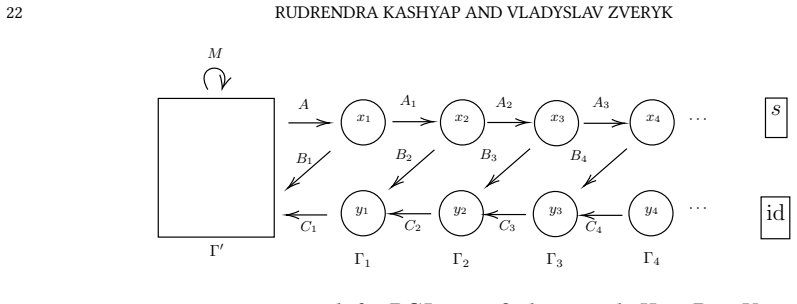
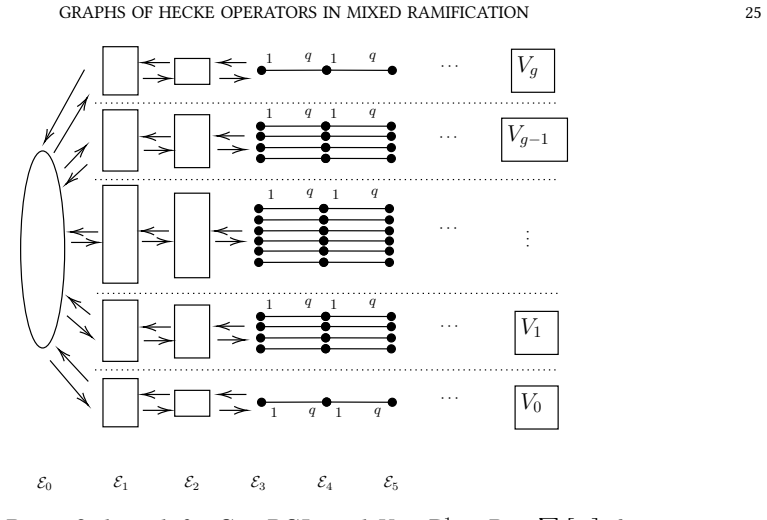
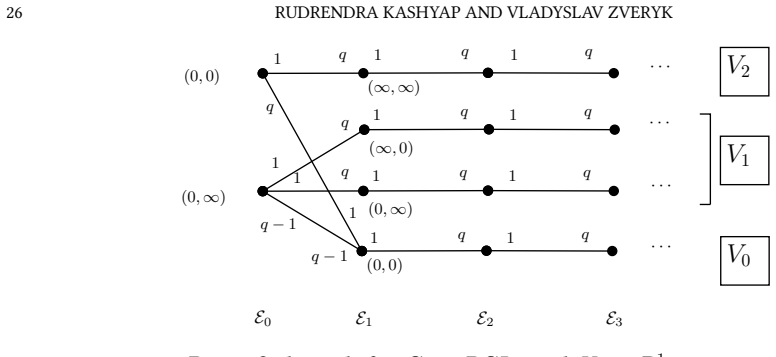
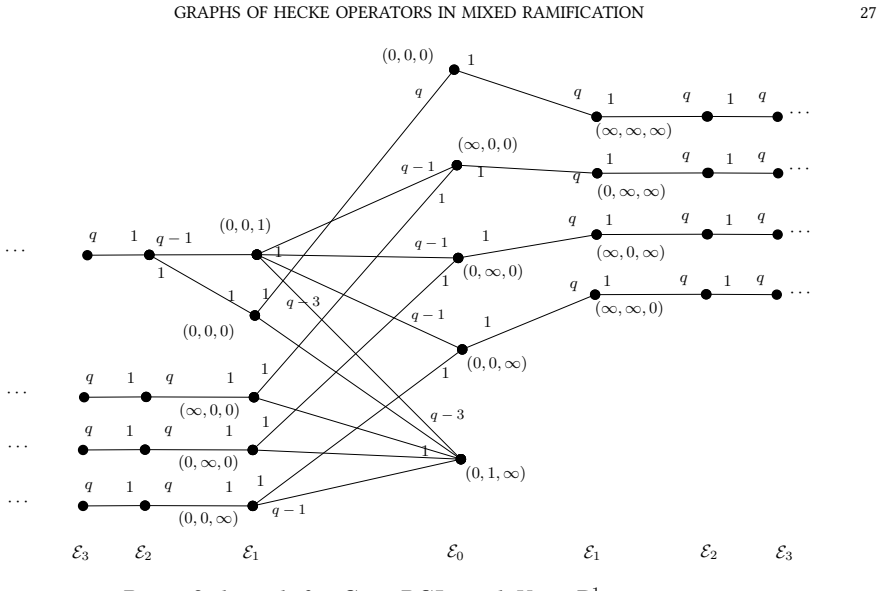
We study Hecke operators on moduli spaces of ramified $G$-bundles using the combinatorial language of Hecke graphs. We introduce a general notion of $\mathcal H$-ramification in the spirit of parahoric ramification, which depends on a choice of a divisor and subgroups of $G$ at every point of the divisor. Building on our previous work, we prove that, under mild regularity conditions, the action of a Hecke operator in the deep cusp of $\mathrm{Bun}_G$ in a highly complex ramification mimics an action in a much simpler ramification. This reduces the study to a smaller number of cases which, in particular, involve divisors supported at no more than two points. We demonstrate our methods by computing various examples for $G=\mathrm{PGL}_2$ and computing the dimensions of spaces of Hecke eigenforms for generic eigenvalues.
Editorial analysis
A structured set of objections, weighed in public.
Referee Report
Summary. The manuscript introduces a general notion of H-ramification for moduli spaces of G-bundles, depending on a divisor and choices of subgroups of G at each point of the divisor. Building on prior work, it proves that under mild regularity conditions the action of a Hecke operator in the deep cusp of Bun_G for highly complex ramification mimics the corresponding action for a much simpler ramification (in particular, divisors supported at no more than two points). The argument proceeds combinatorially via Hecke graphs. The methods are illustrated by explicit computations for G = PGL_2, including dimensions of spaces of Hecke eigenforms for generic eigenvalues.
Significance. If the central reduction theorem holds, the work provides a useful combinatorial simplification for studying Hecke operators on Bun_G in mixed ramification settings, allowing many cases to be reduced to low-support divisors. The explicit PGL_2 examples supply concrete verification and new dimension computations, strengthening the paper's contribution to the interface of algebraic geometry and automorphic forms.
minor comments (2)
- §2: The precise statement of the 'mild regularity conditions' on ramification data and subgroup choices should be isolated as a numbered hypothesis or definition to make the scope of the mimicking theorem immediately visible.
- The notation for Hecke graphs and the deep cusp could be cross-referenced more explicitly between the general setup and the PGL_2 examples to improve readability for readers not already familiar with the authors' prior work.
Simulated Author's Rebuttal
We thank the referee for the positive summary, significance assessment, and recommendation of minor revision. The description accurately reflects our introduction of H-ramification, the combinatorial reduction via Hecke graphs to low-support divisors, and the PGL_2 computations. Since the report contains no specific major comments, we have no point-by-point responses to address.
Circularity Check
No significant circularity in the derivation chain
full rationale
The paper's central reduction theorem follows from combinatorial properties of Hecke graphs applied to the introduced notion of H-ramification, under explicitly stated mild regularity conditions on divisors and subgroups. The mimicking property for complex versus simple ramification is derived directly from these graph structures rather than by fitting parameters to the target result or by self-definition. Concrete PGL_2 examples provide independent verification of the method. The reference to prior work supplies background but does not reduce the load-bearing combinatorial argument to an unverified self-citation chain. The derivation remains self-contained against external combinatorial benchmarks.
Axiom & Free-Parameter Ledger
Lean theorems connected to this paper
-
IndisputableMonolith/Foundation/RealityFromDistinction.leanreality_from_one_distinction unclear?
unclearRelation between the paper passage and the cited Recognition theorem.
under mild regularity conditions, the action of a Hecke operator in the deep cusp of Bun_G in a highly complex ramification mimics an action in a much simpler ramification... divisors supported at no more than two points
What do these tags mean?
- matches
- The paper's claim is directly supported by a theorem in the formal canon.
- supports
- The theorem supports part of the paper's argument, but the paper may add assumptions or extra steps.
- extends
- The paper goes beyond the formal theorem; the theorem is a base layer rather than the whole result.
- uses
- The paper appears to rely on the theorem as machinery.
- contradicts
- The paper's claim conflicts with a theorem or certificate in the canon.
- unclear
- Pith found a possible connection, but the passage is too broad, indirect, or ambiguous to say the theorem truly supports the claim.
Reference graph
Works this paper leans on
-
[1]
Israel Journal of Mathematics , volume =
Arkhipov, Sergey and Bezrukavnikov, Roman , title =. Israel Journal of Mathematics , volume =. 2009 , doi =
work page 2009
-
[2]
Journal of Number Theory , year =
Alvarenga, Roberto , title =. Journal of Number Theory , year =
-
[3]
Journal of Number Theory , year =
Alvarenga, Roberto and Bonnel, Nans , title =. Journal of Number Theory , year =
-
[4]
Rendiconti dell'Istituto di Matematica dell'Universit
Alvarenga, Roberto and Kaur, Inder and Mo. Rendiconti dell'Istituto di Matematica dell'Universit
-
[5]
Israel Journal of Mathematics , volume =
Alvarenga, Roberto , title =. Israel Journal of Mathematics , volume =. 2020 , pages =
work page 2020
-
[6]
Publications mathématiques de l'IHÉS , volume =
Bezrukavnikov, Roman , title =. Publications mathématiques de l'IHÉS , volume =. 2016 , doi =
work page 2016
-
[7]
International Mathematics Research Notices , volume =
uit de Bos, Niels , title =. International Mathematics Research Notices , volume =. 2022 , pages =
work page 2022
-
[8]
Ben-Zvi, David and Nadler, David , title =. Algebraic Geometry: Salt Lake City 2015 , series =. 2018 , doi =. 1606.08523 , archivePrefix =
work page internal anchor Pith review Pith/arXiv arXiv 2015
- [9]
-
[10]
Transformation Groups , volume =
Besson, Marc and Hong, Jiuzu , title =. Transformation Groups , volume =
-
[11]
Drinfel'd, V. G. , title =. Journal of Soviet Mathematics , volume =. 1987 , pages =. doi:10.1007/BF01104975 , note =
-
[12]
Cambridge Journal of Mathematics , volume =
Drinfeld, Vladimir and Gaitsgory, Dennis , title =. Cambridge Journal of Mathematics , volume =. 2015 , pages =
work page 2015
-
[13]
Journal of the American Mathematical Society , volume =
Frenkel, Edward and Gaitsgory, Dennis and Vilonen, Kari , title =. Journal of the American Mathematical Society , volume =. 2002 , pages =
work page 2002
-
[14]
Annales de l'Institut Fourier , volume =
Heinloth, Jochen , title =. Annales de l'Institut Fourier , volume =. 2004 , pages =
work page 2004
-
[15]
Kloosterman sheaves for reductive groups , journal =
Heinloth, Jochen and Ng. Kloosterman sheaves for reductive groups , journal =. 2013 , pages =
work page 2013
-
[16]
Affine Flag Manifolds and Principal Bundles , editor =
Heinloth, Jochen , title =. Affine Flag Manifolds and Principal Bundles , editor =. 2010 , pages =
work page 2010
-
[17]
Toroidal automorphic forms for some function fields , author=. 2008 , eprint=
work page 2008
-
[18]
Mathematische Zeitschrift , volume =
Lorscheid, Oliver , title =. Mathematische Zeitschrift , volume =. 2012 , pages =
work page 2012
-
[19]
Algebra & Number Theory , year =
Lorscheid, Oliver , title =. Algebra & Number Theory , year =
-
[20]
Faces and maximizer subsets of highest weight modules
Apoorva Khare , title =. arXiv preprint , year =. 1301.1140 , archivePrefix =
work page internal anchor Pith review Pith/arXiv arXiv
-
[21]
Eigenforms and graphs of Hecke operators with wild ramification , author=. 2026 , eprint=
work page 2026
- [22]
- [23]
- [24]
- [25]
-
[26]
Huybrechts, Daniel and Lehn, Manfred , title =. 2010 , edition =. doi:10.1017/CBO9780511711985 , isbn =
- [27]
- [28]
- [29]
-
[30]
Recent progress in geometric Langlands theory , author=. 2016 , eprint=
work page 2016
-
[31]
Gaitsgory, Dennis and Lurie, Jacob , title =
-
[32]
Ramanathan, A. , title =. Mathematische Annalen , volume =. 1975 , pages =. doi:10.1007/BF01343949 , url =
-
[33]
Selecta Mathematica , series =
Yun, Zhiwei , title =. Selecta Mathematica , series =. 2016 , pages =
work page 2016
- [34]
-
[35]
Rigidity in automorphic representations and local systems
Yun, Zhiwei , title =. Current Developments in Mathematics 2013 , pages =. 2014 , doi =. 1405.3035 , archivePrefix =
work page internal anchor Pith review Pith/arXiv arXiv 2013
discussion (0)
Sign in with ORCID, Apple, or X to comment. Anyone can read and Pith papers without signing in.