Recognition: no theorem link
From DES to KiDS: Domain adaptation for cross-survey detection of low-surface-brightness galaxies
Pith reviewed 2026-05-14 17:42 UTC · model grok-4.3
The pith
Domain adaptation allows deep learning models trained on DES data to detect low-surface-brightness galaxies in KiDS imaging.
A machine-rendered reading of the paper's core claim, the machinery that carries it, and where it could break.
Core claim
Models trained on DES cutouts and applied through domain adaptation to KiDS DR5 imaging identify 20,180 LSBGs and 434 UDGs whose structural parameters, size-luminosity relation, and color bimodality match known populations from other surveys, with cluster environments linked to redder colors and suppressed star formation.
What carries the argument
Domain adaptation of an ensemble consisting of one convolutional neural network and two transformer models trained on DES cutouts for application to KiDS DR5 imaging.
If this is right
- 20,180 LSBGs and 434 UDGs are catalogued in KiDS DR5 with structural parameters matching those from DES and HSC-SSP.
- The LSBGs follow a continuous size-luminosity relation that bridges classical dwarf galaxies and ultra-diffuse galaxies.
- Cluster LSBGs exhibit redder colors and lower star formation rates than field systems, as shown by spectroscopic cross-matches.
- The same transfer method supplies a scalable route to uniform LSBG catalogues once LSST and Euclid imaging become available.
Where Pith is reading between the lines
- The same adaptation pipeline could be applied to additional overlapping surveys to enlarge combined LSBG samples for statistical studies.
- Environmental trends measured here suggest LSBG star-formation histories are shaped by local density, a relation that can be tested with future cluster surveys.
- Once validated on larger areas, this approach reduces the need for survey-specific retraining and supports automated processing of petabyte-scale datasets.
Load-bearing premise
The models trained on DES generalize to KiDS without large biases from survey differences in depth, seeing, or filters, and the detected objects are genuine LSBGs rather than contaminants.
What would settle it
A blind visual inspection or independent catalog cross-match of a random subset of the 20,180 candidates that reveals systematic differences in detection purity or structural parameters between the two surveys.
Figures







read the original abstract
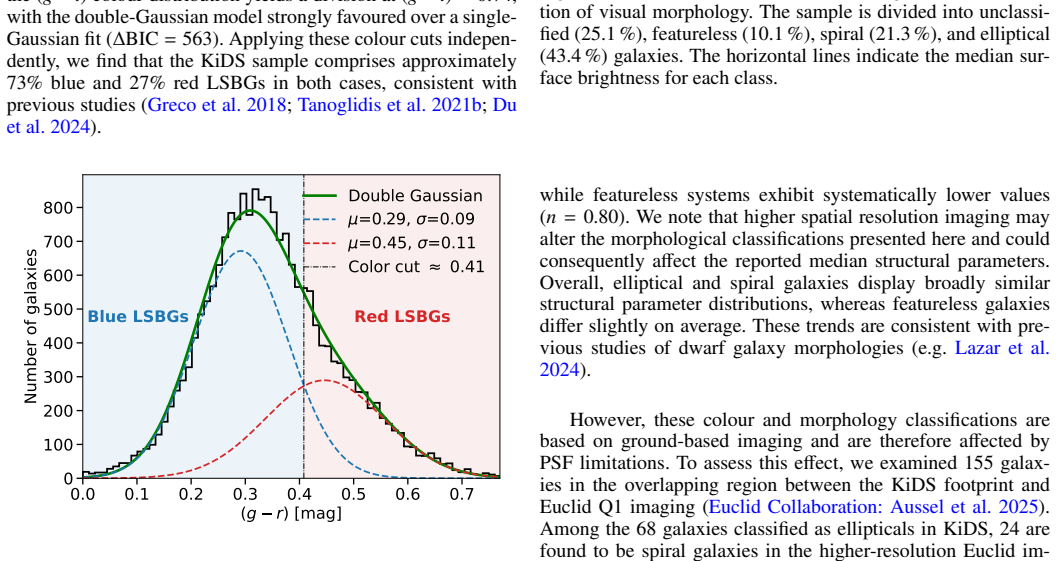
Low-surface-brightness galaxies (LSBGs) are vital for understanding galaxy formation, but their diffuse nature makes them challenging to detect. Upcoming large-scale surveys are expected to uncover large numbers of LSBGs, requiring robust automated methods to identify them across heterogeneous datasets. As a precursor to the Legacy Survey of Space and Time (LSST) and Euclid, we explore domain adaptation techniques for cross-survey LSBG identification. Using models trained on the Dark Energy Survey (DES), we search for LSBGs in the Kilo-Degree Survey Data Release 5 (KiDS DR5). We used an ensemble consisting of one convolutional neural network (CNN) and two transformer models trained on DES cutouts and applied to KiDS DR5 imaging data. Structural parameters were estimated with galfitm, and photometric redshifts and stellar population properties were estimated through spectral energy distribution fitting with CIGALE. We identify 20,180 LSBGs and 434 ultra-diffuse galaxies (UDGs) in KiDS DR5. Their structural parameters are similar to known LSBGs from DES and the Hyper Suprime-Cam SSP Survey (HSC-SSP). The KiDS-LSBGs follow a continuous size-luminosity relation connecting classical dwarf galaxies and UDGs, and their colours are bimodal ($\sim73\%$ blue, $\sim27\%$ red). Cross-matching with spectroscopic and cluster catalogues provides redshifts for 4,913 systems, enabling a systematic characterisation of the star-forming main sequence of LSBGs. Strong environmental trends are evident, with cluster LSBGs and UDGs exhibiting redder colours and reduced star formation compared to non-cluster systems. We demonstrate that domain adaptation enables robust cross-survey LSBG identification with deep learning models, providing a scalable pathway for constructing homogeneous LSBG catalogues for the LSST and Euclid era.
Editorial analysis
A structured set of objections, weighed in public.
Referee Report
Summary. The paper claims that domain adaptation with an ensemble of one CNN and two transformer models trained on DES cutouts can be applied to KiDS DR5 imaging to robustly detect LSBGs, yielding 20,180 LSBGs and 434 UDGs whose galfitm structural parameters and CIGALE-derived properties are consistent with DES and HSC-SSP samples; a subset with spectroscopic redshifts shows expected trends in the star-forming main sequence and environmental effects, demonstrating a scalable pathway for homogeneous LSBG catalogs in the LSST/Euclid era.
Significance. If the generalization claim holds, the work would be significant as a practical demonstration of cross-survey LSBG detection that could enable large, homogeneous samples for future wide-field surveys. The reported sample size, multi-wavelength characterization, and environmental analysis are strengths, and the use of an ensemble plus cross-matching with spectroscopic catalogs provides a concrete starting point for catalog construction.
major comments (4)
- [Abstract] Abstract and §3 (implied methods): the domain-adaptation technique itself is not described (no equations, no training details on how DES-to-KiDS shift is mitigated), so it is impossible to evaluate whether differences in depth, seeing, and filter response are actually addressed.
- [Abstract] Abstract and Results: no quantitative metrics (precision, recall, contamination fraction, or false-positive rate) are supplied for the KiDS detections; the central claim of 'robust' identification therefore rests only on post-selection similarity of galfitm and CIGALE parameters, which does not directly test model performance on the target domain.
- [Results] Results: the reported 20,180 detections and 4,913 spectroscopic redshifts lack error bars, statistical tests for parameter agreement with DES/HSC, or a control sample to quantify selection biases introduced by the domain shift.
- [Validation] Validation: no held-out KiDS labeled set or domain-shift simulations are presented, leaving open the possibility that a non-negligible fraction of detections are imaging artifacts rather than genuine LSBGs.
minor comments (2)
- [Figures] Figure captions and axis labels for the size-luminosity relation should explicitly state the selection cuts applied to both KiDS and comparison samples.
- [Methods] The ensemble architecture (CNN + two transformers) would benefit from a short table summarizing input sizes, training hyperparameters, and inference thresholds.
Simulated Author's Rebuttal
We thank the referee for their constructive and detailed comments, which have highlighted important areas for clarification and strengthening of the manuscript. We address each major comment below and will revise the paper to incorporate additional details, analyses, and explicit discussions of limitations where feasible.
read point-by-point responses
-
Referee: [Abstract] Abstract and §3 (implied methods): the domain-adaptation technique itself is not described (no equations, no training details on how DES-to-KiDS shift is mitigated), so it is impossible to evaluate whether differences in depth, seeing, and filter response are actually addressed.
Authors: We agree that the current description of the domain adaptation procedure is insufficiently detailed for full evaluation. In the revised manuscript we will expand §3 to provide the specific domain-adaptation methods, including any equations or procedures used to mitigate differences in depth, seeing, and filter response, together with the training protocol for the CNN and transformer ensemble. revision: yes
-
Referee: [Abstract] Abstract and Results: no quantitative metrics (precision, recall, contamination fraction, or false-positive rate) are supplied for the KiDS detections; the central claim of 'robust' identification therefore rests only on post-selection similarity of galfitm and CIGALE parameters, which does not directly test model performance on the target domain.
Authors: The referee is correct that direct performance metrics on the target domain are not reported. Because no labeled KiDS LSBG validation set exists, precision, recall, and false-positive rates cannot be computed directly. We will revise the text to state this limitation explicitly, to justify the indirect validation via parameter consistency, and to include any available contamination estimates from visual inspection or other proxies. revision: partial
-
Referee: [Results] Results: the reported 20,180 detections and 4,913 spectroscopic redshifts lack error bars, statistical tests for parameter agreement with DES/HSC, or a control sample to quantify selection biases introduced by the domain shift.
Authors: We will add Poisson error bars to the reported counts. In the revised results section we will include statistical tests (e.g., Kolmogorov-Smirnov) comparing structural-parameter distributions with the DES and HSC-SSP samples and will introduce a control-sample analysis to quantify selection biases arising from the domain shift. revision: yes
-
Referee: [Validation] Validation: no held-out KiDS labeled set or domain-shift simulations are presented, leaving open the possibility that a non-negligible fraction of detections are imaging artifacts rather than genuine LSBGs.
Authors: We acknowledge the absence of a held-out labeled KiDS set. In the revised validation section we will add domain-shift simulations to test model robustness under controlled differences in imaging properties and will discuss the risk of imaging artifacts together with the selection criteria used to reduce them, while noting this as an inherent limitation. revision: partial
- The absence of a labeled KiDS validation set prevents direct computation of precision, recall, contamination fraction, or false-positive rate on the target domain.
Circularity Check
No circularity: empirical application of pre-trained models with independent post-processing validation
full rationale
The paper applies an ensemble of CNN and transformer models (pre-trained on DES) directly to KiDS DR5 cutouts, then measures structural parameters via galfitm and SED properties via CIGALE on the resulting detections. These downstream measurements are independent of the detection step and serve as external checks against DES/HSC samples. No equations, parameter fits, or self-citations are used to derive the central claim; the result is an empirical catalog whose properties are compared to external benchmarks rather than predicted from the training inputs by construction. This is a standard non-circular empirical ML transfer study.
Axiom & Free-Parameter Ledger
axioms (1)
- domain assumption Deep-learning models trained on DES cutouts will generalize to KiDS DR5 imaging despite differences in depth, PSF, and filters.
Reference graph
Works this paper leans on
-
[1]
Using mock Low Surface Brightness dwarf galaxies to probe Wide Survey detection capabilities
Euclid preparation. Using mock Low Surface Brightness dwarf galaxies to probe Wide Survey detection capabilities. arXiv e-prints , keywords =. doi:10.48550/arXiv.2509.13163 , archivePrefix =. 2509.13163 , primaryClass =
-
[2]
Euclid Quick Data Release (Q1) -- Data release overview. arXiv e-prints , keywords =. doi:10.48550/arXiv.2503.15302 , archivePrefix =. 2503.15302 , primaryClass =
-
[3]
Mateusz Buda and Atsuto Maki and Maciej A. Mazurowski , keywords =. A systematic study of the class imbalance problem in convolutional neural networks , journal =. 2018 , issn =. doi:https://doi.org/10.1016/j.neunet.2018.07.011 , url =
-
[4]
Neural Networks , year=
Early Stopping-But When? , author=. Neural Networks , year=
-
[5]
A Highly Consistent Framework for the Evolution of the Star-Forming "Main Sequence" from z~0-6
A Highly Consistent Framework for the Evolution of the Star-Forming ``Main Sequence'' from z -0.5ex 0-6. , keywords =. doi:10.1088/0067-0049/214/2/15 , archivePrefix =. 1405.2041 , primaryClass =
work page internal anchor Pith review Pith/arXiv arXiv doi:10.1088/0067-0049/214/2/15 2041
-
[6]
Discovery and analysis of low-surface-brightness galaxies in the environment of NGC 1052. , keywords =. doi:10.1051/0004-6361/202142161 , archivePrefix =. 2110.09527 , primaryClass =
-
[7]
Hybrid-z: Enhancing the Kilo-Degree Survey bright galaxy sample photometric redshifts with deep learning. , keywords =. doi:10.1051/0004-6361/202453576 , archivePrefix =. 2501.01942 , primaryClass =
-
[8]
Dust Attenuation Curves in the Local Universe: Demographics and New Laws for Star-forming Galaxies and High-redshift Analogs. , keywords =. doi:10.3847/1538-4357/aabf3c , archivePrefix =. 1804.05850 , primaryClass =
work page internal anchor Pith review Pith/arXiv arXiv doi:10.3847/1538-4357/aabf3c
-
[9]
Impact of stochastic star-formation histories and dust on selecting quiescent galaxies with JWST photometry. arXiv e-prints , keywords =. doi:10.48550/arXiv.2509.10117 , archivePrefix =. 2509.10117 , primaryClass =
work page internal anchor Pith review Pith/arXiv arXiv doi:10.48550/arxiv.2509.10117
-
[10]
Starbursts in and out of the star-formation main sequence
Starbursts in and out of the star-formation main sequence. , keywords =. doi:10.1051/0004-6361/201732370 , archivePrefix =. 1711.10047 , primaryClass =
work page internal anchor Pith review Pith/arXiv arXiv doi:10.1051/0004-6361/201732370
-
[11]
The Star Forming Main Sequence of Dwarf Low Surface Brightness Galaxies
The Star-forming Main Sequence of Dwarf Low Surface Brightness Galaxies. , keywords =. doi:10.3847/1538-4357/aa9790 , archivePrefix =. 1710.11236 , primaryClass =
work page internal anchor Pith review Pith/arXiv arXiv doi:10.3847/1538-4357/aa9790
-
[12]
In pursuit of giants. I. The evolution of the dust-to-stellar mass ratio in distant dusty galaxies. , keywords =. doi:10.1051/0004-6361/202038405 , archivePrefix =. 2008.09995 , primaryClass =
-
[13]
Photometric redshifts for the Kilo-Degree Survey. Machine-learning analysis with artificial neural networks. , keywords =. doi:10.1051/0004-6361/201731942 , archivePrefix =. 1709.04205 , primaryClass =
work page internal anchor Pith review Pith/arXiv arXiv doi:10.1051/0004-6361/201731942
-
[14]
Photometric Redshifts based on standard SED fitting procedures
Photometric redshifts based on standard SED fitting procedures. , keywords =. doi:10.48550/arXiv.astro-ph/0003380 , archivePrefix =. astro-ph/0003380 , primaryClass =
work page internal anchor Pith review Pith/arXiv arXiv doi:10.48550/arxiv.astro-ph/0003380
-
[15]
Long-slit Spectroscopy of Edge-on Low Surface Brightness Galaxies
Long-slit Spectroscopy of Edge-on Low Surface Brightness Galaxies. , keywords =. doi:10.3847/1538-4357/aa6194 , archivePrefix =. 1702.06026 , primaryClass =
work page internal anchor Pith review Pith/arXiv arXiv doi:10.3847/1538-4357/aa6194
-
[16]
URLhttps://doi.org/ 10.1080/01621459.1995.10476572
Robert E. Kass and Adrian E. Raftery , title =. Journal of the American Statistical Association , volume =. 1995 , publisher =. doi:10.1080/01621459.1995.10476572 , URL =
-
[17]
MCXC-II: Second release of the Meta-Catalogue of X-ray detected Clusters of galaxies. , keywords =. doi:10.1051/0004-6361/202449427 , archivePrefix =. 2402.01538 , primaryClass =
-
[18]
Correcting for the Effects of Interstellar Extinction
Correcting for the Effects of Interstellar Extinction. , keywords =. doi:10.1086/316293 , archivePrefix =. astro-ph/9809387 , primaryClass =
work page internal anchor Pith review Pith/arXiv arXiv doi:10.1086/316293
-
[19]
Mass and Environment as Drivers of Galaxy Evolution in SDSS and zCOSMOS and the Origin of the Schechter Function. , keywords =. doi:10.1088/0004-637X/721/1/193 , archivePrefix =. 1003.4747 , primaryClass =
work page internal anchor Pith review Pith/arXiv arXiv doi:10.1088/0004-637x/721/1/193
-
[20]
The Journal of Open Source Software , year = 2016, month = oct, volume =
SEP: Source Extractor as a library. The Journal of Open Source Software , year = 2016, month = oct, volume =. doi:10.21105/joss.00058 , adsurl =
-
[21]
Photo-z performance for precision cosmology. , keywords =. doi:10.1111/j.1365-2966.2010.16765.x , archivePrefix =. 0910.5735 , primaryClass =
-
[22]
CFHTLenS: improving the quality of photometric redshifts with precision photometry. , keywords =. doi:10.1111/j.1365-2966.2012.20468.x , archivePrefix =. 1111.4434 , primaryClass =
-
[23]
Star formation and the interstellar medium in low surface brightness galaxies. II. Deep CO observations of low surface brightness disk galaxies. , keywords =. doi:10.48550/arXiv.astro-ph/9804291 , archivePrefix =. astro-ph/9804291 , primaryClass =
work page internal anchor Pith review Pith/arXiv arXiv doi:10.48550/arxiv.astro-ph/9804291
-
[24]
Oxygen Abundances in Low Surface Brightness Disk Galaxies
Oxygen Abundances in Low Surface Brightness Disk Galaxies. , keywords =. doi:10.1086/174049 , archivePrefix =. astro-ph/9311064 , primaryClass =
work page internal anchor Pith review Pith/arXiv arXiv doi:10.1086/174049
-
[25]
Galaxy merger challenge: A comparison study between machine learning-based detection methods. , keywords =. doi:10.1051/0004-6361/202348239 , archivePrefix =. 2403.15118 , primaryClass =
-
[26]
Fitting the Shadows: Star Formation Scaling Relations in the Low Surface Brightness Regime. arXiv e-prints , keywords =. doi:10.48550/arXiv.2509.20080 , archivePrefix =. 2509.20080 , primaryClass =
-
[27]
The main sequence of star-forming galaxies across cosmic times. , keywords =. doi:10.1093/mnras/stac3214 , archivePrefix =. 2203.10487 , primaryClass =
-
[28]
Ultra-diffuse galaxies in the Kilo-Degree Survey with deep learning. , keywords =. doi:10.1051/0004-6361/202556535 , archivePrefix =. 2509.13910 , primaryClass =
-
[29]
Stellar population synthesis at the resolution of 2003. , keywords =. doi:10.1046/j.1365-8711.2003.06897.x , archivePrefix =. astro-ph/0309134 , primaryClass =
-
[30]
M., 2000, @doi [ ] 10.1086/309250 , http://adsabs.harvard.edu/abs/2000ApJ...539..718C 539, 718
A Simple Model for the Absorption of Starlight by Dust in Galaxies. , keywords =. doi:10.1086/309250 , archivePrefix =. astro-ph/0003128 , primaryClass =
work page internal anchor Pith review Pith/arXiv arXiv doi:10.1086/309250
-
[31]
Galactic Stellar and Substellar Initial Mass Function. , keywords =. doi:10.1086/376392 , archivePrefix =. astro-ph/0304382 , primaryClass =
work page internal anchor Pith review Pith/arXiv arXiv doi:10.1086/376392
-
[32]
The Messenger , year = 2013, month = dec, volume =
The VISTA Kilo-degree Infrared Galaxy (VIKING) Survey: Bridging the Gap between Low and High Redshift. The Messenger , year = 2013, month = dec, volume =
2013
-
[33]
CIGALE: a python Code Investigating GALaxy Emission
CIGALE: a python Code Investigating GALaxy Emission. , keywords =. doi:10.1051/0004-6361/201834156 , archivePrefix =. 1811.03094 , primaryClass =
work page internal anchor Pith review Pith/arXiv arXiv doi:10.1051/0004-6361/201834156
-
[34]
Report of the Dark Energy Task Force
Report of the Dark Energy Task Force. arXiv e-prints , keywords =. doi:10.48550/arXiv.astro-ph/0609591 , archivePrefix =. astro-ph/0609591 , primaryClass =
work page internal anchor Pith review Pith/arXiv arXiv doi:10.48550/arxiv.astro-ph/0609591
-
[35]
Research in Astronomy and Astrophysics , keywords =
Low Surface Brightness Galaxies from BASS+MzLS with Machine Learning. Research in Astronomy and Astrophysics , keywords =. doi:10.1088/1674-4527/ad3954 , archivePrefix =. 2404.18408 , primaryClass =
-
[36]
The fifth data release of the Kilo Degree Survey: Multi-epoch optical/NIR imaging covering wide and legacy-calibration fields. , keywords =. doi:10.1051/0004-6361/202346730 , archivePrefix =. 2503.19439 , primaryClass =
-
[37]
2024 , eprint=
The effect of image quality on galaxy merger identification with deep learning , author=. 2024 , eprint=
2024
-
[38]
Olson and Dursun Delen , title=
David L. Olson and Dursun Delen , title=. doi:10.1007/978-3-540-76917-0 , isbn=
-
[39]
Chandra and ROSAT Observations of A194: Detection of an X-Ray Cavity and Mapping the Dynamics of the Cluster. , keywords =. doi:10.1088/0004-637X/743/1/59 , archivePrefix =. 1106.3434 , primaryClass =
work page internal anchor Pith review Pith/arXiv arXiv doi:10.1088/0004-637x/743/1/59
-
[40]
The Pan-STARRS 1 Photometric Reference Ladder, Release 12.0
The Pan-STARRS 1 Photometric Reference Ladder, Release 12.01. , keywords =. doi:10.1088/0067-0049/205/2/20 , archivePrefix =. 1303.3634 , primaryClass =
work page internal anchor Pith review Pith/arXiv arXiv doi:10.1088/0067-0049/205/2/20
-
[41]
Luminosity Functions of 10 Nearby Clusters of Galaxies. I. Data. , keywords =. doi:10.1086/324731 , adsurl =
-
[42]
The Pan-STARRS1 Photometric System
The Pan-STARRS1 Photometric System. , keywords =. doi:10.1088/0004-637X/750/2/99 , archivePrefix =. 1203.0297 , primaryClass =
work page internal anchor Pith review Pith/arXiv arXiv doi:10.1088/0004-637x/750/2/99
-
[43]
The Pan-STARRS1 Surveys. arXiv e-prints , keywords =. doi:10.48550/arXiv.1612.05560 , archivePrefix =. 1612.05560 , primaryClass =
work page internal anchor Pith review Pith/arXiv arXiv doi:10.48550/arxiv.1612.05560
-
[44]
Photometric Calibration of the First 1.5 Years of the Pan-STARRS1 Survey
Photometric Calibration of the First 1.5 Years of the Pan-STARRS1 Survey. , keywords =. doi:10.1088/0004-637X/756/2/158 , archivePrefix =. 1201.2208 , primaryClass =
work page internal anchor Pith review Pith/arXiv arXiv doi:10.1088/0004-637x/756/2/158
-
[45]
The Ninth Data Release of the Sloan Digital Sky Survey: First Spectroscopic Data from the SDSS-III Baryon Oscillation Spectroscopic Survey. , keywords =. doi:10.1088/0067-0049/203/2/21 , archivePrefix =. 1207.7137 , primaryClass =
work page internal anchor Pith review Pith/arXiv arXiv doi:10.1088/0067-0049/203/2/21
-
[46]
Astronomical Data Analysis Software and Systems XXV , year = 2017, editor =
The LSST Data Management System. Astronomical Data Analysis Software and Systems XXV , year = 2017, editor =. doi:10.48550/arXiv.1512.07914 , archivePrefix =. 1512.07914 , primaryClass =
-
[47]
Serbian Astronomical Journal , keywords =
Large Synoptic Survey Telescope: From Science Drivers To Reference Design. Serbian Astronomical Journal , keywords =. doi:10.2298/SAJ0876001I , adsurl =
-
[48]
The Hyper Suprime-Cam Software Pipeline
The Hyper Suprime-Cam software pipeline. , keywords =. doi:10.1093/pasj/psx080 , archivePrefix =. 1705.06766 , primaryClass =
work page internal anchor Pith review Pith/arXiv arXiv doi:10.1093/pasj/psx080
-
[49]
MUSE observations of the giant low surface brightness galaxy Malin 1: Numerous HII regions, star formation rate, metallicity, and dust attenuation. , keywords =. doi:10.1051/0004-6361/202347669 , archivePrefix =. 2310.11872 , primaryClass =
-
[50]
The Galaxy Evolution Explorer: A Space Ultraviolet Survey Mission. , keywords =. doi:10.1086/426387 , archivePrefix =. astro-ph/0411302 , primaryClass =
work page internal anchor Pith review Pith/arXiv arXiv doi:10.1086/426387
-
[51]
2004, MNRAS, 351, 1379, doi: 10.1111/j.1365-2966.2004.07876.x
The cosmological significance of low surface brightness galaxies found in a deep blind neutral hydrogen survey. , keywords =. doi:10.1111/j.1365-2966.2004.08409.x , archivePrefix =. astro-ph/0409628 , primaryClass =
-
[52]
Measuring Reddening with Sloan Digital Sky Survey Stellar Spectra and Recalibrating SFD. , keywords =. doi:10.1088/0004-637X/737/2/103 , archivePrefix =. 1012.4804 , primaryClass =
work page internal anchor Pith review Pith/arXiv arXiv doi:10.1088/0004-637x/737/2/103
-
[53]
The Astronomical Journal , abstract =
Wei Du and Cheng Cheng and Zheng Zheng and Hong Wu , title =. The Astronomical Journal , abstract =. 2020 , month =. doi:10.3847/1538-3881/ab6efb , url =
-
[54]
The Astrophysical Journal Supplement Series , author =
The Calibration and Data Products of GALEX. , keywords =. doi:10.1086/520512 , archivePrefix =. 0706.0755 , primaryClass =
-
[55]
Hyper Suprime-Cam: Camera dewar design. , keywords =. doi:10.1093/pasj/psx069 , adsurl =
-
[56]
Hyper Suprime-Cam: System design and verification of image quality. , keywords =. doi:10.1093/pasj/psx063 , adsurl =
-
[57]
Hyper Suprime-Cam: Filters. , keywords =. doi:10.1093/pasj/psy056 , adsurl =
-
[58]
The on-site quality-assurance system for Hyper Suprime-Cam: OSQAH. , keywords =. doi:10.1093/pasj/psx079 , adsurl =
-
[59]
Revised Catalog of GALEX Ultraviolet Sources. I. The All-Sky Survey: GUVcat\_AIS. , keywords =. doi:10.3847/1538-4365/aa7053 , archivePrefix =. 1704.05903 , primaryClass =
work page internal anchor Pith review Pith/arXiv arXiv doi:10.3847/1538-4365/aa7053
-
[60]
PEARLS: Low Stellar Density Galaxies in the El Gordo Cluster Observed with JWST. , keywords =. doi:10.3847/1538-4357/ace343 , archivePrefix =. 2303.04726 , primaryClass =
-
[61]
Maps of Dust IR Emission for Use in Estimation of Reddening and CMBR Foregrounds
Maps of Dust Infrared Emission for Use in Estimation of Reddening and Cosmic Microwave Background Radiation Foregrounds. , keywords =. doi:10.1086/305772 , archivePrefix =. astro-ph/9710327 , primaryClass =
work page internal anchor Pith review Pith/arXiv arXiv doi:10.1086/305772
-
[62]
The Cosmological Unimportance of Low Surface Brightness Galaxies
The Cosmological Unimportance of Low Surface Brightness Galaxies. , keywords =. doi:10.1086/497565 , archivePrefix =. astro-ph/0510259 , primaryClass =
work page internal anchor Pith review Pith/arXiv arXiv doi:10.1086/497565
-
[63]
Multiple Classifier Systems , pages=
Ensemble methods in machine learning , author=. Multiple Classifier Systems , pages=. 2000 , publisher=
2000
-
[64]
Proceedings of the fifth ACM SIGKDD international conference on Knowledge discovery and data mining , pages=
Metacost: a general method for making classifiers cost-sensitive , author=. Proceedings of the fifth ACM SIGKDD international conference on Knowledge discovery and data mining , pages=. 1999 , organization=
1999
-
[65]
APLpy: Astronomical Plotting Library in Python
-
[66]
Color Separation of Galaxy Types in the Sloan Digital Sky Survey Imaging Data
Color Separation of Galaxy Types in the Sloan Digital Sky Survey Imaging Data. , keywords =. doi:10.1086/323301 , archivePrefix =. astro-ph/0107201 , primaryClass =
work page internal anchor Pith review Pith/arXiv arXiv doi:10.1086/323301
-
[67]
Galaxy Zoo: the dependence of morphology and colour on environment*. , keywords =. doi:10.1111/j.1365-2966.2008.14252.x , archivePrefix =. 0805.2612 , primaryClass =
-
[68]
International Conference on Learning Representations , year=
Wisdom of Committees: An Overlooked Approach To Faster and More Accurate Models , author=. International Conference on Learning Representations , year=
-
[69]
Imfit: A Fast, Flexible New Program for Astronomical Image Fitting
IMFIT: A Fast, Flexible New Program for Astronomical Image Fitting. , keywords =. doi:10.1088/0004-637X/799/2/226 , archivePrefix =. 1408.1097 , primaryClass =
work page internal anchor Pith review Pith/arXiv arXiv doi:10.1088/0004-637x/799/2/226
-
[70]
Dark Energy Survey Year 3 Results: Photometric Data Set for Cosmology. , keywords =. doi:10.3847/1538-4365/abeb66 , archivePrefix =. 2011.03407 , primaryClass =
-
[71]
Paying Attention to Astronomical Transients: Introducing the Time-series Transformer for Photometric Classification. arXiv e-prints , keywords =. doi:10.48550/arXiv.2105.06178 , archivePrefix =. 2105.06178 , primaryClass =
-
[72]
Deep Attention-based Supernovae Classification of Multiband Light Curves. , keywords =. doi:10.3847/1538-3881/ac9ab4 , archivePrefix =. 2201.08482 , primaryClass =
-
[73]
Detection of Strongly Lensed Arcs in Galaxy Clusters with Transformers. , keywords =. doi:10.3847/1538-3881/aca1c2 , archivePrefix =. 2211.05972 , primaryClass =
-
[74]
Astronomical CCD Observing and Reduction Techniques , year = 1992, editor =
Basic Photometry Techniques. Astronomical CCD Observing and Reduction Techniques , year = 1992, editor =
1992
-
[75]
Strong Gravitational Lensing Parameter Estimation with Vision Transformer
Huang, Kuan-Wei and Chen, Geoff Chih-Fan and Chang, Po-Wen and Lin, Sheng-Chieh and Hsu, ChiaJung and Thengane, Vishal and Lin, Joshua Yao-Yu. Strong Gravitational Lensing Parameter Estimation with Vision Transformer. Computer Vision -- ECCV 2022 Workshops. 2023
2022
-
[76]
Science China Physics, Mechanics, and Astronomy , keywords =
The FAST all sky H I survey (FASHI): The first release of catalog. Science China Physics, Mechanics, and Astronomy , keywords =. doi:10.1007/s11433-023-2219-7 , archivePrefix =. 2312.06097 , primaryClass =
-
[77]
The Arecibo Legacy Fast ALFA Survey: The ALFALFA Extragalactic HI Source Catalog
The Arecibo Legacy Fast ALFA Survey: The ALFALFA Extragalactic H I Source Catalog. , keywords =. doi:10.3847/1538-4357/aac956 , archivePrefix =. 1805.11499 , primaryClass =
work page internal anchor Pith review Pith/arXiv arXiv doi:10.3847/1538-4357/aac956
-
[78]
2001, MNRAS, 322, 231, doi: 10.1046/j.1365-8711.2001.04022.x
The 2dF Galaxy Redshift Survey: spectra and redshifts. , keywords =. doi:10.1046/j.1365-8711.2001.04902.x , archivePrefix =. astro-ph/0106498 , primaryClass =
-
[79]
The Seventeenth Data Release of the Sloan Digital Sky Surveys: Complete Release of MaNGA, MaStar, and APOGEE-2 Data. , keywords =. doi:10.3847/1538-4365/ac4414 , archivePrefix =. 2112.02026 , primaryClass =
-
[80]
Data Release 1 of the Dark Energy Spectroscopic Instrument
Data Release 1 of the Dark Energy Spectroscopic Instrument. arXiv e-prints , keywords =. doi:10.48550/arXiv.2503.14745 , archivePrefix=. 2503.14745 , primaryClass =
work page internal anchor Pith review Pith/arXiv arXiv doi:10.48550/arxiv.2503.14745
discussion (0)
Sign in with ORCID, Apple, or X to comment. Anyone can read and Pith papers without signing in.