Recognition: no theorem link
Vision-Based Runtime Monitoring under Varying Specifications using Semantic Latent Representations
Pith reviewed 2026-05-15 05:14 UTC · model grok-4.3
The pith
The vector of atom robustness scores is the minimal reusable interface that certifies any past-time STL formula from images after one calibration.
A machine-rendered reading of the paper's core claim, the machinery that carries it, and where it could break.
Core claim
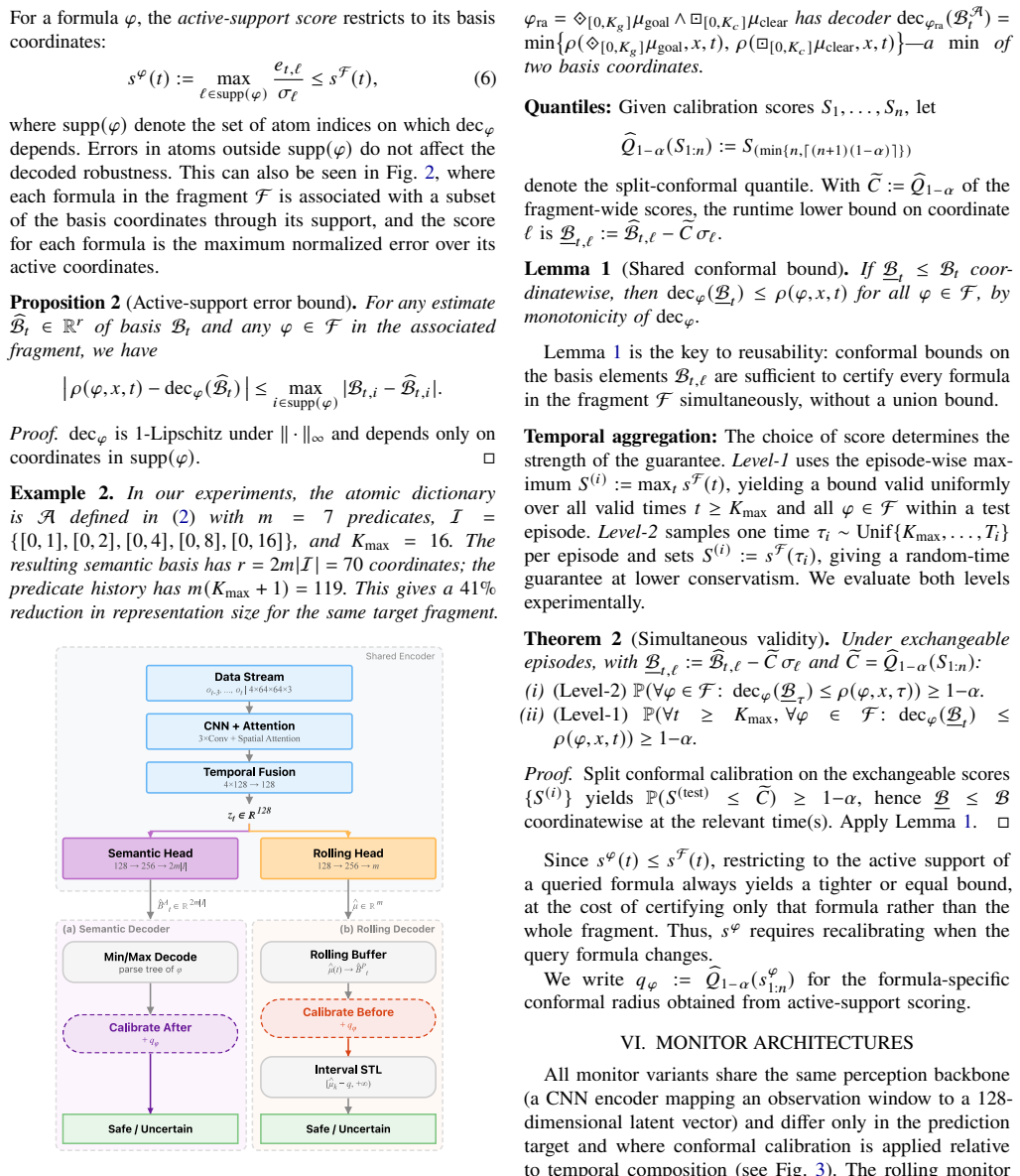
For fragments induced by a finite dictionary of temporal atoms, the semantic basis (the vector of atom robustness scores) is the minimum prediction target among all monotone, 1-Lipschitz reusable interfaces. Any formula is then evaluated by a deterministic decoder derived from the parse tree, and a single conformal calibration pass certifies the entire fragment with no union bound. The rolling prediction monitor, which predicts only current predicate values and reconstructs temporal history online, is easier to learn but grows conservative at long horizons.
What carries the argument
The semantic basis, a vector of atom robustness scores for a finite dictionary of temporal atoms, which serves as the minimum prediction target for monotone 1-Lipschitz reusable interfaces and enables deterministic decoding of any formula via its parse tree.
If this is right
- Any formula in the target fragment can be monitored without retraining once the model and calibration are fixed.
- The semantic-basis monitor produces up to four-times tighter certified bounds than rolling prediction at long horizons on the pedestrian-crossroad benchmark.
- Both monitors satisfy the conformal coverage guarantee on real-world Waymo driving data.
- The rolling monitor trades off easier learning for increased conservatism as the prediction horizon grows.
Where Pith is reading between the lines
- The same single-calibration property could support runtime switching between formulas in safety-critical systems without recalibrating.
- If similar finite atom dictionaries exist for other temporal logics, the minimum-target argument might extend beyond past-time STL.
- Tighter long-horizon performance of the semantic-basis monitor suggests it could reduce false alarms in extended autonomous driving scenarios compared with rolling alternatives.
Load-bearing premise
The target fragment must be induced by a finite dictionary of temporal atoms and the interfaces must be monotone and 1-Lipschitz; if either fails, the reusability and single-calibration guarantees may not hold.
What would settle it
A test in which the calibrated semantic-basis predictor is applied to a formula whose robustness cannot be recovered exactly from the atom scores would produce coverage below the nominal level, or a comparison on the benchmark would fail to show the claimed factor-of-four tightness improvement at long horizons.
Figures




read the original abstract
We study certified runtime monitoring of past-time signal temporal logic (ptSTL) from visual observations under partial observability. The monitor must infer safety-relevant quantities from images and provide finite-sample guarantees, while being \emph{reusable}: once trained and calibrated, it should certify any formula in a target fragment without per-formula retraining. For fragments induced by a finite dictionary of temporal atoms, we prove that the \emph{semantic basis}, the vector of atom robustness scores, is the minimum prediction target within the class of monotone, 1-Lipschitz reusable interfaces: any formula is evaluated by a deterministic decoder derived from the parse tree, and a single conformal calibration pass certifies the entire fragment with no union bound. We also introduce a \emph{rolling prediction monitor} that predicts only current predicate values and reconstructs temporal history online; this is easier to learn but grows conservative at long horizons. On a pedestrian-crossroad benchmark, rolling achieves tighter certified bounds at short horizons while the semantic-basis monitor is up to 4-times tighter at long horizons. We validate the presented monitors on real-world Waymo driving data, where both monitors satisfy the conformal coverage guarantee empirically.
Editorial analysis
A structured set of objections, weighed in public.
Referee Report
Summary. The paper claims to prove that, for past-time STL fragments induced by a finite dictionary of temporal atoms, the vector of atom robustness scores (the semantic basis) is the minimal prediction target within the class of monotone 1-Lipschitz reusable interfaces. Any formula in the fragment is recovered by a deterministic decoder derived from the parse tree, and a single conformal calibration on the basis vector certifies coverage for the entire fragment without a union bound. The work also introduces a rolling prediction monitor that predicts current predicate values and reconstructs history online, and reports empirical results on a pedestrian-crossroad benchmark (where the semantic-basis monitor is up to 4 times tighter at long horizons) together with validation on Waymo driving data.
Significance. If the central minimality proof holds under the stated assumptions, the result provides a reusable certified monitor that avoids per-formula retraining and union-bound penalties, which is a meaningful advance for vision-based runtime monitoring under varying specifications. The explicit scoping to monotone 1-Lipschitz interfaces and the empirical comparison of tightness versus conservatism are useful for practitioners.
major comments (1)
- [§3] §3 (proof of minimality): the argument that the semantic basis is minimal within the monotone 1-Lipschitz class relies on the learned predictors satisfying monotonicity and the 1-Lipschitz condition; the manuscript must explicitly verify or enforce these properties for the neural networks used in practice, because any violation would invalidate both the deterministic decoder guarantee and the single-calibration coverage claim.
minor comments (2)
- [Abstract] The abstract states that rolling achieves tighter bounds at short horizons while the semantic-basis monitor is up to 4-times tighter at long horizons, but the precise metric (e.g., certified interval width) and the horizon lengths at which the crossover occurs are not stated; add a reference to the corresponding figure or table.
- [Experiments] The experimental section should include the exact data exclusion criteria and the full conformal calibration protocol (including the number of calibration samples and the choice of nonconformity score) used for the Waymo validation so that the reported coverage guarantees can be reproduced.
Simulated Author's Rebuttal
We thank the referee for the positive evaluation and the minor revision recommendation. The single major comment is addressed point-by-point below.
read point-by-point responses
-
Referee: [§3] §3 (proof of minimality): the argument that the semantic basis is minimal within the monotone 1-Lipschitz class relies on the learned predictors satisfying monotonicity and the 1-Lipschitz condition; the manuscript must explicitly verify or enforce these properties for the neural networks used in practice, because any violation would invalidate both the deterministic decoder guarantee and the single-calibration coverage claim.
Authors: We agree that the minimality result and the single-calibration coverage claim are valid only when the learned predictors lie in the monotone 1-Lipschitz class. The manuscript states this modeling assumption but does not describe the concrete mechanisms used to realize it. In the revised manuscript we will insert a new paragraph in §3 that (i) specifies the architectural choices—monotonicity is obtained by restricting all hidden activations to monotonically non-decreasing functions and by using weight matrices with non-negative entries where required; the 1-Lipschitz condition is enforced by spectral normalization applied after each training epoch—and (ii) reports post-training verification: on the held-out validation set we compute the empirical Lipschitz constant via finite differences and confirm that it remains ≤ 1 + ε with ε < 0.05 for all models used in the experiments. These additions make the link between theory and implementation explicit while leaving the central claims unchanged. revision: yes
Circularity Check
No significant circularity
full rationale
The paper's central derivation is a mathematical proof that, within the explicitly stated class of monotone 1-Lipschitz reusable interfaces over a finite dictionary of temporal atoms, the vector of atom robustness scores is the minimal prediction target. Any ptSTL formula is recovered via a deterministic decoder constructed from the parse tree, and a single conformal calibration on this basis vector yields coverage for the entire fragment without union bound. These steps follow directly from the assumptions and from standard conformal prediction (an external method), with no reduction to fitted parameters defined by the authors, no self-definitional loops, and no load-bearing self-citations. The rolling monitor is introduced separately as a practical trade-off. The argument is self-contained and does not rely on renaming known results or smuggling ansatzes via prior work.
Axiom & Free-Parameter Ledger
axioms (2)
- domain assumption Target fragments are induced by a finite dictionary of temporal atoms
- domain assumption Interfaces are monotone and 1-Lipschitz
invented entities (2)
-
Semantic basis
no independent evidence
-
Rolling prediction monitor
no independent evidence
Reference graph
Works this paper leans on
-
[1]
Conformal prediction for STL runtime verification,
L. Lindemann, X. Qin, J. V. Deshmukh, and G. J. Pappas, “Conformal prediction for STL runtime verification,” inACM/IEEE International Conference on Cyber-Physical Systems, 2023, pp. 142–153
work page 2023
-
[2]
Conformal quantitative predictive monitoring of STL requirements for stochastic processes,
F. Cairoli, N. Paoletti, and L. Bortolussi, “Conformal quantitative predictive monitoring of STL requirements for stochastic processes,” inACM International Conference on Hybrid Systems: Computation and Control, 2023, pp. 1–11
work page 2023
-
[3]
Robust conformal prediction for STL runtime verification under distribution shift,
Y. Zhao, B. Hoxha, G. Fainekos, J. V. Deshmukh, and L. Lindemann, “Robust conformal prediction for STL runtime verification under distribution shift,” inACM/IEEE International Conference on Cyber- Physical Systems, 2024, pp. 169–179
work page 2024
-
[4]
Robustness of temporal logic specifications for continuous-time signals,
G. E. Fainekos and G. J. Pappas, “Robustness of temporal logic specifications for continuous-time signals,”Theoretical Computer Science, vol. 410, no. 42, pp. 4262–4291, 2009
work page 2009
-
[5]
Robust online monitoring of signal temporal logic,
J. V. Deshmukh, A. Donz ´e, S. Ghosh, X. Jin, G. Juniwal, and S. A. Seshia, “Robust online monitoring of signal temporal logic,”Formal Methods in System Design, vol. 51, no. 1, pp. 5–30, 2017
work page 2017
-
[6]
On-line monitoring for temporal logic robustness,
A. Dokhanchi, B. Hoxha, and G. Fainekos, “On-line monitoring for temporal logic robustness,” inInternational Conference on Runtime Verification. Springer, 2014, pp. 231–246. TABLE I Results under Level-2 (random-time) and Level-1 (episodewise) calibration ( 𝛼=0.10). CSR: certified safe rate. Prec: precision (fraction of safe certifications that are correc...
work page 2014
-
[7]
RTAMT: Runtime robustness monitors with application to CPS and robotics,
T. Yamaguchi, B. Hoxha, and D. Ni ˇckovi´c, “RTAMT: Runtime robustness monitors with application to CPS and robotics,”Softw. Tools Technol. Transfer, vol. 26, no. 1, pp. 79–99, 2024
work page 2024
-
[8]
Safe planning in dynamic environments using conformal prediction,
L. Lindemann, M. Cleaveland, G. Shim, and G. J. Pappas, “Safe planning in dynamic environments using conformal prediction,”IEEE Robotics and Automation Letters, vol. 8, no. 8, pp. 5116–5123, 2023
work page 2023
-
[9]
Adaptive conformal prediction for motion planning among dynamic agents,
A. Dixit, L. Lindemann, S. X. Wei, M. Cleaveland, G. J. Pappas, and J. W. Burdick, “Adaptive conformal prediction for motion planning among dynamic agents,” inLearning for Dynamics and Control Conference. PMLR, 2023, pp. 300–314
work page 2023
-
[10]
L. Bortolussi, F. Cairoli, N. Paoletti, S. A. Smolka, and S. D. Stoller, “Neural predictive monitoring,” inInternational Conference on Runtime Verification. Springer, 2019, pp. 129–147
work page 2019
-
[11]
Neural predictive monitoring under partial observability,
F. Cairoli, L. Bortolussi, and N. Paoletti, “Neural predictive monitoring under partial observability,” inInternational Conference on Runtime Verification. Springer, 2021, pp. 121–141
work page 2021
-
[12]
B. Zhong, C. Jordan, and J. Provost, “Extending signal temporal logic with quantitative semantics by intervals for robust monitoring of cyber- physical systems,”ACM Transactions on Cyber-Physical Systems, vol. 5, no. 2, pp. 1–25, 2021
work page 2021
-
[13]
Interval signal temporal logic from natural inclusion functions,
L. Baird, A. Harapanahalli, and S. Coogan, “Interval signal temporal logic from natural inclusion functions,”IEEE Control Systems Letters, vol. 7, pp. 3555–3560, 2023
work page 2023
-
[14]
B. Finkbeiner, M. Fr ¨anzle, F. Kohn, and P. Kr ¨oger, “A truly robust signal temporal logic: Monitoring safety properties of interacting cyber- physical systems under uncertain observation,”Algorithms, vol. 15, no. 4, p. 126, 2022
work page 2022
-
[15]
PerceMon: Online monitoring for perception systems,
A. Balakrishnan, J. Deshmukh, B. Hoxha, T. Yamaguchi, and G. Fainekos, “PerceMon: Online monitoring for perception systems,” inProc. 21st International Conference on Runtime Verification (RV), 2021, pp. 297–308
work page 2021
-
[16]
M. Hekmatnejad, B. Hoxha, J. V. Deshmukh, Y. Yang, and G. Fainekos, “Formalizing and evaluating requirements of perception systems for automated vehicles using spatio-temporal perception logic,”IJRR, vol. 43, no. 2, pp. 203–238, 2024
work page 2024
-
[17]
Predictive representations of state,
M. Littman and R. S. Sutton, “Predictive representations of state,” Advances in Neural Information Processing Systems, vol. 14, 2001
work page 2001
-
[18]
Predictive state representa- tions: A new theory for modeling dynamical systems,
S. Singh, M. R. James, and M. R. Rudary, “Predictive state representa- tions: A new theory for modeling dynamical systems,” inConference on Uncertainty in Artificial Intelligence, 2004, pp. 512–519
work page 2004
-
[19]
Pretrained embeddings as a behavior specification mechanism,
P. Kapoor, A. Hammer, A. Kapoor, K. Leung, and E. Kang, “Pretrained embeddings as a behavior specification mechanism,”arXiv preprint arXiv:2503.02012, 2025
-
[20]
V-CEM: Bridging performance and intervenability in concept-based models,
F. De Santis, G. Ciravegna, P. Bich, D. Giordano, and T. Cerquitelli, “V-CEM: Bridging performance and intervenability in concept-based models,” inWorld Conference on Explainable Artificial Intelligence, 2025, pp. 48–67
work page 2025
-
[21]
Adaptive conformal inference under distribu- tion shift,
I. Gibbs and E. Candes, “Adaptive conformal inference under distribu- tion shift,”Advances in Neural Information Processing Systems, vol. 34, pp. 1660–1672, 2021
work page 2021
-
[22]
Monitoring temporal properties of continuous signals,
O. Maler and D. Nickovic, “Monitoring temporal properties of continuous signals,” inInternational Symposium on Formal Techniques in Real-Time and Fault-Tolerant Systems. Springer, 2004, pp. 152–166
work page 2004
-
[23]
CBFKit: A control barrier function toolbox for robotics applications,
M. Black, G. Fainekos, B. Hoxha, H. Okamoto, and D. Prokhorov, “CBFKit: A control barrier function toolbox for robotics applications,” inIEEE/RSJ Int. Conference on Intelligent Robots and Systems, 2024
work page 2024
-
[24]
Large scale interactive motion forecasting for autonomous driving: The waymo open motion dataset,
S. Ettinger, S. Cheng, B. Caine, C. Liu, H. Zhao, S. Pradhan, Y. Chai, B. Sapp, C. R. Qi, Y. Zhou, Z. Yang, A. Chouard, P. Sun, J. Ngiam, V. Vasudevan, A. McCauley, J. Shlens, and D. Anguelov, “Large scale interactive motion forecasting for autonomous driving: The waymo open motion dataset,” inProceedings of the IEEE/CVF International Conference on Comput...
work page 2021
-
[25]
WOMD-LiDAR: Raw sensor dataset benchmark for motion forecasting,
K. Chen, R. Ge, H. Qiu, R. Ai-Rfou, C. R. Qi, X. Zhou, Z. Yang, S. Ettinger, P. Sun, Z. Leng, M. Mustafa, I. Bogun, W. Wang, M. Tan, and D. Anguelov, “WOMD-LiDAR: Raw sensor dataset benchmark for motion forecasting,” inProceedings of the IEEE International Conference on Robotics and Automation (ICRA), May 2024
work page 2024
-
[26]
Mining parametric temporal logic properties in model-based design for cyber-physical systems,
B. Hoxha, A. Dokhanchi, and G. Fainekos, “Mining parametric temporal logic properties in model-based design for cyber-physical systems,” International Journal on Software Tools for Technology Transfer, vol. 20, no. 1, pp. 79–93, 2018
work page 2018
discussion (0)
Sign in with ORCID, Apple, or X to comment. Anyone can read and Pith papers without signing in.