Recognition: 2 theorem links
· Lean TheoremDay-to-Day Traffic Network Modeling under Route-Guidance Misinformation: Endogenous Trust and Resilience in CAV Environments
Pith reviewed 2026-05-15 01:39 UTC · model grok-4.3
The pith
Endogenous trust creates a threshold-based resilience mechanism against route-guidance misinformation in traffic networks.
A machine-rendered reading of the paper's core claim, the machinery that carries it, and where it could break.
Core claim
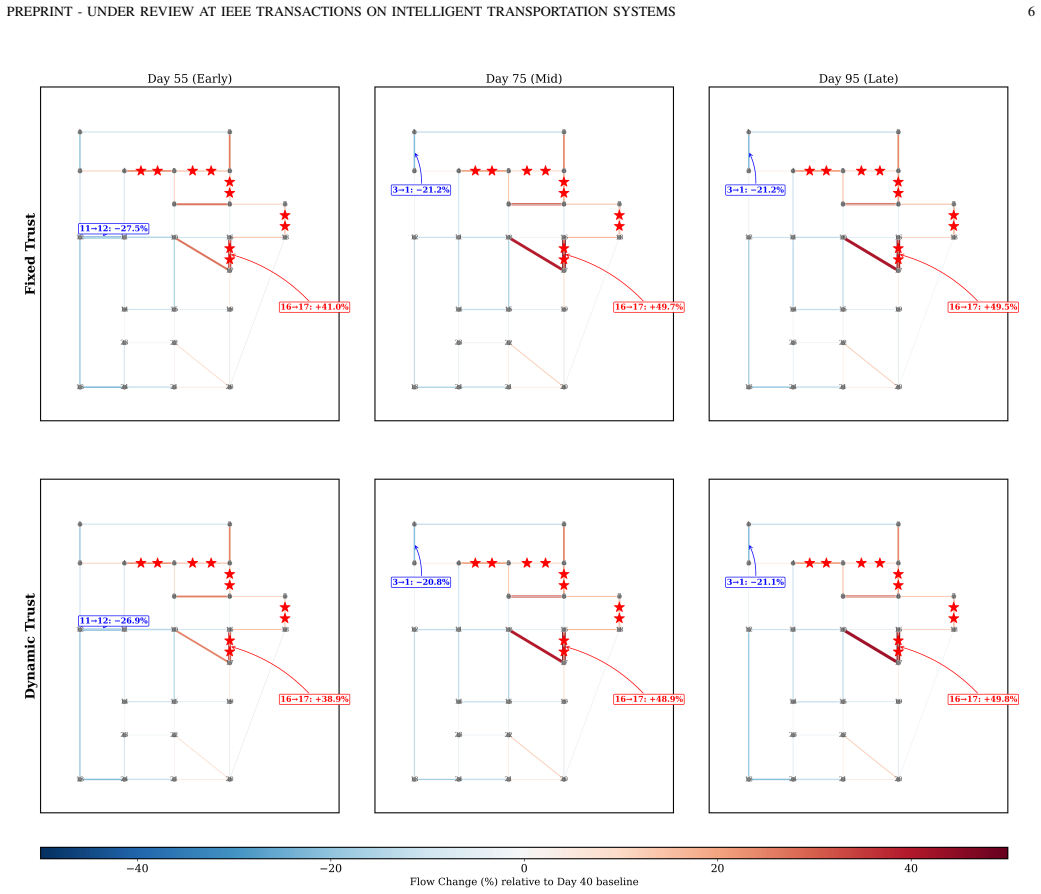
The central claim is that endogenous trust, represented as an aggregate class-level state updated through a Beta evidence model from guidance errors, produces a sharp threshold-based resilience effect in coupled day-to-day traffic assignment. Below the threshold the attack remains stealthy; above it, trust erosion reduces the effect of sustained misinformation by 91 percent in Sioux Falls and 85 percent in Anaheim. The same model shows that CAV penetration raises fixed-trust vulnerability while preserving dynamic attenuation, and that traffic recovers before trust, creating a 77-day hidden vulnerability window.
What carries the argument
The coupled framework of LWR within-day loading and trust-dependent bounded-rationality logit day-to-day route choice, with trust encoded as an aggregate Beta evidence state updated from repeated guidance errors.
If this is right
- Resilience emerges only after trust accumulates past a critical level through repeated exposure to bad guidance.
- Sustained misinformation attacks lose most of their effect once the threshold is crossed.
- Higher CAV penetration increases vulnerability when trust is treated as fixed but does not remove the attenuation provided by endogenous trust.
- Traffic performance can return to near-normal while trust remains low, leaving an extended period of latent susceptibility.
Where Pith is reading between the lines
- Real-time monitoring of aggregate trust could allow operators to detect when a network has crossed into the resilient regime.
- Initial misinformation campaigns may need rapid counter-measures before the trust threshold is reached.
- Adding user-level heterogeneity to the Beta model could expose additional subgroups that remain vulnerable even after aggregate trust rises.
- The recovery lag suggests that post-attack audits should continue for weeks after flow metrics normalize.
Load-bearing premise
Trust can be represented as a single aggregate class-level state following a Beta distribution and updated only from guidance errors, without individual heterogeneity or external factors.
What would settle it
Observe whether trust levels in a real or high-fidelity simulated network cross the predicted threshold and produce an 85-91 percent reduction in attack impact, or whether the 77-day traffic-trust recovery lag appears.
Figures




read the original abstract
Connected and autonomous vehicles and smart mobility services increasingly use digital route guidance as an operational input to traffic network management. When this information becomes unreliable or adversarial, day-to-day traffic models must represent not only flow adaptation but also the evolution of user trust in the information source. This paper develops a coupled day-to-day traffic assignment and trust-evolution framework for route-guidance misinformation. Within-day congestion is represented by Lighthill-Whitham-Richards network loading, while day-to-day route choice follows bounded-rationality logit learning with trust-dependent reliance on external guidance. Trust is modeled as an aggregate class-level behavioral reliance state encoded by a Beta evidence model and updated from repeated guidance errors. Theoretical analysis establishes stationary equilibria, a conservative stability guide, a weighted compliance index for population-level vulnerability, and an asymmetric recovery law that explains post-attack trust hysteresis. Numerical experiments on Sioux Falls, with an Anaheim robustness check, show that endogenous trust creates a threshold-based resilience mechanism. Below the trust-activation threshold, the attack remains behaviorally stealthy and dynamic trust provides almost no attenuation. Above the threshold, trust erosion reduces the impact of the fixed-trust attack by about 91 percent in Sioux Falls and 85 percent in Anaheim. The experiments also show that CAV penetration increases fixed-trust vulnerability while preserving dynamic attenuation, and that traffic performance can recover before trust, resulting in a 77-day hidden vulnerability window. The results provide a trust-aware modeling basis for resilience analysis in CAV-enabled traffic networks.
Editorial analysis
A structured set of objections, weighed in public.
Referee Report
Summary. The paper develops a coupled day-to-day traffic assignment and trust-evolution framework for route-guidance misinformation in CAV environments. Within-day congestion uses LWR network loading; day-to-day route choice uses bounded-rationality logit learning with trust-dependent guidance reliance. Trust is an aggregate class-level state encoded by a Beta evidence model updated from guidance errors. Theoretical analysis covers stationary equilibria, a conservative stability guide, a weighted compliance index, and an asymmetric recovery law. Numerical experiments on Sioux Falls (with Anaheim robustness check) show endogenous trust creates a threshold-based resilience mechanism: below the activation threshold the attack is stealthy with negligible attenuation; above it, trust erosion reduces fixed-trust attack impact by ~91% (Sioux Falls) and ~85% (Anaheim). Additional findings include increased fixed-trust vulnerability with higher CAV penetration, preserved dynamic attenuation, and a 77-day hidden vulnerability window where traffic recovers before trust.
Significance. If the results hold, the work provides a useful integration of behavioral trust dynamics into traffic network modeling for resilience against misinformation, with direct relevance to CAV deployment. The threshold resilience mechanism and quantified attenuation levels offer concrete insights for vulnerability assessment. Strengths include the theoretical treatment of equilibria and stability plus the use of standard benchmark networks (Sioux Falls, Anaheim) for experiments. The aggregate Beta trust model is a simplifying choice that enables closed-form updates but requires scrutiny for robustness.
major comments (2)
- [Trust modeling and numerical experiments] Trust model (abstract and trust-evolution section): The headline threshold-based resilience and the 91%/85% attenuation figures rest on the aggregate class-level Beta evidence accumulator updated solely from guidance errors. This implicitly assumes homogeneous response within each class and no external influences; if individual heterogeneity in updating rates exists, both the location of the activation threshold and the post-threshold erosion magnitude can shift, so the numerical results test a special case rather than the general mechanism.
- [Theoretical analysis] Stability and recovery analysis: The conservative stability guide and asymmetric recovery law are presented as explaining post-attack hysteresis and the 77-day hidden vulnerability window. The manuscript should explicitly state the conditions under which the guide remains conservative when the Beta parameters vary or when CAV penetration changes the class composition.
minor comments (2)
- [Abstract] Abstract: The 77-day window and the exact definition of the trust-activation threshold should be briefly defined or cross-referenced to the relevant equation or figure.
- [Numerical experiments] Numerical results: A single comparative table or figure showing Sioux Falls versus Anaheim metrics (attenuation, threshold values, recovery times) would improve readability of the robustness claim.
Simulated Author's Rebuttal
We thank the referee for the constructive and detailed comments, which help clarify the scope and limitations of our modeling choices. We address each major comment below and have revised the manuscript to improve transparency on assumptions and conditions.
read point-by-point responses
-
Referee: Trust model (abstract and trust-evolution section): The headline threshold-based resilience and the 91%/85% attenuation figures rest on the aggregate class-level Beta evidence accumulator updated solely from guidance errors. This implicitly assumes homogeneous response within each class and no external influences; if individual heterogeneity in updating rates exists, both the location of the activation threshold and the post-threshold erosion magnitude can shift, so the numerical results test a special case rather than the general mechanism.
Authors: We thank the referee for this observation. The aggregate class-level Beta model is deliberately chosen in Section 3.2 for its closed-form update rules and analytical tractability, which enable the derivation of equilibria and stability results. This formulation abstracts individual heterogeneity to focus on class-level endogenous trust dynamics. Consequently, the reported 91% (Sioux Falls) and 85% (Anaheim) attenuation figures, as well as the precise threshold location, are specific to the homogeneous case. We agree that heterogeneous updating rates could alter these quantities. In the revised manuscript we have added a dedicated paragraph in Section 5 (Discussion) that explicitly states this modeling assumption, notes that the threshold resilience mechanism is demonstrated under class-level homogeneity, and identifies heterogeneous trust updating as an important avenue for future work. The core feedback loop between trust erosion and route-choice adaptation remains the source of the resilience effect and is expected to hold qualitatively beyond the current setting. revision: yes
-
Referee: Stability and recovery analysis: The conservative stability guide and asymmetric recovery law are presented as explaining post-attack hysteresis and the 77-day hidden vulnerability window. The manuscript should explicitly state the conditions under which the guide remains conservative when the Beta parameters vary or when CAV penetration changes the class composition.
Authors: We agree that the conditions of applicability should be stated more explicitly. The conservative stability guide in Section 4.2 is derived under the assumptions of time-invariant Beta parameters (α, β) for each user class and fixed class proportions determined by a constant CAV penetration rate. In the revised version we have inserted a new paragraph immediately following the guide’s statement that lists these conditions verbatim: the guide remains conservative provided (i) Beta parameters do not change during the attack horizon and (ii) CAV penetration (hence class composition) is held constant. We further note that time-varying Beta parameters or dynamic class composition would require a re-derivation of the bound, which lies outside the present scope. This addition directly addresses the referee’s request while preserving the original analysis. revision: yes
Circularity Check
No circularity: model derivations and results are self-contained
full rationale
The paper defines a coupled day-to-day assignment and Beta-trust evolution model using standard LWR network loading and bounded-rationality logit choice with trust-dependent guidance weight. Stationary equilibria, stability guide, compliance index, and asymmetric recovery law are derived directly from the stated dynamics and update rules without reducing any claimed prediction or equilibrium to a fitted parameter or prior self-citation by construction. Numerical attenuation percentages (91% Sioux Falls, 85% Anaheim) are simulation outputs from the integrated model on benchmark networks, not forced by re-using the same data or ansatz. No self-definitional, fitted-input, or uniqueness-imported steps appear in the derivation chain.
Axiom & Free-Parameter Ledger
free parameters (1)
- Beta distribution parameters for trust updates
axioms (2)
- standard math Lighthill-Whitham-Richards network loading for within-day congestion
- domain assumption Bounded-rationality logit learning for day-to-day route choice
invented entities (1)
-
Aggregate trust state encoded by Beta evidence model
no independent evidence
Lean theorems connected to this paper
-
IndisputableMonolith/Cost/FunctionalEquation.leanwashburn_uniqueness_aczel unclear?
unclearRelation between the paper passage and the cited Recognition theorem.
Trust is modeled as an aggregate class-level behavioral reliance state encoded by a Beta evidence model and updated from repeated guidance errors... T_k = α_k/(α_k+β_k)
-
IndisputableMonolith/Foundation/RealityFromDistinction.leanreality_from_one_distinction unclear?
unclearRelation between the paper passage and the cited Recognition theorem.
endogenous trust creates a threshold-based resilience mechanism... trust erosion reduces the impact... by about 91 percent
What do these tags mean?
- matches
- The paper's claim is directly supported by a theorem in the formal canon.
- supports
- The theorem supports part of the paper's argument, but the paper may add assumptions or extra steps.
- extends
- The paper goes beyond the formal theorem; the theorem is a base layer rather than the whole result.
- uses
- The paper appears to rely on the theorem as machinery.
- contradicts
- The paper's claim conflicts with a theorem or certificate in the canon.
- unclear
- Pith found a possible connection, but the passage is too broad, indirect, or ambiguous to say the theorem truly supports the claim.
Reference graph
Works this paper leans on
-
[1]
Use and effects of advanced traveller information services (atis): A review of the literature,
C. G. Chorus, E. J. E. Molin, and B. van Wee, “Use and effects of advanced traveller information services (atis): A review of the literature,” Transport Reviews, vol. 26, no. 2, pp. 127–149, 2006
work page 2006
-
[2]
Which road do i take? a learning-based model of route-choice behavior with real-time information,
E. Ben-Elia and Y . Shiftan, “Which road do i take? a learning-based model of route-choice behavior with real-time information,”Transporta- tion Research Part A: Policy and Practice, vol. 44, no. 4, pp. 249–264, 2010
work page 2010
-
[3]
Forecasting americans’ long-term adoption of connected and autonomous vehicle technologies,
P. Bansal and K. M. Kockelman, “Forecasting americans’ long-term adoption of connected and autonomous vehicle technologies,”Trans- portation Research Part A: Policy and Practice, vol. 95, pp. 49–63, 2017
work page 2017
-
[4]
Influence of connected and autonomous vehicles on traffic flow stability and throughput,
A. Talebpour and H. S. Mahmassani, “Influence of connected and autonomous vehicles on traffic flow stability and throughput,”Trans- portation Research Part C: Emerging Technologies, vol. 71, pp. 143– 163, 2016
work page 2016
-
[5]
Ghost riders: Sybil attacks on crowdsourced mobile mapping services,
G. Wang, B. Wang, T. Wang, A. Nika, H. Zheng, and B. Y . Zhao, “Ghost riders: Sybil attacks on crowdsourced mobile mapping services,” IEEE/ACM Transactions on Networking, vol. 26, no. 3, pp. 1123–1136, 2018
work page 2018
-
[6]
Sybil-based attacks on Google Maps or how to forge the image of city life,
C. Eryonucu and P. Papadimitratos, “Sybil-based attacks on Google Maps or how to forge the image of city life,” inProceedings of the 15th ACM Conference on Security and Privacy in Wireless and Mobile Networks (WiSec). ACM, 2022, pp. 73–84. PREPRINT - UNDER REVIEW AT IEEE TRANSACTIONS ON INTELLIGENT TRANSPORTATION SYSTEMS 10
work page 2022
-
[7]
On the impact of Sybil-based attacks on mobile crowdsensing for transportation,
A. S ¨oderh¨all, Z. Alimadadi, and P. Papadimitratos, “On the impact of Sybil-based attacks on mobile crowdsensing for transportation,” inProceedings of the IEEE International Conference on Pervasive Computing and Communications Workshops and Other Affiliated Events (PerCom Workshops). IEEE, 2025, pp. 482–488
work page 2025
-
[8]
All your GPS are belong to us: Towards stealthy manipulation of road navigation systems,
K. C. Zeng, S. Liu, Y . Shu, D. Wang, H. Li, Y . Dou, G. Wang, and Y . Yang, “All your GPS are belong to us: Towards stealthy manipulation of road navigation systems,” inProceedings of the 27th USENIX Security Symposium. USENIX Association, 2018, pp. 1527–1544
work page 2018
-
[9]
Potential cyberattacks on automated vehicles,
J. Petit and S. E. Shladover, “Potential cyberattacks on automated vehicles,”IEEE Transactions on Intelligent Transportation Systems, vol. 16, no. 2, pp. 546–556, 2015
work page 2015
-
[10]
Security vulnerabilities of connected vehicle streams and their impact on cooperative driving,
M. Amoozadeh, A. Raghuramu, C.-N. Chuah, D. Ghosal, H. M. Zhang, J. Rowe, and K. Levitt, “Security vulnerabilities of connected vehicle streams and their impact on cooperative driving,”IEEE Communications Magazine, vol. 53, no. 6, pp. 126–132, 2015
work page 2015
-
[11]
A stochastic process approach to the analysis of temporal dynamics in transportation networks,
E. Cascetta, “A stochastic process approach to the analysis of temporal dynamics in transportation networks,”Transportation Research Part B: Methodological, vol. 23, no. 1, pp. 1–17, 1989
work page 1989
-
[12]
The stability of a dynamic model of traffic assignment: An application of a method of Lyapunov,
M. J. Smith, “The stability of a dynamic model of traffic assignment: An application of a method of Lyapunov,”Transportation Science, vol. 18, no. 3, pp. 245–252, 1984
work page 1984
-
[13]
Dynamic processes and equilibrium in transportation networks: Towards a unifying theory,
G. E. Cantarella and E. Cascetta, “Dynamic processes and equilibrium in transportation networks: Towards a unifying theory,”Transportation Science, vol. 29, no. 4, pp. 305–329, 1995
work page 1995
-
[14]
Day-to-day dynamic network disequilibria and idealized traveler information systems,
T. L. Friesz, D. Bernstein, T. E. Smith, R. L. Tobin, and B.-W. Wie, “Day-to-day dynamic network disequilibria and idealized traveler information systems,”Operations Research, vol. 42, no. 6, pp. 1120– 1136, 1994
work page 1994
-
[15]
Stability of the stochastic equilibrium assignment prob- lem: A dynamical systems approach,
D. Watling, “Stability of the stochastic equilibrium assignment prob- lem: A dynamical systems approach,”Transportation Research Part B: Methodological, vol. 33, no. 4, pp. 281–312, 1999
work page 1999
-
[16]
A link-based day-to-day traffic assignment model,
X. He, X. Guo, and H. X. Liu, “A link-based day-to-day traffic assignment model,”Transportation Research Part B: Methodological, vol. 44, no. 4, pp. 597–608, 2010
work page 2010
-
[17]
Y . Yu, K. Han, and W. Ochieng, “Day-to-day dynamic traffic assign- ment with imperfect information, bounded rationality and information sharing,”Transportation Research Part C: Emerging Technologies, vol. 114, pp. 59–83, 2020
work page 2020
-
[18]
Day-to-day dynamics with advanced traveler information,
H. Ye, F. Xiao, and H. Yang, “Day-to-day dynamics with advanced traveler information,”Transportation Research Part B: Methodological, vol. 144, pp. 23–44, 2021
work page 2021
-
[19]
Stabilisation strategy for unstable transport systems under general evolutionary dynamics,
T. Iryo, M. J. Smith, and D. Watling, “Stabilisation strategy for unstable transport systems under general evolutionary dynamics,”Transportation Research Part B: Methodological, vol. 132, pp. 136–151, 2020
work page 2020
-
[20]
Managing mixed traffic with autonomous vehicles: A day-to-day routing allocation scheme,
R.-Y . Guo, W. Wang, and J. Wang, “Managing mixed traffic with autonomous vehicles: A day-to-day routing allocation scheme,”Trans- portation Research Part C: Emerging Technologies, vol. 140, p. 103726, 2022
work page 2022
-
[21]
H. Liang, Y . Li, X. Chen, T. Pan, and R. Zhong, “Day-to-day traffic control for networks mixed with regular human-piloted and connected autonomous vehicles,”Transportation Research Part B: Methodological, vol. 178, p. 102847, 2023
work page 2023
-
[22]
V . A. C. van den Berg and E. T. Verhoef, “Autonomous cars and dynamic bottleneck congestion: The effects on capacity, value of time and pref- erence heterogeneity,”Transportation Research Part B: Methodological, vol. 94, pp. 43–60, 2016
work page 2016
-
[23]
J. Lin, W. Yu, N. Zhang, X. Yang, and L. Ge, “Data integrity attacks against dynamic route guidance in transportation-based cyber-physical systems: Modeling, analysis, and defense,”IEEE Transactions on Ve- hicular Technology, vol. 67, no. 9, pp. 8738–8753, 2018
work page 2018
-
[24]
E. Ka and S. V . Ukkusuri, “Route guidance attacks in cyber trans- portation networks: A user-centered study of behavioral sensitivity,” Transportation Research Part F: Traffic Psychology and Behaviour, vol. 115, p. 103354, 2025
work page 2025
-
[25]
K. Yang, Z. Ying, and S.-W. Shen, “Anomaly detection against GPS spoofing attacks on connected and autonomous vehicles using learning from demonstration,”IEEE Transactions on Intelligent Transportation Systems, vol. 24, no. 9, pp. 9462–9475, 2023
work page 2023
-
[26]
Cybersecurity for next-generation road transportation: A review,
S. V . Ukkusuri, O. F. Hamim, Z. Lei, E. Ka, M. S. Salek, M. Chowdhury, M. H. Amini, A. A. Cardenas, and B. M. Thuraisingham, “Cybersecurity for next-generation road transportation: A review,”ACM Journal on Autonomous Transportation Systems, vol. 3, no. 2, 2025
work page 2025
-
[27]
Trust in automation: Designing for appropriate reliance,
J. D. Lee and K. A. See, “Trust in automation: Designing for appropriate reliance,”Human Factors, vol. 46, no. 1, pp. 50–80, 2004
work page 2004
-
[28]
Trust in automation: Integrating empirical evidence on factors that influence trust,
K. A. Hoff and M. Bashir, “Trust in automation: Integrating empirical evidence on factors that influence trust,”Human Factors, vol. 57, no. 3, pp. 407–434, 2015
work page 2015
-
[29]
B. M. Muir and N. Moray, “Trust in automation. part ii. experimental studies of trust and human intervention in a process control simulation,” Ergonomics, vol. 39, no. 3, pp. 429–460, 1996
work page 1996
-
[30]
The role of trust in automation reliance,
M. T. Dzindolet, S. A. Peterson, R. A. Pomranky, L. G. Pierce, and H. P. Beck, “The role of trust in automation reliance,”International Journal of Human-Computer Studies, vol. 58, no. 6, pp. 697–718, 2003
work page 2003
-
[31]
J. Kraus, D. Scholz, D. Stiegemeier, and M. Baumann, “The more you know: Trust dynamics and calibration in highly automated driving and the effects of take-overs, system malfunction, and system transparency,” Human Factors, vol. 62, no. 5, pp. 718–736, 2020
work page 2020
-
[32]
Modeling and predicting trust dynamics in human–robot teaming: A Bayesian inference approach,
Y . Guo and X. J. Yang, “Modeling and predicting trust dynamics in human–robot teaming: A Bayesian inference approach,”International Journal of Social Robotics, vol. 13, no. 8, pp. 1899–1909, 2021
work page 1909
-
[33]
Investigating the importance of trust on adopting an autonomous vehicle,
J. K. Choi and Y . G. Ji, “Investigating the importance of trust on adopting an autonomous vehicle,”International Journal of Human-Computer Interaction, vol. 31, no. 10, pp. 692–702, 2015
work page 2015
-
[34]
A. Jøsang and R. Ismail, “The Beta reputation system,” inProceedings of the 15th Bled Electronic Commerce Conference, 2002, pp. 2502–2511
work page 2002
-
[35]
Effect of multiple traffic information sources on route choice: A driving simulator study,
P. Imants, J. Theeuwes, A. W. Bronkhorst, and M. H. Martens, “Effect of multiple traffic information sources on route choice: A driving simulator study,”Transportation Research Part F: Traffic Psychology and Behaviour, vol. 81, pp. 1–13, 2021
work page 2021
-
[36]
Computing dynamic user equilibria on large-scale networks with software implementation,
K. Han, G. Eve, and T. L. Friesz, “Computing dynamic user equilibria on large-scale networks with software implementation,”Networks and Spatial Economics, vol. 19, no. 3, pp. 869–902, 2019. Eunhan Kais a Postdoctoral Researcher with the Lyles School of Civil and Construction Engineering, Purdue University. He received the B.S. and M.S. degrees in civil an...
work page 2019
discussion (0)
Sign in with ORCID, Apple, or X to comment. Anyone can read and Pith papers without signing in.