Recognition: 2 theorem links
· Lean TheoremDistill: Uncovering the True Intent behind Human-Robot Communication
Pith reviewed 2026-05-15 02:42 UTC · model grok-4.3
The pith
Distill refines initial robot task specifications by removing steps, generalizing meanings, and relaxing order constraints to better match users' true intent.
A machine-rendered reading of the paper's core claim, the machinery that carries it, and where it could break.
Core claim
Given a task specification provided by the user, Distill removes unnecessary steps, generalizes the meaning behind individual steps, and relaxes ordering constraints between steps, thereby eliciting and refining the user's true underlying intent, as shown by implementation in a web interface and validation through a crowdsourcing study.
What carries the argument
The Distill process, which applies three operations to a user's initial task specification: removing unnecessary steps, generalizing the meanings of individual steps, and relaxing ordering constraints between steps.
If this is right
- Robot interfaces can start from imprecise natural-language or overly specific program inputs and still produce usable task plans.
- The web interface implementation shows that the three operations can be applied automatically to refine user specifications in real time.
- Crowdsourced validation demonstrates measurable improvement in how well the refined output captures what users meant.
- Communication between humans and robots becomes less dependent on users providing perfect initial specifications.
Where Pith is reading between the lines
- The same refinement steps could be applied to task specifications in non-robotic settings such as virtual assistants or automated planning tools.
- Combining Distill with later user feedback loops might further reduce the risk of unintended changes to intent.
- The approach implies that user intent is often best represented at a level of abstraction higher than the initial specification, which could guide design of future intent-capture systems.
Load-bearing premise
The three operations accurately uncover and preserve the user's true underlying intent without introducing distortions or requiring additional user feedback.
What would settle it
A follow-up crowdsourcing study in which participants judge whether the Distill-refined specifications match their original intent; if a large fraction of participants report mismatches, the claim that the operations reliably elicit true intent would be falsified.
Figures




read the original abstract
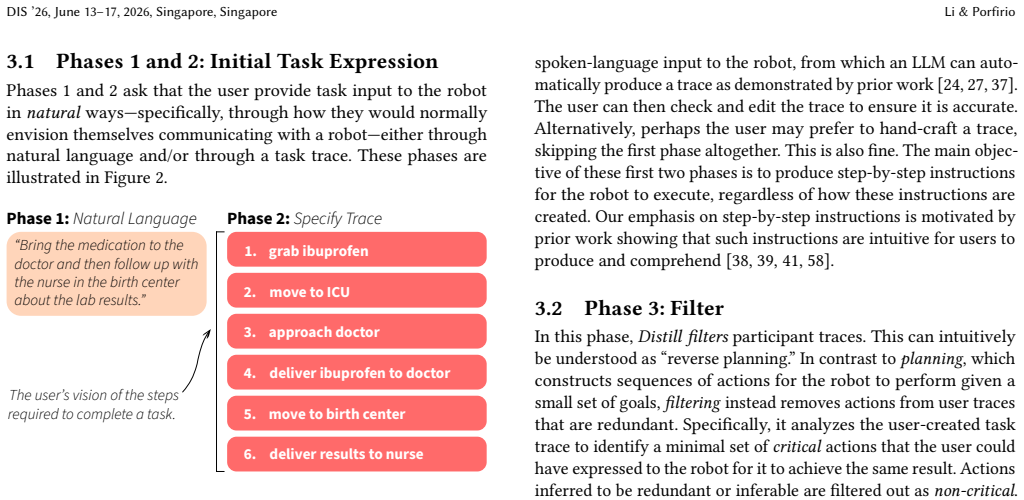
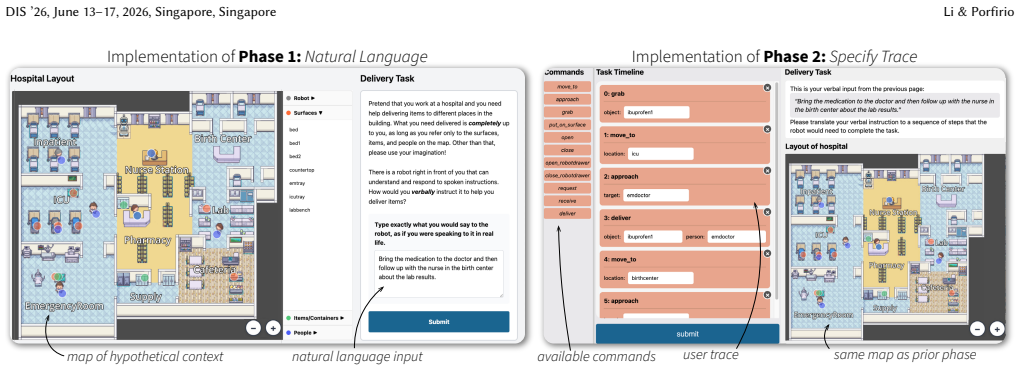
As robots become increasingly integrated into everyday environments, intuitive communication paradigms such as natural language and end-user programming have become indispensable for specifying autonomous robot behavior. However, these mechanisms are ineffective at fully capturing user intent: natural language is imprecise and ambiguous, whereas end-user programming can be overly specific. As a result, understanding what users truly mean when they interact with robots remains a central challenge for human-AI communication systems. To address this issue, we propose the Distill approach for human-robot communication interfaces. Given a task specification provided by the user, Distill (1) removes unnecessary steps; (2) generalizes the meaning behind individual steps; and (3) relaxes ordering constraints between steps. We implemented Distill on a web interface and, through a crowdsourcing study, demonstrated its ability to elicit and refine user intent from initial task specifications.
Editorial analysis
A structured set of objections, weighed in public.
Referee Report
Summary. The paper proposes the Distill approach for refining user intent in human-robot communication. Given an initial task specification, Distill applies three operations—removing unnecessary steps, generalizing the meaning of individual steps, and relaxing ordering constraints between steps—to produce a more accurate representation of the user's underlying intent. The authors implemented the method in a web interface and report that a crowdsourcing study demonstrates its ability to elicit and refine intent from initial specifications.
Significance. If the central claim holds with proper validation, the work could meaningfully advance intuitive interfaces for robot task specification by bridging the gap between imprecise natural language and overly rigid end-user programming. The approach is conceptually straightforward and targets a recognized challenge in HRI, but its significance is currently constrained by the absence of detailed empirical evidence.
major comments (2)
- [Crowdsourcing study description] The description of the crowdsourcing study (mentioned in the abstract and the implementation paragraph) provides no methodology details, participant information, metrics, quantitative results, or error analysis. This absence leaves the central empirical claim—that Distill refines user intent—without visible data support and prevents assessment of whether the three operations recover latent intent or merely produce simpler but altered specifications.
- [Distill approach definition] The weakest assumption—that the three operations (remove steps, generalize meanings, relax ordering) accurately uncover and preserve true user intent without distortion—is not tested against an independent ground truth. No post-distillation confirmation step, behavioral re-execution match, follow-up interview, or comparison to alternative elicitation methods (e.g., demonstrations) is described that could falsify the possibility of plausible but incorrect refinements.
minor comments (1)
- [Abstract] The abstract would be strengthened by including at least one concrete metric or qualitative finding from the crowdsourcing study rather than a general statement of demonstration.
Simulated Author's Rebuttal
We thank the referee for their thoughtful and constructive comments, which highlight important gaps in the empirical validation of our work. We address each major comment below and commit to a major revision that strengthens the manuscript's claims with additional details and discussion.
read point-by-point responses
-
Referee: [Crowdsourcing study description] The description of the crowdsourcing study (mentioned in the abstract and the implementation paragraph) provides no methodology details, participant information, metrics, quantitative results, or error analysis. This absence leaves the central empirical claim—that Distill refines user intent—without visible data support and prevents assessment of whether the three operations recover latent intent or merely produce simpler but altered specifications.
Authors: We agree that the current version of the manuscript provides insufficient detail on the crowdsourcing study. This was an oversight during preparation. In the revised manuscript, we will add a full subsection describing the study protocol, participant recruitment and demographics (e.g., number of participants, age range, prior robot experience), the exact metrics collected (intent alignment ratings on a Likert scale), quantitative results with statistical tests, and an error analysis showing cases where distillation improved versus altered the specification. These additions will directly support the claim that the three operations recover latent intent. revision: yes
-
Referee: [Distill approach definition] The weakest assumption—that the three operations (remove steps, generalize meanings, relax ordering) accurately uncover and preserve true user intent without distortion—is not tested against an independent ground truth. No post-distillation confirmation step, behavioral re-execution match, follow-up interview, or comparison to alternative elicitation methods (e.g., demonstrations) is described that could falsify the possibility of plausible but incorrect refinements.
Authors: The crowdsourcing study asked participants to compare original and distilled specifications and rate which better matched their intended task, providing direct user validation of the operations. However, we acknowledge that this self-report approach does not constitute an independent ground truth such as behavioral re-execution or comparison to demonstrations. In the revision we will explicitly discuss this limitation, add a paragraph on potential distortion risks, and include a small additional analysis comparing a subset of distilled outputs against user-provided demonstrations where available. We believe the user-centric validation is appropriate for an intent-elicitation interface but will strengthen it as noted. revision: partial
Circularity Check
No circularity: Distill operations defined independently and evaluated externally
full rationale
The paper defines the Distill method through three explicit, non-recursive operations applied to user-provided task specifications: removing unnecessary steps, generalizing step meanings, and relaxing ordering constraints. These are introduced as a direct proposal without equations, fitted parameters, self-citations for uniqueness theorems, or any reduction where the output is defined in terms of itself. Validation occurs via an external crowdsourcing study on a web interface that measures participant ratings, which serves as an independent check rather than a self-referential loop. No load-bearing step reduces by construction to the inputs, satisfying the criteria for a self-contained method proposal.
Axiom & Free-Parameter Ledger
axioms (1)
- domain assumption User-provided task specifications contain unnecessary steps, over-specific meanings, and strict ordering constraints that can be removed, generalized, or relaxed while still capturing true intent.
Lean theorems connected to this paper
-
IndisputableMonolith/Cost/FunctionalEquation.leanwashburn_uniqueness_aczel unclear?
unclearRelation between the paper passage and the cited Recognition theorem.
Distill (1) removes unnecessary steps; (2) generalizes the meaning behind individual steps; and (3) relaxes ordering constraints between steps.
-
IndisputableMonolith/Foundation/RealityFromDistinction.leanreality_from_one_distinction unclear?
unclearRelation between the paper passage and the cited Recognition theorem.
We implemented Distill on a web interface and, through a crowdsourcing study, demonstrated its ability to elicit and refine user intent from initial task specifications.
What do these tags mean?
- matches
- The paper's claim is directly supported by a theorem in the formal canon.
- supports
- The theorem supports part of the paper's argument, but the paper may add assumptions or extra steps.
- extends
- The paper goes beyond the formal theorem; the theorem is a base layer rather than the whole result.
- uses
- The paper appears to rely on the theorem as machinery.
- contradicts
- The paper's claim conflicts with a theorem or certificate in the canon.
- unclear
- Pith found a possible connection, but the passage is too broad, indirect, or ambiguous to say the theorem truly supports the claim.
Reference graph
Works this paper leans on
-
[1]
[n. d.]. LimeZu. https://limezu.itch.io/. Accessed: 2026-04-25
work page 2026
-
[2]
Gopika Ajaykumar, Maureen Steele, and Chien-Ming Huang. 2021. A survey on end-user robot programming.ACM Computing Surveys (CSUR)54, 8 (2021), 1–36. doi:10.1145/3466819
-
[3]
Sonya Alexandrova, Zachary Tatlock, and Maya Cakmak. 2015. RoboFlow: A flow-based visual programming language for mobile manipulation tasks. In2015 IEEE international conference on robotics and automation (ICRA). IEEE, 5537–5544. doi:10.1109/ICRA.2015.7139973
-
[4]
Saleema Amershi, Dan Weld, Mihaela Vorvoreanu, Adam Fourney, Besmira Nushi, Penny Collisson, Jina Suh, Shamsi Iqbal, Paul N Bennett, Kori Inkpen, et al. 2019. Guidelines for human-AI interaction. InProceedings of the 2019 chi conference on human factors in computing systems. 1–13. doi:10.1145/3290605.3300233 Distill: Uncovering the True Intent behind Huma...
-
[5]
Virginia Braun and Victoria Clarke. 2021. Thematic analysis: A practical guide. (2021)
work page 2021
-
[6]
Gordon Briggs, Tom Williams, and Matthias Scheutz. 2017. Enabling robots to understand indirect speech acts in task-based interactions.Journal of Human- Robot Interaction6, 1 (2017), 64–94. doi:10.5898/JHRI.6.1.Briggs
-
[7]
Anthony Brohan, Yevgen Chebotar, Chelsea Finn, Karol Hausman, Alexander Herzog, Daniel Ho, Julian Ibarz, Alex Irpan, Eric Jang, Ryan Julian, et al. 2023. Do as i can, not as i say: Grounding language in robotic affordances. InConference on robot learning. PMLR, 287–318
work page 2023
-
[8]
Yuanzhi Cao, Tianyi Wang, Xun Qian, Pawan S Rao, Manav Wadhawan, Ke Huo, and Karthik Ramani. 2019. GhostAR: A time-space editor for embodied authoring of human-robot collaborative task with augmented reality. InProceedings of the 32nd Annual ACM Symposium on User Interface Software and Technology. 521–534. doi:10.1145/3332165.3347902
-
[9]
Yuanzhi Cao, Zhuangying Xu, Fan Li, Wentao Zhong, Ke Huo, and Karthik Ramani. 2019. V.Ra: An in-situ visual authoring system for robot-iot task planning with augmented reality. InProceedings of the 2019 on designing interactive systems conference. 1059–1070. doi:10.1145/3322276.3322278
-
[10]
Eugenio Chisari, Jan Ole Von Hartz, Fabien Despinoy, and Abhinav Valada. 2025. Robotic Task Ambiguity Resolution via Natural Language Interaction. In2025 IEEE/RSJ International Conference on Intelligent Robots and Systems (IROS). 14821– 14827. doi:10.1109/IROS60139.2025.11247661
-
[11]
Dagoberto Cruz-Sandoval, Michele Murakami, Alyssa Kubota, and Laurel D Riek. 2025. PODER: A Robot Programming Framework to Further Inclusion of People with Mild Cognitive Impairment in HRI Research. In2025 20th ACM/IEEE International Conference on Human-Robot Interaction (HRI). IEEE, 599–609. doi:10. 1109/HRI61500.2025.10974039
-
[12]
Fethiye Irmak Doğan, Ilaria Torre, and Iolanda Leite. 2022. Asking follow-up clarifications to resolve ambiguities in human-robot conversation. In2022 17th ACM/IEEE International Conference on Human-Robot Interaction (HRI). IEEE, 461–
work page 2022
-
[13]
doi:10.1109/HRI53351.2022.9889368
-
[14]
Maria Fox and Derek Long. 2003. PDDL2. 1: An extension to PDDL for expressing temporal planning domains.Journal of artificial intelligence research20 (2003), 61–124. doi:10.1613/jair.1129
-
[15]
2016.Automated planning and acting
Malik Ghallab, Dana Nau, and Paolo Traverso. 2016.Automated planning and acting. Cambridge University Press
work page 2016
-
[16]
Dylan Glas, Satoru Satake, Takayuki Kanda, and Norihiro Hagita. 2012. An interaction design framework for social robots. InRobotics: Science and Systems, Vol. 7. 89. doi:10.15607/RSS.2011.VII.014
-
[17]
Javi F Gorostiza and Miguel A Salichs. 2011. End-user programming of a social robot by dialog.Robotics and Autonomous Systems59, 12 (2011). doi:10.1016/j. robot.2011.07.009
work page doi:10.1016/j 2011
-
[19]
Peter E Hart, Nils J Nilsson, and Bertram Raphael. 1968. A formal basis for the heuristic determination of minimum cost paths.IEEE transactions on Systems Science and Cybernetics4, 2 (1968), 100–107. doi:10.1109/TSSC.1968.300136
-
[20]
Malte Helmert. 2006. The fast downward planning system.Journal of Artificial Intelligence Research26 (2006), 191–246. doi:10.1613/jair.1705
- [21]
-
[22]
Gaoping Huang, Pawan S Rao, Meng-Han Wu, Xun Qian, Shimon Y Nof, Karthik Ramani, and Alexander J Quinn. 2020. Vipo: Spatial-visual programming with functions for robot-IoT workflows. InProceedings of the 2020 CHI conference on human factors in computing systems. 1–13. doi:10.1145/3313831.3376670
-
[23]
Justin Huang and Maya Cakmak. 2017. Code3: A system for end-to-end program- ming of mobile manipulator robots for novices and experts. InProceedings of the 2017 ACM/IEEE International Conference on Human-Robot Interaction. 453–462. doi:10.1145/2909824.3020215
-
[24]
Justin Huang, Tessa Lau, and Maya Cakmak. 2016. Design and evaluation of a rapid programming system for service robots. In2016 11th ACM/IEEE International Conference on Human-Robot Interaction (HRI). IEEE, 295–302. doi:10.1109/HRI. 2016.7451765
work page doi:10.1109/hri 2016
-
[25]
Subbarao Kambhampati, Karthik Valmeekam, Lin Guan, Mudit Verma, Kaya Stechly, Siddhant Bhambri, Lucas Paul Saldyt, and Anil B Murthy. 2024. Position: LLMs Can’t Plan, But Can Help Planning in LLM-Modulo Frameworks. InPro- ceedings of the 41st International Conference on Machine Learning (Proceedings of Machine Learning Research, Vol. 235), Ruslan Salakhut...
work page 2024
-
[26]
Stephanie Kim, Jacy Reese Anthis, and Sarah Sebo. 2024. A taxonomy of robot autonomy for human-robot interaction. InProceedings of the 2024 ACM/IEEE In- ternational Conference on Human-Robot Interaction. 381–393. doi:10.1145/3610977. 3634993
-
[27]
Alyssa Kubota, Emma IC Peterson, Vaishali Rajendren, Hadas Kress-Gazit, and Laurel D Riek. 2020. Jessie: Synthesizing social robot behaviors for personalized neurorehabilitation and beyond. InProceedings of the 2020 ACM/IEEE international conference on human-robot interaction. 121–130. doi:10.1145/3319502.3374836
-
[28]
Christine P Lee, David Porfirio, Xinyu Jessica Wang, Kevin Chenkai Zhao, and Bilge Mutlu. 2025. Veriplan: Integrating formal verification and llms into end- user planning. InProceedings of the 2025 CHI Conference on Human Factors in Computing Systems. 1–19. doi:10.1145/3706598.3714113
-
[29]
Yuan-Hong Liao, Xavier Puig, Marko Boben, Antonio Torralba, and Sanja Fidler
-
[30]
InPro- ceedings of the IEEE/CVF Conference on Computer Vision and Pattern Recognition
Synthesizing environment-aware activities via activity sketches. InPro- ceedings of the IEEE/CVF Conference on Computer Vision and Pattern Recognition. 6291–6299. doi:10.1109/CVPR.2019.00645
-
[31]
Stephanie Lukin, Claire Bonial, Matthew Marge, Taylor A Hudson, Cory Hayes, Kimberly Pollard, Anthony Baker, Ashley N Foots, Ron Artstein, Felix Gervits, et al. 2024. SCOUT: A situated and multi-modal human-robot dialogue corpus. In Proceedings of the 2024 Joint International Conference on Computational Linguistics, Language Resources and Evaluation (LREC...
work page 2024
-
[32]
Matthew Marge, Felix Gervits, Gordon Briggs, Matthias Scheutz, and Antonio Roque. 2020. Let’s do that first! a comparative analysis of instruction-giving in human-human and human-robot situated dialogue. InProceedings of the 24th Workshop on the Semantics and Pragmatics of Dialogue (SemDial). 18–19
work page 2020
-
[33]
Andrea Micheli, Arthur Bit-Monnot, Gabriele Röger, Enrico Scala, Alessandro Valentini, Luca Framba, Alberto Rovetta, Alessandro Trapasso, Luigi Bonassi, Alfonso Emilio Gerevini, et al. 2025. Unified Planning: Modeling, manipulating and solving AI planning problems in Python.SoftwareX29 (2025), 102012. doi:10.1016/j.softx.2024.102012
-
[34]
Dipendra K Misra, Jaeyong Sung, Kevin Lee, and Ashutosh Saxena. 2016. Tell me dave: Context-sensitive grounding of natural language to manipulation in- structions.The International Journal of Robotics Research35, 1-3 (2016), 281–300. doi:10.1177/0278364915602060
-
[35]
Aishwarya Padmakumar, Jesse Thomason, Ayush Shrivastava, Patrick Lange, Anjali Narayan-Chen, Spandana Gella, Robinson Piramuthu, Gokhan Tur, and Dilek Hakkani-Tur. 2022. TEACh: Task-Driven Embodied Agents That Chat. Proceedings of the AAAI Conference on Artificial Intelligence36, 2 (Jun. 2022), 2017–2025. doi:10.1609/aaai.v36i2.20097
-
[36]
Chris Paxton, Andrew Hundt, Felix Jonathan, Kelleher Guerin, and Gregory D Hager. 2017. CoSTAR: Instructing collaborative robots with behavior trees and vision. In2017 IEEE international conference on robotics and automation (ICRA). IEEE, 564–571. doi:10.1109/ICRA.2017.7989070
-
[37]
Steven T Piantadosi, Harry Tily, and Edward Gibson. 2012. The communicative function of ambiguity in language.Cognition122, 3 (2012), 280–291. doi:10.1016/ j.cognition.2011.10.004
work page 2012
-
[38]
Kaitlynn Taylor Pineda, Ethan Brown, and Chien-Ming Huang. 2025. “See You Later, Alligator”: Impacts of Robot Small Talk on Task, Rapport, and In- teraction Dynamics in Human-Robot Collaboration. In2025 20th ACM/IEEE International Conference on Human-Robot Interaction (HRI). IEEE, 819–828. doi:10.1109/HRI61500.2025.10973942
-
[39]
David Porfirio, Vincent Hsiao, Morgan Fine-Morris, Leslie Smith, and Laura M. Hiatt. 2025. Bootstrapping Human-Like Planning via LLMs. In2025 34th IEEE International Conference on Robot and Human Interactive Communication (RO- MAN). 665–670. doi:10.1109/RO-MAN63969.2025.11217637
-
[40]
David Porfirio, Mark Roberts, and Laura M Hiatt. 2024. Goal-oriented end- user programming of robots. InProceedings of the 2024 ACM/IEEE International Conference on Human-Robot Interaction. 582–591. doi:10.1145/3610977.3634974
-
[41]
David Porfirio, Mark Roberts, and Laura M Hiatt. 2025. An Interaction Speci- fication Language for Robot Application Development. In2025 20th ACM/IEEE International Conference on Human-Robot Interaction (HRI). IEEE, 1062–1066. doi:10.1109/HRI61500.2025.10973839
- [42]
-
[43]
David Porfirio, Allison Sauppé, Maya Cakmak, Aws Albarghouthi, and Bilge Mutlu. 2023. Crowdsourcing Task Traces for Service Robotics. InCompanion of the 2023 ACM/IEEE International Conference on Human-Robot Interaction. 389–393. doi:10.1145/3568294.3580112
-
[44]
Emmanuel Pot, Jérôme Monceaux, Rodolphe Gelin, and Bruno Maisonnier. 2009. Choregraphe: a graphical tool for humanoid robot programming. InRo-man 2009-the 18th ieee international symposium on robot and human interactive com- munication. IEEE, 46–51. doi:10.1109/ROMAN.2009.5326209
-
[45]
Xavier Puig, Kevin Ra, Marko Boben, Jiaman Li, Tingwu Wang, Sanja Fidler, and Antonio Torralba. 2018. Virtualhome: Simulating household activities via programs. InProceedings of the IEEE conference on computer vision and pattern recognition. 8494–8502. doi:10.1109/CVPR.2018.00886
-
[46]
Benedict Quartey, Eric Rosen, Stefanie Tellex, and George Konidaris. 2025. Ver- ifiably following complex robot instructions with foundation models. In2025 IEEE International Conference on Robotics and Automation (ICRA). IEEE, 1–8. DIS ’26, June 13–17, 2026, Singapore, Singapore Li & Porfirio doi:10.1109/ICRA55743.2025.11127418
-
[47]
Rebecca Ramnauth, Dražen Brščić, and Brian Scassellati. 2025. A Robot-Assisted Approach to Small Talk Training for Adults with ASD. InProceedings of Robotics: Science and Systems. LosAngeles, CA, USA. doi:10.15607/RSS.2025.XXI.088
-
[48]
Allison Sauppé and Bilge Mutlu. 2014. Design patterns for exploring and pro- totyping human-robot interactions. InProceedings of the SIGCHI conference on human factors in computing systems. 1439–1448. doi:10.1145/2556288.2557057
-
[49]
Andrew Schoen, Curt Henrichs, Mathias Strohkirch, and Bilge Mutlu. 2020. Authr: A task authoring environment for human-robot teams. InProceedings of the 33rd annual acm symposium on user interface software and technology. 1194–1208. doi:10.1145/3379337.3415872
-
[50]
Andrew Schoen and Bilge Mutlu. 2024. OpenVP: A Customizable Visual Programming Environment for Robotics Applications. InProceedings of the 2024 ACM/IEEE International Conference on Human-Robot Interaction. 944–948. doi:10.1145/3610977.3637477
-
[51]
Andrew Schoen, Dakota Sullivan, Ze Dong Zhang, Daniel Rakita, and Bilge Mutlu
-
[52]
InProceedings of the 2023 ACM/IEEE International Conference on Human-Robot Interaction
Lively: Enabling multimodal, lifelike, and extensible real-time robot motion. InProceedings of the 2023 ACM/IEEE International Conference on Human-Robot Interaction. 594–602. doi:10.1145/3568162.3576982
-
[53]
Andrew Schoen, Nathan White, Curt Henrichs, Amanda Siebert-Evenstone, David Shaffer, and Bilge Mutlu. 2022. CoFrame: A system for training novice cobot programmers. In2022 17th ACM/IEEE International Conference on Human-Robot Interaction (HRI). IEEE, 185–194. doi:10.5555/3523760.3523788
-
[54]
Emmanuel Senft, Michael Hagenow, Robert Radwin, Michael Zinn, Michael Gleicher, and Bilge Mutlu. 2021. Situated live programming for human-robot collaboration. InThe 34th Annual ACM Symposium on User Interface Software and Technology. 613–625. doi:10.1145/3472749.3474773
-
[55]
Parshin Shojaee, Iman Mirzadeh, Keivan Alizadeh, Maxwell Horton, Samy Bengio, and Mehrdad Farajtabar. 2025. The illusion of thinking: Understanding the strengths and limitations of reasoning models via the lens of problem complexity. arXiv preprint arXiv:2506.06941(2025)
work page internal anchor Pith review arXiv 2025
-
[56]
Mohit Shridhar, Jesse Thomason, Daniel Gordon, Yonatan Bisk, Winson Han, Roozbeh Mottaghi, Luke Zettlemoyer, and Dieter Fox. 2020. Alfred: A benchmark for interpreting grounded instructions for everyday tasks. InProceedings of the IEEE/CVF conference on computer vision and pattern recognition. 10740–10749. doi:10.1109/CVPR42600.2020.01075
-
[57]
Saurav Singh, Esa Rantanen, and Jamison Heard. 2026. Human–Robot Teaming: A Comprehensive Survey on Collaboration, Communication, and Cognition.ACM Transactions on Human-Robot Interaction15, 2 (2026), 1–48. doi:10.1145/3776548
-
[58]
David E Smith, Jeremy Frank, and William Cushing. 2008. The ANML language. InThe ICAPS-08 Workshop on Knowledge Engineering for Planning and Scheduling (KEPS), Vol. 31
work page 2008
-
[59]
David Speck. 2023. SymK–A versatile symbolic search planner.Tenth International Planning Competition (IPC-10): Planner Abstracts(2023)
work page 2023
-
[60]
Laura Stegner, Yuna Hwang, David Porfirio, and Bilge Mutlu. 2024. Understanding on-the-fly end-user robot programming. InProceedings of the 2024 ACM Designing Interactive Systems Conference. 2468–2480. doi:10.1145/3643834.3660721
-
[61]
J Gregory Trafton and Brian J Reiser. 1991. Providing natural representations to facilitate novices’ understanding in a new domain: Forward and backward reasoning in programming. InProceedings of the Annual Meeting of the Cognitive Science Society, Vol. 13
work page 1991
-
[62]
Thank You for Sharing that Interesting Fact!
Tom Williams, Daria Thames, Julia Novakoff, and Matthias Scheutz. 2018. "Thank You for Sharing that Interesting Fact!" Effects of Capability and Context on Indirect Speech Act Use in Task-Based Human-Robot Dialogue. InProceedings of the 2018 acm/ieee international conference on human-robot interaction. 298–306. doi:10.1145/3171221.3171246
-
[63]
Alex Wuqi Zhang, Rafael Queiroz, and Sarah Sebo. 2025. Balancing User Control and Perceived Robot Social Agency through the Design of End-User Robot Pro- gramming Interfaces. In2025 20th ACM/IEEE International Conference on Human- Robot Interaction (HRI). IEEE, 899–908. doi:10.1109/HRI61500.2025.10974063
-
[64]
Yan Zhang, Tharaka Sachintha Ratnayake, Cherie Sew, Jarrod Knibbe, Jorge Goncalves, and Wafa Johal. 2025. Can you pass that tool?: Implications of indirect speech in physical human-robot collaboration. InProceedings of the 2025 CHI Conference on Human Factors in Computing Systems. 1–18. doi:10.1145/3706598. 3713780
-
[65]
Fangyun Zhao, Curt Henrichs, and Bilge Mutlu. 2020. Task interdependence in human-robot teaming. In2020 29th IEEE International Conference on Robot and Human Interactive Communication (RO-MAN). IEEE, 1143–1149. doi:10.1109/RO- MAN47096.2020.9223555
work page doi:10.1109/ro- 2020
-
[66]
Sanketi, Grecia Salazar, Michael S
Brianna Zitkovich, Tianhe Yu, Sichun Xu, Peng Xu, Ted Xiao, Fei Xia, Jialin Wu, Paul Wohlhart, Stefan Welker, Ayzaan Wahid, Quan Vuong, Vincent Van- houcke, Huong Tran, Radu Soricut, Anikait Singh, Jaspiar Singh, Pierre Ser- manet, Pannag R. Sanketi, Grecia Salazar, Michael S. Ryoo, Krista Reymann, Kanishka Rao, Karl Pertsch, Igor Mordatch, Henryk Michale...
-
[67]
RT-2: Vision-Language-Action Models Transfer Web Knowledge to Robotic Control. InProceedings of The 7th Conference on Robot Learning (Proceedings of Ma- chine Learning Research, Vol. 229), Jie Tan, Marc Toussaint, and Kourosh Darvish (Eds.). PMLR, 2165–2183. https://proceedings.mlr.press/v229/zitkovich23a.html Distill: Uncovering the True Intent behind Hu...
work page 2026
discussion (0)
Sign in with ORCID, Apple, or X to comment. Anyone can read and Pith papers without signing in.