Recognition: 2 theorem links
· Lean TheoremReconstructing the Stripping History of the Sagittarius Stream with Neural Networks
Pith reviewed 2026-05-15 02:36 UTC · model grok-4.3
The pith
A neural network trained on simulations infers when Sagittarius Stream stars were stripped from their dwarf galaxy, revealing a clear metallicity gradient with time.
A machine-rendered reading of the paper's core claim, the machinery that carries it, and where it could break.
Core claim
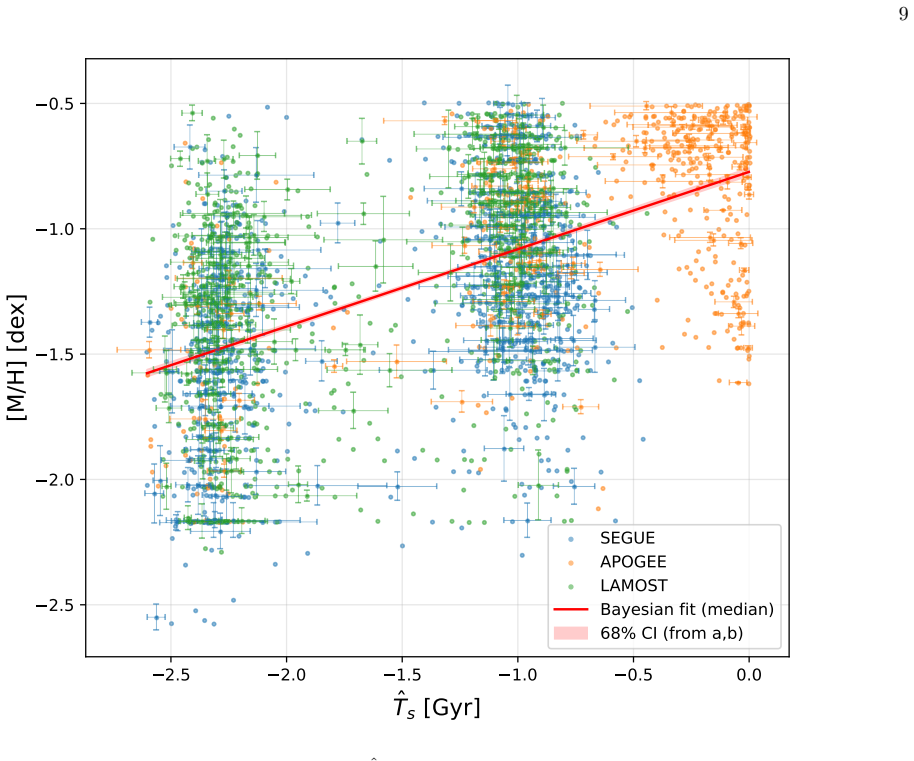
A neural network trained on N-body simulations of the Sagittarius dwarf spheroidal can recover the time at which each stream star was stripped from its phase-space coordinates alone. Real data yield a clear linear metallicity-stripping-time relation with slope approximately 0.3 dex Gyr^{-1}. The network places M54, Terzan 7, Terzan 8 and Arp 2 as still bound, while dating Pal 12 to 0.9 Gyr ago, Whiting 1 to 1.1 Gyr ago and NGC 2419 to 2.1 Gyr ago.
What carries the argument
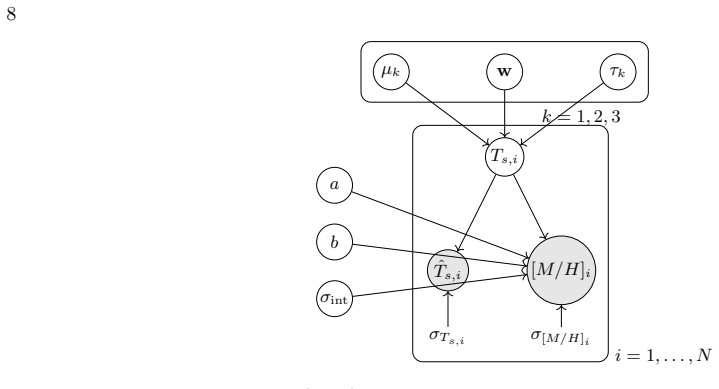
Neural network that maps observed phase-space coordinates directly to stripping time, trained on N-body simulations of the Sagittarius dwarf disruption.
If this is right
- Metallicity increases linearly with more recent stripping time at roughly 0.3 dex per Gyr.
- M54, Terzan 7, Terzan 8 and Arp 2 remain bound to the Sagittarius remnant today.
- Pal 12, Whiting 1 and NGC 2419 left the dwarf 0.9, 1.1 and 2.1 Gyr ago respectively.
- NGC 4147 and NGC 5634, if confirmed as members, were stripped about 1.1 Gyr ago.
- Data-driven stripping-time estimates can reconstruct both the dynamical orbit and the chemical history of the stream.
Where Pith is reading between the lines
- The identical training procedure could be repeated for other known stellar streams to date their own stripping sequences.
- A confirmed gradient would constrain how long the Sagittarius dwarf continued forming stars before its gas was exhausted.
- Adding future high-precision radial-velocity or abundance data would allow the method to map changes in the dwarf's orbital decay rate.
- The approach may help identify additional faint members that current selection cuts miss.
Load-bearing premise
The neural network trained only on simulations produces unbiased stripping-time estimates when applied to real stars despite differences in dynamics or selection.
What would settle it
A large independent sample of stream stars with direct age or abundance measurements showing no correlation between metallicity and the network-predicted stripping time.
Figures


read the original abstract
The Sagittarius (Sgr) Stream is produced by the ongoing disruption of the Sgr dwarf spheroidal (dSph) galaxy and is thought to contain multiple wraps that were stripped during different pericentric passages. In this study, we introduce a neural-network--based method trained on $N$-body simulations to infer the stripping time of Sgr Stream stars directly from their phase-space coordinates. We combine spectroscopic data from SEGUE, APOGEE DR17, and LAMOST DR7 LRS with \textit{Gaia} EDR3 astrometry and distance estimates from the latest \texttt{StarHorse} catalog to identify high-quality Sgr Stream members. Applying our method to these stars, we measure a clear metallicity gradient with stripping time, well described by a linear relation with slope $\sim 0.3~\mathrm{dex~Gyr^{-1}}$. We further predict the stripping times of globular clusters previously suggested to originate from the Sgr dSph. M 54, Terzan 7, Terzan 8, and Arp 2 exhibit stripping times consistent with being currently bound to the Sgr remnant. Pal 12, Whiting 1, and NGC 2419 are inferred to have been stripped $0.9 \pm 0.1$, $1.1 \pm 0.2$, and $2.1 \pm 0.2$ Gyr ago, respectively. For NGC 4147 and NGC 5634, whose membership in the Sgr system remains uncertain, our analysis suggests stripping times of $1.1 \pm 0.4$ and $1.1 \pm 0.1$ Gyr, respectively, if they are ultimately confirmed as genuine Sgr members. These results demonstrate that data-driven models of dynamical stripping histories offer a promising approach for reconstructing the formation and chemical evolution of the Sgr Stream.
Editorial analysis
A structured set of objections, weighed in public.
Referee Report
Summary. The paper introduces a neural-network method trained on N-body simulations to infer the stripping times of Sagittarius Stream stars directly from phase-space coordinates. Combining SEGUE, APOGEE, LAMOST, Gaia EDR3, and StarHorse data, the authors identify high-quality stream members and report a metallicity gradient with stripping time of slope ~0.3 dex Gyr^{-1}. They further predict stripping times for several globular clusters previously linked to the Sgr dSph, including values such as 0.9 Gyr for Pal 12 and 2.1 Gyr for NGC 2419.
Significance. If the neural network generalizes reliably, the work provides a novel data-driven route to reconstruct the multi-wrap stripping history of the Sgr stream and to link chemical gradients to dynamical epochs. The reported linear metallicity-stripping-time relation and the specific GC age predictions constitute falsifiable outputs that could be tested with future spectroscopic surveys or improved simulations.
major comments (2)
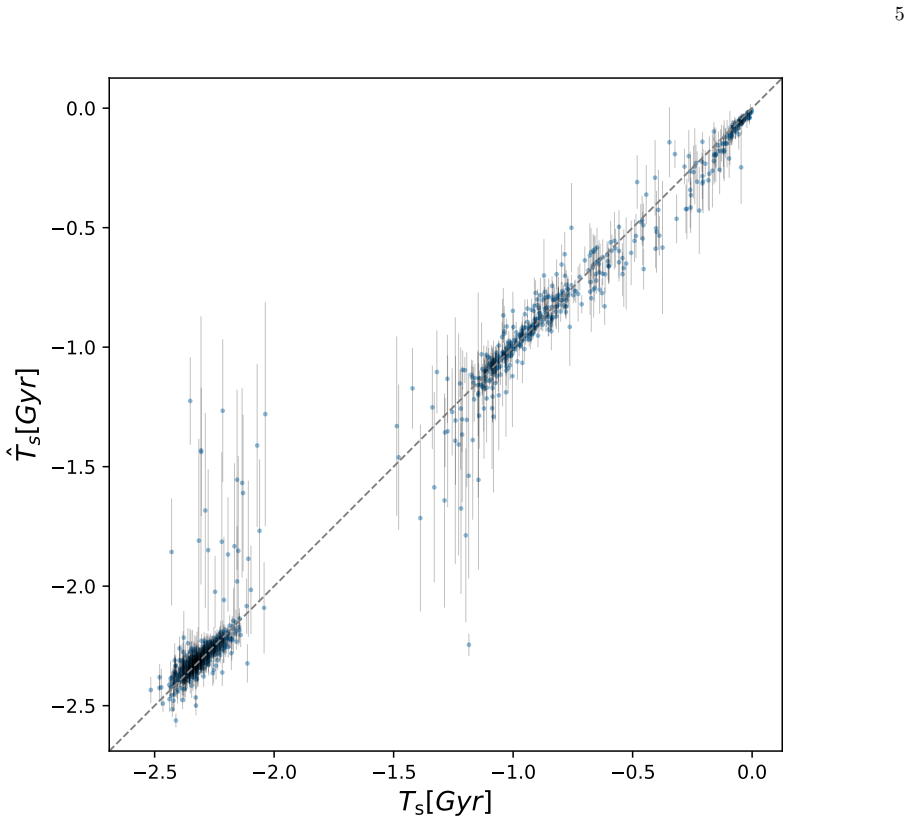
- [Abstract and §3] Abstract and §3 (Methods): no performance metrics, cross-validation scores, or recovery tests on held-out simulations are reported for the neural network's ability to predict known stripping times. Without these, the central claim that the network accurately maps observed (x, v) to stripping time remains only moderately supported.
- [§4] §4 (Application to observations): the training set consists of noise-free N-body particles, yet the manuscript does not describe injection of realistic Gaia/StarHorse uncertainties (distance errors ~10-20%, proper-motion and RV errors) during training or Monte-Carlo propagation at inference. This omission directly affects the reliability of the reported ~0.3 dex Gyr^{-1} gradient and the GC stripping times (e.g., NGC 2419 at 2.1 Gyr).
minor comments (1)
- [Abstract] The abstract states the gradient is 'well described by a linear relation' but does not quote the intercept or the formal uncertainty on the slope; these should be added for reproducibility.
Simulated Author's Rebuttal
We thank the referee for their constructive and detailed report. Their comments have identified areas where the original manuscript could be strengthened through additional validation and clearer description of uncertainty handling. We address each major comment below and have revised the manuscript accordingly.
read point-by-point responses
-
Referee: [Abstract and §3] Abstract and §3 (Methods): no performance metrics, cross-validation scores, or recovery tests on held-out simulations are reported for the neural network's ability to predict known stripping times. Without these, the central claim that the network accurately maps observed (x, v) to stripping time remains only moderately supported.
Authors: We agree that quantitative performance metrics were not presented in the original submission. In the revised manuscript we have expanded §3 with a new subsection on validation. This includes 5-fold cross-validation results on the simulation training set and recovery tests on held-out N-body particles, together with quantitative metrics (mean absolute error and correlation coefficient between predicted and true stripping times) and new figures showing the recovery performance. These additions directly support the claim that the network maps phase-space coordinates to stripping time. revision: yes
-
Referee: [§4] §4 (Application to observations): the training set consists of noise-free N-body particles, yet the manuscript does not describe injection of realistic Gaia/StarHorse uncertainties (distance errors ~10-20%, proper-motion and RV errors) during training or Monte-Carlo propagation at inference. This omission directly affects the reliability of the reported ~0.3 dex Gyr^{-1} gradient and the GC stripping times (e.g., NGC 2419 at 2.1 Gyr).
Authors: We agree that the original text did not adequately describe uncertainty handling. The training was performed on noise-free particles to learn the clean dynamical mapping; observational errors are instead propagated at inference via Monte Carlo sampling of each star's phase-space coordinates within their reported uncertainties. In the revised manuscript we have added a detailed description of this procedure in §4, including the number of realizations drawn and how the resulting distributions are used to obtain the reported stripping times and their uncertainties. We have also included a robustness test in which realistic Gaia/StarHorse-level noise was injected into simulation particles, confirming that the recovered metallicity gradient remains consistent. These changes improve the presentation of the reliability of the ~0.3 dex Gyr^{-1} gradient and the globular-cluster ages. revision: yes
Circularity Check
No significant circularity: NN trained on independent N-body simulations applied to external observations
full rationale
The derivation trains a neural network on N-body simulations (independent of observations) to map phase-space coordinates to stripping times, then applies the model to real SEGUE/APOGEE/LAMOST+Gaia+StarHorse data. The metallicity gradient (~0.3 dex Gyr^{-1}) and GC stripping-time predictions are computed from these inferred times plus observed metallicities, without reducing to the training inputs by construction. No self-definitional steps, fitted inputs renamed as predictions, load-bearing self-citations, uniqueness theorems, or ansatzes appear in the abstract or described method. The chain remains self-contained against external benchmarks.
Axiom & Free-Parameter Ledger
free parameters (1)
- neural network weights and hyperparameters
axioms (1)
- domain assumption N-body simulations faithfully reproduce the phase-space distributions of stars stripped at different pericentric passages
Lean theorems connected to this paper
-
IndisputableMonolith/Cost/FunctionalEquation.leanwashburn_uniqueness_aczel unclear?
unclearRelation between the paper passage and the cited Recognition theorem.
neural-network–based method trained on N-body simulations to infer the stripping time of Sgr Stream stars directly from their phase-space coordinates
-
IndisputableMonolith/Foundation/AlphaCoordinateFixation.leanJ_uniquely_calibrated_via_higher_derivative unclear?
unclearRelation between the paper passage and the cited Recognition theorem.
linear relation with slope ∼0.3 dex Gyr^{-1}
What do these tags mean?
- matches
- The paper's claim is directly supported by a theorem in the formal canon.
- supports
- The theorem supports part of the paper's argument, but the paper may add assumptions or extra steps.
- extends
- The paper goes beyond the formal theorem; the theorem is a base layer rather than the whole result.
- uses
- The paper appears to rely on the theorem as machinery.
- contradicts
- The paper's claim conflicts with a theorem or certificate in the canon.
- unclear
- Pith found a possible connection, but the passage is too broad, indirect, or ambiguous to say the theorem truly supports the claim.
Reference graph
Works this paper leans on
-
[1]
The Astropy Project: Sustaining and Growing a Community-oriented Open-source Project and the Latest Major Release (v5.0) of the Core Package. , keywords =. doi:10.3847/1538-4357/ac7c74 , archivePrefix =. 2206.14220 , primaryClass =
work page internal anchor Pith review Pith/arXiv arXiv doi:10.3847/1538-4357/ac7c74
-
[2]
The Astropy Project: Building an inclusive, open-science project and status of the v2.0 core package
The Astropy Project: Building an Open-science Project and Status of the v2.0 Core Package. , keywords =. doi:10.3847/1538-3881/aabc4f , archivePrefix =. 1801.02634 , primaryClass =
work page internal anchor Pith review Pith/arXiv arXiv doi:10.3847/1538-3881/aabc4f
-
[3]
Astropy: A Community Python Package for Astronomy
Astropy: A community Python package for astronomy. , keywords =. 2013. doi:10.1051/0004-6361/201322068 , archivePrefix =. 1307.6212 , primaryClass =
work page internal anchor Pith review Pith/arXiv arXiv doi:10.1051/0004-6361/201322068 2013
-
[4]
Core condensation in heavy halos: a two-stage theory for galaxy formation and clustering. , keywords =. doi:10.1093/mnras/183.3.341 , adsurl =
-
[5]
Simulating the joint evolution of quasars, galaxies and their large-scale distribution
Simulations of the formation, evolution and clustering of galaxies and quasars. , keywords =. doi:10.1038/nature03597 , archivePrefix =. astro-ph/0504097 , primaryClass =
work page internal anchor Pith review Pith/arXiv arXiv doi:10.1038/nature03597
-
[6]
A Two Micron All Sky Survey View of the Sagittarius Dwarf Galaxy. I. Morphology of the Sagittarius Core and Tidal Arms. , keywords =. doi:10.1086/379504 , archivePrefix =. astro-ph/0304198 , primaryClass =
work page internal anchor Pith review Pith/arXiv arXiv doi:10.1086/379504
-
[7]
, year = 1994, month = jul, volume =
A dwarf satellite galaxy in Sagittarius. , year = 1994, month = jul, volume =. doi:10.1038/370194a0 , adsurl =
-
[8]
Revising members and candidates with Gaia DR2
Globular clusters in the Sagittarius stream. Revising members and candidates with Gaia DR2. , keywords =. doi:10.1051/0004-6361/202037621 , archivePrefix =. 2003.07871 , primaryClass =
-
[9]
Tango for three: Sagittarius, LMC, and the Milky Way. , keywords =. doi:10.1093/mnras/staa3673 , archivePrefix =. 2009.10726 , primaryClass =
-
[10]
Building up the stellar halo of the Galaxy. , keywords =. doi:10.1046/j.1365-8711.1999.02616.x , archivePrefix =. astro-ph/9901102 , primaryClass =
-
[11]
Co-formation of the Galactic disc and the stellar halo
Co-formation of the disc and the stellar halo. , keywords =. doi:10.1093/mnras/sty982 , archivePrefix =. 1802.03414 , primaryClass =
work page internal anchor Pith review Pith/arXiv arXiv doi:10.1093/mnras/sty982
-
[12]
The merger that led to the formation of the Milky Way's inner stellar halo and thick disk
The merger that led to the formation of the Milky Way's inner stellar halo and thick disk. , keywords =. doi:10.1038/s41586-018-0625-x , archivePrefix =. 1806.06038 , primaryClass =
work page internal anchor Pith review Pith/arXiv arXiv doi:10.1038/s41586-018-0625-x
-
[13]
Multiple retrograde substructures in the Galactic halo: A shattered view of Galactic history. , keywords =. doi:10.1051/0004-6361/201936738 , archivePrefix =. 1909.08924 , primaryClass =
-
[14]
Evidence for Two Early Accretion Events That Built the Milky Way Stellar Halo
Evidence for two early accretion events that built the Milky Way stellar halo. , keywords =. doi:10.1093/mnras/stz1770 , archivePrefix =. 1904.03185 , primaryClass =
work page internal anchor Pith review Pith/arXiv arXiv doi:10.1093/mnras/stz1770 1904
-
[15]
Evidence from the H3 Survey That the Stellar Halo Is Entirely Comprised of Substructure. , keywords =. doi:10.3847/1538-4357/abaef4 , archivePrefix =. 2006.08625 , primaryClass =
-
[16]
A tail of two populations: chemo-dynamics of the Sagittarius stream and implications for its original mass. , keywords =. doi:10.1093/mnras/stw2328 , archivePrefix =. 1607.00803 , primaryClass =
work page internal anchor Pith review Pith/arXiv arXiv doi:10.1093/mnras/stw2328
-
[17]
A Diffuse Metal-poor Component of the Sagittarius Stream Revealed by the H3 Survey. , keywords =. doi:10.3847/1538-4357/abab08 , archivePrefix =. 2007.14408 , primaryClass =
-
[18]
Phase-space Properties and Chemistry of the Sagittarius Stellar Stream Down to the Extremely Metal-poor ([Fe/H] -3) Regime. , keywords =. doi:10.3847/1538-4357/acb694 , archivePrefix =. 2212.08249 , primaryClass =
-
[19]
Stellar streams in the Gaia era. , keywords =. doi:10.1016/j.newar.2024.101713 , archivePrefix =. 2405.19410 , primaryClass =
-
[20]
Evidence for the Sagittarius Dwarf Galaxy at Low Galactic Latitudes. , keywords =. doi:10.1086/309917 , adsurl =
-
[21]
Discovery of a Tidal Extension of the Sagittarius Dwarf Spheroidal Galaxy. , keywords =. doi:10.1086/309919 , adsurl =
-
[22]
Tracing the Outer Structure of the Sagittarius Dwarf Galaxy:Detections at Angular Distances between 10 and 34. , keywords =. doi:10.1086/311720 , archivePrefix =. astro-ph/9810015 , primaryClass =
work page internal anchor Pith review Pith/arXiv arXiv doi:10.1086/311720
-
[23]
MACHO Project Photometry of RR Lyrae Stars in the Sgr Dwarf Galaxy
MACHO Project Photometry of RR Lyrae Stars in the Sagittarius Dwarf Galaxy. , keywords =. doi:10.1086/303467 , archivePrefix =. astro-ph/9605148 , primaryClass =
work page internal anchor Pith review Pith/arXiv arXiv doi:10.1086/303467
-
[24]
A., Ramsay, G., Andronov, I., et al
The APM survey for cool carbon stars in the Galactic halo - I. , keywords =. doi:10.1046/j.1365-8711.1998.01086.x , adsurl =
-
[25]
Starcounts Redivivus. III. A Possible Detection of the Sagittarius Dwarf Spheroidal Galaxy at B=-40 deg. , keywords =. doi:10.1086/301036 , archivePrefix =. astro-ph/9906455 , primaryClass =
work page internal anchor Pith review Pith/arXiv arXiv doi:10.1086/301036
-
[26]
Galactic Halo Substructure in the Sloan Digital Sky Survey: The Ancient Tidal Stream from the Sagittarius Dwarf Galaxy. , keywords =. doi:10.1086/318894 , archivePrefix =. astro-ph/0004255 , primaryClass =
work page internal anchor Pith review Pith/arXiv arXiv doi:10.1086/318894
-
[27]
Sagittarius Tidal Debris 90 kpc from the Galactic Center
Sagittarius Tidal Debris 90 Kiloparsecs from the Galactic Center. , keywords =. doi:10.1086/379316 , archivePrefix =. astro-ph/0309162 , primaryClass =
work page internal anchor Pith review Pith/arXiv arXiv doi:10.1086/379316
-
[28]
The Field of Streams: Sagittarius and its Siblings
The Field of Streams: Sagittarius and Its Siblings. , keywords =. doi:10.1086/504797 , archivePrefix =. astro-ph/0605025 , primaryClass =
work page internal anchor Pith review Pith/arXiv arXiv doi:10.1086/504797
-
[29]
Precession of the Sagittarius stream
Precession of the Sagittarius stream. , keywords =. doi:10.1093/mnras/stt1862 , archivePrefix =. 1301.7069 , primaryClass =
work page internal anchor Pith review Pith/arXiv arXiv doi:10.1093/mnras/stt1862
-
[30]
The Geometry of Sagittarius Stream from Pan-STARRS1 3$\pi$ RR Lyrae
The Geometry of the Sagittarius Stream from Pan-STARRS1 3 RR Lyrae. , keywords =. doi:10.3847/1538-4357/aa960c , archivePrefix =. 1710.09436 , primaryClass =
work page internal anchor Pith review Pith/arXiv arXiv doi:10.3847/1538-4357/aa960c
-
[31]
2001, MNRAS, 322, 231, doi: 10.1046/j.1365-8711.2001.04022.x
Simple dynamical models of the Sagittarius dwarf galaxy. , keywords =. doi:10.1046/j.1365-8711.2001.04238.x , archivePrefix =. astro-ph/0002482 , primaryClass =
-
[32]
Velocity trends in the debris of Sagittarius and the shape of the dark-matter halo of the Galaxy
Velocity Trends in the Debris of Sagittarius and the Shape of the Dark Matter Halo of Our Galaxy. , keywords =. doi:10.1086/423340 , archivePrefix =. astro-ph/0406396 , primaryClass =
work page internal anchor Pith review Pith/arXiv arXiv doi:10.1086/423340
-
[33]
A Two Micron All Sky Survey View of the Sagittarius Dwarf Galaxy. III. Constraints on the Flattening of the Galactic Halo. , keywords =. doi:10.1086/426777 , archivePrefix =. astro-ph/0407565 , primaryClass =
work page internal anchor Pith review Pith/arXiv arXiv doi:10.1086/426777
-
[34]
A Two Micron All-Sky Survey View of the Sagittarius Dwarf Galaxy. IV. Modeling the Sagittarius Tidal Tails. , keywords =. doi:10.1086/426779 , archivePrefix =. astro-ph/0407566 , primaryClass =
work page internal anchor Pith review Pith/arXiv arXiv doi:10.1086/426779
-
[35]
The Origin of the Bifurcation in the Sagittarius Stream
The Origin of the Bifurcation in the Sagittarius Stream. , keywords =. doi:10.1086/507128 , archivePrefix =. astro-ph/0605026 , primaryClass =
work page internal anchor Pith review Pith/arXiv arXiv doi:10.1086/507128
-
[36]
Was the progenitor of the Sagittarius stream a disc galaxy?. , keywords =. doi:10.1111/j.1745-3933.2010.00921.x , archivePrefix =. 1007.1485 , primaryClass =
-
[37]
The Sagittarius Dwarf Galaxy: a Model for Evolution in a Triaxial Milky Way Halo
The Sagittarius Dwarf Galaxy: A Model for Evolution in a Triaxial Milky Way Halo. , keywords =. doi:10.1088/0004-637X/714/1/229 , archivePrefix =. 1003.1132 , primaryClass =
work page internal anchor Pith review Pith/arXiv arXiv doi:10.1088/0004-637x/714/1/229
-
[38]
The Gaia mission. , keywords =. doi:10.1051/0004-6361/201629272 , archivePrefix =. 1609.04153 , primaryClass =
work page internal anchor Pith review Pith/arXiv arXiv doi:10.1051/0004-6361/201629272
-
[39]
Gaia Data Release 1. Summary of the astrometric, photometric, and survey properties
Gaia Data Release 1. Summary of the astrometric, photometric, and survey properties. , keywords =. doi:10.1051/0004-6361/201629512 , archivePrefix =. 1609.04172 , primaryClass =
work page internal anchor Pith review Pith/arXiv arXiv doi:10.1051/0004-6361/201629512
-
[40]
2018, , 616, A1, 10.1051/0004-6361/201833051
Gaia Data Release 2. Summary of the contents and survey properties. , keywords =. doi:10.1051/0004-6361/201833051 , archivePrefix =. 1804.09365 , primaryClass =
work page internal anchor Pith review Pith/arXiv arXiv doi:10.1051/0004-6361/201833051
-
[41]
Summary of the contents and survey properties
Gaia Early Data Release 3. Summary of the contents and survey properties. , keywords =. doi:10.1051/0004-6361/202039657 , archivePrefix =. 2012.01533 , primaryClass =
-
[42]
An all-sky proper-motion map of the Sagittarius stream using Gaia DR2. , keywords =. doi:10.1051/0004-6361/201937145 , archivePrefix =. 2001.10012 , primaryClass =
-
[43]
A Panoramic Landscape of the Sagittarius Stream in Gaia DR2 Revealed with the STREAMFINDER Spyglass. , keywords =. doi:10.3847/2041-8213/ab77c7 , archivePrefix =. 2002.11121 , primaryClass =
-
[44]
The Sagittarius stream in Gaia Early Data Release 3 and the origin of the bifurcations. , keywords =. doi:10.1051/0004-6361/202142830 , archivePrefix =. 2112.02105 , primaryClass =
-
[45]
StarHorse results for spectroscopic surveys and Gaia DR3: Chrono-chemical populations in the solar vicinity, the genuine thick disk, and young alpha-rich stars. , keywords =. doi:10.1051/0004-6361/202245399 , archivePrefix =. 2303.09926 , primaryClass =
-
[46]
Gaia Data Release 3. Summary of the content and survey properties. , keywords =. doi:10.1051/0004-6361/202243940 , archivePrefix =. 2208.00211 , primaryClass =
-
[47]
Properties and validation of the radial velocities
Gaia Data Release 3. Properties and validation of the radial velocities. , keywords =. doi:10.1051/0004-6361/202244220 , archivePrefix =. 2206.05902 , primaryClass =
-
[48]
2012, Research in Astronomy and Astrophysics, 12, 1197, doi: 10.1088/1674-4527/12/9/003
The Large Sky Area Multi-Object Fiber Spectroscopic Telescope (LAMOST). Research in Astronomy and Astrophysics , year = 2012, month = sep, volume =. doi:10.1088/1674-4527/12/9/003 , adsurl =
-
[49]
Research in Astronomy and Astrophysics , year = 2012, month = jul, volume =
LAMOST spectral survey An overview. Research in Astronomy and Astrophysics , year = 2012, month = jul, volume =. doi:10.1088/1674-4527/12/7/002 , adsurl =
-
[50]
Detection of the gravitational redshift in the orbit of the star S2 near the Galactic centre massive black hole. , keywords =. doi:10.1051/0004-6361/201833718 , archivePrefix =. 1807.09409 , primaryClass =
work page internal anchor Pith review Pith/arXiv arXiv doi:10.1051/0004-6361/201833718
-
[51]
Vertical waves in the solar neighbourhood in Gaia DR2
Vertical waves in the solar neighbourhood in Gaia DR2. , keywords =. doi:10.1093/mnras/sty2813 , archivePrefix =. 1809.03507 , primaryClass =
work page internal anchor Pith review Pith/arXiv arXiv doi:10.1093/mnras/sty2813
-
[52]
The mass distribution and gravitational potential of the Milky Way
The mass distribution and gravitational potential of the Milky Way. , keywords =. doi:10.1093/mnras/stw2759 , archivePrefix =. 1608.00971 , primaryClass =
work page internal anchor Pith review Pith/arXiv arXiv doi:10.1093/mnras/stw2759
-
[53]
Local kinematics and the local standard of rest. , keywords =. doi:10.1111/j.1365-2966.2010.16253.x , archivePrefix =. 0912.3693 , primaryClass =
-
[54]
AGAMA: Action-based galaxy modelling architecture
AGAMA: action-based galaxy modelling architecture. , keywords =. doi:10.1093/mnras/sty2672 , archivePrefix =. 1802.08239 , primaryClass =
work page internal anchor Pith review Pith/arXiv arXiv doi:10.1093/mnras/sty2672
-
[55]
Understanding Deep Neural Networks with Rectified Linear Units
Understanding Deep Neural Networks with Rectified Linear Units. arXiv e-prints , keywords =. doi:10.48550/arXiv.1611.01491 , archivePrefix =. 1611.01491 , primaryClass =
work page internal anchor Pith review Pith/arXiv arXiv doi:10.48550/arxiv.1611.01491
-
[56]
Exploring the Sagittarius stream with RR Lyrae stars from Gaia Data Release 3. , keywords =. doi:10.1051/0004-6361/202555670 , archivePrefix =. 2505.20165 , primaryClass =
-
[57]
Reconstructing the whole 6D properties of the Sagittarius stream with N-body simulations. arXiv e-prints , keywords =. doi:10.48550/arXiv.2204.08542 , archivePrefix =. 2204.08542 , primaryClass =
-
[58]
Detection of a population gradient in the Sagittarius Stream
Detection of a population gradient in the Sagittarius stream. , keywords =. doi:10.1051/0004-6361:20066002 , archivePrefix =. astro-ph/0608513 , primaryClass =
work page internal anchor Pith review Pith/arXiv arXiv doi:10.1051/0004-6361:20066002
-
[59]
A 2MASS All-Sky View of the Sagittarius Dwarf Galaxy. V. Variation of the Metallicity Distribution Function along the Sagittarius Stream. , keywords =. doi:10.1086/522483 , archivePrefix =. astro-ph/0605101 , primaryClass =
work page internal anchor Pith review Pith/arXiv arXiv doi:10.1086/522483
-
[60]
High-resolution spectroscopy of RGB stars in the Sagittarius streams. I. Radial velocities and chemical abundances. , keywords =. doi:10.1051/0004-6361:20066228 , archivePrefix =. astro-ph/0611070 , primaryClass =
work page internal anchor Pith review Pith/arXiv arXiv doi:10.1051/0004-6361:20066228
-
[61]
Kinematics and Chemistry of Stars along the Sagittarius Trailing Tidal Tail and Constraints on the Milky Way Mass Distribution. , keywords =. doi:10.1088/0004-637X/744/1/25 , archivePrefix =. 1111.0014 , primaryClass =
work page internal anchor Pith review Pith/arXiv arXiv doi:10.1088/0004-637x/744/1/25
-
[62]
Discovery of a Dynamical Cold Point in the Heart of the Sagittarius dSph Galaxy with Observations from the APOGEE Project. , keywords =. doi:10.1088/2041-8205/777/1/L13 , archivePrefix =. 1309.5535 , primaryClass =
work page internal anchor Pith review Pith/arXiv arXiv doi:10.1088/2041-8205/777/1/l13 2041
-
[63]
Chemical abundances in the nucleus of the Sagittarius dwarf spheroidal galaxy
Chemical abundances in the nucleus of the Sagittarius dwarf spheroidal galaxy. , keywords =. doi:10.1051/0004-6361/201730707 , archivePrefix =. 1705.03251 , primaryClass =
work page internal anchor Pith review Pith/arXiv arXiv doi:10.1051/0004-6361/201730707
-
[64]
A photometric metallicity analysis of the Sagittarius dwarf spheroidal galaxy
The Pristine Inner Galaxy Survey (PIGS) - IV. A photometric metallicity analysis of the Sagittarius dwarf spheroidal galaxy. , keywords =. doi:10.1093/mnras/stac2869 , archivePrefix =. 2204.12140 , primaryClass =
-
[65]
Chemical Cartography of the Sagittarius Stream with Gaia. , keywords =. doi:10.3847/1538-4357/ad187b , archivePrefix =. 2307.08730 , primaryClass =
-
[66]
Full 5D characterisation of the Sagittarius stream with Gaia DR2 RR Lyrae. , keywords =. doi:10.1051/0004-6361/202037819 , archivePrefix =. 2002.11142 , primaryClass =
-
[67]
Tracing Kinematic and Chemical Properties of Sagittarius Stream by K-Giants, M-Giants, and BHB stars. , keywords =. doi:10.3847/1538-4357/ab48e2 , archivePrefix =. 1909.12558 , primaryClass =
-
[68]
Revisiting a Disky Origin for the Faint Branch of the Sagittarius Stellar Stream. , keywords =. doi:10.3847/2041-8213/ac738c , archivePrefix =. 2205.14902 , primaryClass =
-
[69]
A Pristine-UNIONS view on the Galaxy: Kinematics of the distant spur feature of the Sagittarius stream traced by blue horizontal branch stars. , keywords =. doi:10.1051/0004-6361/202554131 , archivePrefix =. 2502.17319 , primaryClass =
-
[70]
Mapping the Stellar Halo with the H3 Spectroscopic Survey. , keywords =. doi:10.3847/1538-4357/ab38b8 , archivePrefix =. 1907.07684 , primaryClass =
-
[71]
SEGUE: A Spectroscopic Survey of 240,000 stars with g=14-20
SEGUE: A Spectroscopic Survey of 240,000 Stars with g = 14-20. , keywords =. doi:10.1088/0004-6256/137/5/4377 , archivePrefix =. 0902.1781 , primaryClass =
work page internal anchor Pith review Pith/arXiv arXiv doi:10.1088/0004-6256/137/5/4377
-
[72]
Tracing Sagittarius Structure with SDSS and SEGUE Imaging and Spectroscopy
Tracing Sagittarius Structure with SDSS and SEGUE Imaging and Spectroscopy. , keywords =. doi:10.1088/0004-637X/700/2/1282 , archivePrefix =. 0905.4502 , primaryClass =
work page internal anchor Pith review Pith/arXiv arXiv doi:10.1088/0004-637x/700/2/1282
-
[73]
The GALAH Survey: Scientific Motivation
The GALAH survey: scientific motivation. , keywords =. doi:10.1093/mnras/stv327 , archivePrefix =. 1502.04767 , primaryClass =
work page internal anchor Pith review Pith/arXiv arXiv doi:10.1093/mnras/stv327
-
[74]
The GALAH Survey: Observational Overview and Gaia DR1 companion
The GALAH survey: observational overview and Gaia DR1 companion. , keywords =. doi:10.1093/mnras/stw2835 , archivePrefix =. 1609.02822 , primaryClass =
work page internal anchor Pith review Pith/arXiv arXiv doi:10.1093/mnras/stw2835
-
[75]
The Seventeenth Data Release of the Sloan Digital Sky Surveys: Complete Release of MaNGA, MaStar, and APOGEE-2 Data. , keywords =. doi:10.3847/1538-4365/ac4414 , archivePrefix =. 2112.02026 , primaryClass =
-
[76]
The Sixth Data Release of the Radial Velocity Experiment (RAVE). II. Stellar Atmospheric Parameters, Chemical Abundances, and Distances. , keywords =. doi:10.3847/1538-3881/ab9ab8 , archivePrefix =. 2002.04512 , primaryClass =
-
[77]
The Eleventh and Twelfth Data Releases of the Sloan Digital Sky Survey: Final Data from SDSS-III
The Eleventh and Twelfth Data Releases of the Sloan Digital Sky Survey: Final Data from SDSS-III. , keywords =. doi:10.1088/0067-0049/219/1/12 , archivePrefix =. 1501.00963 , primaryClass =
work page internal anchor Pith review Pith/arXiv arXiv doi:10.1088/0067-0049/219/1/12
-
[78]
Evolution of the Milky Way: Some Open Issues for Gaia. Galactic Archaeology: Near-Field Cosmology and the Formation of the Milky Way , year = 2012, editor =
work page 2012
-
[79]
The Gaia-ESO Public Spectroscopic Survey: Implementation, data products, open cluster survey, science, and legacy. , keywords =. doi:10.1051/0004-6361/202243141 , archivePrefix =. 2206.02901 , primaryClass =
-
[80]
Accurate distances to Galactic globular clusters through a combination of Gaia EDR3, HST, and literature data. , keywords =. doi:10.1093/mnras/stab1474 , archivePrefix =. 2105.09526 , primaryClass =
discussion (0)
Sign in with ORCID, Apple, or X to comment. Anyone can read and Pith papers without signing in.