Recognition: 2 theorem links
· Lean TheoremPhysics-Based iOCT Sonification for Real-time Interaction Awareness in Subretinal Injection
Pith reviewed 2026-05-15 01:28 UTC · model grok-4.3
The pith
A physics-based sonification system turns iOCT images into real-time sound cues for needle position and retinal deformation in subretinal injection.
A machine-rendered reading of the paper's core claim, the machinery that carries it, and where it could break.
Core claim
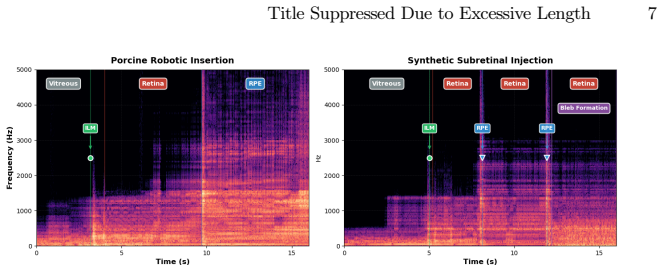
The structured real-time sonification framework, employing a physics-inspired acoustic model with segmented retinal layers from iOCT B-scans as drivers and needle motion plus injection-induced displacements as excitations, provides perceptual auditory feedback that enables high-accuracy identification of retinal layers and deformation events during subretinal injection procedures.
What carries the argument
The physics-inspired acoustic model that takes segmented retinal layers and needle motion as inputs to generate sound representing tool position and tissue deformation.
If this is right
- Surgeons receive continuous auditory information about needle depth relative to retinal layers without diverting visual attention from the en face microscope view.
- Enhanced detection of injection-induced retinal deformation reduces the likelihood of unintended RPE perforation.
- Expert evaluation supports potential for integration into clinical workflows for vitreoretinal surgery.
- Overall event identification improves significantly over existing sonification baselines.
Where Pith is reading between the lines
- Combining this auditory channel with visual iOCT could further reduce errors in high-stakes phases of the procedure.
- Similar physics-based mappings might apply to other image-guided interventions where visual attention is split.
- Future work could test real-time performance under actual surgical lighting and time pressures.
Load-bearing premise
The physics-inspired acoustic model accurately captures real tissue interactions and that performance in a controlled lab study with simulated conditions will hold in actual operating rooms with live patients.
What would settle it
A clinical trial in which surgeons perform subretinal injections on patients using the sonification system and show no improvement in deformation detection accuracy or an increase in perforation incidents compared to visual-only guidance.
Figures


read the original abstract
Subretinal injection is a delicate vitreoretinal procedure requiring precise needle placement within the subretinal space while avoiding perforation of the retinal pigment epithelium (RPE), a layer directly beneath the target with extremely limited regenerative capacity. To enhance depth perception during cannula advancement, intraoperative optical coherence tomography (iOCT) offers high-resolution cross-sectional visualization of needle-tissue interaction; however, interpreting these images requires sustained visual attention alongside the en face microscope view, thereby increasing cognitive load during critical phases and placing additional demands on the surgeon's proprioceptive control. In this paper, we propose a structured, real-time sonification framework designed for extensible mapping of iOCT-derived anatomical features into perceptual auditory feedback. The method employs a physics-inspired acoustic model driven by segmented retinal layers from a stream of iOCT B-scans, with needle motion and injection-induced retinal layer displacements serving as excitation inputs to the sound model, enabling perception of tool position and retinal deformation. In a controlled user study (n=34), the proposed sonification achieved high retinal layer identification accuracy and robust detection of retinal deformation-related events, significantly outperforming a state-of-the-art baseline in overall event identification (83.4% vs. 60.6%, p < 0.001), with gains driven primarily by enhanced detection of injection-induced retinal deformation. Evaluation by experts (n=4) confirmed the clinical relevance and potential intraoperative applicability of the method. These results establish structured iOCT sonification as a viable complementary modality for real-time surgical guidance in subretinal injection.
Editorial analysis
A structured set of objections, weighed in public.
Referee Report
Summary. The manuscript proposes a real-time sonification framework for intraoperative optical coherence tomography (iOCT) during subretinal injection. It maps segmented retinal layers and needle motion from iOCT B-scans into a physics-inspired acoustic model to deliver auditory cues for tool position and injection-induced retinal deformation. A controlled user study (n=34) reports superior overall event identification (83.4% vs. 60.6%, p<0.001) relative to a state-of-the-art baseline, driven mainly by better detection of retinal deformation events, with supporting expert review (n=4) affirming clinical relevance.
Significance. If the performance gains hold under live operating-room conditions, the work could meaningfully reduce surgeons' visual attention demands by adding a complementary auditory channel during a high-precision procedure involving non-regenerative tissue. The controlled user study with a sizable participant cohort and the explicit comparison against a baseline constitute a concrete empirical contribution; the focus on a clinically urgent problem is also a strength.
major comments (2)
- [Abstract] Abstract: The reported event-identification rates (83.4% vs. 60.6%, p<0.001) are presented without any description of retinal-layer segmentation accuracy, the explicit equations or parameters of the physics-inspired acoustic model, the precise baseline implementation, participant training, number of trials, or multiple-comparison corrections. These omissions are load-bearing because the central claim attributes the gains to the proposed sonification; without them the result cannot be reproduced or attributed.
- [Abstract] Abstract / presumed Methods: No quantitative sensitivity analysis is supplied showing how layer-boundary jitter, real-time segmentation errors, or unmodeled viscoelastic fluid effects during injection propagate through the acoustic model to alter the auditory output. This directly undermines the assertion that the sonification 'accurately represents real tissue interactions' and the extrapolation from the controlled study to live surgery.
minor comments (1)
- [Abstract] Abstract: The phrase 'structured, real-time sonification framework' is introduced without a brief definition or reference to prior sonification literature, which would help readers outside the immediate subfield.
Simulated Author's Rebuttal
We thank the referee for the thorough review and constructive comments. We address each major comment below and indicate the revisions made to the manuscript.
read point-by-point responses
-
Referee: [Abstract] Abstract: The reported event-identification rates (83.4% vs. 60.6%, p<0.001) are presented without any description of retinal-layer segmentation accuracy, the explicit equations or parameters of the physics-inspired acoustic model, the precise baseline implementation, participant training, number of trials, or multiple-comparison corrections. These omissions are load-bearing because the central claim attributes the gains to the proposed sonification; without them the result cannot be reproduced or attributed.
Authors: We agree that the abstract omits some details due to space limitations. The full manuscript provides the retinal-layer segmentation accuracy in the Methods section, the explicit equations and parameters of the acoustic model in Section 3, the baseline implementation details, participant training protocol, number of trials, and confirms that no multiple-comparison corrections were applied as there was only one primary comparison. We will revise the abstract to include a brief mention of these elements to facilitate reproduction and attribution. revision: yes
-
Referee: [Abstract] Abstract / presumed Methods: No quantitative sensitivity analysis is supplied showing how layer-boundary jitter, real-time segmentation errors, or unmodeled viscoelastic fluid effects during injection propagate through the acoustic model to alter the auditory output. This directly undermines the assertion that the sonification 'accurately represents real tissue interactions' and the extrapolation from the controlled study to live surgery.
Authors: The manuscript does not include a quantitative sensitivity analysis on the propagation of layer-boundary jitter, segmentation errors, or viscoelastic effects. This is a valid point, and we will add a limitations paragraph in the Discussion acknowledging the controlled nature of the study and the need for such analysis in future work to support extrapolation to live surgery. The current results are based on the user study and expert review under the described conditions. revision: partial
- The lack of quantitative sensitivity analysis for segmentation errors and unmodeled effects.
Circularity Check
No circularity: empirical evaluation independent of model internals
full rationale
The paper presents a sonification framework whose performance claims rest on a controlled user study (n=34) that measures identification accuracy against a stated baseline. No equations, fitted parameters, or self-citations are shown to reduce the reported metrics (83.4% vs 60.6%) to quantities defined inside the paper. The derivation chain is therefore self-contained against external benchmarks.
Axiom & Free-Parameter Ledger
Lean theorems connected to this paper
-
IndisputableMonolith/Cost/FunctionalEquation.leanwashburn_uniqueness_aczel unclear?
unclearRelation between the paper passage and the cited Recognition theorem.
The underlying sound model is formulated as a two-dimensional mass–spring–damper system... hand-crafted mapping M:(class,I)→(m,k,d,N)
-
IndisputableMonolith/Foundation/RealityFromDistinction.leanreality_from_one_distinction unclear?
unclearRelation between the paper passage and the cited Recognition theorem.
physics-inspired acoustic model driven by segmented retinal layers... needle motion and injection-induced retinal layer displacements
What do these tags mean?
- matches
- The paper's claim is directly supported by a theorem in the formal canon.
- supports
- The theorem supports part of the paper's argument, but the paper may add assumptions or extra steps.
- extends
- The paper goes beyond the formal theorem; the theorem is a base layer rather than the whole result.
- uses
- The paper appears to rely on the theorem as machinery.
- contradicts
- The paper's claim conflicts with a theorem or certificate in the canon.
- unclear
- Pith found a possible connection, but the passage is too broad, indirect, or ambiguous to say the theorem truly supports the claim.
Reference graph
Works this paper leans on
-
[1]
2025 IEEE International Conference on Robotics and Automation (ICRA) pp
Arikan, D., Zhang, P., Sommersperger, M., Dehghani, S., Esfandiari, M., Taylor, R.H., Nasseri, M.A., Gehlbach, P.L., Navab, N., Iordachita, I.I.: Real-time deformation-aware control for autonomous robotic subretinal injection under ioct guidance. 2025 IEEE International Conference on Robotics and Automation (ICRA) pp. 10531–10537 (2024), https://api.seman...
work page 2025
-
[2]
Arikan, D., Zhang, P., Sommersperger, M., Dehghani, S., Esfandiari, M., Taylor, R.H., Nasseri, M.A., Gehlbach, P.L., Navab, N., Iordachita, I.I.: Towards motion compensation in autonomous robotic subretinal injections. 2025 International Symposium on Medical Robotics(ISMR)pp.66–72(2024),https://api.semanticscholar.org/CorpusID:274306241
work page 2025
-
[3]
Black, D., Hansen, C., Nabavi, A., Kikinis, R., Hahn, H.K.: A survey of auditory display in image-guided interventions. International Journal of Computer Assisted Radiology and Surgery12, 1665–1676 (2017), https://api.semanticscholar.org/CorpusID:11833443
work page 2017
-
[4]
In: Applied Mathematical Sciences (1978), https://api.semanticscholar.org/CorpusID:122101452
de Boor, C.: A practical guide to splines. In: Applied Mathematical Sciences (1978), https://api.semanticscholar.org/CorpusID:122101452
work page 1978
-
[5]
2023 IEEE International Conference on Robotics and Automation (ICRA) pp
Dehghani, S., Sommersperger, M., Zhang, P., Martin-Gomez, A., Busam, B., Gehlbach, P.L., Navab, N., Nasseri, M.A., Iordachita, I.I.: Robotic navigation autonomy for subretinal injection via intelligent real-time virtual ioct volume slicing. 2023 IEEE International Conference on Robotics and Automation (ICRA) pp. 4724–4731 (2023), https://api.semanticschol...
work page 2023
-
[6]
Ophthalmology 125 7, 1014–1027 (2018), https://api.semanticscholar.org/CorpusID:3781305 10 L.D
Ehlers, J.P., Modi, Y.S., Pecen, P.E., Goshe, J.M., Dupps, W.J., Rachitskaya, A.V., Sharma, S., Yuan, A., Singh, R.P., Kaiser, P.K., Reese, J.L., Calabrise, C., Watts, A., Srivastava, S.K.: The discover study 3-year results: Feasibility and usefulness of microscope-integrated intraoperative oct during ophthalmic surgery. Ophthalmology 125 7, 1014–1027 (20...
work page 2018
-
[7]
Fastl, H., Zwicker, E.: Psychoacoustics: Facts and models (1990), https: //api.semanticscholar.org/CorpusID:144689350
work page 1990
-
[8]
Progress in Retinal and Eye Research85(2021), https://api.semanticscholar.org/CorpusID:233354736
George, S.M., Lu, F., Rao, M., Leach, L.L., Gross, J.M.: The retinal pigment epithelium: Development, injury responses, and regenerative potential in mammalian and non-mammalian systems. Progress in Retinal and Eye Research85(2021), https://api.semanticscholar.org/CorpusID:233354736
work page 2021
-
[9]
Gupta,P.K.,Jensen,P.S.,deJuan,E.:Surgicalforcesandtactileperceptionduringretinal microsurgery. In: International Conference on Medical Image Computing and Computer- Assisted Intervention (1999), https://api.semanticscholar.org/CorpusID:12455806
work page 1999
-
[10]
Hermann, T., Weger, M.: Data-driven auditory contrast enhancement for everyday sounds and sonifications. Proceedings of the 25th International Conference on Auditory Display (ICAD 2019) (2019), https://api.semanticscholar.org/CorpusID:197859996
work page 2019
-
[11]
Statistics (Berlin, DDR)8(1), 41–53 (1977)
Huber, P.J.: Robust methods of estimation of regression coefficients. Statistics (Berlin, DDR)8(1), 41–53 (1977). https://doi.org/10.1080/02331887708801356
-
[12]
Surgical Endoscopy29, 3184–3189 (2015), https://api.semanticscholar.org/CorpusID:21429272
Hughes-Hallett, A., Mayer, E.K., Marcus, H.J., Pratt, P., Mason, S., Darzi, A., Vale, J.: Inattention blindness in surgery. Surgical Endoscopy29, 3184–3189 (2015), https://api.semanticscholar.org/CorpusID:21429272
work page 2015
-
[13]
Journal of Clinical Medicine11(16), 4717 (2022)
Irigoyen, C., others: Subretinal injection techniques for retinal disease: A review. Journal of Clinical Medicine11(16), 4717 (2022). https://doi.org/10.3390/jcm11164717, https://www.mdpi.com/2077-0383/11/16/4717
-
[14]
Investigative Ophthalmology & Visual Science52(9), 6497–6500 (2011)
Jo, Y.J., Heo, D.W., Shin, Y.I., Kim, J.Y.: Diurnal variation of retina thickness measured with time domain and spectral domain optical coherence tomography in healthy subjects. Investigative Ophthalmology & Visual Science52(9), 6497–6500 (2011). https://doi.org/10.1167/iovs.11-7403
-
[15]
Nature Biomedical Engineering5, 1–13 (02 2021)
Ling, S., Yang, S., Hu, X., Yin, D., Dai, Y., Qian, X., Wang, D., Pan, X., Hong, J., Sun, X., Yang, H., Paludan, S., Cai, Y.: Lentiviral delivery of co-packaged cas9 mrna and a vegfa-targeting guide rna prevents wet age-related macular degeneration in mice. Nature Biomedical Engineering5, 1–13 (02 2021). https://doi.org/10.1038/s41551-020-00656-y
-
[16]
Medical Image Analysis103, 103571 (2025)
Matinfar, S., Dehghani, S., Salehi, M., Sommersperger, M., Navab, N., Faridpooya, K., Fairhurst, M., Navab, N.: From tissue to sound: A new paradigm for medical sonic interaction design. Medical Image Analysis103, 103571 (2025)
work page 2025
-
[17]
Matinfar, S., Dehghani, S., Sommersperger, M., Faridpooya, K., Fairhurst, M., Navab, N.: Ocular stethoscope: Auditory support for retinal membrane peeling. In: International Conference on Medical Image Computing and Computer-Assisted Intervention (2024), https://api.semanticscholar.org/CorpusID:273232345
work page 2024
-
[18]
International Journal of Computer Assisted Radiology and Surgery13 (07 2018)
Matinfar, S., Nasseri, M.A., Eck, U., Kowalsky, M., Roodaki, H., Lohmann, C., Maier, M., Navab, N.: Surgical soundtracks: automatic acoustic augmentation of surgical procedures. International Journal of Computer Assisted Radiology and Surgery13 (07 2018). https://doi.org/10.1007/s11548-018-1827-2
-
[19]
Scientific Reports13(2022), https://api.semanticscholar.org/CorpusID:250144608
Matinfar, S., Salehi, M., Suter, D., Seibold, M., Navab, N., Dehghani, S., Wanivenhaus, F., Furnstahl, P., Farshad, M., Navab, N.: Sonification as a reliable alterna- tive to conventional visual surgical navigation. Scientific Reports13(2022), https://api.semanticscholar.org/CorpusID:250144608
work page 2022
-
[20]
2024 IEEE Interna- tional Conference on Robotics and Automation (ICRA) pp
Pannek, S., Dehghani, S., Sommersperger, M., Zhang, P., Gehlbach, P.L., Nasseri, M.A., Iordachita, I.I., Navab, N.: Exploring the needle tip interaction force with retinal tissue deformation in vitreoretinal surgery. 2024 IEEE Interna- tional Conference on Robotics and Automation (ICRA) pp. 16999–17005 (2024), https://api.semanticscholar.org/CorpusID:271798975
work page 2024
-
[21]
Roodaki, H., Navab, N., Eslami, A., Stapleton, C., Navab, N.: Sonifeye: Soni- fication of visual information using physical modeling sound synthesis. IEEE Title Suppressed Due to Excessive Length 11 Transactions on Visualization and Computer Graphics23(11), 2366–2371 (2017). https://doi.org/10.1109/TVCG.2017.2734327
-
[22]
Ruozzi, V., Matinfar, S., Schütz, L., Wiestler, B., Redaelli, A., Votta, E., Navab, N.: Biosonix:Canphysics-basedsonificationperceptualizetissuedeformationsfromtoolinter- actions? In: Oguz, I., Zhang, S., Metaxas, D.N. (eds.) Information Processing in Medical Imaging(IPMI2025).LectureNotesinComputerScience,vol.15830,pp.19–33.Springer Nature Switzerland, C...
-
[23]
Scientific Reports15(1) (Dec 2025)
Schütz, L., Dehghani, S., Sommersperger, M., Faridpooya, K., Navab, N.: The impact of intraoperative optical coherence tomography on cognitive load in virtual reality vitreoretinal surgery training. Scientific Reports15(1) (Dec 2025). https: //doi.org/10.1038/s41598-025-07670-7, publisher Copyright:©The Author(s) 2025
-
[24]
Serafin, S., Franinović, K., Hermann, T., Lemaitre, G., Rinott, M., Rocchesso, D.: The sonification handbook (2011), https://api.semanticscholar.org/CorpusID:31502560
work page 2011
-
[25]
Unser, M.A.: Splines: a perfect fit for signal and image processing. IEEE Signal Process. Mag.16, 22–38 (1999), https://api.semanticscholar.org/CorpusID:62688047
work page 1999
-
[26]
Villeneuve, J., Leonard, J.: Mass-interaction physical models for sound ans multi-sensory creation : Starting anew (2019), https://api.semanticscholar.org/CorpusID:204780346
work page 2019
-
[27]
Journal of visualized experiments : JoVE126(2017), https://api.semanticscholar.org/CorpusID:13764597
ping Zhao, C., Boles, N.C., Miller, J.D., Kawola, S., Temple, S., Davis, R.J., Stern, J.H.: Development of a refined protocol for trans-scleral subretinal transplantation of human retinal pigment epithelial cells into rat eyes. Journal of visualized experiments : JoVE126(2017), https://api.semanticscholar.org/CorpusID:13764597
work page 2017
-
[28]
Zhou, M., Guo, X., Grimm, M., Lochner, E., Jiang, Z., Eslami, A., Ye, J., Navab, N., Knoll, A., Nasseri, M.A.: Needle detection and localisation for robot-assisted subretinal injection using deep learning. CAAI Trans. Intell. Technol.10, 703–715 (2025), https://api.semanticscholar.org/CorpusID:280322493
work page 2025
discussion (0)
Sign in with ORCID, Apple, or X to comment. Anyone can read and Pith papers without signing in.