Recognition: no theorem link
McShane-Rivin norm balls and simple-length multiplicities
Pith reviewed 2026-05-15 01:18 UTC · model grok-4.3
The pith
For any finite-area hyperbolic once-punctured torus, at most C (log L)^2 simple closed geodesics share any fixed length L.
A machine-rendered reading of the paper's core claim, the machinery that carries it, and where it could break.
Core claim
For every complete finite-area hyperbolic once-punctured torus X the number of simple closed geodesics of length exactly L ≥ 2 is at most C_X (log L)^2. Specializing to the modular torus gives that the preimage size #λ_M^{-1}(m) is at most C (log log(3m))^2 for every Markoff number m. The same estimates also supply new quantitative control on the local geometry of the McShane-Rivin norm balls, including obstructions to infinite-order flatness at certain irrational directions.
What carries the argument
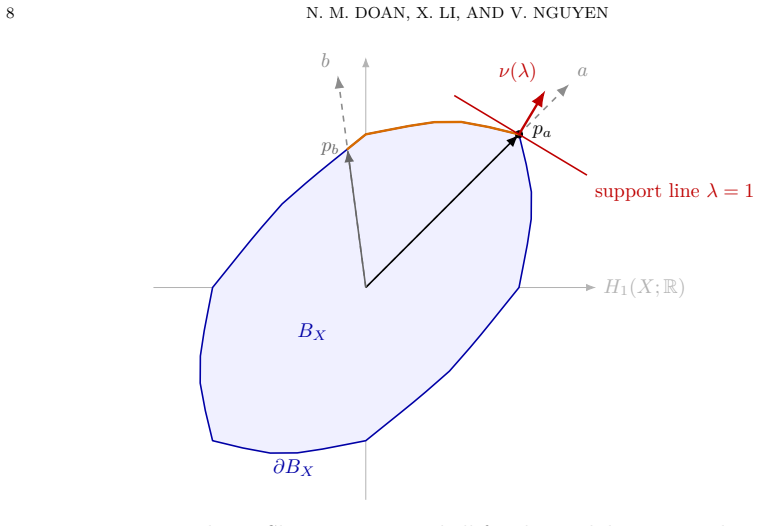
Normal-turn estimates for McShane-Rivin norm balls, which bound directional turning inside the balls and thereby turn volume-growth data into exact-norm multiplicity bounds.
If this is right
- The multiplicity bound holds uniformly for all complete finite-area hyperbolic once-punctured tori.
- Markoff-number fibers satisfy the improved bound C (log log(3m))^2.
- The same estimates yield quantitative obstructions to infinite-order flatness at certain irrational directions in the norm balls.
- Local geometry of the McShane-Rivin norm balls receives new explicit controls near the boundary.
Where Pith is reading between the lines
- The normal-turn estimates might be sharpened to replace the (log L)^2 factor by a slower-growing function or even a constant.
- The same ball-geometry technique could be tested on simple geodesics for other finite-area hyperbolic surfaces with punctures.
- Explicit constants in the bound C_X would allow effective computational checks of the multiplicity for moderate L.
Load-bearing premise
The normal-turn estimates for McShane-Rivin norm balls hold uniformly enough to convert growth control into a multiplicity bound without additional length-dependent losses.
What would settle it
An explicit sequence of lengths L_n on some once-punctured torus where the number of distinct simple closed geodesics of length exactly L_n grows faster than any constant times (log L_n)^2 would falsify the claim.
Figures



read the original abstract
We use normal-turn estimates for McShane--Rivin norm balls to prove that, for every complete finite-area hyperbolic once-punctured torus $X$, the number of simple closed geodesics of length exactly $L\geq 2$ is at most $C_X(\log L)^2$. For the modular torus, this gives $$ \#\lambda_M^{-1}(m)\leq C(\log\log(3m))^2 $$ for every Markoff number $m$, improving the previous logarithmic Markoff-fiber bounds. These estimates also give new quantitative information on the local geometry of McShane--Rivin norm balls, including obstructions to infinite-order flatness at certain irrational directions.
Editorial analysis
A structured set of objections, weighed in public.
Referee Report
Summary. The paper uses normal-turn estimates for McShane-Rivin norm balls to prove that, for every complete finite-area hyperbolic once-punctured torus X, the number of simple closed geodesics of length exactly L ≥ 2 is at most C_X (log L)^2. For the modular torus this specializes to the bound #λ_M^{-1}(m) ≤ C (log log(3m))^2 on Markoff-number multiplicities, improving prior logarithmic bounds. The estimates also yield quantitative control on the local geometry of the norm balls, including obstructions to infinite-order flatness at certain irrational directions.
Significance. If the central derivation holds, the result supplies improved, explicit multiplicity bounds for simple geodesics on once-punctured tori and for Markoff fibers, obtained from uniform geometric estimates rather than parameter fitting. The conversion of controlled ball growth into a (log L)^2 multiplicity bound without additional length-dependent losses is technically useful and strengthens the link between norm-ball geometry and counting problems in hyperbolic surfaces.
minor comments (2)
- [Main theorem statement] The dependence of the constant C_X on the surface X should be stated more explicitly in the main theorem (e.g., whether it depends only on the area or on additional geometric invariants of X).
- [Abstract and introduction] The abstract refers to 'new quantitative information' on obstructions to infinite-order flatness; the introduction or §4 should list the precise statements (e.g., which irrational directions are obstructed and by what quantitative measure).
Simulated Author's Rebuttal
We thank the referee for their positive assessment of the manuscript and for recommending minor revision. The central result improves the multiplicity bound for simple geodesics on hyperbolic once-punctured tori to O((log L)^2) via normal-turn estimates on McShane-Rivin norm balls, with the stated specialization to Markoff numbers. We address the report below.
Circularity Check
No significant circularity; derivation relies on independent geometric estimates
full rationale
The paper derives the multiplicity bound #λ^{-1}(L) ≤ C_X (log L)^2 directly from normal-turn estimates on McShane-Rivin norm balls. These estimates are obtained from the hyperbolic geometry of the once-punctured torus and control the growth of the balls uniformly in length. The resulting multiplicity bound follows by converting this growth control into a counting argument without any parameter fitting to the target count, without self-definitional reduction, and without load-bearing self-citations that would collapse the claim. The specialization to the modular torus and Markoff numbers is a direct substitution of the same estimates. The argument is therefore self-contained against external geometric benchmarks.
Axiom & Free-Parameter Ledger
free parameters (1)
- C_X
axioms (1)
- domain assumption Hyperbolic once-punctured tori admit a complete finite-area metric and the McShane-Rivin norm is well-defined on the space of measured laminations.
Reference graph
Works this paper leans on
- [1]
-
[2]
Khinchin, Aleksandr Yakovlevich , title =
-
[3]
Rockett, Andrew M. and Sz. Continued Fractions , publisher =
-
[4]
Durrett, Rick , title =
-
[5]
Cassels, J. W. S. , title =
-
[6]
Button, J. O. , title =. Journal of Number Theory , volume =. 2001 , doi =
work page 2001
-
[7]
Journal of Number Theory , volume =
Chen, Feng-Juan and Chen, Yong-Gao , title =. Journal of Number Theory , volume =. 2013 , doi =
work page 2013
-
[8]
The Electronic Journal of Combinatorics , volume =
Gyoda, Yasuaki and Matsushita, Kodai , title =. The Electronic Journal of Combinatorics , volume =. 2023 , doi =
work page 2023
-
[9]
The Ramanujan Journal , volume =
Banaian, Esther and Sen, Archan , title =. The Ramanujan Journal , volume =. 2024 , doi =
work page 2024
- [10]
-
[11]
Schneider, Rolf , title =
- [12]
-
[13]
Canadian Mathematical Bulletin , volume =
Baragar, Arthur , title =. Canadian Mathematical Bulletin , volume =. 1996 , doi =
work page 1996
-
[14]
Bowditch, B. H. , title =. Bulletin of the London Mathematical Society , volume =. 1996 , doi =
work page 1996
-
[15]
Bowditch, B. H. , title =. Proceedings of the London Mathematical Society , volume =. 1998 , doi =
work page 1998
-
[16]
Button, J. O. , title =. Journal of the London Mathematical Society , volume =. 1998 , doi =
work page 1998
-
[17]
Annals of Mathematics , volume =
Cohn, Harvey , title =. Annals of Mathematics , volume =. 1955 , doi =
work page 1955
-
[18]
Geometric and Functional Analysis , volume =
Erlandsson, Viveka and Souto, Juan , title =. Geometric and Functional Analysis , volume =. 2016 , doi =
work page 2016
- [19]
- [20]
-
[21]
Advances in Mathematics , volume =
Gaster, Jonah , title =. Advances in Mathematics , volume =. 2022 , doi =
work page 2022
-
[22]
Mathematische Zeitschrift , volume =
Jarn. Mathematische Zeitschrift , volume =. 1926 , doi =
work page 1926
-
[23]
Advances in Applied Mathematics , volume =
Lee, Kyungyong and Li, Li and Rabideau, Michelle and Schiffler, Ralf , title =. Advances in Applied Mathematics , volume =. 2023 , doi =
work page 2023
-
[24]
McShane, Greg , title =
-
[25]
Inventiones Mathematicae , volume =
McShane, Greg , title =. Inventiones Mathematicae , volume =. 1998 , doi =
work page 1998
-
[26]
Geometry & Topology , volume =
McShane, Greg and Parlier, Hugo , title =. Geometry & Topology , volume =. 2008 , doi =
work page 2008
-
[27]
International Mathematics Research Notices , volume =
McShane, Greg and Rivin, Igor , title =. International Mathematics Research Notices , volume =. 1995 , doi =
work page 1995
-
[28]
McShane, Greg and Rivin, Igor , title =. Comptes Rendus de l'Acad
-
[29]
Annals of Mathematics , volume =
Mirzakhani, Maryam , title =. Annals of Mathematics , volume =. 2008 , doi =
work page 2008
-
[30]
Advances in Mathematics , volume =
Rabideau, Michelle and Schiffler, Ralf , title =. Advances in Mathematics , volume =. 2020 , doi =
work page 2020
-
[31]
Mathematische Annalen , volume =
Schmutz, Paul , title =. Mathematische Annalen , volume =. 1996 , doi =
work page 1996
- [32]
- [33]
-
[34]
Geometriae Dedicata , volume =
Lang, Mong Lung and Tan, Ser Peow , title =. Geometriae Dedicata , volume =. 2007 , doi =
work page 2007
-
[35]
Mathematics of Computation , volume =
Zagier, Don , title =. Mathematics of Computation , volume =. 1982 , doi =
work page 1982
-
[36]
Zhang, Ying , title =. Acta Arithmetica , volume =. 2007 , doi =
work page 2007
discussion (0)
Sign in with ORCID, Apple, or X to comment. Anyone can read and Pith papers without signing in.