Recognition: 2 theorem links
· Lean TheoremConformal Rigidity of Graphs: Subdifferentials and Orbit-Isometries
Pith reviewed 2026-05-15 03:04 UTC · model grok-4.3
The pith
A single eigenvector certifies conformal rigidity for vertex-transitive graphs and similar symmetric ones.
A machine-rendered reading of the paper's core claim, the machinery that carries it, and where it could break.
Core claim
A graph is lower conformally rigid when uniform weights maximize lambda_2 and upper conformally rigid when they minimize lambda_n. The subdifferential analysis shows that an orbit-isometric embedding certifies either property, and symmetry reduction implies that for vertex-transitive graphs a single eigenvector suffices, yielding an algebraically exact test via linear feasibility or quadratic equations solved by Gröbner bases.
What carries the argument
The orbit-isometric spectral embedding, a symmetry-reduced analogue of edge-isometric embeddings that remains sufficient to certify conformal rigidity.
Load-bearing premise
That orbit-isometric embeddings characterize conformal rigidity just as edge-isometric ones do.
What would settle it
A vertex-transitive graph on which the single-eigenvector algebraic test declares rigidity but direct numerical maximization of lambda_2(w) or minimization of lambda_n(w) finds a non-uniform weight that improves the extremum.
Figures






read the original abstract
A connected undirected graph $G = (V,E)$ is lower conformally rigid if uniform edge weights maximize the second smallest Laplacian eigenvalue $\lambda_2(w)$ over all normalized edge weights $w$, and upper conformally rigid if uniform edge weights minimize the largest eigenvalue $\lambda_n(w)$ over all normalized edge weights; $G$ is conformally rigid if it is lower or upper conformally rigid. This paper establishes a new framework for conformal rigidity through the language of subdifferentials, unifying the variational perspective on eigenvalue optimization with the geometry of edge-isometric spectral embeddings, which are known to characterize conformal rigidity. This subdifferential framework lends itself naturally to techniques of symmetry reduction that motivate the notion of an orbit-isometric embedding - a weaker condition than edge-isometry that accounts for the symmetries of $G$ while remaining sufficient for conformal rigidity. The notion opens the door to tools from representation theory: for a large class of graphs, including all vertex-transitive ones, we show that conformal rigidity is certified by a single eigenvector, resolving an open question and explaining the conformal rigidity of previously unexplained graphs. This extra structure enables a new, algebraically exact certification method for conformal rigidity, bypassing the numerical difficulties of prior approaches. In many cases, the problem reduces to a check of linear feasibility, and in general, to solving a system of quadratic equations via Gr\"{o}bner bases.
Editorial analysis
A structured set of objections, weighed in public.
Referee Report
Summary. The paper introduces a subdifferential framework unifying variational optimization of Laplacian eigenvalues with the geometry of edge-isometric spectral embeddings to characterize conformal rigidity of graphs. It defines orbit-isometric embeddings as a symmetry-aware weakening of edge-isometry that remains sufficient for rigidity, then uses representation theory to show that for vertex-transitive graphs (and a larger class) rigidity is certified by a single eigenvector. This yields an algebraic certification procedure reducing in many cases to linear feasibility or Gröbner-basis solution of quadratic equations.
Significance. If the central claims hold, the work supplies an exact, non-numerical certification method for conformal rigidity that resolves an open question for vertex-transitive graphs and explains previously unexplained examples. The unification of subdifferentials, orbit-isometries, and representation-theoretic reduction constitutes a genuine technical advance with potential to streamline future work on symmetric graphs.
major comments (2)
- [Abstract / §3] Abstract and §3 (orbit-isometric definition): the reduction from full orbit-isometry on the eigenspace to a single-eigenvector check is load-bearing for the vertex-transitive claim. When multiplicity of λ₂ exceeds 1 (e.g., cycles C_n, n>3), the isometry condition must hold on the entire irreducible representation; the manuscript must supply an explicit invariance or projection argument showing why a single vector suffices, or the claim is not yet established.
- [§4] §4 (main theorem): the statement that orbit-isometric embeddings characterize conformal rigidity for the stated class relies on the subdifferential characterization of edge-isometric embeddings. The paper must verify that the subdifferential inclusion remains equivalent after the orbit-isometric relaxation; otherwise the sufficiency direction fails.
minor comments (2)
- [§2] Notation for the normalized weight set and the subdifferential operator should be introduced once with a dedicated display equation rather than inline.
- [§5] The Gröbner-basis certification procedure is mentioned only in the abstract; a brief complexity or termination remark in the main text would aid readability.
Simulated Author's Rebuttal
We thank the referee for the careful reading and the positive evaluation of our work. The comments highlight important points that require clarification in the presentation. We address each major comment below and will revise the manuscript accordingly to strengthen the arguments.
read point-by-point responses
-
Referee: [Abstract / §3] Abstract and §3 (orbit-isometric definition): the reduction from full orbit-isometry on the eigenspace to a single-eigenvector check is load-bearing for the vertex-transitive claim. When multiplicity of λ₂ exceeds 1 (e.g., cycles C_n, n>3), the isometry condition must hold on the entire irreducible representation; the manuscript must supply an explicit invariance or projection argument showing why a single vector suffices, or the claim is not yet established.
Authors: We appreciate this observation. In the manuscript, the orbit-isometric embedding is defined such that it respects the group action on the eigenspace. For vertex-transitive graphs, the relevant eigenspace forms an irreducible representation of the automorphism group. By the properties of irreducible representations and the fact that the condition is invariant under the group action, satisfaction for a single eigenvector (chosen generically) implies the condition for the entire space via projection onto the representation. However, to address the referee's concern directly, we will add an explicit lemma in Section 3 that provides the invariance argument: specifically, if the embedding is orbit-isometric for one vector in the eigenspace, then by averaging the inner products over the group orbits, the condition holds for all vectors in the space. This will make the reduction rigorous and explicit. revision: yes
-
Referee: [§4] §4 (main theorem): the statement that orbit-isometric embeddings characterize conformal rigidity for the stated class relies on the subdifferential characterization of edge-isometric embeddings. The paper must verify that the subdifferential inclusion remains equivalent after the orbit-isometric relaxation; otherwise the sufficiency direction fails.
Authors: We agree that the equivalence needs to be verified explicitly for the relaxed condition. In the proof of Theorem 4.1, the necessity direction follows directly from the definition, as orbit-isometry is weaker but still implies the edge conditions for the subdifferential. For sufficiency, we show that if the subdifferential condition holds for an orbit-isometric embedding, it corresponds to the variational characterization. To strengthen this, we will include a dedicated proposition in Section 4 that proves the subdifferential inclusion is preserved under the orbit-isometric relaxation by demonstrating that the supporting hyperplanes or subgradients align due to the symmetry reduction. This will confirm that the characterization remains valid. revision: yes
Circularity Check
No significant circularity; derivation introduces independent framework and certification
full rationale
The paper defines lower/upper conformal rigidity directly from the variational properties of Laplacian eigenvalues under normalized edge weights. It unifies this with the known (external) characterization via edge-isometric spectral embeddings and introduces the new, weaker orbit-isometric condition plus subdifferential language as sufficient for rigidity. For vertex-transitive graphs the single-eigenvector certification is derived via representation-theoretic reduction of the orbit condition; this step is presented as new content resolving an open question rather than a tautological renaming or self-citation reduction. No equations are shown to be equivalent by construction to fitted inputs, no ansatz is smuggled via self-citation, and the central claims retain independent mathematical content beyond the starting definitions. The derivation is therefore self-contained against external benchmarks.
Axiom & Free-Parameter Ledger
axioms (1)
- domain assumption G is a connected undirected graph
invented entities (1)
-
orbit-isometric embedding
no independent evidence
Lean theorems connected to this paper
-
IndisputableMonolith/Cost/FunctionalEquation.leanwashburn_uniqueness_aczel echoes?
echoesECHOES: this paper passage has the same mathematical shape or conceptual pattern as the Recognition theorem, but is not a direct formal dependency.
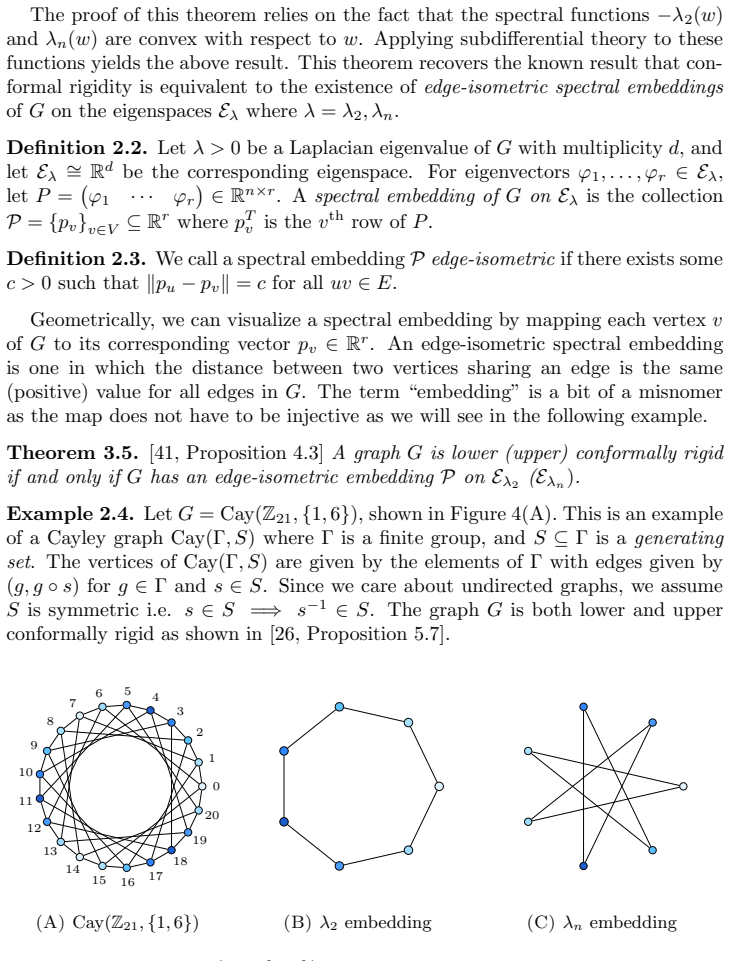
A graph G is lower (upper) conformally rigid if and only if there exist nonzero eigenvectors φ1,…φr∈Eλ2(Eλn), coefficients ai≥0, and a constant c>0 such that c=∑ai(φi(u)−φi(v))² for all uv∈E (Theorem 3.4)
-
IndisputableMonolith/Foundation/AlexanderDuality.leanalexander_duality_circle_linking unclear?
unclearRelation between the paper passage and the cited Recognition theorem.
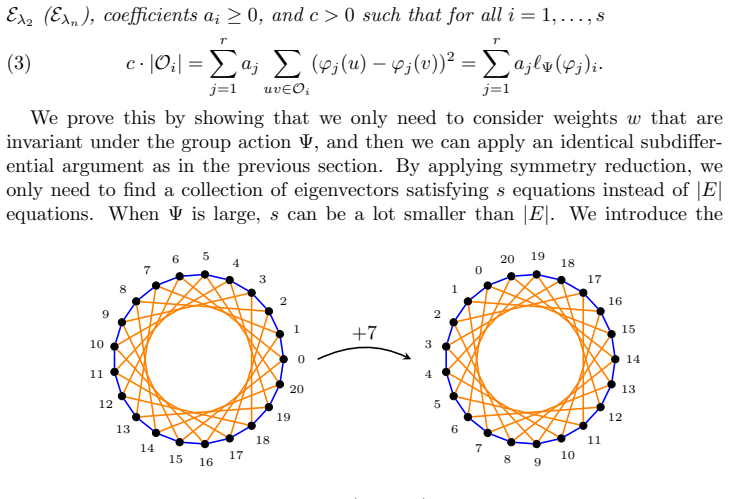
For vertex-transitive graphs, conformal rigidity is certified by a single eigenvector φ∈Eλ2 such that |Oi|=∑uv∈Oi(φ(u)−φ(v))² (Theorem 6.9)
What do these tags mean?
- matches
- The paper's claim is directly supported by a theorem in the formal canon.
- supports
- The theorem supports part of the paper's argument, but the paper may add assumptions or extra steps.
- extends
- The paper goes beyond the formal theorem; the theorem is a base layer rather than the whole result.
- uses
- The paper appears to rely on the theorem as machinery.
- contradicts
- The paper's claim conflicts with a theorem or certificate in the canon.
- unclear
- Pith found a possible connection, but the passage is too broad, indirect, or ambiguous to say the theorem truly supports the claim.
Reference graph
Works this paper leans on
-
[1]
Catherine Babecki, Stefan Steinerberger, and Rekha R. Thomas. Spectrahedral geometry of graph sparsifiers.SIAM J. Discrete Math., 39(1):449–483, 2025
work page 2025
-
[2]
Laugesen.Symmetrization in analysis
Albert II Baernstein, David Drasin, and Richard S. Laugesen.Symmetrization in analysis. With a foreword by Walter Hayman, volume 36 ofNew Math. Monogr.Cambridge: Cam- bridge University Press, 2019
work page 2019
-
[3]
MPS/SIAM Series on Optimization
Aharon Ben-Tal and Arkadi Nemirovski.Lectures on modern convex optimization. MPS/SIAM Series on Optimization. Society for Industrial and Applied Mathematics (SIAM), Philadelphia, PA; Mathematical Programming Society (MPS), Philadelphia, PA, 2001. Anal- ysis, algorithms, and engineering applications
work page 2001
-
[4]
Allan Bickle. A survey of maximalk-degenerate graphs andk-trees.Theory and Applications of Graphs, 0(1):Article 5, 2024
work page 2024
-
[5]
Jacek Bochnak, Michel Coste, and Marie-Fran¸ coise Roy.Real algebraic geometry. Transl. from the French., volume 36 ofErgeb. Math. Grenzgeb., 3. Folge. Berlin: Springer, rev. and updated ed. edition, 1998
work page 1998
-
[6]
Cambridge University Press, Cambridge, 2004
Stephen Boyd and Lieven Vandenberghe.Convex optimization. Cambridge University Press, Cambridge, 2004
work page 2004
-
[7]
All Ramsey numbersr(K 3, G) for connected graphs of order 9.Electron
Stephan Brandt, Gunnar Brinkmann, and Thomas Harmuth. All Ramsey numbersr(K 3, G) for connected graphs of order 9.Electron. J. Comb., 5(1):research paper r7, 20, 1998
work page 1998
-
[8]
Texts Math.Springer, Cham, 1985
Theodor Br¨ ocker and Tammo tom Dieck.Representations of compact Lie groups, volume 98 ofGrad. Texts Math.Springer, Cham, 1985
work page 1985
-
[9]
Paulus-rozenfield graphs.https://aeb.win.tue.nl/graphs/Paulus.html, 1973–present
Andries Brouwer. Paulus-rozenfield graphs.https://aeb.win.tue.nl/graphs/Paulus.html, 1973–present. Accessed: 2026-02-17
work page 1973
-
[10]
Frans C. Bussemaker and Dragoˇ s M. Cvetkovic. There are exactly 13 connected, cubic, inte- gral graphs.Publ. Fac. ´Electrotech. Univ. Belgrade, S´ er. Math. Phys., 544-576:43–48, 1977
work page 1977
-
[11]
On the order-diameter ratio of girth-diameter cages
Stijn Cambie, Jan Goedgebeur, Jorik Jooken, and Tibo Van den Eede. On the order-diameter ratio of girth-diameter cages. Preprint, arXiv:2511.21144 [math.CO] (2025), 2025
-
[12]
Fan R. K. Chung.Spectral graph theory, volume 92 ofReg. Conf. Ser. Math.Providence, RI: AMS, American Mathematical Society, 1997
work page 1997
-
[13]
George E. Collins. Quantifier elimination for real closed fields by cylindrical algebraic de- composition. InAutomata theory and formal languages (Second GI Conf., Kaiserslautern, 1975), Lecture Notes in Comput. Sci., Vol. 33, pages 134–183. Springer, Berlin-New York, 1975
work page 1975
-
[14]
Kris Coolsaet, Sven D’hondt, and Jan Goedgebeur. House of Graphs 2.0: A database of interesting graphs and more.Discrete Applied Mathematics, 325:97–107, 2023
work page 2023
-
[15]
An introduction to computational algebraic geometry and commutative algebra.Undergraduate Texts Math
David Cox, John Little, and Donal O’Shea.Ideals, varieties, and algorithms. An introduction to computational algebraic geometry and commutative algebra.Undergraduate Texts Math. New York, NY: Springer, 2nd ed. edition, 1996. 50
work page 1996
-
[16]
Etienne de Klerk. Exploiting special structure in semidefinite programming: A survey of theory and applications.European J. Oper. Res., 201(1):1–10, 2010
work page 2010
-
[17]
Attainable bounds for algebraic connectivity and maximally connected regular graphs.J
Geoffrey Exoo, Theodore Kolokolnikov, Jeanette Janssen, and Timothy Salamon. Attainable bounds for algebraic connectivity and maximally connected regular graphs.J. Graph Theory, 107(3):522–549, 2024
work page 2024
-
[18]
Douglas R. Farenick and Barbara A. F. Pidkowich. The spectral theorem in quaternions. Linear Algebra Appl., 371:75–102, 2003
work page 2003
-
[19]
Some minimax problems for graphs.Discrete Math., 121(1-3):65–74, 1993
Miroslav Fiedler. Some minimax problems for graphs.Discrete Math., 121(1-3):65–74, 1993
work page 1993
-
[20]
A first course, volume 129 ofGrad
William Fulton and Joe Harris.Representation theory. A first course, volume 129 ofGrad. Texts Math.New York etc.: Springer-Verlag, 1991
work page 1991
-
[21]
Karin Gatermann and Pablo A. Parrilo. Symmetry groups, semidefinite programs, and sums of squares.J. Pure Appl. Algebra, 192(1-3):95–128, 2004
work page 2004
-
[22]
Chris Godsil and Gordon Royle.Algebraic graph theory, volume 207 ofGrad. Texts Math. New York, NY: Springer, 2001
work page 2001
-
[23]
Exhaustive generation of edge-girth-regular graphs
Jan Goedgebeur and Jorik Jooken. Exhaustive generation of edge-girth-regular graphs. Preprint, arXiv:2401.08271 [math.CO] (2024), 2024
-
[24]
Graph realizations associated with minimizing the maximum eigenvalue of the Laplacian.Math
Frank G¨ oring, Christoph Helmberg, and Susanna Reiss. Graph realizations associated with minimizing the maximum eigenvalue of the Laplacian.Math. Program., 131(1-2 (A)):95–111, 2012
work page 2012
-
[25]
Embedded in the shadow of the separator.SIAM J
Frank G¨ oring, Christoph Helmberg, and Markus Wappler. Embedded in the shadow of the separator.SIAM J. Optim., 19(1):472–501, 2008
work page 2008
- [26]
-
[27]
Part 1: Fundamentals, volume 305 ofGrundlehren Math
Jean-Baptiste Hiriart-Urruty and Claude Lemar´ echal.Convex analysis and minimization algorithms. Part 1: Fundamentals, volume 305 ofGrundlehren Math. Wiss.Berlin: Springer- Verlag, 1993
work page 1993
-
[28]
Jean-Baptiste Hiriart-Urruty and Claude Lemar´ echal.Fundamentals of convex analysis. Grundlehren Text Edit. Berlin: Springer, 2001
work page 2001
-
[29]
Roger A. Horn and Charles R. Johnson.Matrix analysis.Cambridge: Cambridge University Press, 2nd ed. edition, 2013
work page 2013
-
[30]
On vertex-girth-regular graphs: (non-)existence, bounds and enumeration.Electron
Robert Jajcay, Jorik Jooken, and Istv´ an Porups´ anszki. On vertex-girth-regular graphs: (non-)existence, bounds and enumeration.Electron. J. Comb., 32(4):research paper p4.51, 27, 2025
work page 2025
-
[31]
A faster interior point method for semidefinite programming
Tarun Kathuria, Swati Padmanabhan, Yin Tat Lee, Haotian Jiang, and Zhao Song. A faster interior point method for semidefinite programming. InProceedings of the 61st annual IEEE symposium on foundations of computer science, FOCS 2020, virtual conference, November 16–19, 2020, pages 910–918. Los Alamitos, CA: IEEE Computer Society, 2020
work page 2020
-
[32]
Small Ram- sey numbers for books, wheels, and generalizations.Electron
Bernard Lidick´ y, Gwen McKinley, Florian Pfender, and Steven Van Overberghe. Small Ram- sey numbers for books, wheels, and generalizations.Electron. J. Comb., 32(4):research paper p4.64, 20, 2025
work page 2025
-
[33]
Ernst W. Mayr and Albert R. Meyer. The complexity of the word problems for commutative semigroups and polynomial ideals.Adv. in Math., 46(3):305–329, 1982
work page 1982
-
[34]
MOSEK ApS.MOSEK Optimization Library Version 11.1, 2026
work page 2026
-
[35]
Joint numerical ranges: recent advances and applications minicourse by V
Vladim´ ır M¨ uller and Yuri Tomilov. Joint numerical ranges: recent advances and applications minicourse by V. M¨ uller and Yu. Tomilov.Concr. Oper., 7:133–154, 2020
work page 2020
-
[36]
Andrew Niu, 2026.https://github.com/andrewmniu/conformally-rigid-graphs
work page 2026
-
[37]
Reza Olfati-Saber, J. Alex Fax, and Richard M. Murray. Consensus and cooperation in net- worked multi-agent systems.Proc. IEEE, 95(1):215–233, 2007
work page 2007
-
[38]
Extremal graph realizations and graph Laplacian eigenvalues.SIAM J
Braxton Osting. Extremal graph realizations and graph Laplacian eigenvalues.SIAM J. Dis- crete Math., 37(3):1630–1644, 2023
work page 2023
-
[39]
Leiba Rodman.Topics in quaternion linear algebra. Princeton Ser. Appl. Math. Princeton, NJ: Princeton University Press, 2014
work page 2014
-
[40]
Translated from the French by Leonard L
Jean-Pierre Serre.Linear representations of finite groups. Translated from the French by Leonard L. Scott, volume 42 ofGrad. Texts Math.Springer, Cham, 1977
work page 1977
-
[41]
Stefan Steinerberger and Rekha R. Thomas. Conformally rigid graphs.J. Graph Theory, 109(3):366–386, 2025. 51
work page 2025
-
[42]
Jun Sun, Stephen Boyd, Lin Xiao, and Persi Diaconis. The fastest mixing Markov process on a graph and a connection to a maximum variance unfolding problem.SIAM Rev., 48(4):681– 699, 2006
work page 2006
-
[43]
The Sage Developers.SageMath, the Sage Mathematics Software System (Version 10.7), 2025.https://www.sagemath.org
work page 2025
-
[44]
Symmetry in semidefinite programs.Linear Algebra Appl., 430(1):360–369, 2009
Frank Vallentin. Symmetry in semidefinite programs.Linear Algebra Appl., 430(1):360–369, 2009
work page 2009
-
[45]
West.Introduction to graph theory
Douglas B. West.Introduction to graph theory. New Delhi: Prentice-Hall of India, 2nd ed. edition, 2005
work page 2005
-
[46]
Exploring structure and randomness
Yufei Zhao.Graph theory and additive combinatorics. Exploring structure and randomness. Cambridge: Cambridge University Press, 2023
work page 2023
-
[47]
Krzysztof T. Zwierzy´ nski. Generating integral graphs using PRACE research infrastructure. Technical white paper, Partnership for Advanced Computing in Europe (PRACE), 2013
work page 2013
-
[48]
Alexander A. Zykov. ¨Uber einige Eigenschaften der Streckenkomplexe.Mat. Sb., Nov. Ser., 24:163–188, 1949. Department of Mathematics, University of W ashington, Seattle W A 98195 Email address:amniu@uw.edu 52
work page 1949
discussion (0)
Sign in with ORCID, Apple, or X to comment. Anyone can read and Pith papers without signing in.