Recognition: 2 theorem links
· Lean TheoremMazur manifolds and symplectic structures
Pith reviewed 2026-05-15 02:55 UTC · model grok-4.3
The pith
Heegaard Floer cobordism maps obstruct symplectic structures on specific Akbulut-Kirby Mazur manifolds bounded by Brieskorn spheres.
A machine-rendered reading of the paper's core claim, the machinery that carries it, and where it could break.
Core claim
The Akbulut-Kirby Mazur manifolds whose boundary is a Brieskorn sphere Y among Σ(2,3,13), Σ(2,5,7) and Σ(3,4,5) do not admit symplectic structures. This follows from the fact that the Heegaard Floer homology cobordism maps associated to the 2-handles in their handle decompositions fail to satisfy the properties that any symplectic filling would impose on the Floer groups. The same obstruction yields exotic pairs of simply connected 4-manifolds with definite intersection forms that are bounded by each such Y.
What carries the argument
The Heegaard Floer homology cobordism maps induced by the 2-handles of the Mazur manifold.
If this is right
- The three listed Akbulut-Kirby Mazur manifolds admit no symplectic structure.
- For each such boundary Y there exist exotic pairs of simply connected 4-manifolds carrying the same definite intersection form.
- The obstruction arises precisely because the relevant cobordism maps are nonzero in a way forbidden by symplectic geometry.
- The method applies uniformly to the three chosen Brieskorn spheres using only their Floer data.
Where Pith is reading between the lines
- The same cobordism-map technique may rule out symplectic structures on other Mazur manifolds or handlebodies with known Floer data.
- These examples suggest that definite intersection forms on 4-manifolds bounded by Brieskorn spheres can be realized by non-symplectic manifolds in multiple ways.
- Contact invariants on the boundary spheres might be related to the same maps, though the paper does not compute them.
Load-bearing premise
The Heegaard Floer cobordism maps for the specific 2-handles and chosen Brieskorn spheres detect the absence of a symplectic structure without additional assumptions on the filling or on the contact structure induced on the boundary.
What would settle it
An explicit symplectic filling of one of the listed Mazur manifolds whose induced map on Heegaard Floer homology matches the computed cobordism map would falsify the obstruction for that manifold.
Figures




read the original abstract
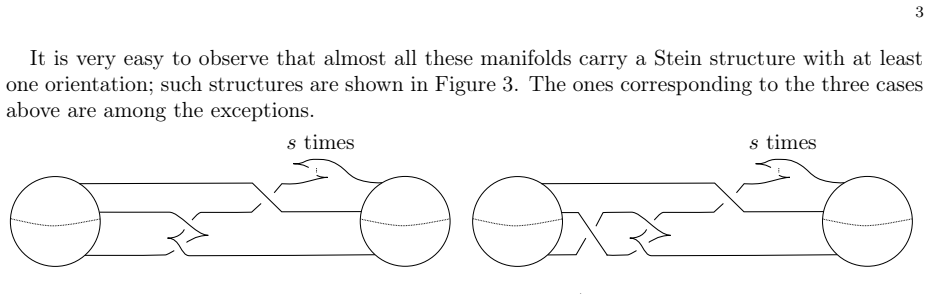
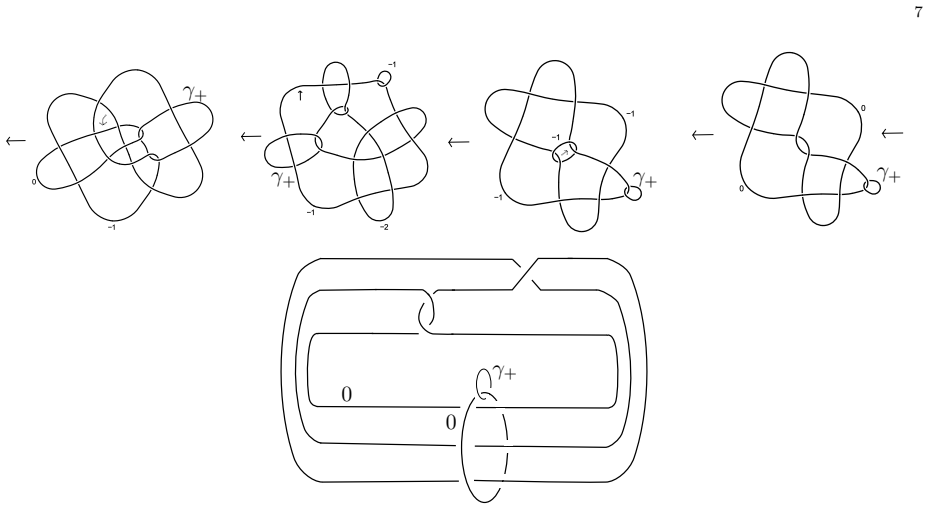
We use the Heegaard Floer homology cobordism maps to obstruct the existence of a symplectic structure on the Akbulut-Kirby Mazur manifolds whose boundary is a Brieskorn sphere $Y$ among $\Sigma(2,3,13),$ $\Sigma(2,5,7)$ and $\Sigma(3,4,5)$. Furthermore, we describe how our results imply the existence of exotic pairs of simply connected 4-manifolds, with definite intersection form, whose boundary is $Y$.
Editorial analysis
A structured set of objections, weighed in public.
Referee Report
Summary. The paper claims to use Heegaard Floer homology cobordism maps induced by 2-handle attachments to obstruct the existence of symplectic structures on the Akbulut-Kirby Mazur manifolds whose boundaries are the Brieskorn spheres Σ(2,3,13), Σ(2,5,7), and Σ(3,4,5). It further derives from these obstructions the existence of exotic pairs of simply connected 4-manifolds with definite intersection forms that share these boundaries.
Significance. If the cobordism map computations are correct, the results supply explicit new examples of non-symplectic Mazur manifolds and rare exotic pairs of definite 4-manifolds with the same boundary, strengthening the literature on symplectic fillings of Brieskorn spheres via standard HF tools without new axioms or fitted parameters.
minor comments (2)
- [Abstract] The abstract refers to 'Akbulut-Kirby Mazur manifolds' without naming the precise handle attachments or diagrams; a sentence or reference to the relevant figures in the introduction would aid readers unfamiliar with the specific presentations.
- [Introduction] Notation for the Brieskorn spheres is consistent, but the manuscript should explicitly recall the grading or module structure of HF^+(Y) for each Y in a preliminary section to make the obstruction arguments self-contained.
Simulated Author's Rebuttal
We thank the referee for their careful reading of the manuscript and for recommending acceptance. The referee's summary accurately describes our use of Heegaard Floer cobordism maps to obstruct symplectic structures on the indicated Mazur manifolds and the consequent construction of exotic definite pairs.
Circularity Check
No significant circularity in derivation chain
full rationale
The paper computes explicit Heegaard Floer cobordism maps induced by 2-handle attachments in the Mazur manifold presentations for the listed Brieskorn spheres and uses their non-vanishing or rank properties to obstruct symplectic fillings. These maps rely on standard, externally established properties of HF homology from prior literature (Ozsváth-Szabó and related works) rather than any self-definition, fitted parameter renamed as prediction, or load-bearing self-citation chain. The obstruction follows directly from the module structure and grading already known for these spheres, with no reduction of the target claim to the paper's own inputs by construction. The derivation remains self-contained against external benchmarks.
Axiom & Free-Parameter Ledger
axioms (1)
- standard math Heegaard Floer homology cobordism maps are well-defined and functorial for the relevant 4-dimensional cobordisms
Lean theorems connected to this paper
-
IndisputableMonolith/Foundation/RealityFromDistinction.leanreality_from_one_distinction unclear?
unclearRelation between the paper passage and the cited Recognition theorem.
We use the Heegaard Floer homology cobordism maps to obstruct the existence of a symplectic structure on the Akbulut-Kirby Mazur manifolds
-
IndisputableMonolith/Cost/FunctionalEquation.leanwashburn_uniqueness_aczel unclear?
unclearRelation between the paper passage and the cited Recognition theorem.
the cobordism map bF_W-(m) : dHF(S^3) → dHF_0(Y-(m)) sends the generator to [V0]
What do these tags mean?
- matches
- The paper's claim is directly supported by a theorem in the formal canon.
- supports
- The theorem supports part of the paper's argument, but the paper may add assumptions or extra steps.
- extends
- The paper goes beyond the formal theorem; the theorem is a base layer rather than the whole result.
- uses
- The paper appears to rely on the theorem as machinery.
- contradicts
- The paper's claim conflicts with a theorem or certificate in the canon.
- unclear
- Pith found a possible connection, but the passage is too broad, indirect, or ambiguous to say the theorem truly supports the claim.
Reference graph
Works this paper leans on
-
[1]
Akbulut,Cork twists and automorphisms of3-manifolds, J
S. Akbulut,Cork twists and automorphisms of3-manifolds, J. Gökova Geom. Topol. GGT.,14(2020), pp. 1–13
work page 2020
-
[2]
S. Akbulut and S. Durusoy,An involution acting nontrivially on Heegaard-Floer homology, Geometry and topology of manifolds. Papers from the conference held at McMaster University, Hamilton, ON, Canada, May 14–18, 2004
work page 2004
-
[3]
S. Akbulut and Ç. Karakurt,Action of the Cork twist on Floer homology, Proceedings of the 18th Gökova geometry-topology conference, Gökova, Turkey, May 30–June 4, 2011
work page 2011
-
[4]
S. Akbulut and R. Kirby,Mazur manifolds, Michigan Math. J.,26(1979), no. 3, pp. 259–284
work page 1979
-
[5]
S. Akbulut and K. Larson,Brieskorn spheres bounding rational balls, Proc. Amer. Math. Soc.,146(2018), no. 4, pp. 1817–1824
work page 2018
-
[6]
A. Alfieri and A. Cavallo,Holomorphic curves in Stein domains and the tau-invariant, arXiv:2310.08657
-
[7]
Brieskorn spheres and rational homology ball symplectic fillings
A. Alfieri, A. Cavallo and I. Matkovič,Brieskorn spheres and rational homology ball symplectic fillings, arXiv:2605.13812
work page internal anchor Pith review Pith/arXiv arXiv
-
[8]
N. Anvari and I. Hambleton,Cyclic branched coverings of Brieskorn spheres bounding acyclic4-manifolds, Glasg. Math. J.,63(2021), no. 2, pp. 400–413
work page 2021
-
[9]
J. Bodnár and O. Plamenevskaya,Heegaard Floer invariants of contact structures on links of surface singular- ities, Quantum Topol.,12(2021), no. 3, pp. 411–437
work page 2021
-
[10]
Chantraine,Lagrangian concordance of Legendrian knots, Algebr
B. Chantraine,Lagrangian concordance of Legendrian knots, Algebr. Geom. Topol.,10(2010), no. 1, pp. 63–85
work page 2010
-
[11]
Fillable structures on negative-definite Seifert fibred spaces
A. Cavallo and I. Matkovič,Fillable structures on negative-definite Seifert fibred spaces, arXiv:2604.28174
work page internal anchor Pith review Pith/arXiv arXiv
-
[12]
I. Dai, M. Hedden and A. Mallick,Corks, involutions, and Heegaard Floer homology, J. Eur. Math. Soc.,25 (2023), no. 6, pp. 2319–2389
work page 2023
-
[13]
H. C. Fickle,Knots,Z-homology3-spheres and contractible4-manifolds, Houston J. Math.,10(1984), no. 4, pp. 467–493
work page 1984
-
[14]
R. Fintushel and R. Stern,An exotic free involution onS4, Ann. of Math. (2),113(1981), no. 2, pp. 357–365
work page 1981
-
[15]
Freedman,The topology of four-dimensional manifolds, J
M. Freedman,The topology of four-dimensional manifolds, J. Differential Geometry,17(1982), no. 3, pp. 357–453
work page 1982
-
[16]
Ghiggini,Ozsváth-Szabó invariants and fillability of contact structures, Math
P. Ghiggini,Ozsváth-Szabó invariants and fillability of contact structures, Math. Z.,253(2006), no. 1, pp. 159–175
work page 2006
-
[17]
Hedden,An Ozsváth-Szabó Floer homology invariant of knots in a contact manifold, Adv
M. Hedden,An Ozsváth-Szabó Floer homology invariant of knots in a contact manifold, Adv. Math.,219 (2008) no. 1 pp. 89–117. 13
work page 2008
-
[18]
M. Hedden and K. Raoux,Knot Floer homology and relative adjunction inequalities, Selecta Math. (N.S.),29 (2023), no. 1, 48 pp
work page 2023
-
[19]
T. Mark and B. Tosun,Obstructing pseudoconvex embeddings and contractible Stein fillings for Brieskorn spheres, Adv. Math.,335(2018), pp. 878–895
work page 2018
-
[20]
Némethi,On the Ozsváth-Szabó invariant of negative definite plumbed3-manifolds, Geom
A. Némethi,On the Ozsváth-Szabó invariant of negative definite plumbed3-manifolds, Geom. Topol.,9(2005), pp. 991–1042
work page 2005
-
[21]
P. Ozsváth and Z. Szabó,Absolutely graded Floer homologies and intersection forms for four-manifolds with boundary, Adv. Math.,173(2003), pp. 179–261
work page 2003
-
[22]
P. Ozsváth and Z. Szabó,On the Floer homology of plumbed three-manifolds, Geom. Topol.,7(2003), no. 1, pp. 185–224
work page 2003
-
[23]
P. Ozsváth and Z. Szabó,Heegaard Floer homology and contact structures, Duke Math. J.,129(2005), no. 1, pp. 39–61
work page 2005
-
[24]
Plamenevskaya,Contact structures with distinct Heegaard Floer invariants, Math
O. Plamenevskaya,Contact structures with distinct Heegaard Floer invariants, Math. Res. Let.,11(2004), pp. 547–561. HUN-REN Alfréd Rényi Insitute of Mathematics, Budapest 1053, Hungary Email address:acavallo@impan.pl
work page 2004
discussion (0)
Sign in with ORCID, Apple, or X to comment. Anyone can read and Pith papers without signing in.