Agentic Pipeline for Self-Synchronized Multiview Joint Angle Monitoring in Uncalibrated Environments
Pith reviewed 2026-05-20 21:27 UTC · model grok-4.3
The pith
An agentic pipeline uses multimodal language models to synchronize two uncalibrated cameras and estimate joint angles for home-based rehabilitation monitoring.
A machine-rendered reading of the paper's core claim, the machinery that carries it, and where it could break.
Core claim
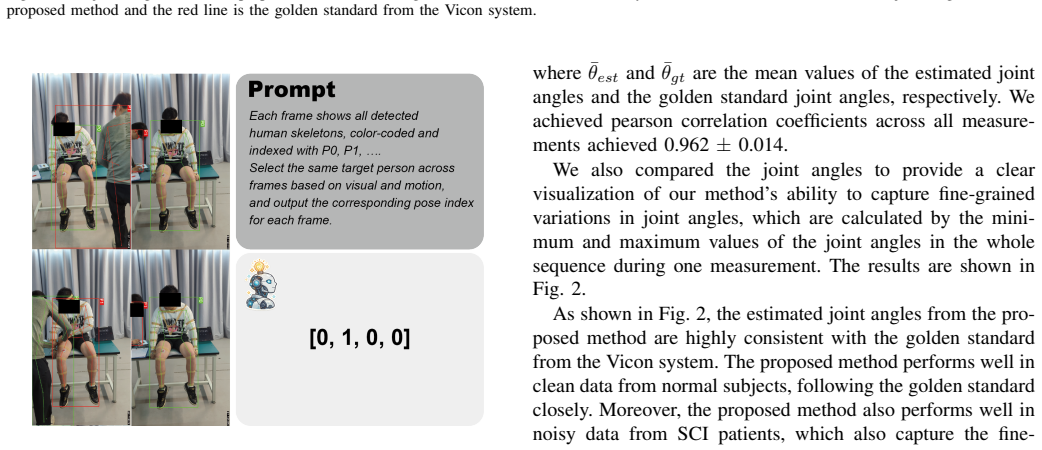
The central claim is that multimodal large language models can drive automatic video synchronization and agent-driven self-verification while an agent-based selection mechanism extracts consistent 2D poses from state-of-the-art monocular estimators, allowing geometric optimization to recover accurate joint angles from uncalibrated two-camera sequences even in the presence of multiple individuals and occlusions.
What carries the argument
The agentic pipeline that uses multimodal large language models to perform automatic video synchronization, self-verification, and target-subject selection before geometric optimization of joint angles.
If this is right
- Patients can self-deploy the system for daily kinematic monitoring without professional calibration or hardware triggers.
- Joint angles remain interpretable because they derive from explicit geometric modeling rather than black-box regression.
- The pipeline maintains consistent subject tracking across views despite other people or temporary occlusions in the scene.
- Performance reaches MAE of 5.97 degrees and Pearson correlation of 0.962 relative to laboratory-grade motion capture.
Where Pith is reading between the lines
- The same synchronization and selection logic could be tested on longer daily recordings to assess drift over hours rather than short sessions.
- Replacing one of the two cameras with a smartphone might further lower the barrier to home use while preserving the reported accuracy range.
- Combining the geometric angle estimates with simple wearable sensors could provide a hybrid check that flags when visual tracking degrades.
Load-bearing premise
Multimodal large language models can reliably perform automatic synchronization, self-verification, and subject selection amid multiple people and occlusions in uncalibrated real-world videos.
What would settle it
Simultaneous recordings from two ordinary cameras and a Vicon system in a home scene containing multiple moving individuals and partial occlusions, where the pipeline's joint-angle outputs show mean absolute error substantially larger than 6 degrees or Pearson correlation below 0.9.
Figures


read the original abstract
Kinematic monitoring plays a critical role in long-term rehabilitation for patients with spinal cord injury (SCI), where multi-view markerless motion capture methods have shown significant potential. However, owing to the reliance on calibration and the difficulty of achieving multi-view synchronization, their deployment in patient self-deployed environments remains challenging. In this work, we propose an agentic pipeline for self-synchronized multi-view joint angle monitoring in uncalibrated environments using two cameras without hardware triggers. The Multimodal large language models enable automatic video synchronization and agent-driven self-verification. State-of-the-art monocular 2D pose estimation models are employed to extract candidate poses, where an agent-based selection mechanism is then applied to automatically identify and track the target subject, thereby producing consistent 2D poses in the presence of multiple individuals and occlusions. Such 2D poses are optimized to estimate joint angles from uncalibrated multi-view pose sequences, ensuring interpretability through explicit geometric modeling. Validation against Vicon system demonstrated the strong performance, achieving an MAE of $5.97^\circ \pm 2.36^\circ$ and a Pearson correlation coefficient of $0.962 \pm 0.014$. The proposed method is expected to provide a practical, patient self-deployable system to perform daily kinematic monitoring in uncalibrated home environments.
Editorial analysis
A structured set of objections, weighed in public.
Referee Report
Summary. The paper introduces an agentic pipeline for self-synchronized multiview joint angle monitoring in uncalibrated environments using two cameras. It leverages multimodal large language models (MLLMs) for automatic video synchronization and agent-driven self-verification, employs state-of-the-art monocular 2D pose estimation with an agent-based selection to handle multiple individuals and occlusions, and uses geometric optimization for joint angle estimation. The approach is validated against a Vicon system, achieving an MAE of 5.97° ± 2.36° and a Pearson correlation coefficient of 0.962 ± 0.014, with the goal of enabling practical daily kinematic monitoring for patients with spinal cord injury in home settings.
Significance. If the results hold, this work has significant potential to facilitate accessible, markerless motion capture for long-term rehabilitation monitoring without the need for specialized equipment or calibration. The explicit use of geometric modeling for angle estimation provides interpretability, and the validation against an independent external Vicon benchmark strengthens the claims while maintaining low circularity. Strengths include the quantitative metrics reported and the focus on real-world deployability. However, the effectiveness hinges on the reliability of the MLLM components in complex scenes, which warrants additional validation to fully realize the practical impact.
major comments (1)
- [§4 (Experiments and Validation)] §4 (Experiments and Validation): The central validation reports an MAE of 5.97° ± 2.36° and Pearson r = 0.962 ± 0.014 against Vicon, but this end-to-end metric is not accompanied by ablations or separate quantitative assessments of the MLLM-driven synchronization (e.g., temporal frame offset errors) or the agent-based subject selection (e.g., precision/recall in multi-person occluded videos). Since the abstract and methods tie the accuracy directly to these components, and failures here cannot necessarily be mitigated by the downstream optimization, this undermines confidence in the robustness for uncalibrated home environments with potential occlusions and multiple subjects.
minor comments (1)
- [Abstract] Abstract: The abstract provides limited detail on the specific implementation of the LLM synchronization, agent selection, and optimization steps, which would help readers assess the novelty and reproducibility.
Simulated Author's Rebuttal
We thank the referee for their constructive feedback and positive assessment of the work's potential for accessible rehabilitation monitoring. We address the major comment on validation below and have revised the manuscript to incorporate additional component-level assessments.
read point-by-point responses
-
Referee: The central validation reports an MAE of 5.97° ± 2.36° and Pearson r = 0.962 ± 0.014 against Vicon, but this end-to-end metric is not accompanied by ablations or separate quantitative assessments of the MLLM-driven synchronization (e.g., temporal frame offset errors) or the agent-based subject selection (e.g., precision/recall in multi-person occluded videos). Since the abstract and methods tie the accuracy directly to these components, and failures here cannot necessarily be mitigated by the downstream optimization, this undermines confidence in the robustness for uncalibrated home environments with potential occlusions and multiple subjects.
Authors: We agree that separate quantitative evaluations of the MLLM synchronization and agent-based subject selection would strengthen claims about robustness in multi-subject and occluded home settings. While the end-to-end Vicon comparison demonstrates overall pipeline performance under realistic conditions, we acknowledge that component-specific metrics provide clearer insight into failure modes. In the revised manuscript, we will add a new subsection in §4 reporting: (1) temporal offset errors for MLLM synchronization against manually annotated ground-truth frame alignments on a held-out video subset, and (2) precision, recall, and F1 scores for the agent-based subject selection on multi-person occluded test sequences. These additions will clarify the contribution of each stage without altering the core end-to-end results. revision: yes
Circularity Check
No significant circularity; derivation uses independent external benchmark and explicit geometric modeling
full rationale
The paper derives joint angles via explicit geometric optimization on 2D poses extracted from monocular estimators, then validates the resulting angles directly against an independent Vicon motion-capture system (MAE 5.97° ± 2.36°, Pearson 0.962 ± 0.014). This external benchmark comparison and geometric formulation do not reduce any reported prediction to a fitted parameter or self-referential definition. No self-citation chains, ansatz smuggling, or renaming of known results appear as load-bearing steps in the abstract or described pipeline. The MLLM components for synchronization and subject selection are methodological inputs whose reliability is asserted but not derived tautologically from the final angle metrics.
Axiom & Free-Parameter Ledger
axioms (2)
- domain assumption State-of-the-art monocular 2D pose estimation models can extract candidate poses reliably even with multiple subjects and occlusions
- domain assumption Multimodal large language models can perform automatic video synchronization and agent-driven self-verification without hardware triggers
Lean theorems connected to this paper
-
IndisputableMonolith/Foundation/RealityFromDistinction.leanreality_from_one_distinction unclear?
unclearRelation between the paper passage and the cited Recognition theorem.
Multimodal large language models enable automatic video synchronization and agent-driven self-verification... optimized to estimate joint angles from uncalibrated multi-view pose sequences
-
IndisputableMonolith/Foundation/AbsoluteFloorClosure.leanabsolute_floor_iff_bare_distinguishability unclear?
unclearRelation between the paper passage and the cited Recognition theorem.
Validation against Vicon system demonstrated... MAE of 5.97° ± 2.36°
What do these tags mean?
- matches
- The paper's claim is directly supported by a theorem in the formal canon.
- supports
- The theorem supports part of the paper's argument, but the paper may add assumptions or extra steps.
- extends
- The paper goes beyond the formal theorem; the theorem is a base layer rather than the whole result.
- uses
- The paper appears to rely on the theorem as machinery.
- contradicts
- The paper's claim conflicts with a theorem or certificate in the canon.
- unclear
- Pith found a possible connection, but the passage is too broad, indirect, or ambiguous to say the theorem truly supports the claim.
Reference graph
Works this paper leans on
-
[1]
Sunghoon Ivan Lee, Yunda Liu, Gloria Vergara-D ´ıaz, Benito Lorenzo Pugliese, Randie Black-Schaffer, Mary Ellen Stoykov, and Paolo Bonato. Wearable-based kinematic analysis of upper-limb movements during daily activities could provide insights into stroke survivors’ motor ability. Neurorehabilitation and neural repair, 38(9):659–669, 2024
work page 2024
-
[2]
Bruce H Dobkin. Wearable motion sensors to continuously measure real- world physical activities.Current opinion in neurology, 26(6):602–608, 2013
work page 2013
-
[3]
Nicolas Hankov, Miroslav Caban, Robin Demesmaeker, Margaux Roulet, Salif Komi, Michele Xiloyannis, Anne Gehrig, Camille Varescon, Martina Rebeka Spiess, Serena Maggioni, et al. Augmenting rehabilitation robotics with spinal cord neuromodulation: A proof of concept.Science robotics, 10(100):eadn5564, 2025
work page 2025
-
[4]
Lamprini Lili, Katharina S Sunnerhagen, Tiina Rekand, and Margit Alt Murphy. Quantifying an upper extremity everyday task with 3d kinematic analysis in people with spinal cord injury and non-disabled controls.Frontiers in Neurology, 12:755790, 2021
work page 2021
-
[5]
Amy Bellitto, Alice De Luca, Simona Gamba, Luca Losio, Antonino Massone, Maura Casadio, and Camilla Pierella. Clinical, kinematic and muscle assessment of bilateral coordinated upper-limb movements following cervical spinal cord injury.IEEE Transactions on Neural Systems and Rehabilitation Engineering, 2023
work page 2023
-
[6]
Marvin Wolf, R ¨udiger Rupp, and Andreas Schwarz. Decoding of unimanual and bimanual reach-and-grasp actions from emg and imu signals in persons with cervical spinal cord injury.Journal of Neural Engineering, 21(2):026042, 2024
work page 2024
-
[7]
Rebekah Kempske, Karin Postma, Daniel Lemus Perez, Arma ˆgan Al- bayrak, Rutger Osterthun, Heike Vallery, Gerard Ribbers, and Herwin Horemans. Identifying requirements of an imu-based gait assessment interface for incomplete spinal cord injury through user-centred design approach.Design for Health, 7(2):219–239, 2023
work page 2023
-
[8]
R James Cotton. Kinematic tracking of rehabilitation patients with markerless pose estimation fused with wearable inertial sensors. In2020 15th IEEE International Conference on Automatic Face and Gesture Recognition (FG 2020), pages 508–514. IEEE, 2020
work page 2020
-
[9]
Erika D’Antonio, Juri Taborri, Ilaria Mileti, Stefano Rossi, and Fabrizio Patan´e. Validation of a 3d markerless system for gait analysis based on openpose and two rgb webcams.IEEE Sensors Journal, 21(15):17064– 17075, 2021
work page 2021
-
[10]
Markerless gait analysis based on a single rgb camera
Xiao Gu, Fani Deligianni, Benny Lo, Wei Chen, and Guang-Zhong Yang. Markerless gait analysis based on a single rgb camera. In2018 IEEE 15th International conference on wearable and implantable body sensor networks (BSN), pages 42–45. IEEE, 2018
work page 2018
-
[11]
Riky Tri Yunardi, Tri Arief Sardjono, and Ronny Mardiyanto. Motion capture system based on rgb camera for human walking recognition using marker-based and markerless for kinematics of gait. In2023 IEEE 13th Symposium on Computer Applications & Industrial Electronics (ISCAIE), pages 262–267. IEEE, 2023
work page 2023
-
[12]
A single rgb camera based gait analysis with a mobile tele- robot for healthcare
Ziyang Wang, Fani Deligianni, Irina V oiculescu, and Guang-Zhong Yang. A single rgb camera based gait analysis with a mobile tele- robot for healthcare. In2021 43rd Annual International Conference of the IEEE Engineering in Medicine & Biology Society (EMBC), pages 6933–6936. IEEE, 2021
work page 2021
-
[13]
Dimitrios Menychtas, Nikolaos Petrou, Ioannis Kansizoglou, Erasmia Giannakou, Athanasios Grekidis, Antonios Gasteratos, Vassilios Gour- goulis, Eleni Douda, Ilias Smilios, Maria Michalopoulou, et al. Gait analysis comparison between manual marking, 2d pose estimation algorithms, and 3d marker-based system.Frontiers in Rehabilitation Sciences, 4:1238134, 2023
work page 2023
-
[14]
Soshi Shimada, Vladislav Golyanik, Weipeng Xu, Patrick P ´erez, and Christian Theobalt. Neural monocular 3d human motion capture with physical awareness.ACM Transactions on Graphics (ToG), 40(4):1–15, 2021
work page 2021
-
[15]
Motionet: 3d human motion reconstruction from monocular video with skeleton consistency
Mingyi Shi, Kfir Aberman, Andreas Aristidou, Taku Komura, Dani Lischinski, Daniel Cohen-Or, and Baoquan Chen. Motionet: 3d human motion reconstruction from monocular video with skeleton consistency. Acm transactions on graphics (tog), 40(1):1–15, 2020
work page 2020
-
[16]
Multiview 3d markerless human pose estima- tion from openpose skeletons
Maarten Slembrouck, Hiep Luong, Joeri Gerlo, Kurt Sch ¨utte, Dimitri Van Cauwelaert, Dirk De Clercq, Benedicte Vanwanseele, Peter Veelaert, and Wilfried Philips. Multiview 3d markerless human pose estima- tion from openpose skeletons. InAdvanced Concepts for Intelligent Vision Systems: 20th International Conference, ACIVS 2020, Auckland, New Zealand, Febr...
work page 2020
-
[17]
arXiv preprint arXiv:2408.12569 , year=
Rawal Khirodkar, Timur Bagautdinov, Julieta Martinez, Su Zhaoen, Austin James, Peter Selednik, Stuart Anderson, and Shunsuke Saito. Sapiens: Foundation for human vision models.arXiv preprint arXiv:2408.12569, 2024
-
[18]
Rtmpose: Real-time multi-person pose estimation based on mmpose, 2023
Tao Jiang, Peng Lu, Li Zhang, Ningsheng Ma, Rui Han, Chengqi Lyu, Yining Li, and Kai Chen. Rtmpose: Real-time multi-person pose estimation based on mmpose, 2023
work page 2023
-
[19]
MMDetection: Open MMLab Detection Toolbox and Benchmark
Kai Chen, Jiaqi Wang, Jiangmiao Pang, Yuhang Cao, Yu Xiong, Xiaox- iao Li, Shuyang Sun, Wansen Feng, Ziwei Liu, Jiarui Xu, Zheng Zhang, Dazhi Cheng, Chenchen Zhu, Tianheng Cheng, Qijie Zhao, Buyu Li, Xin Lu, Rui Zhu, Yue Wu, Jifeng Dai, Jingdong Wang, Jianping Shi, Wanli Ouyang, Chen Change Loy, and Dahua Lin. MMDetection: Open mmlab detection toolbox and...
work page internal anchor Pith review Pith/arXiv arXiv 1906
discussion (0)
Sign in with ORCID, Apple, or X to comment. Anyone can read and Pith papers without signing in.