The impact of seasonality over the sensitivity of Einstein Telescope and the SNR of CBC signals at the Sardinia candidate site
Pith reviewed 2026-05-21 08:17 UTC · model grok-4.3
The pith
The Sardinia site experiences only minor seasonal variations in Einstein Telescope sensitivity, with SNR impacts on compact binary signals limited to a few percent.
A machine-rendered reading of the paper's core claim, the machinery that carries it, and where it could break.
Core claim
The low seismic noise of the Sardinia site results in only minor seasonal variations in detector sensitivity. The corresponding impact on SNR is limited to a few percent, even without including Newtonian noise mitigation. These results indicate that seasonal environmental fluctuations have a minor effect on the early inspiral detectability of compact binaries, confirming the suitability of the Sardinia site for achieving ET low-frequency sensitivity goals.
What carries the argument
Seismic spectra measured in deep boreholes used to estimate Newtonian noise in the 2-10 Hz band and to derive modified ET sensitivity curves for SNR simulations.
Load-bearing premise
The seismic spectra measured in the deep boreholes between 2022 and 2025 accurately represent the Newtonian noise environment that the Einstein Telescope would experience at the actual detector location.
What would settle it
Measurements of seismic noise at the precise future detector positions that show substantially larger seasonal variations than the borehole records, or new SNR calculations that produce changes exceeding a few percent.
Figures





read the original abstract
This work investigates the impact of seasonal variations in seismic noise on the low-frequency performance of the Einstein Telescope (ET) at the Sardinia candidate site, focusing on implications for compact binary coalescence observations. Using seismic data collected between 2022 and 2025 in deep boreholes, we characterize monthly noise variations and identify representative best and worst case scenarios, corresponding to July and December. The measured seismic spectra are used to estimate the Newtonian noise contribution in the 2-10 Hz band and to derive modified ET sensitivity curves. These are implemented in a simulation framework to evaluate their effect on the signal-to-noise ratio (SNR) of binary neutron star and intermediate mass black hole signals, assuming the triangular ET configuration. We find that the low seismic noise of the Sardinia site results in only minor seasonal variations in detector sensitivity. The corresponding impact on SNR is limited to a few percent, even without including Newtonian noise mitigation. These results indicate that seasonal environmental fluctuation have a minor effect on the early inspired detectability of compact binaries, confirming the suitability of the Sardinia site for achieving ET low-frequency sensitivity goals.
Editorial analysis
A structured set of objections, weighed in public.
Referee Report
Summary. The manuscript analyzes seasonal seismic noise variations at the Sardinia candidate site for the Einstein Telescope using multi-year (2022-2025) borehole data. It defines best-case (July) and worst-case (December) spectra, estimates the Newtonian noise contribution in the 2-10 Hz band, derives modified ET sensitivity curves, and evaluates the resulting SNR impact on binary neutron star and intermediate-mass black hole signals in the triangular configuration. The central claim is that the site's low seismic noise produces only minor seasonal sensitivity variations, limiting SNR changes to a few percent even without Newtonian noise mitigation, thereby supporting the site's suitability for ET low-frequency goals.
Significance. If the borehole-to-NN mapping holds, the work supplies direct empirical constraints on environmental variability for ET site selection, using measured spectra rather than purely modeled inputs. This strengthens planning for compact binary coalescence observations by quantifying that seasonal effects remain sub-dominant to other noise sources in the target band.
major comments (1)
- Newtonian noise estimation from borehole spectra (described in the methods for sensitivity curve modification): the conversion of measured seismic displacement spectra into an additive NN strain term assumes the borehole data at their specific depths and horizontal positions accurately sample the gravity-gradient coupling at the final ET cavern location and depth. No depth-extrapolation, wave-speed profile validation, or cross-check against independent NN models is presented; if this assumption is inexact, the reported 'few percent' SNR variation could shift, directly affecting the central claim of minor seasonal impact.
minor comments (2)
- The abstract states SNR impact is 'limited to a few percent' but does not quote the exact range or which signals (BNS vs IMBH) achieve the upper end; adding this would improve precision without altering the result.
- Figure captions for the modified sensitivity curves should explicitly note which curve corresponds to the July versus December spectrum for immediate readability.
Simulated Author's Rebuttal
We thank the referee for the positive summary, significance assessment, and recommendation of minor revision. The single major comment is addressed point-by-point below with a commitment to strengthen the manuscript.
read point-by-point responses
-
Referee: Newtonian noise estimation from borehole spectra (described in the methods for sensitivity curve modification): the conversion of measured seismic displacement spectra into an additive NN strain term assumes the borehole data at their specific depths and horizontal positions accurately sample the gravity-gradient coupling at the final ET cavern location and depth. No depth-extrapolation, wave-speed profile validation, or cross-check against independent NN models is presented; if this assumption is inexact, the reported 'few percent' SNR variation could shift, directly affecting the central claim of minor seasonal impact.
Authors: We thank the referee for highlighting this important methodological point. The borehole data were acquired at the Sardinia candidate site at depths (approximately 200–300 m) chosen to be representative of the planned ET cavern locations. The NN estimation applies standard gravity-gradient coupling relations to the measured displacement spectra in the 2–10 Hz band, following the approach used in prior ET site-characterization studies. While the manuscript does not present explicit depth extrapolation, site-specific wave-speed profiles, or cross-validation against independent NN models, the analysis focuses on the relative seasonal change between the July (best-case) and December (worst-case) spectra rather than on absolute NN amplitudes. Because the same conversion is applied to both seasonal spectra, the differential impact on sensitivity and SNR remains robust even if the absolute NN level carries some systematic uncertainty. To address the referee’s concern directly, we will revise the Methods section to include an expanded discussion of the assumptions in the borehole-to-NN mapping, explicitly note the absence of depth extrapolation and independent validation, and add a short limitations paragraph stating that future geophysical surveys could refine the absolute NN contribution. These additions will not alter the central result that seasonal variations produce only minor (few-percent) SNR changes. revision: yes
Circularity Check
No significant circularity; derivation rests on direct measurements and forward simulation
full rationale
The paper derives its conclusions from measured seismic spectra (2022-2025 borehole data) converted via standard Newtonian-noise coupling formulas into additive strain terms, which are then used to rescale the ET sensitivity curve and compute SNR via simulation. No equation or claim reduces by construction to a fitted parameter renamed as prediction, nor does any load-bearing step rely on a self-citation chain or self-definitional loop. The central result (few-percent SNR variation) follows from the input data and the ET noise model without circular reduction. This is the normal case of an empirical forward-modeling study that remains self-contained against external seismic and detector benchmarks.
Axiom & Free-Parameter Ledger
axioms (1)
- domain assumption Newtonian noise from seismic ground motion dominates the low-frequency sensitivity budget in the 2-10 Hz band.
Lean theorems connected to this paper
-
IndisputableMonolith/Cost/FunctionalEquation.leanwashburn_uniqueness_aczel unclear?
unclearRelation between the paper passage and the cited Recognition theorem.
We estimate the NN contribution ... as h_NN(f) = (4 pi / 3) G rho_0 (2 sqrt(2) / L) (1/(2 pi f)^2) x(f)
-
IndisputableMonolith/Foundation/ArrowOfTime.leanz_monotone_absolute unclear?
unclearRelation between the paper passage and the cited Recognition theorem.
Using seismic data collected between 2022 and 2025 in deep boreholes... best and worst case scenarios, corresponding to July and December
What do these tags mean?
- matches
- The paper's claim is directly supported by a theorem in the formal canon.
- supports
- The theorem supports part of the paper's argument, but the paper may add assumptions or extra steps.
- extends
- The paper goes beyond the formal theorem; the theorem is a base layer rather than the whole result.
- uses
- The paper appears to rely on the theorem as machinery.
- contradicts
- The paper's claim conflicts with a theorem or certificate in the canon.
- unclear
- Pith found a possible connection, but the passage is too broad, indirect, or ambiguous to say the theorem truly supports the claim.
Reference graph
Works this paper leans on
-
[1]
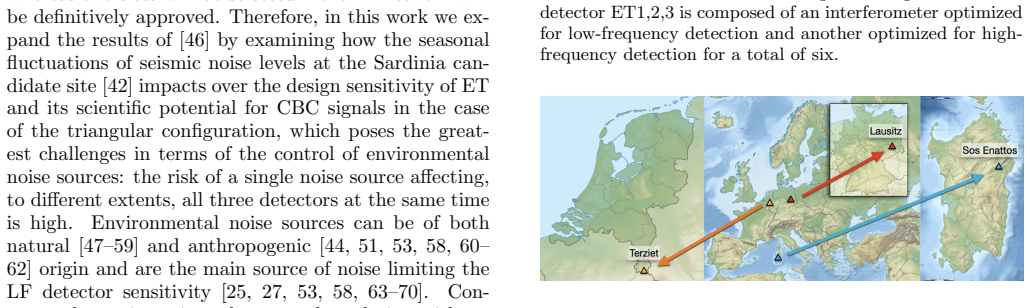
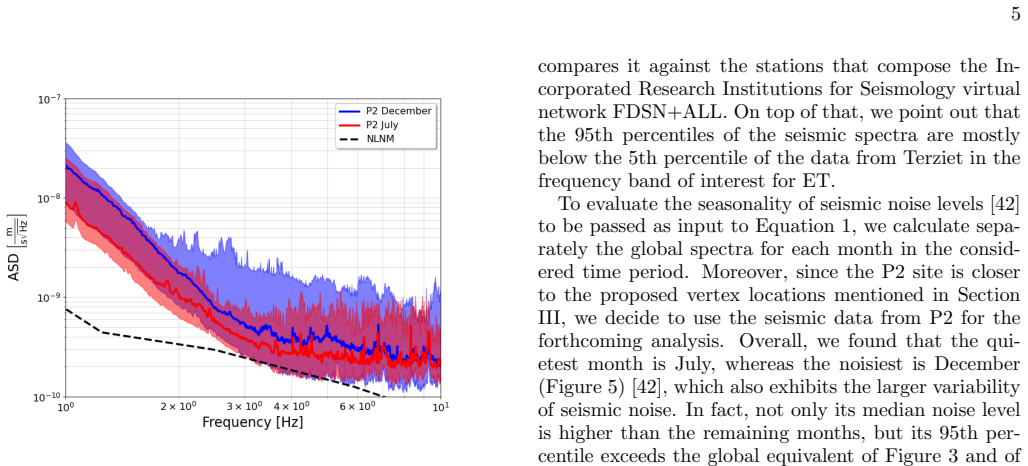
In each frame, the vertical bar indicates the average level of noise as observed at P2 in the same time span. 5 FIG. 5. Comparison of the seismic spectra from P2 in July (red) and December (blue). The two represent the best and worst periods, respectively, in terms of the impact of season- ality over the seismic noise levels in Sardinia. Seismic data rela...
work page 2022
-
[2]
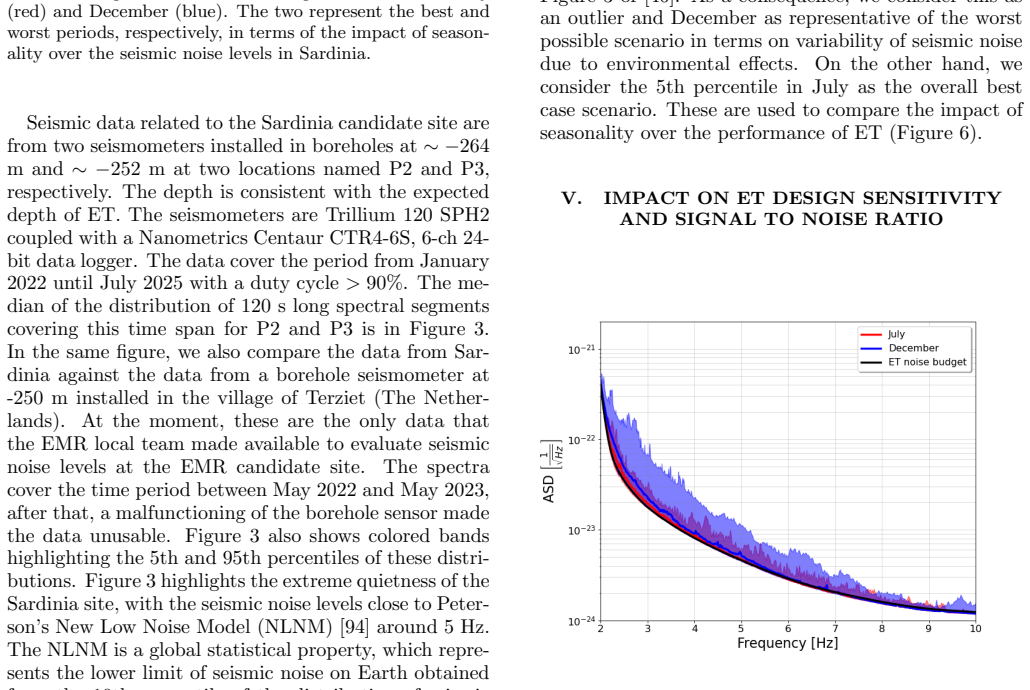
with respect to the design sensitivity case
at 16 Gpc withM tot = 3.47M J overlapped with the median sensitivity curves used in this work. with respect to the design sensitivity case. The events that never reach the thresholdSN R= 12 in any case, are removed from the analysis. The overall results, in- cluding all classes of astrophysical objects considered in this work, are also summarized in Table...
work page 2022
-
[3]
LVC Collaboration, GWTC-1: A gravitational-wave transient catalog of compact binary mergers observed by LIGO and Virgo during the first and second observ- ing runs, Phys. Rev. X9, 031040 (2019)
work page 2019
-
[4]
LVK Collaboration, GWTC-2: Compact binary coales- cences observed by LIGO and Virgo during the first half of the third observing run, Phys. Rev. X11, 021053 (2021)
work page 2021
-
[5]
LVK Collaboration, GWTC-3: Compact binary coales- cences observed by LIGO and Virgo during the second part of the third observing run, Phys. Rev. X13, 041039 (2023)
work page 2023
-
[6]
LVK Collaboration, GWTC-4.0: Updating the gravitational-wave transient catalog with observations from the first part of the fourth LIGO-Virgo-KAGRA observing run (2025), arXiv:2508.18082 [gr-qc]
work page internal anchor Pith review Pith/arXiv arXiv 2025
-
[7]
LVK Collaboration, GWTC-4.0: An introduction to ver- sion 4.0 of the gravitational-wave transient catalog, The Astrophysical Journal Letters995, L18 (2025)
work page 2025
-
[8]
E. Bigongiari, M. Di Giovanni, and G. Losurdo, Grav- itational wave experiments: Achievements and plans, inReference Module in Materials Science and Materials Engineering(Elsevier, 2026)
work page 2026
-
[9]
Virgo Collaboration, Advanced Virgo: a second- generation interferometric gravitational wave detector, Classical Quant. Grav.32, 024001 (2014)
work page 2014
-
[10]
LSC Collaboration, Advanced ligo, Classical Quant. Grav.32, 074001 (2015)
work page 2015
-
[11]
KAGRA Collaboration, Kagra: 2.5 generation interfer- ometric gravitational wave detector, Nat. Astron.3, 35 (2019)
work page 2019
-
[12]
Maggioreet al., Science case for the einstein telescope, JCAP2020(03), 050
-
[13]
Branchesiet al., Science with the Einstein Telescope: a comparison of different designs, JCAP2023(07), 068
-
[14]
Iacovelliet al., Combining underground and on- surface third-generation gravitational-wave interferom- eters, Journal of Cosmology and Astroparticle Physics 2024(10), 085
work page 2024
-
[15]
A. Abacet al., The science of the einstein telescope, Journal of Cosmology and Astroparticle Physics2026 (03), 081
-
[16]
E. Codazzoet al., Impact of coalescence signals on the search for continuous gravitational waves with einstein telescope (2026), arXiv:2605.12249 [gr-qc]
work page internal anchor Pith review Pith/arXiv arXiv 2026
-
[17]
Reitzeet al., Cosmic Explorer: The US contribu- tion to gravitational-wave astronomy beyond LIGO, arxiv.org/abs/1907.04833 (2019)
work page internal anchor Pith review Pith/arXiv arXiv 1907
-
[18]
Evanset al., A horizon study for Cosmic Ex- plorer: Science, observatories, and community, arxiv.org/abs/2109.09882 (2021)
work page internal anchor Pith review Pith/arXiv arXiv 2021
-
[19]
Hallet al., Cosmic Explorer: A next-generation ground-based gravitational-wave observatory, Galaxies 10, 10.3390/galaxies10040090 (2022)
-
[20]
M. Di Giovanni, Einstein Telescope and Cosmic Ex- plorer, inProceedings of the 59th Rencontres de Moriond – Gravitation 2025, edited by E. Aug´ e, J. Dumarchez, and J. Tran Thanh Van (2025) pp. 135–140
work page 2025
-
[21]
Punturoet al., The Einstein Telescope: a third- generation gravitational wave observatory, Classical Quant. Grav.27, 194002 (2010)
work page 2010
-
[22]
ET Science Team, The Einstein Telescope: a third- generation gravitational wave observatory, Classical Quant. Grav.27, 194002 (2010)
work page 2010
-
[23]
ET Science Team, Einstein gravitational wave telescope conceptual design study, ET-0106C-10 (2011)
work page 2011
-
[24]
ET Science Team, Design report update for the Einstein Telescope, ET-0028A-20 (2020)
work page 2020
-
[25]
Huttet al., Broadband seismic noise atten- uation versus depth at the albuquerque seis- mological laboratory, Bulletin of the Seismo- logical Society of America107, 1402 (2017), https://pubs.geoscienceworld.org/ssa/bssa/article- pdf/107/3/1402/2641899/BSSA-2016187.1.pdf. 10
work page 2017
-
[26]
Weiss,Electromagnetically Coupled Broadband Gravita- tional Antenna, Quarterly Progress Report RLE QPR 105 (MIT Research Laboratory of Electronics, 1972)
work page 1972
-
[27]
Beccariaet al., Relevance of newtonian seismic noise for the Virgo interferometer sensitivity, Classical Quant. Grav.15, 3339 (1998)
work page 1998
-
[28]
S. A. Hughes and K. S. Thorne, Seismic gravity-gradient noise in interferometric gravitational-wave detectors, Physical Review D58, 122002 (1998)
work page 1998
-
[29]
Harms, Terrestrial gravity fluctuations, Liv. Rev. Rel. 22, 10.1007/s41114-019-0022-2 (2019)
-
[30]
Harmset al., A lower limit for Newtonian-noise models of the Einstein Telescope, The European Physical Jour- nal Plus137, 687 (2022)
work page 2022
-
[31]
Branchesi, Multi-messenger astronomy: gravitational waves, neutrinos, photons, and cosmic rays, Journal of Physics: Conference Series718, 022004 (2016)
work page 2016
-
[32]
A. H. Nitz and T. D. Canton, Pre-merger localization of compact-binary mergers with third-generation obser- vatories, The Astrophysical Journal Letters917, L27 (2021)
work page 2021
- [33]
-
[34]
LVC Collaboration, Multi-messenger observations of a binary neutron star merger, Astrophys. J.848, L12 (2017)
work page 2017
-
[35]
Branchesi, Gw170817: The dawn of multi-messenger as- tronomy including gravitational waves, inMultiple Mes- sengers and Challenges in Astroparticle Physics, edited by R. Aloisio, E. Coccia, and F. Vissani (Springer Inter- national Publishing, Cham, 2018) pp. 489–497
work page 2018
-
[36]
Radiceet al., GW170817: Joint constraint on the neu- tron star equation of state from multimessenger obser- vations, Astroph. Jour. Lett.852, L29 (2018)
work page 2018
-
[37]
LVC Collaboration, A gravitational-wave standard siren measurement of the Hubble constant, Nature551, 85 (2017)
work page 2017
-
[38]
Koliopanos, Intermediate Mass Black Holes: A Review, PoSMUL TIF2017, 051 (2018)
work page 2018
-
[39]
Mezcua, Observational evidence for intermediate- mass black holes, International Journal of Modern Physics D26, 1730021 (2017), https://doi.org/10.1142/S021827181730021X
-
[40]
Greeneet al., A gravitational-wave standard siren mea- surement of the Hubble constant, Ann. Rev. of Aston. Astroph.58, 257 (2020)
work page 2020
-
[41]
Naticchioniet al., Microseismic studies of an under- ground site for a new interferometric gravitational wave detector, Classical Quant. Grav.31(2014)
work page 2014
-
[42]
Naticchioniet al., Characterization of the Sos Enattos site for the Einstein Telescope, J. Phys.: Conf. Ser.1468 (2020)
work page 2020
-
[43]
Di Giovanniet al., A seismological study of the Sos Enattos area—the Sardinia candidate site for the Ein- stein Telescope, Seismol. Res. Lett.92, 352 (2021)
work page 2021
-
[44]
Di Giovanniet al., Temporal variations of the ambient seismic field at the Sardinia candidate site of the Ein- stein Telescope, Geophysical Journal International234, 1943 (2023), https://academic.oup.com/gji/article- pdf/234/3/1943/50285042/ggad178.pdf
work page 1943
-
[45]
Saccorottiet al., Array analysis of seismic noise at the Sos Enattos mine, the italian candidate site for the ein- stein telescope, Eur. Phys. J. Plus138, 793 (2023)
work page 2023
-
[46]
G. Diaferiaet al., Seismic noise characterization for the buddus` o–ala dei sardi wind park (sardinia, italy) and its impact on the einstein telescope candidate site, Solid Earth16, 441 (2025)
work page 2025
-
[47]
G. Diaferiaet al., Seismic array measurements in the italian candidate site for the einstein telescope, the third-generation gravitational wave detector, Seismica 5, 10.26443/seismica.v5i1.1809 (2026)
-
[48]
M. Di Giovanniet al., The impact of local noise recorded at the et candidate sites on the signal to noise ratio of cbc gravitational wave signals for the et triangle con- figuration, Classical and Quantum Gravity42, 155001 (2025)
work page 2025
-
[49]
Longuet-Higgins, A theory of the origin of microseisms, Phil. Trans. R. Soc. Lond.243, 35 (1950)
work page 1950
-
[50]
Ward and Crawford, Wind-induced vibrations and building modes, Bull. Seism. Soc. Am.56, 793 (1966)
work page 1966
-
[51]
Cessaro, Sources of primary and secondary microseisms, Bull. Seism. Soc. Am.84, 142 (1994)
work page 1994
-
[52]
Witherset al., High-frequency analysis of seismic back- ground noise as a function of wind speed and shallow depth, B. Seismol. Soc. Am.86, 1507 (1996)
work page 1996
-
[53]
Acerneseet al., Properties of seismic noise at the Virgo site, Classical and Quantum Gravity21, S433 (2004)
work page 2004
-
[54]
Cowardet al., Characterizing seismic noise in the 2–20 hz band at a gravitational wave observatory, Review of scientific instruments76, 044501 (2005)
work page 2005
-
[55]
Virgo Collaboration, Environmental noise studies at Virgo, J. Phys. Conf. Ser.32, 80 (2006)
work page 2006
-
[56]
Burtinet al., Spectral analysis of seismic noise induced by rivers: A new tool to monitor spatiotemporal changes in stream hydrodynamics, J. Geophys. Res.-Sol. Ea.113 (2008)
work page 2008
-
[57]
Anthonyet al., The widespread influence of great lakes microseisms across the midwestern united states re- vealed by the 2014 polar vortex, Geop. Res. Lett.45, 3436 (2018)
work page 2014
-
[58]
Smith and Tape, Seismic noise in central alaska and in- fluences from rivers, wind, and sedimentary basins, JGR Solid Earth124, 11678 (2019)
work page 2019
-
[59]
Dybinget al., Two mechanisms explain microseisms with periods 3 to 300 s, Geophys. Res. Lett.42, 765 (2019)
work page 2019
-
[60]
Virgo Collaboration, The Virgo O3 run and the impact of the environment, Classical and Quantum Gravity39, 235009 (2022)
work page 2022
-
[61]
Anthonyet al., Seismic background noise levels across the continental united states from usarray transportable array: The influence of geology and geography, Bulletin of the Seismological Society of America112, 646 (2022), https://pubs.geoscienceworld.org/ssa/bssa/article- pdf/112/2/646/5638811/bssa-2021176.1.pdf
work page 2022
-
[62]
Saccorottiet al., Seismic noise by wind farms: a case study from the Virgo gravitational wave observatory, italy, Bull. Seis. Soc. Am.101(2011)
work page 2011
-
[63]
Piccininiet al., COVID-19 lockdown and its latency in Northern Italy: Seismic evidence and socio-economic in- terpretation, Sci. Rep.10, 16487 (2020)
work page 2020
-
[64]
Poliet al., The 2020 coronavirus lockdown and seismic monitoring of anthropic activities in Northern Italy, Sci. Rep.10, 9404 (2020)
work page 2020
-
[65]
Virgo Collaboration, Properties of seismic noise at the Virgo site, Classical Quan. Grav.21, S433 (2004). 11
work page 2004
- [66]
-
[67]
Virgo Collaboration, Characterization of the Virgo seis- mic environment, Class. Quant. Grav.29(2011)
work page 2011
-
[68]
thesis, Vrije Universiteit Amsterdam (2020)
Koley,Sensor networks to measure environmental noise at gravitational wave detector sites, Ph.d. thesis, Vrije Universiteit Amsterdam (2020)
work page 2020
-
[69]
Fioriet al., Environmental noise in gravitational-wave interferometers, inHandbook of Gravitational Wave As- tronomy(Springer Singapore, Singapore, 2020) pp. 1– 72
work page 2020
-
[70]
Virgo Collaboration, Noise from scattered light in Virgo’s second science run data, Classical and Quantum Gravity27, 194011 (2010)
work page 2010
-
[71]
Martynovet al., Sensitivity of the Advanced LIGO de- tectors at the beginning of gravitational wave astron- omy, Phys. Rev. D93, 112004 (2016)
work page 2016
-
[72]
Saulson, Terrestrial gravitational noise on a gravita- tional wave antenna, Phys. Rev. D30, 732 (1984)
work page 1984
-
[73]
Alloccaet al., Seismic glitchness at Sos Enattos site: impact on intermediate black hole binaries detection ef- ficiency, Eur. Phys. J. Plus , 511 (2021)
work page 2021
-
[74]
Wikimedia Commons, Sardinia relief location map (2010),https://commons.wikimedia.org/wiki/File: Italy_Sardinia_relief_location_map.svg
work page 2010
-
[75]
Wikimedia Commons, Netherlands relief location map (2013),https://commons.wikimedia.org/wiki/File: Netherlands_relief_location_map.svg
work page 2013
-
[76]
Wikimedia Commons, Europe relief location map (2010),https://commons.wikimedia.org/wiki/File: Europe_relief_laea_location_map.jpg
work page 2010
-
[77]
LVK collaboration, Search for intermediate-mass black hole binaries in the third observing run of Advanced LIGO and Advanced Virgo, A&A659, A84 (2022)
work page 2022
-
[78]
I. V. Chilingarianet al., A population of bona fide intermediate-mass black holes identified as low- luminosity active galactic nuclei, The Astrophysical Journal863, 1 (2018)
work page 2018
-
[79]
T. J. Maccaroneet al., A black hole in a globular cluster, Nature445, 183 (2007)
work page 2007
-
[80]
H. Baumgardtet al., A dynamical model for the globular cluster g1, The Astrophysical Journal589, L25 (2003)
work page 2003
discussion (0)
Sign in with ORCID, Apple, or X to comment. Anyone can read and Pith papers without signing in.