Pulse profile modelling of the 2024 outburst of the accreting millisecond pulsar SRGA J144459.2-604207
Pith reviewed 2026-05-20 08:52 UTC · model grok-4.3
The pith
NICER and IXPE data favor large mass and radius for the accreting pulsar SRGA J144459.2-604207 with two hotspots.
A machine-rendered reading of the paper's core claim, the machinery that carries it, and where it could break.
Core claim
NICER and IXPE jointly favour a large mass and radius for our best-fitting model, for which the neutron star has two independent hotspots. The primary hotspot is centered near the northern rotational pole, the secondary in the southern hemisphere, and the observer inclination is in the range 50-75 degrees. The primary hotspot is large (up to half the surface area) and contributes the majority of the non-pulsed X-rays, while the secondary is hotter and the major contributor to the overall pulse profile shape.
What carries the argument
Two-hotspot relativistic ray-tracing model fitted simultaneously to NICER timing and IXPE polarization data.
If this is right
- The neutron star is inferred to have both large mass and large radius.
- The primary hotspot covers up to half the stellar surface and supplies most of the steady X-ray flux.
- The secondary hotspot is hotter and largely determines the shape of the pulse profile.
- The line of sight lies at an inclination between 50 and 75 degrees.
- The numerical results depend on the precise method chosen to combine the two data sets.
Where Pith is reading between the lines
- The noted sensitivity to analysis method indicates that synthetic-data tests will be needed to validate joint fitting procedures for future multi-instrument campaigns.
- If the near-bound parameters persist in higher-quality data, the model will need to incorporate atmospheric or column physics to remain viable.
- The same two-hotspot framework can be applied to other accreting millisecond pulsars to enlarge the sample of mass-radius constraints.
Load-bearing premise
The two-hotspot relativistic ray-tracing model fully accounts for the emission physics without needing additional effects such as complex spot shapes, atmospheric scattering, or accretion-column contributions.
What would settle it
An independent mass or radius measurement for this neutron star that lies well below the large values preferred by the current two-hotspot fit.
Figures

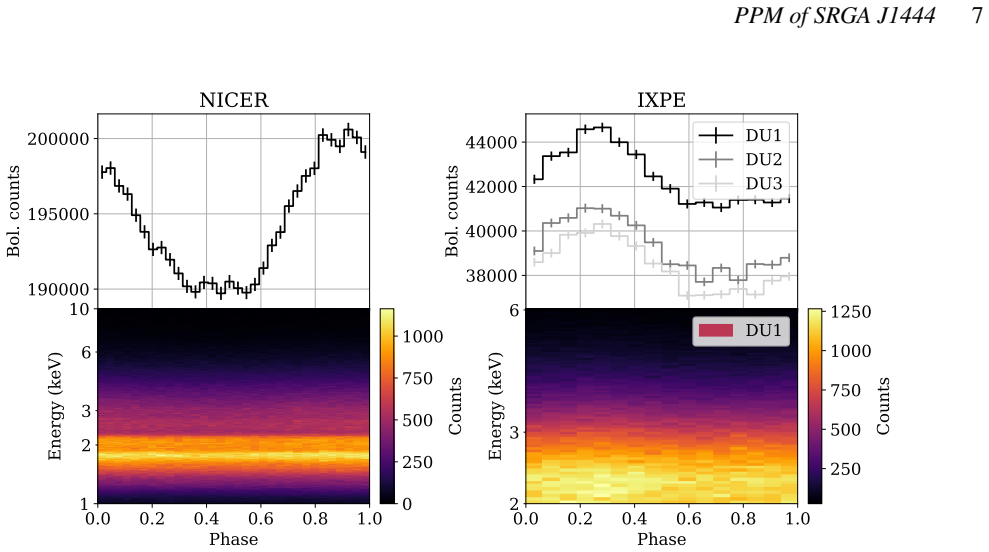
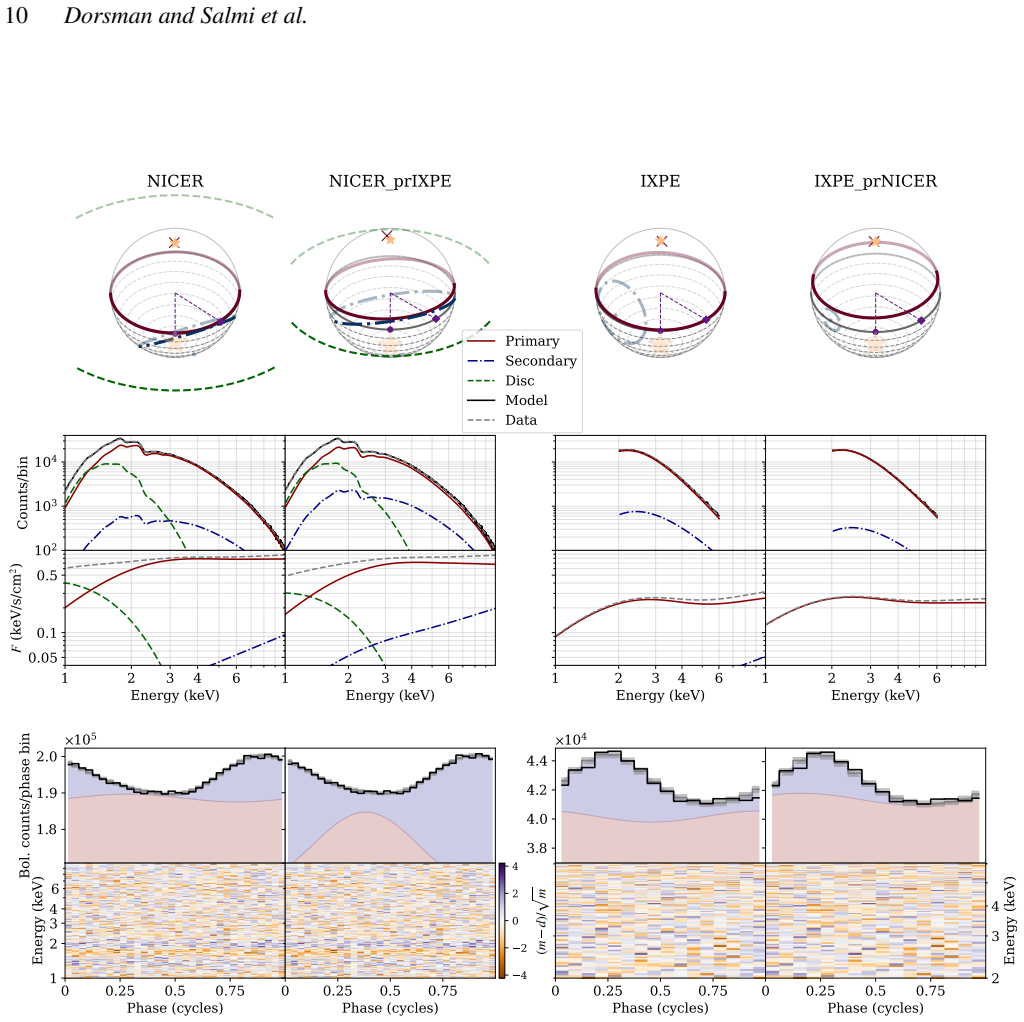


read the original abstract
Pulse profile modelling via relativistic ray-tracing can constrain the system parameters of neutron stars, notably their mass and radius. Among these objects, accreting millisecond pulsars (AMPs) are promising targets, because they are bright in X-rays and their potentially polarized radiation can lead to complementary constraints on the emission geometry. We perform combined analysis of NICER and IXPE observations of the recently discovered the 448-Hz pulsar SRGA J144459.2-604207, with IXPE providing X-ray polarization information. NICER and IXPE jointly favour a large mass and radius for our best-fitting model, for which the neutron star has two independent hotspots. The primary hotspot is centered near the northern rotational pole, the secondary in the southern hemisphere, and the observer inclination is in the range 50-75 degrees. The primary hotspot is large (up to half the surface area) and contributes the majority of the non-pulsed X-rays, while the secondary is hotter and the major contributor to the overall pulse profile shape. However, many parameters are inferred to be near the prior bounds, which could indicate that the model does not adequately account for important physics. Furthermore, we tested several different methodologies for joint analysis of the two data sets: the results are sensitive to the method used, something that merits further study with synthetic data. In the future, we expect simultaneously recorded data will lead to improved parameter constraints, especially when multi-band and polarized data are combined.
Editorial analysis
A structured set of objections, weighed in public.
Referee Report
Summary. The manuscript presents a combined NICER and IXPE analysis of the 448-Hz accreting millisecond pulsar SRGA J144459.2-604207 during its 2024 outburst. Using relativistic ray-tracing pulse-profile modeling with a two-hotspot geometry, the authors report that the data jointly favor a large neutron-star mass and radius. The primary hotspot is large (up to half the surface), centered near the northern rotational pole, and dominates the non-pulsed flux; the secondary hotspot is hotter, located in the southern hemisphere, and primarily shapes the pulse profile. Observer inclination is constrained to 50–75°. The paper notes that multiple parameters lie near prior boundaries and that the inferred values are sensitive to the choice of joint-analysis methodology, recommending synthetic-data tests for validation.
Significance. If the two-hotspot model proves adequate, the work would supply useful mass-radius constraints for an accreting millisecond pulsar by combining timing and polarimetric information. The joint use of NICER count-rate and IXPE polarization data is a methodological strength that could tighten geometric inferences. However, the reported proximity of parameters to prior bounds and the dependence on joint-analysis choices indicate that the specific large-mass/large-radius preference may not yet be robust, limiting its immediate utility for equation-of-state studies until the suggested validation is performed.
major comments (2)
- [Abstract and Results] The central claim that NICER and IXPE jointly favour a large mass and radius rests on the two-hotspot relativistic ray-tracing model. The abstract and results section explicitly state that many parameters lie near prior bounds; this raises the possibility that the model is forcing unphysical configurations (e.g., hotspot size reaching half the surface or extreme temperatures) to accommodate the data, which can systematically shift the mass-radius posteriors. Because the pulse shape and polarization signals depend directly on spot geometry, beaming, and temperature, boundary-hitting parameters constitute a load-bearing concern for the quantitative M-R result.
- [Discussion] The paper reports that the inferred mass and radius change with the choice of joint-analysis methodology for combining the NICER and IXPE datasets. Since the headline claim of large mass and radius is obtained from this joint fit, the lack of robustness to reasonable variations in analysis approach directly undermines in the reported values. The authors themselves flag the need for synthetic-data tests; until such tests are completed and the methodology dependence is quantified, the specific numerical constraints cannot be regarded as secure.
minor comments (2)
- Tabulate the exact prior ranges and any boundary conditions applied to each free parameter (mass, radius, hotspot colatitudes, sizes, temperatures, etc.) so that readers can immediately see which quantities are hitting the edges.
- Clarify in the figure captions or text whether the reported 50–75° inclination range is the 68 % or 90 % credible interval, and whether it is marginalized over the full posterior or conditioned on the best-fit hotspot geometry.
Simulated Author's Rebuttal
We thank the referee for their careful and constructive review of our manuscript. We address each major comment below and have made targeted revisions to improve clarity and emphasize limitations.
read point-by-point responses
-
Referee: [Abstract and Results] The central claim that NICER and IXPE jointly favour a large mass and radius rests on the two-hotspot relativistic ray-tracing model. The abstract and results section explicitly state that many parameters lie near prior bounds; this raises the possibility that the model is forcing unphysical configurations (e.g., hotspot size reaching half the surface or extreme temperatures) to accommodate the data, which can systematically shift the mass-radius posteriors. Because the pulse shape and polarization signals depend directly on spot geometry, beaming, and temperature, boundary-hitting parameters constitute a load-bearing concern for the quantitative M-R result.
Authors: We agree this is a substantive concern. The manuscript already states that many parameters lie near prior bounds and that this could indicate missing physics. In the revised version we have expanded the discussion to quantify the effect of boundary proximity on the M-R posteriors (via additional prior-variation runs) and have added explicit language in both the abstract and results cautioning that the precise numerical values should be interpreted with care for EOS applications. The two-hotspot geometry remains the statistically preferred model, but we now more clearly separate the qualitative geometric conclusions from the quantitative M-R constraints. revision: partial
-
Referee: [Discussion] The paper reports that the inferred mass and radius change with the choice of joint-analysis methodology for combining the NICER and IXPE datasets. Since the headline claim of large mass and radius is obtained from this joint fit, the lack of robustness to reasonable variations in analysis approach directly undermines in the reported values. The authors themselves flag the need for synthetic-data tests; until such tests are completed and the methodology dependence is quantified, the specific numerical constraints cannot be regarded as secure.
Authors: We concur that the observed sensitivity to joint-analysis choices limits the robustness of the specific M-R numbers. The original text already reports results from multiple methodologies and notes the need for synthetic-data validation. In revision we have added a quantitative comparison table of M-R posteriors across the tested methods and have strengthened the discussion of this dependence. Full synthetic-data tests are computationally demanding and were not completed for the current submission; we have therefore inserted a clearer statement that the reported numerical constraints should be regarded as preliminary pending such validation, while the geometric inferences (two hotspots, inclination range) are more stable across methods. revision: partial
Circularity Check
No significant circularity; derivation is data-driven fit to external observations
full rationale
The paper conducts Bayesian inference of neutron-star mass, radius, and hotspot geometry by fitting a two-hotspot relativistic ray-tracing model directly to independent NICER count-rate and IXPE polarization data. No equation reduces the reported mass or radius to a fitted normalization constant, nor does any step equate a prediction to its own input by construction. The authors explicitly flag that several parameters lie near prior bounds and that results are sensitive to joint-analysis methodology, but these are acknowledged model limitations rather than self-referential derivations. The central claim therefore rests on external observational constraints and remains self-contained.
Axiom & Free-Parameter Ledger
free parameters (5)
- neutron-star mass
- neutron-star radius
- primary hotspot size and location
- secondary hotspot temperature and location
- observer inclination
axioms (2)
- domain assumption Relativistic ray-tracing accurately maps emission from surface hotspots to the observer for the chosen spacetime metric.
- domain assumption Two independent circular hotspots are sufficient to describe the emission geometry.
Lean theorems connected to this paper
-
IndisputableMonolith/Foundation/BranchSelection.leanbranch_selection unclear?
unclearRelation between the paper passage and the cited Recognition theorem.
many parameters are inferred to be near the prior bounds, which could indicate that the model does not adequately account for important physics
What do these tags mean?
- matches
- The paper's claim is directly supported by a theorem in the formal canon.
- supports
- The theorem supports part of the paper's argument, but the paper may add assumptions or extra steps.
- extends
- The paper goes beyond the formal theorem; the theorem is a base layer rather than the whole result.
- uses
- The paper appears to rely on the theorem as machinery.
- contradicts
- The paper's claim conflicts with a theorem or certificate in the canon.
- unclear
- Pith found a possible connection, but the passage is too broad, indirect, or ambiguous to say the theorem truly supports the claim.
Reference graph
Works this paper leans on
-
[1]
2021, AJ, 162, 208, doi: 10.3847/1538-3881/ac19b0
The Instrument of the Imaging X-Ray Polarimetry Explorer. , keywords =. doi:10.3847/1538-3881/ac19b0 , archivePrefix =. 2108.00284 , primaryClass =
-
[2]
The Neutron Star Mass, Distance, and Inclination from Precision Timing of the Brilliant Millisecond Pulsar J0437-4715. , keywords =. doi:10.3847/2041-8213/ad614a , archivePrefix =. 2407.07132 , primaryClass =
-
[3]
The MAXI Mission on the ISS: Science and Instruments for Monitoring All Sky X-Ray Images
The MAXI Mission on the ISS: Science and Instruments for Monitoring All-Sky X-Ray Images. , keywords =. doi:10.1093/pasj/61.5.999 , archivePrefix =. 0906.0631 , primaryClass =
work page internal anchor Pith review Pith/arXiv arXiv doi:10.1093/pasj/61.5.999
-
[4]
SRG X-ray orbital observatory. Its telescopes and first scientific results. , keywords =. doi:10.1051/0004-6361/202141179 , archivePrefix =. 2104.13267 , primaryClass =
-
[5]
The disc instability model of dwarf-novae and low-mass X-ray binary transients
The disc instability model of dwarf novae and low-mass X-ray binary transients. , keywords =. doi:10.1016/S1387-6473(01)00112-9 , archivePrefix =. astro-ph/0102072 , primaryClass =
work page internal anchor Pith review Pith/arXiv arXiv doi:10.1016/s1387-6473(01)00112-9
-
[6]
Pulsar Polar Cap Heating and Surface Thermal X-Ray Emission. I. Curvature Radiation Pair Fronts. , keywords =. doi:10.1086/321589 , archivePrefix =. astro-ph/0104146 , primaryClass =
work page internal anchor Pith review Pith/arXiv arXiv doi:10.1086/321589
-
[7]
Analyzing the Data from X-ray Polarimeters with Stokes Parameters
Analyzing the data from X-ray polarimeters with Stokes parameters. Astroparticle Physics , keywords =. doi:10.1016/j.astropartphys.2015.02.007 , archivePrefix =. 1409.6214 , primaryClass =
work page internal anchor Pith review Pith/arXiv arXiv doi:10.1016/j.astropartphys.2015.02.007 2015
-
[8]
Handling Background in IXPE polarimetric data. , keywords =. doi:10.3847/1538-3881/acba0f , archivePrefix =. 2302.02927 , primaryClass =
-
[9]
A Weighted Analysis to Improve the X-Ray Polarization Sensitivity of the Imaging X-ray Polarimetry Explorer. , keywords =. doi:10.3847/1538-3881/ac51c9 , archivePrefix =. 2202.01093 , primaryClass =
-
[10]
The Radius of PSR J0437─4715 from NICER Data. , keywords =. doi:10.3847/2041-8213/ae5057 , archivePrefix =. 2512.08790 , primaryClass =
-
[11]
Discovery of SRGA J144459.2‑604207 with the SRG/ART-XC telescope: A well-tempered bursting accreting millisecond X-ray pulsar. , keywords =. doi:10.1051/0004-6361/202450581 , archivePrefix =. 2404.19709 , primaryClass =
-
[12]
A Comprehensive Study of Type I (Thermonuclear) Bursts in the New Transient SRGA J144459.2 604207. , keywords =. doi:10.3847/1538-4357/adadee , archivePrefix =. 2412.05779 , primaryClass =
-
[13]
Disk reflection and energetics from the accreting millisecond pulsar SRGA J144459.2‑604207. , keywords =. doi:10.1051/0004-6361/202554075 , archivePrefix =. 2502.08239 , primaryClass =
-
[14]
Relativistic X-ray reflection and thermonuclear burst from accreting millisecond X-ray pulsar SRGA J144459.2 604207. , keywords =. doi:10.1093/mnras/staf1207 , archivePrefix =. 2507.15982 , primaryClass =
-
[15]
Timing and Spectral Studies of SRGA J144459.2‑604207 with NICER, Einstein Probe, IXPE, NuSTAR, Insight-HXMT, and INTEGRAL During its 2024 Outburst. , keywords =. doi:10.3847/1538-4357/adf0ff , archivePrefix =. 2507.00793 , primaryClass =
-
[16]
The Two-Phase Pair Corona Model for Active Galactic Nuclei and X-Ray Binaries: How to Obtain Exact Solutions. , keywords =. doi:10.1086/177865 , archivePrefix =. astro-ph/9605073 , primaryClass =
work page internal anchor Pith review Pith/arXiv arXiv doi:10.1086/177865
-
[17]
Neutron star mass and radius measurements from atmospheric model fits to X-ray burst cooling tail spectra. , keywords =. doi:10.1051/0004-6361/201731082 , archivePrefix =. 1709.09120 , primaryClass =
work page internal anchor Pith review Pith/arXiv arXiv doi:10.1051/0004-6361/201731082
-
[18]
Equation of state constraints for the cold dense matter inside neutron stars using the cooling tail method. , keywords =. doi:10.1051/0004-6361/201527416 , archivePrefix =. 1509.06561 , primaryClass =
work page internal anchor Pith review Pith/arXiv arXiv doi:10.1051/0004-6361/201527416
-
[19]
Neutron star stiff equation of state derived from cooling phases of the X-ray burster 4U 1724-307
A Neutron Star Stiff Equation of State Derived from Cooling Phases of the X-Ray Burster 4U 1724-307. , keywords =. doi:10.1088/0004-637X/742/2/122 , archivePrefix =. 1004.4871 , primaryClass =
work page internal anchor Pith review Pith/arXiv arXiv doi:10.1088/0004-637x/742/2/122
-
[20]
The Radius of the High-mass Pulsar PSR J0740+6620 with 3.6 yr of NICER Data. , keywords =. doi:10.3847/1538-4357/ad5f1f , archivePrefix =. 2406.14466 , primaryClass =
-
[21]
Polarized radiation from an accretion shock in accreting millisecond pulsars using exact Compton scattering formalism. , keywords =. doi:10.1051/0004-6361/202346833 , archivePrefix =. 2309.02329 , primaryClass =
-
[22]
Energy spectra of low-mass binary X-ray sources observed from Tenma. , keywords =
-
[23]
Dense matter with eXTP. Science China Physics, Mechanics, and Astronomy , keywords =. doi:10.1007/s11433-017-9188-4 , archivePrefix =. 1812.04021 , primaryClass =
work page internal anchor Pith review Pith/arXiv arXiv doi:10.1007/s11433-017-9188-4
-
[24]
Constraining the neutron star equation of state using pulse profile modeling. Xiamen-CUSTIPEN Workshop on the Equation of State of Dense Neutron-Rich Matter in the Era of Gravitational Wave Astronomy , year = 2019, series =. doi:10.1063/1.5117798 , archivePrefix =. 1904.07012 , primaryClass =
-
[25]
PSR J0030+0451 Mass and Radius from NICER Data and Implications for the Properties of Neutron Star Matter. , keywords =. doi:10.3847/2041-8213/ab50c5 , archivePrefix =. 1912.05705 , primaryClass =
work page internal anchor Pith review Pith/arXiv arXiv doi:10.3847/2041-8213/ab50c5 2041
-
[26]
A NICER View of PSR J0030+0451: Millisecond Pulsar Parameter Estimation. , keywords =. doi:10.3847/2041-8213/ab481c , archivePrefix =. 1912.05702 , primaryClass =
-
[27]
Constraining the Neutron Star Mass-Radius Relation and Dense Matter Equation of State with NICER. I. The Millisecond Pulsar X-Ray Data Set. , keywords =. doi:10.3847/2041-8213/ab53eb , archivePrefix =. 1912.05706 , primaryClass =
-
[28]
Constraining the Neutron Star Mass-Radius Relation and Dense Matter Equation of State with NICER. II. Emission from Hot Spots on a Rapidly Rotating Neutron Star. , keywords =. doi:10.3847/2041-8213/ab5968 , archivePrefix =. 1912.05707 , primaryClass =
-
[29]
The effect of neglecting variability
Pulse profile modelling of thermonuclear burst oscillations - I. The effect of neglecting variability. , keywords =. doi:10.1093/mnras/stad1030 , archivePrefix =. 2304.01770 , primaryClass =
-
[30]
Determining Neutron Star Properties by Fitting Oblate-Star Waveforms To X-ray Burst Oscillations
Determining Neutron Star Properties by Fitting Oblate-star Waveform Models to X-Ray Burst Oscillations. , keywords =. doi:10.1088/0004-637X/808/1/31 , archivePrefix =. 1407.2579 , primaryClass =
work page internal anchor Pith review Pith/arXiv arXiv doi:10.1088/0004-637x/808/1/31
-
[31]
Hot spots on neutron stars - The near-field gravitational lens. , keywords =. doi:10.1086/161498 , adsurl =
-
[32]
, year = 1998, month = jul, volume =
A millisecond pulsar in an X-ray binary system. , year = 1998, month = jul, volume =. doi:10.1038/28557 , adsurl =
-
[33]
Accretion Powered X-ray Millisecond Pulsars. Millisecond Pulsars , year = 2022, editor =. doi:10.1007/978-3-030-85198-9_4 , adsurl =
-
[34]
Discovery of the X-ray transient SAX J1808.4-3658, a likely low mass X-ray binary
Discovery of the X-ray transient SAX J1808.4-3658, a likely low-mass X-ray binary. , keywords =. doi:10.48550/arXiv.astro-ph/9802098 , archivePrefix =. astro-ph/9802098 , primaryClass =
work page internal anchor Pith review Pith/arXiv arXiv doi:10.48550/arxiv.astro-ph/9802098
-
[35]
Timing Analysis of the 2022 Outburst of the Accreting Millisecond X-Ray Pulsar SAX J1808.4-3658: Hints of an Orbital Shrinking. , keywords =. doi:10.3847/2041-8213/acad81 , archivePrefix =. 2212.09778 , primaryClass =
-
[36]
Helium-rich Thermonuclear Bursts and the Distance to the Accretion-powered Millisecond Pulsar SAX J1808.4-3658. , keywords =. doi:10.1086/507598 , archivePrefix =. astro-ph/0607213 , primaryClass =
work page internal anchor Pith review Pith/arXiv arXiv doi:10.1086/507598
-
[37]
The Journal of Open Source Software , keywords =
X-PSI: A Python package for neutron star X-ray pulse simulation and inference. The Journal of Open Source Software , keywords =. doi:10.21105/joss.04977 , adsurl =
-
[38]
Constraining the Neutron Star Mass-Radius Relation and Dense Matter Equation of State with NICER. III. Model Description and Verification of Parameter Estimation Codes. , keywords =. doi:10.3847/2041-8213/abfb79 , archivePrefix =. 2104.06928 , primaryClass =
-
[39]
Simultaneous X-Ray and Optical Observations of GX 339-4 in an X-Ray High State. , keywords =. doi:10.1086/164534 , adsurl =
-
[40]
Accretion discs in astrophysics. , keywords =. doi:10.1146/annurev.aa.19.090181.001033 , adsurl =
-
[41]
Constraining the magnetic field geometry of the millisecond pulsar PSR J0030+0451 from joint radio, thermal X-ray, and -ray emission. , keywords =. doi:10.1051/0004-6361/202346913 , archivePrefix =. 2309.03620 , primaryClass =
-
[42]
The Multipolar Magnetic Field of the Millisecond Pulsar PSR J0030+0451. , keywords =. doi:10.3847/1538-4357/abcec0 , archivePrefix =. 2009.08567 , primaryClass =
-
[43]
A NICER Thermonuclear Burst from the Millisecond X-Ray Pulsar SAX J1808.4-3658. , keywords =. doi:10.3847/2041-8213/ab4ae1 , archivePrefix =. 1909.03595 , primaryClass =
-
[44]
Timing the Pulsations of the Accreting Millisecond Pulsar SAX J1808.4-3658 during Its 2019 Outburst. , keywords =. doi:10.3847/1538-4357/ab9827 , archivePrefix =. 1910.03062 , primaryClass =
-
[45]
AstroSat observation of the accreting millisecond X-ray pulsar SAX J1808.4-3658 during its 2019 outburst. , keywords =. doi:10.1093/mnras/stac3779 , archivePrefix =. 2212.10088 , primaryClass =
-
[46]
NuSTAR and XMM-Newton broad-band spectrum of SAX J1808.4-3658 during its latest outburst in 2015
NuSTAR and XMM-Newton broad-band spectrum of SAX J1808.4-3658 during its latest outburst in 2015. , keywords =. doi:10.1093/mnras/sty2974 , archivePrefix =. 1811.00940 , primaryClass =
work page internal anchor Pith review Pith/arXiv arXiv doi:10.1093/mnras/sty2974 2015
-
[47]
GRMHD simulations of accreting neutron stars with non-dipole fields. , keywords =. doi:10.1093/mnras/stac1817 , archivePrefix =. 2204.00249 , primaryClass =
-
[48]
The Reflares and Outburst Evolution in the Accreting Millisecond Pulsar SAX J1808.4-3658: A Disk Truncated Near Co-Rotation?. , keywords =. doi:10.3847/0004-637X/817/2/100 , archivePrefix =. 1504.05048 , primaryClass =
work page internal anchor Pith review Pith/arXiv arXiv doi:10.3847/0004-637x/817/2/100
-
[49]
Varying disc-magnetosphere coupling as the origin of pulse profile variability in SAX J1808.4-3658. , keywords =. doi:10.1111/j.1365-2966.2011.19360.x , archivePrefix =. 1107.0180 , primaryClass =
-
[50]
Optical and ultraviolet pulsed emission from an accreting millisecond pulsar. Nature Astronomy , keywords =. doi:10.1038/s41550-021-01308-0 , archivePrefix =. 2102.11704 , primaryClass =
-
[51]
Bayesian parameter constraints for neutron star masses and radii using X-ray timing observations of accretion-powered millisecond pulsars. , keywords =. doi:10.1051/0004-6361/201833348 , archivePrefix =. 1805.01149 , primaryClass =
work page internal anchor Pith review Pith/arXiv arXiv doi:10.1051/0004-6361/201833348
-
[52]
Neutron star parameter constraints for accretion-powered millisecond pulsars from the simulated IXPE data. , keywords =. doi:10.1051/0004-6361/202039470 , archivePrefix =. 2009.09744 , primaryClass =
-
[53]
Effects of scattering in the accretion funnel on the pulse profiles of accreting millisecond pulsars. , keywords =. doi:10.1051/0004-6361/202348153 , archivePrefix =. 2312.08142 , primaryClass =
-
[54]
Accreting Millisecond X-ray Pulsars. Timing Neutron Stars: Pulsations, Oscillations and Explosions , year = 2021, editor =. doi:10.1007/978-3-662-62110-3_4 , archivePrefix =. 1206.2727 , primaryClass =
-
[55]
The two-hour orbit of a binary millisecond X-ray pulsar
The two-hour orbit of a binary millisecond X-ray pulsar. , keywords =. doi:10.1038/28561 , archivePrefix =. astro-ph/9804248 , primaryClass =
work page internal anchor Pith review Pith/arXiv arXiv doi:10.1038/28561
-
[56]
The Oblate Schwarzschild Approximation for Light Curves of Rapidly Rotating Neutron Stars
The Oblate Schwarzschild Approximation for Light Curves of Rapidly Rotating Neutron Stars. , keywords =. doi:10.1086/518648 , archivePrefix =. astro-ph/0703123 , primaryClass =
work page internal anchor Pith review Pith/arXiv arXiv doi:10.1086/518648
-
[57]
Inferring system parameters from the bursts of the accretion-powered pulsar IGR J17498-2921. , keywords =. doi:10.1093/mnras/stae2422 , archivePrefix =. 2403.16471 , primaryClass =
-
[58]
Nested Sampling. Bayesian Inference and Maximum Entropy Methods in Science and Engineering: 24th International Workshop on Bayesian Inference and Maximum Entropy Methods in Science and Engineering , year = 2004, editor =. doi:10.1063/1.1835238 , adsurl =
-
[59]
PyMultiNest: Python interface for MultiNest
-
[60]
Analytical Hot Spot Shapes and Magnetospheric Radius from 3D Simulations of Magnetospheric Accretion
Analytical hotspot shapes and magnetospheric radius from 3D simulations of magnetospheric accretion. , keywords =. doi:10.1093/mnras/stt945 , archivePrefix =. 1303.4681 , primaryClass =
work page internal anchor Pith review Pith/arXiv arXiv doi:10.1093/mnras/stt945
-
[61]
2001, MNRAS, 322, 231, doi:10.1046/j.1365-8711.2001
Atmospheres and spectra of strongly magnetized neutron stars. , keywords =. doi:10.1046/j.1365-8711.2001.04801.x , archivePrefix =. astro-ph/0104199 , primaryClass =
-
[62]
A Neutron Star with a Carbon Atmosphere in the Cassiopeia A Supernova Remnant
A neutron star with a carbon atmosphere in the Cassiopeia A supernova remnant. , keywords =. doi:10.1038/nature08525 , archivePrefix =. 0911.0672 , primaryClass =
work page internal anchor Pith review Pith/arXiv arXiv doi:10.1038/nature08525
-
[63]
2003, MNRAS, 344, 1000, doi: 10.1046/j.1365-8711.2003.06897.x
On the nature of the X-ray emission from the accreting millisecond pulsar SAX J1808.4-3658. , keywords =. doi:10.1046/j.1365-8711.2003.06773.x , archivePrefix =. astro-ph/0303084 , primaryClass =
-
[64]
Limits on Mass and Radius for the ms-Period X-ray Pulsar SAX J1808.4-3658
Limits on Mass and Radius for the Millisecond-Period X-Ray Pulsar SAX J1808.4-3658. , keywords =. doi:10.1086/523794 , archivePrefix =. astro-ph/0703287 , primaryClass =
work page internal anchor Pith review Pith/arXiv arXiv doi:10.1086/523794
-
[65]
40 Years of Pulsars: Millisecond Pulsars, Magnetars and More , year = 2008, editor =
Time delays, Doppler effects and oblateness: results for the ms pulsar SAXJ1808-3658. 40 Years of Pulsars: Millisecond Pulsars, Magnetars and More , year = 2008, editor =. doi:10.1063/1.2900293 , adsurl =
-
[66]
A Simple Comptonization Model. , keywords =. doi:10.1086/648535 , archivePrefix =. 0810.1758 , primaryClass =
work page internal anchor Pith review Pith/arXiv arXiv doi:10.1086/648535
-
[67]
Accreting millisecond pulsar SAX J1808.4-3658 during its 2002 outburst: evidence for a receding disc. , keywords =. doi:10.1111/j.1365-2966.2009.15477.x , archivePrefix =. 0901.0073 , primaryClass =
-
[68]
On the nature of pulse profile variations and timing noise in accreting millisecond pulsars
On the Nature of Pulse Profile Variations and Timing Noise in Accreting Millisecond Pulsars. , keywords =. doi:10.1088/0004-637X/706/1/L129 , archivePrefix =. 0910.5868 , primaryClass =
work page internal anchor Pith review Pith/arXiv arXiv doi:10.1088/0004-637x/706/1/l129
-
[69]
Light curves and polarization of accretion- and nuclear-powered millisecond pulsars
Light curves and polarization of accretion- and nuclear-powered millisecond pulsars. , keywords =. doi:10.1051/0004-6361:20041084 , archivePrefix =. astro-ph/0408250 , primaryClass =
work page internal anchor Pith review Pith/arXiv arXiv doi:10.1051/0004-6361:20041084
-
[70]
Comptonization of low-frequency radiation in accretion disks Angular distribution and polarization of hard radiation. , keywords =
-
[71]
Multi-epoch Analysis of Pulse Shapes from the Neutron Star SAX J1808.4-3658
Multi-epoch Analysis of Pulse Shapes from the Neutron Star SAX J1808.4-3658. , keywords =. doi:10.1088/0004-637X/726/1/56 , archivePrefix =. 0911.0887 , primaryClass =
work page internal anchor Pith review Pith/arXiv arXiv doi:10.1088/0004-637x/726/1/56
-
[72]
Constraints on the Properties of the Neutron Star XTE J1814-338 from Pulse Shape Models
Constraints on the Properties of the Neutron Star XTE J1814-338 from Pulse-Shape Models. , keywords =. doi:10.1088/0004-637X/691/2/1235 , archivePrefix =. 0806.0824 , primaryClass =
work page internal anchor Pith review Pith/arXiv arXiv doi:10.1088/0004-637x/691/2/1235
-
[73]
Universality of the Acceleration Due to Gravity on the Surface of a Rapidly Rotating Neutron Star
Universality of the Acceleration due to Gravity on the Surface of a Rapidly Rotating Neutron Star. , keywords =. doi:10.1088/0004-637X/791/2/78 , archivePrefix =. 1404.0609 , primaryClass =
work page internal anchor Pith review Pith/arXiv arXiv doi:10.1088/0004-637x/791/2/78
-
[74]
Bounds on the Compactness of Neutron Stars from Brightness Oscillations
Bounds on the Compactness of Neutron Stars from Brightness Oscillations during X-Ray Bursts. , keywords =. doi:10.1086/311335 , archivePrefix =. astro-ph/9711325 , primaryClass =
work page internal anchor Pith review Pith/arXiv arXiv doi:10.1086/311335
-
[75]
Three-dimensional Simulations of Disk Accretion to an Inclined Dipole. II. Hot Spots and Variability. , keywords =. doi:10.1086/421867 , archivePrefix =. astro-ph/0404496 , primaryClass =
work page internal anchor Pith review Pith/arXiv arXiv doi:10.1086/421867
-
[76]
Modelling the behaviour of accretion flows in X-ray binaries
Modelling the behaviour of accretion flows in X-ray binaries. Everything you always wanted to know about accretion but were afraid to ask. , keywords =. doi:10.1007/s00159-007-0006-1 , archivePrefix =. 0708.0148 , primaryClass =
work page internal anchor Pith review Pith/arXiv arXiv doi:10.1007/s00159-007-0006-1
-
[77]
A NICER View of the Nearest and Brightest Millisecond Pulsar: PSR J0437-4715. , keywords =. doi:10.3847/2041-8213/ad5a6f , archivePrefix =. 2407.06789 , primaryClass =
-
[78]
Exploring Waveform Variations among Neutron Star Ray-tracing Codes for Complex Emission Geometries. , keywords =. doi:10.3847/1538-4357/ad7255 , archivePrefix =. 2406.07285 , primaryClass =
-
[79]
Determining Neutron Star Masses and Radii Using Energy-resolved Waveforms of X-Ray Burst Oscillations. , keywords =. doi:10.1088/0004-637X/776/1/19 , archivePrefix =. 1304.2330 , primaryClass =
work page internal anchor Pith review Pith/arXiv arXiv doi:10.1088/0004-637x/776/1/19
-
[80]
The Radius of PSR J0740+6620 from NICER with NICER Background Estimates. , keywords =. doi:10.3847/1538-4357/ac983d , archivePrefix =. 2209.12840 , primaryClass =
discussion (0)
Sign in with ORCID, Apple, or X to comment. Anyone can read and Pith papers without signing in.